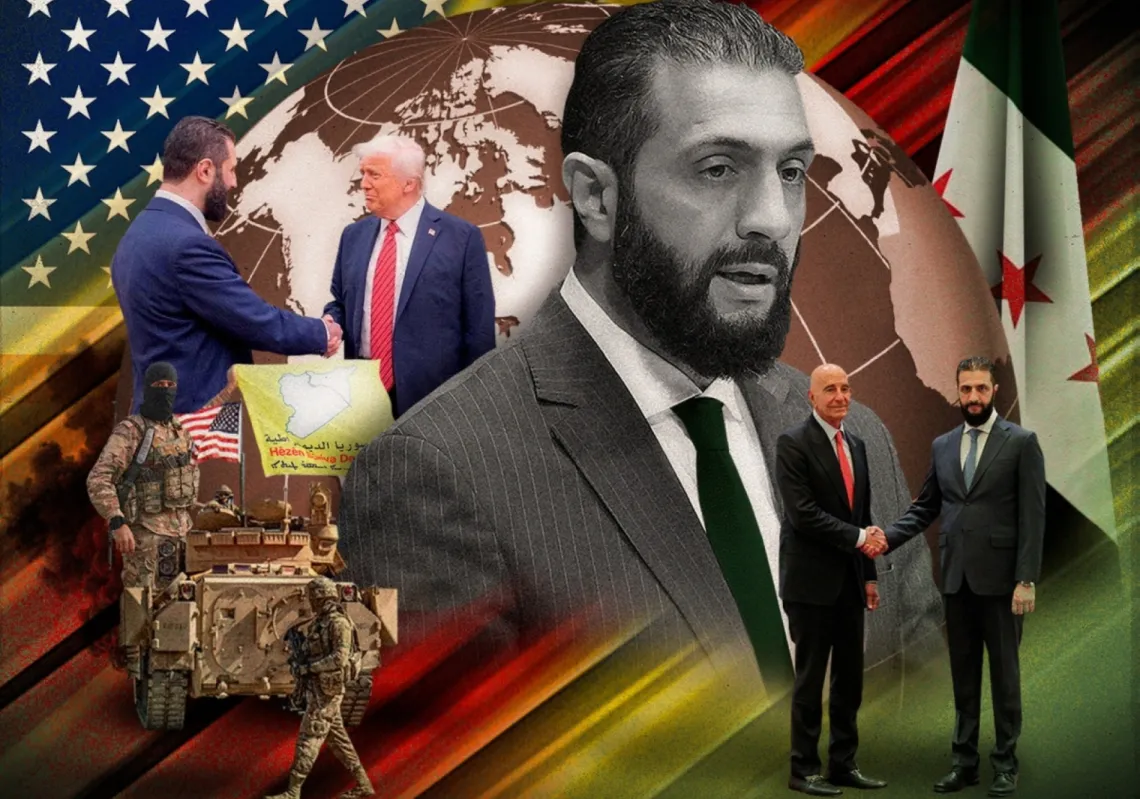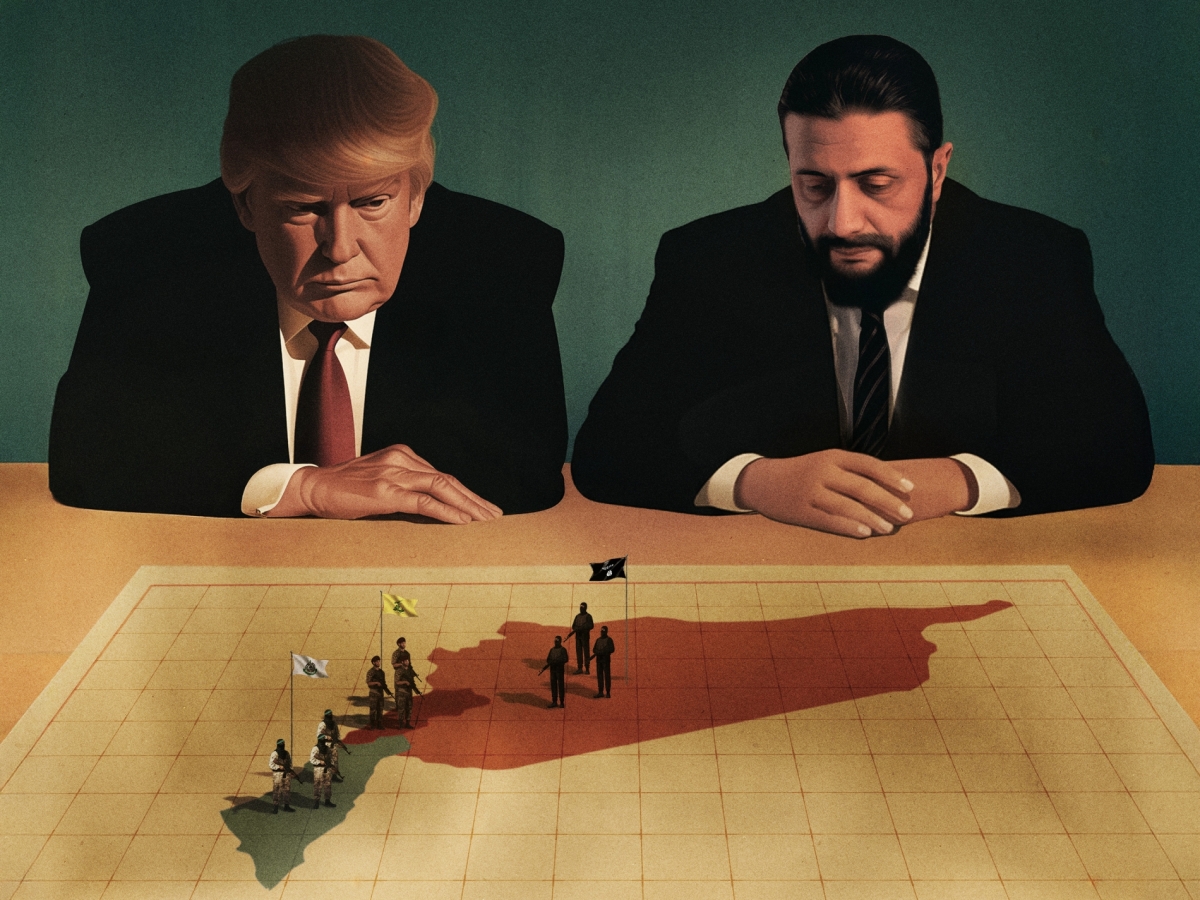

It was during US President Donald Trump’s visit to the Middle East in May that he met Syrian President Ahmed al-Sharaa, after being urged to by Saudi Crown Prince Mohammed bin Salman and Turkish President Recep Tayyip Erdoğan. It was a bold move.
But bolder still was Trump’s later invitation for al-Sharaa to visit the White House, which he did on 10 November. It is rumoured that the president’s move drew the ire of cautious advisors who were subsequently fired.
During al-Sharaa’s White House visit, the Syrian leader held discussions for several hours with key cabinet officials. Not every foreign leader gets to visit the Oval Office, albeit there was none of the pageantry that came with the big ceremonial state welcome given to Saudi Crown Prince Mohammed bin Salman a week later. Still, al-Sharaa’s visit was significant, not least for Trump’s public comments. “He’s a very strong leader,” Trump said of his opposite number. “He comes from a very tough place...I like him. I get along with him...He has had a rough past. We’ve all had a rough past.”
This was the first time a sitting Syrian leader came to the White House, and the first time a sitting American president spoke supportively of a former member of Al-Qaeda. Trump, who appreciates leaders who take decisive action, believes al-Sharaa’s terror links are a thing of the past and expressed his "confidence” that the former Hay'at Tahrir al-Sham (HTS) leader could help Syria be a “successful” element of stability and peace in the region. For his part, al-Sharaa spoke about shared bilateral interests and goals, such as regional stability and counter-terrorism.
Personal diplomacy
After hearing about Syria’s key role in the Middle East from leaders in Türkiye, Saudi Arabia, Qatar, and from al-Sharaa himself, Trump repeats it regularly when talking to the media about Syria. Yet he has had some quiet pushback. Some members of his Republican base reject his characterisation of al-Sharaa. Laura Loomer, a social media personality, is among those to condemn al-Sharaa as an Islamic State (IS) terrorist and criticise his invitation to the White House.
Despite such criticisms, Trump is ploughing ahead with his decision. Some have even suggested that he might accept an invitation to Damascus. US security agencies would have concerns about his safety in the Syrian capital, where the American embassy has yet to reopen. But if Damascus agreed, the US military could take control of a location inside a Syrian airbase near the capital where Trump could hold meetings with Syrian leaders. They did something similar in Baghdad, allowing high-level American officials to meet their Iraqi counterparts during the Iraq War.
While such a visit seems far off, if he were to travel to Damascus, it would have to be for a very deserving reason, such as the announcement of a historic agreement—one that could change the Middle East, namely a full peace agreement between Syria and Israel.

The thorny issues
It is no secret that Trump wants to expand the Abraham Accords, normalising relations between Israel and other states. In a November social media post, he called on Kazakhstan to join, despite the two countries having had formal diplomatic ties since 1992. The Atlantic Council, a well-informed policy institute in Washington, said Trump’s team was working to bring other Central Asian states into the Abraham Accords, to build a coalition of Muslim states that enjoy good relations with Israel.
This would not produce the same immediate political impact and longer-term military implications as a peace agreement between Syria and Israel—Trump knows this, as does al-Sharaa. Both men will be making their own political calculations. For his part, al-Sharaa moves carefully. When Fox News asked him about a peace treaty with Israel, he stressed that it still illegally occupies the Golan Heights, as well Syrian territory in Quneitra seized after Assad’s fall a year ago.
In his first administration, Trump officially recognised Israel's annexation of the Golan. Changing his stance would certainly be difficult, but not outright impossible. Al-Sharaa is therefore focusing on an interim security arrangement in which Israel would withdraw from Quneitra, taken since 8 December 2024, in return for agreed restrictions on Syrian military deployments in southern Syria.
Al-Sharaa is also sensitive to Syrian sovereignty and security risks. Damascus rejected an Israeli demand for humanitarian corridors from the Golan to the restive Druze province of Sweida, well over 100km inside Syria. Israel's reluctance to withdraw to the 1974 line and Syria's reluctance to establish a corridor will make clinching an interim security agreement tricky. This means a comprehensive peace treaty looks to be out of reach at present.
Ending sanctions
Circling back to a point I made earlier, not everyone in Trump's Republican Party is enamoured with Syria's new rulers, and a lot comes down to US sanctions on the country, imposed during the era of Bashar al-Assad. Getting Washington to permanently lift the economic sanctions is a top diplomatic priority for al-Sharaa, particularly the 'Caesar' sanctions, which intimidate foreign companies from investing in Syria's devastated economy.