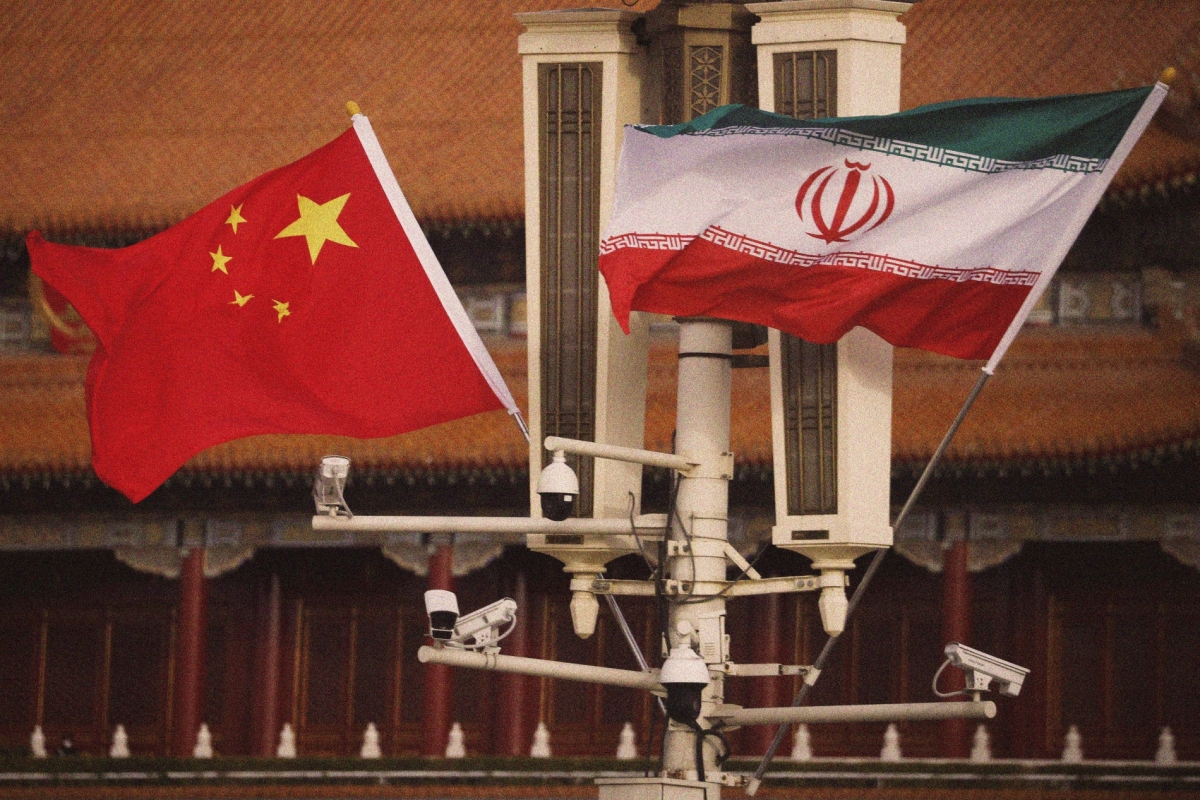
Bigger role, fewer options: how Yemen’s crisis is testing China

In the Gulf, the US is still the dominant power, but Beijing is being urged to do more. Naval exercises, antenna construction, and Chinese-made missiles suggest that this may already be happening

Al Majalla

Bigger role, fewer options: how Yemen’s crisis is testing China

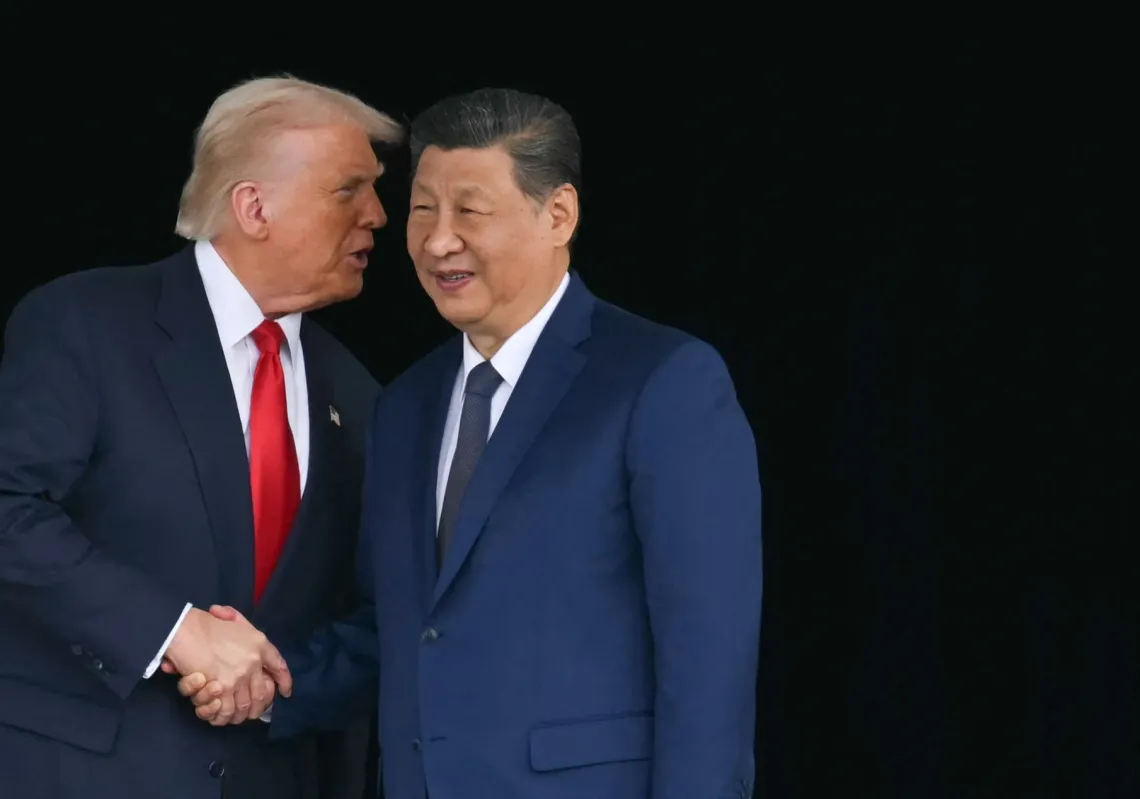
The ink had barely dried on an agreement between Chinese President Xi Jinping and US President Donald Trump over Iran when events in Yemen placed fresh pressure on Beijing. The agreement nudges China gently off the fence, prompting Xi to press Tehran more than he has done to date, so the timing was significant because it is Iran that sponsors the Houthi militia in Yemen.

Chinese diplomats have not wanted to take sides over the US-Israeli war with Iran, which led to the latter blocking the Strait of Hormuz and attacking Arab Gulf states. China buys oil from Iran, but it also has extensive trade relations with Saudi Arabia, the United Arab Emirates, and other Gulf states, not least in hydrocarbons.

Instability in Yemen and the Red Sea affects Beijing’s efforts to expand its political, security, and economic presence in the region. Just three years ago, China raised diplomatic eyebrows when it facilitated an unlikely reconciliation agreement between Iran and Saudi Arabia, under which it has certain obligations. Events in Yemen may now mean that Beijing cannot reconcile its ties to Tehran with its partnerships in the Gulf.

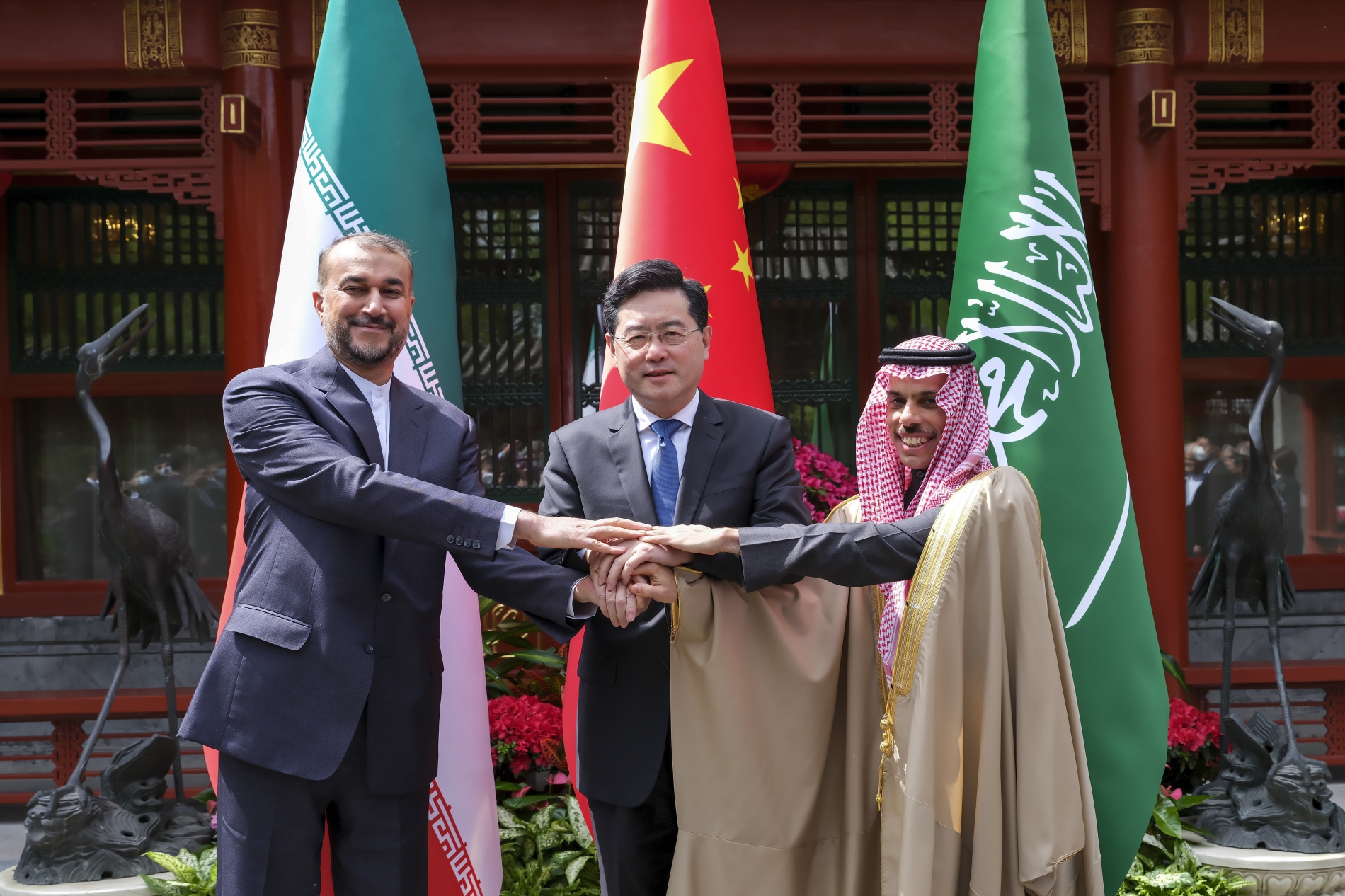
Last month, a lightning offensive left the Houthis in control of western Yemen, seizing ports and territory from the Saudi-backed government that has been based in Aden since the Houthis seized the capital, Sanaa, over a decade ago. Although the Beijing Agreement of March 2023 restored diplomatic relations between Saudi Arabia and Iran, it did not directly address Yemen, from where the Houthis have attacked Saudi infrastructure.

Statements by Houthi leaders and Iranian officials link the US-Iran war (and the resulting Strait of Hormuz closure) to the escalation in Yemen in recent weeks. This placed greater importance on the Bab al-Mandab Strait. Like the Strait of Hormuz, this is a strategic waterway for international trade, including Gulf oil exports. Houthi gains mean that the militia can now target Saudi ships sailing through this narrow passage, while Iran can target Saudi ships sailing through the Strait of Hormuz.
AFP
Iranian Foreign Minister Hossein Amir Abdollahian with his Saudi counterpart Prince Faisal bin Farhan Al Saud, right, and former Chinese counterpart Qin Gang in Beijing on 6 April 2023.

Yemen’s prominence in the trilateral follow-up meetings between China, Saudi Arabia, and Iran lends the issue particular significance. In the final statement issued after the committee’s second meeting in Riyadh on 9 November 2024, the trio reaffirmed their support for a comprehensive political settlement to the Yemeni conflict, based on internationally recognised principles and under United Nations auspices.

At the Xiangshan Security Forum in Beijing, Prince Turki al-Faisal, a former Saudi diplomat in Washington, urged China to help influence Iranian behaviour, arguing that attacks on Saudi Arabia constituted a breach of the Beijing Agreement. Chinese experts say the agreement still provides a valuable channel of communication between Riyadh and Tehran, particularly given the US-Israeli military operations against Iran.

Writing in China’s state-run Global Times, Su Ying, a history professor at Shihezi University, cited a call between Iranian Foreign Minister Abbas Araghchi and his Saudi counterpart, Prince Faisal bin Farhan, as evidence that the channel established through Chinese mediation remains effective.
A Chinese envoy serving in the Gulf told Al Majalla that its diplomats are calling for a greater Chinese role in the Gulf to safeguard expanding relations

Interests and constraints

A Chinese envoy serving in the Gulf told Al Majalla that assessments sent to Beijing by its diplomats call for a greater Chinese role to safeguard the country's expanding relations with Gulf states. Yet they also acknowledged the difficulty of devising an effective approach given Trump's shifting Middle East strategy and Washington's retained position as a major international player in the region.

Envoys know that fully aligning with the Arab Gulf states against Iran, or opposing Houthi escalation, could diminish Beijing's diplomatic leverage, with no guarantee that Chinese pressure will have any effect. At the same time, Beijing must navigate its rivalry with Washington, which wants Gulf states to limit their ties with China, particularly in technology and defence.

The US-China Influence Index, published on 9 October by Alhurra MBN (a media organisation funded by the US Congress), reports that Washington wants Gulf states to remove Chinese technology from their core networks in exchange for access to the latest American Artificial Intelligence (AI) chips. Yet Beijing is offering to be the leading supplier of AI infrastructure on which Gulf economies will depend in areas such as cloud computing, communications, and renewable energy.

China is therefore under growing pressure to play a larger political and security role in a region where Washington still holds the strongest security cards. Its economic and technological ambitions remain constrained by US restrictions and conditions, although the Gulf states retain some room for manoeuvre.

AFP
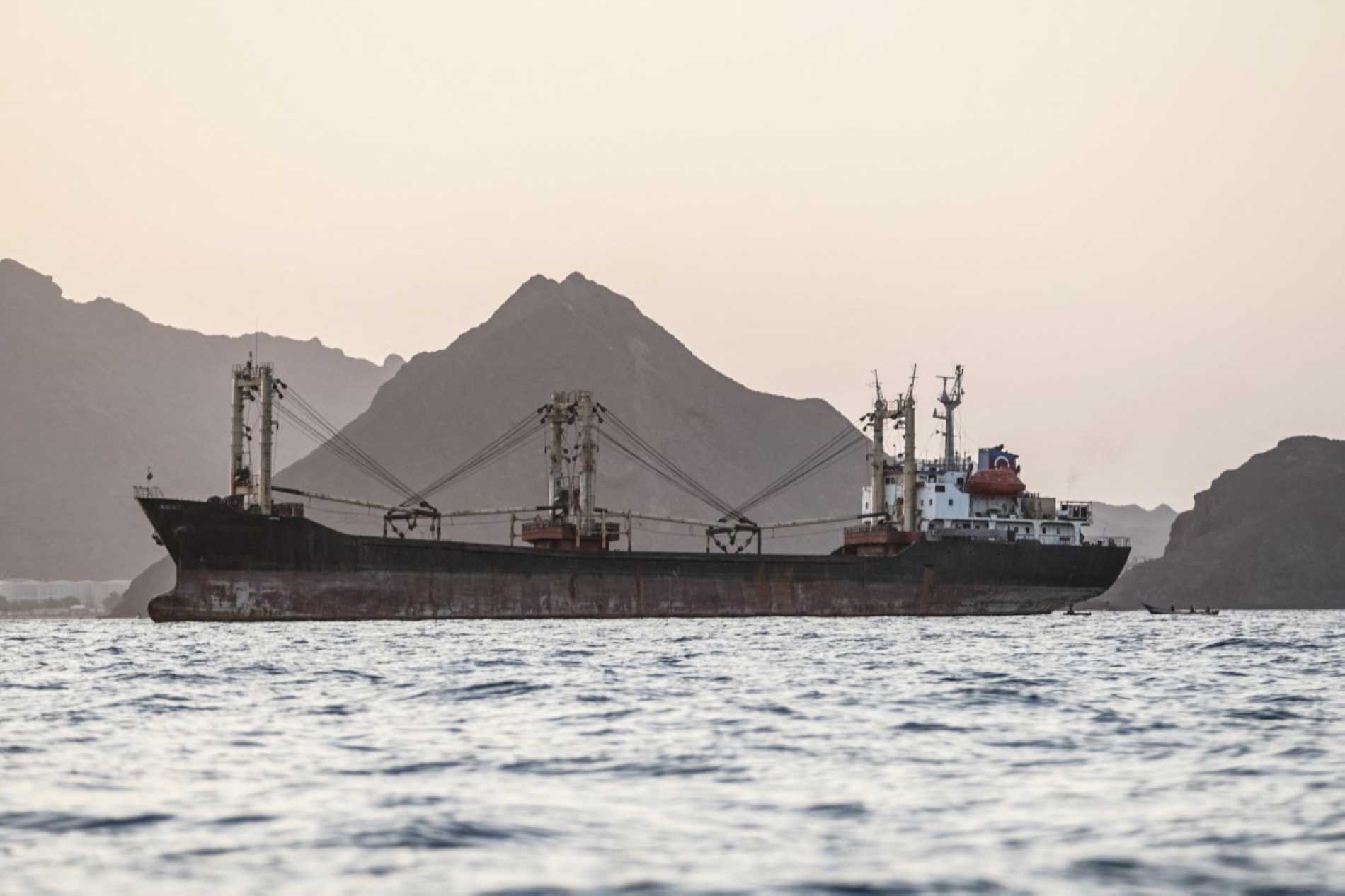
A commercial vessel anchors off Yemen's coast near Bab al-Mandab, the strait linking the Red Sea and the Gulf of Aden, on 12 September, 2026.

Securing trade

These considerations alone cannot fully explain China's position on Yemen, as the Houthis seek to impose a new reality in the Bab al-Mandab Strait. The group announced the closure of the strait to Saudi shipping, warning companies over cargo loading and unloading operations at Saudi ports, yet Reuters reported on 28 July that China had negotiated with the Houthis, in coordination with Iran, to ensure safe passage for its tankers through the Red Sea.

Chinese refiners have bought at least 12 million barrels of Saudi oil for shipment in November, while Saudi Aramco and its local partners have announced the arrival of the first crude oil shipment at their new refining complex in China. If the arrangement remains in place, it could help sustain the flow of Saudi oil, although the wider Houthi threat to shipping would persist. It would also demonstrate a shared Chinese-Saudi interest in protecting energy supplies. Meanwhile, Trump has downplayed the Houthi threat, saying Houthi control of Yemen's Red Sea coast "affects only one country".

At a UN Security Council meeting on 9 October, China reaffirmed that the Yemeni government enjoys broad international recognition and called for respect for the sovereignty, territorial integrity, and security of both Yemen and Saudi Arabia. It also condemned attacks on airports and vital energy facilities, urging the protection of civilians, infrastructure, and commercial shipping. This suggests that Beijing sees the Houthis' actions as having consequences beyond Yemen. It also underscores the need for a comprehensive regional settlement to ease tensions.

Western reports that Chinese-made dual-use components have reached Iran and the Houthis have increased attention on Beijing's position

Military signals

At the same time, Beijing has shown greater readiness to respond to developments in the Red Sea and the Bab al-Mandab Strait. On 20 September, at the height of military tensions between the Houthis and the internationally recognised government along Yemen's Red Sea coast, the Chinese destroyer Kunming conducted naval exercises from China's military base in Djibouti, just 40km away, across the strait. The exercises included using the ship's weapons systems, emergency response procedures, and armed rescue operations.

Beijing has announced no changes to the nature of its fleet's mission, rules of engagement, or coordination with regional actors, but the exercise suggests a greater Chinese readiness to confront threats around this important maritime trade corridor. In parallel, a report published on 17 September by the US-based Centre for Strategic and International Studies (CSIS) drew on satellite imagery to show the construction of two communications facilities within China's Djibouti base. This includes high-frequency antennas and other systems believed to support signals intelligence.

Western reports that Chinese-made dual-use components have reached Iran and the Houthis have increased attention on Beijing's position. A recent report by Conflict Armament Research claimed that the Houthis had bought components from a Chinese supplier to manufacture a version of Iran's precision-guided Kheibar Shekan missile, which has a claimed range of 1,900km. Chinese companies have also been accused of supplying the Houthis with satellite imagery and maritime surveillance data.

Beijing imposes export controls on dual-use components, including licensing, end-user verification, restrictions on changes of use or re-export without authorisation, and subsequent monitoring. China maintains that it complies with these regulations and UN Security Council arms embargo resolutions. It refuses, however, to recognise the legitimacy of Western sanctions against Chinese companies.

REUTERS/Khaled Abdullah
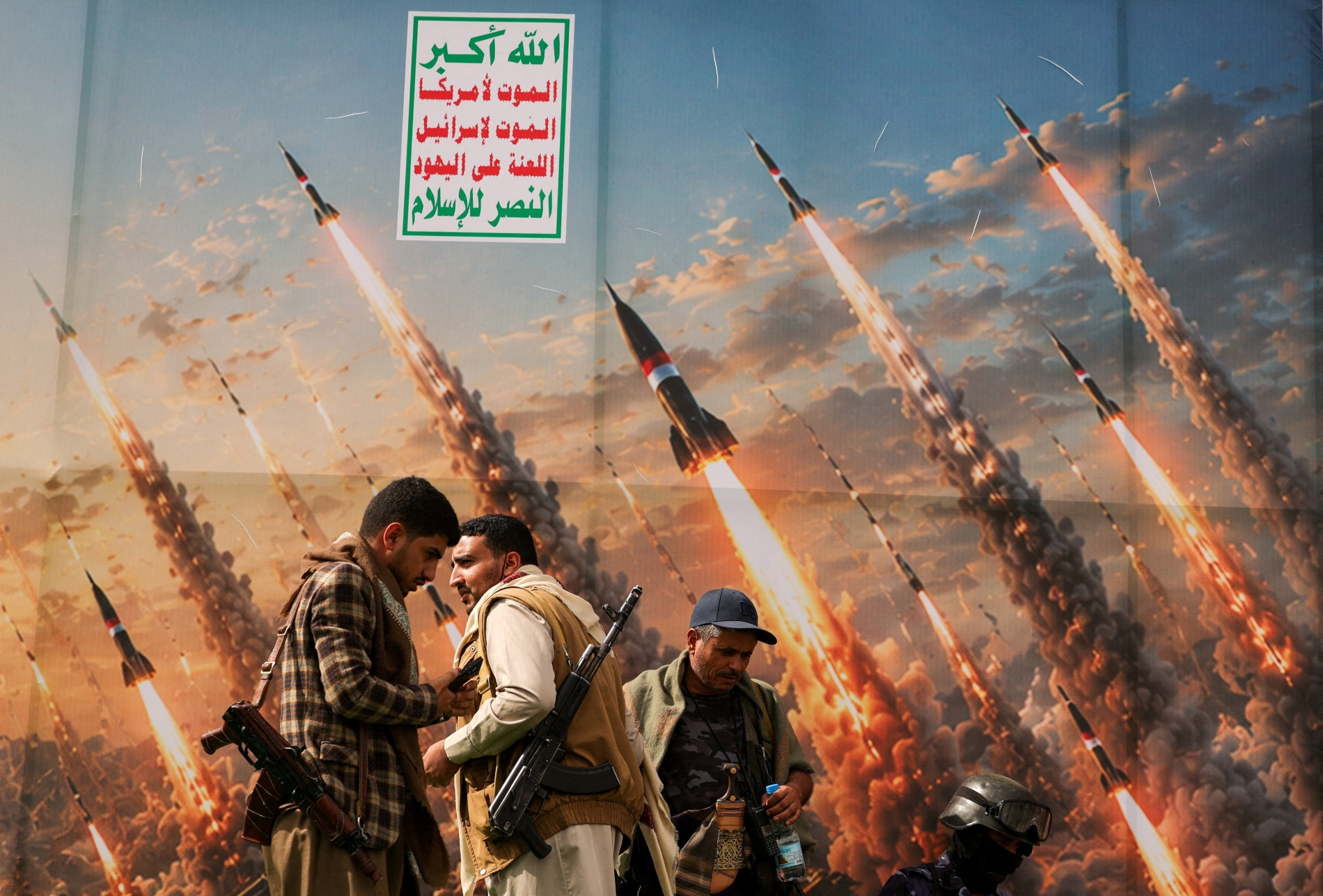
Houthi activists stand on a platform against a banner depicting Houthi missiles amid an escalation campaign against Saudi Arabia, in Sanaa, Yemen, on 31 July 2026.

Two-sided approach

Last month, the wreckage of a Chinese-made Dong Feng-15A ballistic missile was discovered in Yemen's Marib governorate, as Yemeni forces backed by the Saudi-led coalition launched their counteroffensive against the Houthis, raising questions as to its origin and who fired it. Military analysts say the Houthis do not possess this type of missile. The Hong Kong-based South China Morning Post suggested that it might be connected to Pakistan's growing presence in the region, as part of the Mecca Mutual Defence Agreement.

Some in the West wonder whether Saudi Arabia is now using this type of missile. If so, it would suggest that Riyadh has expanded its Chinese-made arsenal as part of its policy of diversifying arms suppliers, having previously acquired Dong Feng-3 missiles (which were displayed during a military parade at the Hafar al-Batin base in April 2014). Riyadh may be increasingly receptive to buying Chinese weapons if Pakistan (which also uses Chinese arms) continues to play an expanding role.

As the region's security and economic interests remain hostage to US-Iran negotiations that appear to have no end in sight, the Yemen crisis has revealed two sides of China's approach. One is the limited role that Beijing can play in the face of structural obstacles, including US restrictions. The other is the growing need for Chinese initiatives as regional states seek to diversify their international partnerships, balance the influence of major powers, and broaden their political and strategic options.

China can press, mediate, offer channels of communication, and harness its economic interests to promote stability, but it cannot unilaterally resolve crises shaped by the competing calculations of Iran, Israel, the US, and regional powers. The most realistic prospect therefore lies in a more active Chinese role as part of a broader approach, while responsibility for halting the escalation and addressing its underlying causes remains with those who have direct influence.

font change