
On 25 July this year, Japanese Prime Minister Sanae Takaichi revealed what was in the deep-sea mud samples scooped up off the island of Minami Torishima a few months earlier: the silvery-white metallic chemical element yttrium, contained within the kind of ore more typically known as ‘rare earth’. Yttrium is an oxide found in some foods such as cabbage, in tiny amounts. But off the coast of Minami Torishima, just as had been predicted back in 2018, they found evidence of large deposits.
The Japanese prime minister mentioned it because yttrium is useful yet difficult to obtain. Its properties mean it is used for LEDs, mobile phone screens, camera lenses, electrodes, electrolytes, lasers, superconductors (such as for use in MRI machines), surgical needles, and radioisotopes for cancer treatment, to name a few. It is even used to make diamonds in a laboratory.
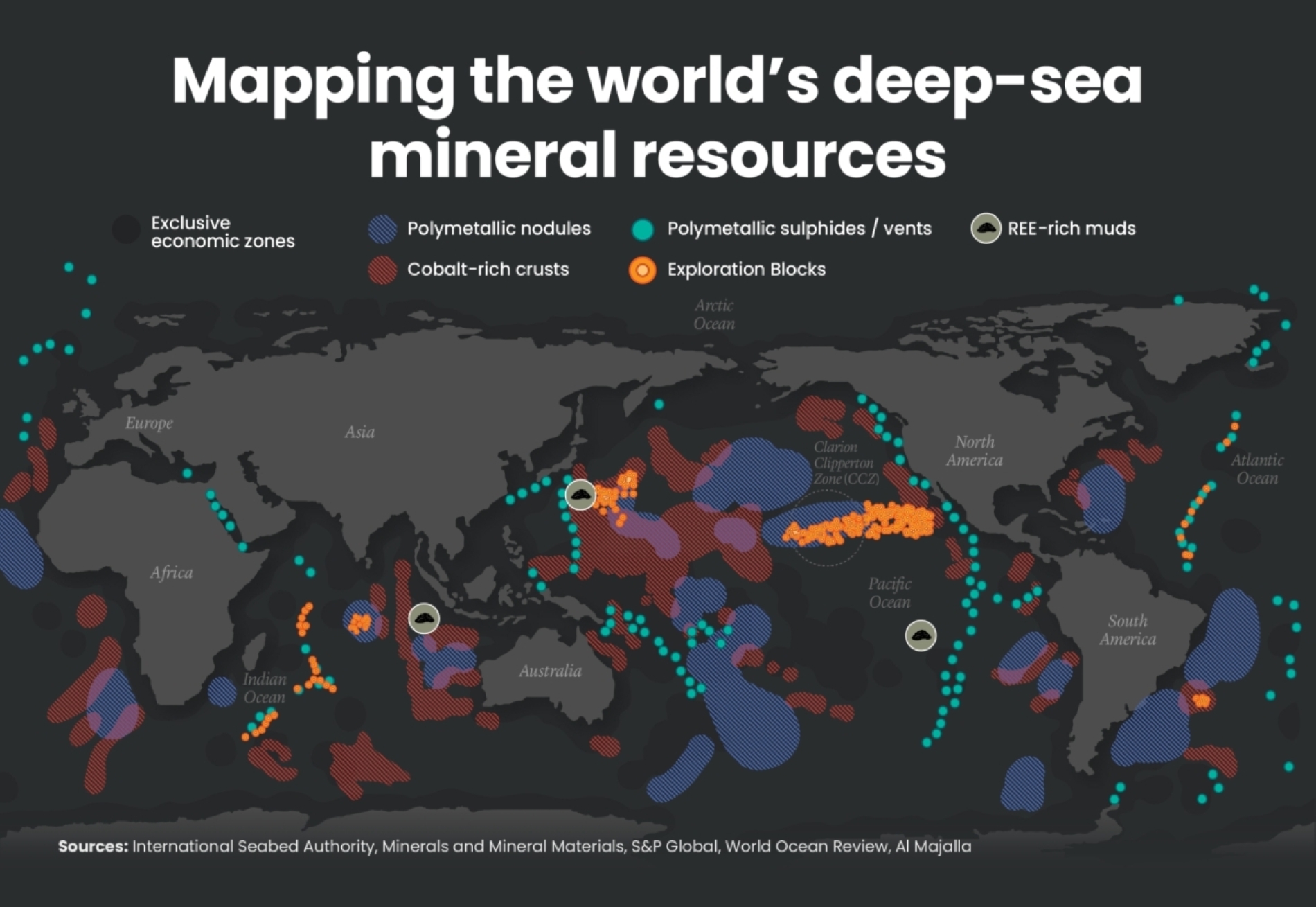
As the yttrium off the coast of Minami Torishima shows, the global contest over critical minerals does not just come down to who controls the land, but who controls the seas and the oceans, and crucially, who has the extraction technology. The yttrium in Japan lies at a depth of at least 6km below sea level (Mount Kilimanjaro, Africa’s highest peak, stands at 5.9km). Challenges remain, however. China currently dominates the rare-earth field, including extraction, refining, and magnet production.
This has not been lost on the White House. The United States and its allies are looking for new resources in places that, until recently, lay well beyond the bounds of industrial calculation, from the ocean depths to the polar regions. Washington and Tokyo have brought the Minami Torishima venture within a broader framework of cooperation on deep-sea resources and the construction of critical-mineral supply chains, and Japan is now planning extraction trials, but questions remain over whether the yttrium can be lifted from the seabed at an acceptable cost, and whether it can then be transported, processed, separated into its constituent elements, and refined.
Wealth in the ocean
Minami Torishima is Japan’s easternmost island, about 1,900km south-east of Tokyo. Around it stretches a large exclusive economic zone (EEZ) containing deposits rich in rare-earth elements. A University of Tokyo study estimates that a 2,500 square-kilometre area contains more than 16 million tonnes of rare-earth oxides, including gadolinium, which is used in MRI scanners, refrigeration, nuclear control rods, and X-ray imaging screens, and dysprosium, which is used in magnets, nuclear reactors, lighting, electric vehicles, and wind turbines. Magnets are essential in manufacturing electric vehicles (EVs) because they create the pushing/pulling force that turns electricity into continuous spinning motion inside an electric motor.
The question is whether these oxides can be extracted economically. In January and February 2026, the Japan Agency for Marine-Earth Science and Technology tested a system for mining rare-earth-rich mud within Japan’s EEZ. The lifting pipe extended around 5.6km and, over three days, brought about 50 tonnes of mud to the surface. This showed that the mud could be lifted continuously from such a depth, a significant engineering achievement, but it has not yet demonstrated its commercial viability, because moving from an engineering trial to a commercial mine requires an enormous increase in scale.
Japan is therefore preparing a much larger test lasting about several weeks from February 2027, with a target of lifting roughly 350 tonnes of mud per day. The mud will be dewatered on the island, then transported to the mainland for tests involving separation, refining, and smelting. An assessment of the prospects for commercial production is scheduled for March 2028, so Japan sees this as a phased feasibility project, rather than a commercial mine ready to operate.
Nevertheless, it offers the tech-heavy country a way to diversify its sources of strategic minerals and reduce its economy’s exposure to external shocks. For the US, it forms part of a wider effort to rebuild its critical-mineral supply chains. On 19 March 2026, both governments signed a memorandum of cooperation on developing deep-sea mineral resources. It sets up a working group to exchange information, expertise, and technology, as they look for opportunities to work together in projects involving mining, processing, and manufacturing. They are also examining measures such as ‘price floors’ that could safeguard new investments from intense competition.
Tedious process
Rare-earth elements do not emerge from a mine in a form that can be fed directly into cars, missiles, or robots. Mining is followed by concentration and chemical separation, refining, and then conversion into metals, alloys, and powders before being used to manufacture products like magnets. Every stage requires specialised facilities, technology, expertise, and stable markets. A new mine must be accompanied by the capacity to process its output.
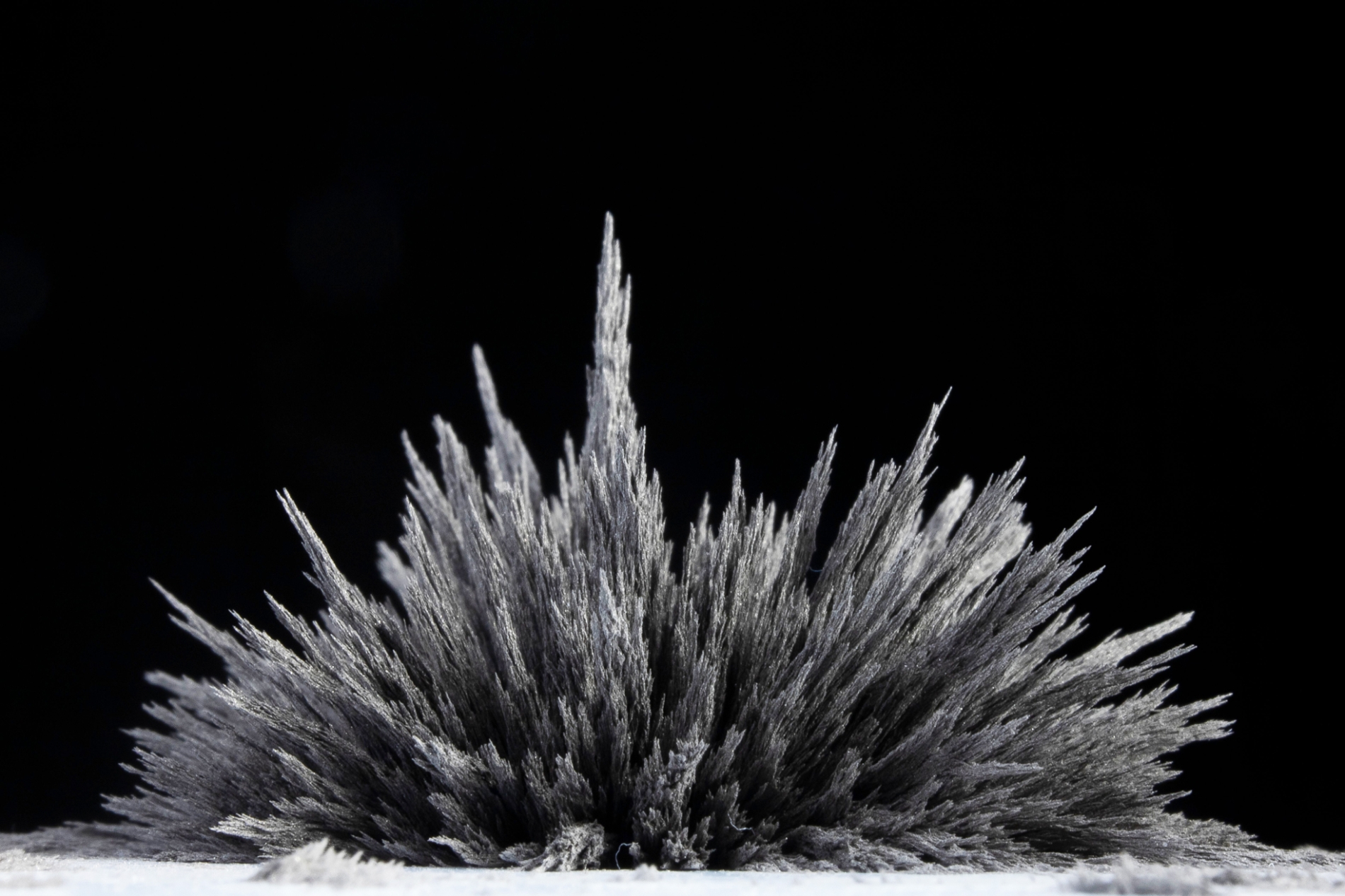
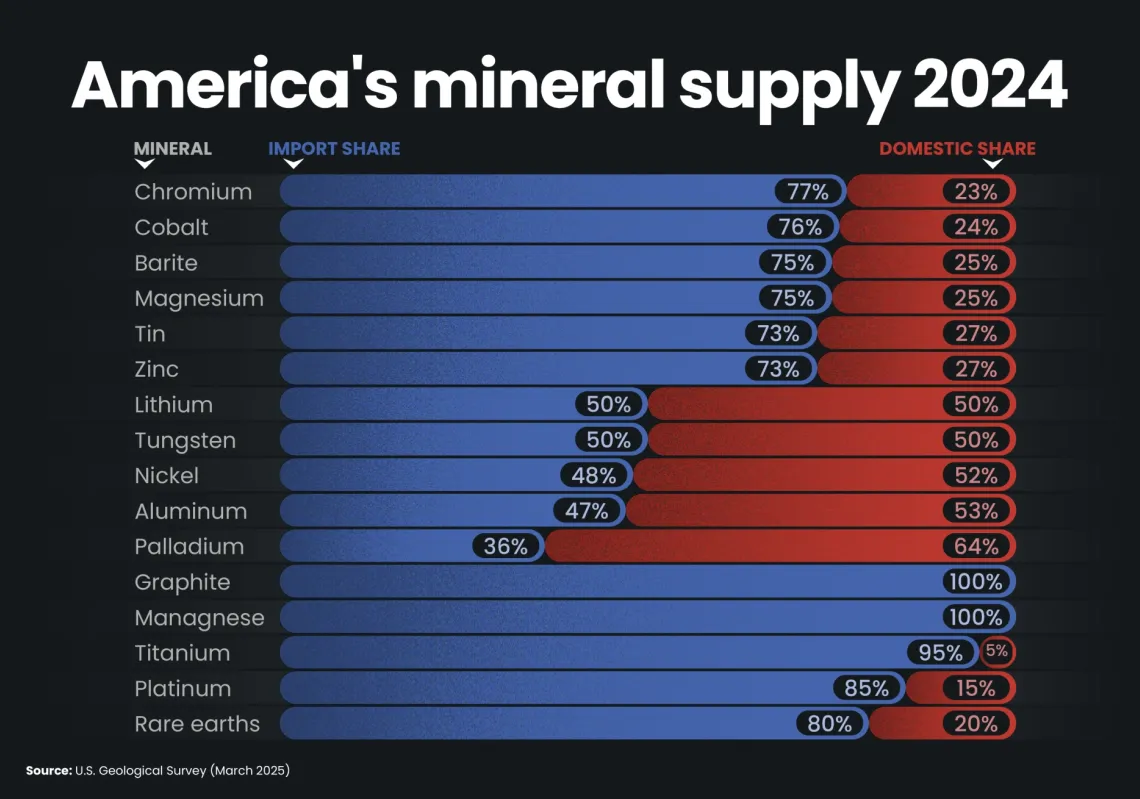
In 2025, American demand for the most widely used type of rare-earth magnet stood at about 48,000 tonnes, while domestic sources supplied only around 300 tonnes, according to data cited by Reuters from the consultancy Arthur D. Little. Washington has poured billions of dollars into about 150 companies operating in the critical-minerals sector, yet mines, processing plants, refineries, and factories take time to build. This is where China’s real advantage lies: not simply in the abundance of its resources or production, but in its control over most of the industrial stages that turn those materials into high-value products.
According to the International Energy Agency, in 2024 China accounted for 60% of global production of rare-earth elements used in magnets, 91% of refined output, and 94% of sintered permanent-magnet production. That is the difference between possessing a resource and controlling a value chain. Washington may extract ore in California, source it from Australia, or develop it with Japan from the ocean floor, but American industry still relies on Chinese capacity for separation, refining, or magnet production. The bottleneck may simply move from the mine to the factory.