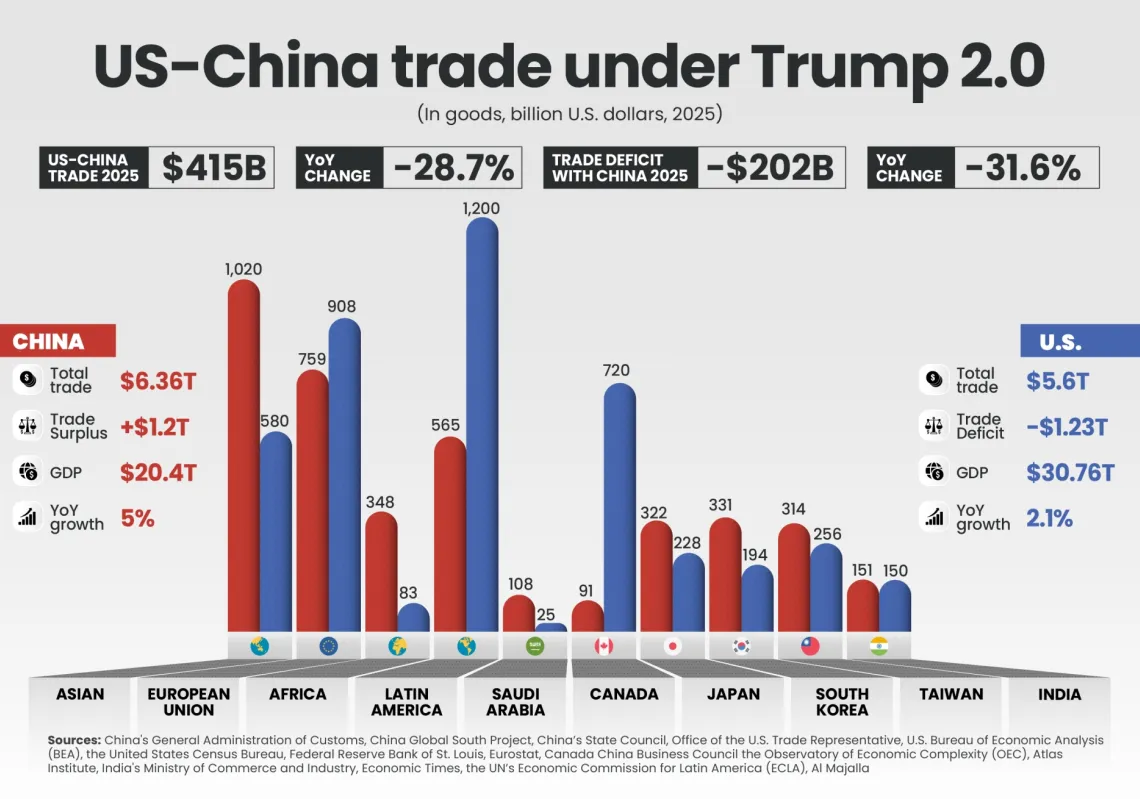

American tariffs have gone beyond their traditional role of raising import costs and protecting domestic industries. As their scope widens and their terms change week-to-week, companies are reconsidering where they source goods, organise supply chains, establish production facilities, and seek alternative markets. So far, the main effect has been a redistribution of trade among markets, manufacturing centres, and commercial routes, with little evidence of a wholesale contraction in global commerce.
Trade data from the US, Canada, Europe, Asia, and the Gulf reveal a changing pattern of US imports, a reassessment of trade relations between Washington and its traditional allies, and the growing importance of economies capable of offering alternative manufacturing bases, transport routes, and markets. One of the clearest indications of the changing geography of American trade lies in the origins of its imports.
An analysis by the McKinsey Global Institute from January to May 2026, compared with the same period a year earlier, found that China’s share of total US imports had fallen by 2.7 percentage points, but the share of the Association of South-East Asian Nations (ASEAN) rose by 4.6 percentage points, and that of the rest of the Asia-Pacific region rose by 3.7 percentage points. Europe’s share declined by 8.1 percentage points, largely reflecting the waning effects of a surge in advance imports during 2025, particularly of chemicals, pharmaceuticals, and gold. The decline also extended to other categories, including cars.
These figures require careful interpretation. The shift in American imports cannot be explained simply as a transfer of trade from China to elsewhere. McKinsey says a product’s country of origin might not reveal where its value was created. Some Asian economies have become intermediate links in production chains that continue to draw on Chinese components and materials alongside inputs from elsewhere.
Broader trend
The broader trend is nevertheless clear: the US is diversifying its sources of imports without necessarily bringing manufacturing back to American soil. More recent US figures also suggest that tariffs have yet to produce a sustained decline in imports. In August 2026, American goods imports rose by 5.5% to $336.1bn, pushing the goods trade deficit up by 11.5% to $132.6bn. Goods continue to enter the American market despite higher tariffs, although rising import values are not the same as an increase in the actual volume of goods purchased.
Tariffs appear to be changing the routes and composition of trade more readily than reducing its overall flow. As a result, ASEAN has assumed greater importance. A study published by the International Monetary Fund (IMF) in June 2026 called Trade and Investment in ASEAN in a Fragmented World found that several member states had increased exports of products targeted by US tariffs in 2018-19. Vietnam also attracted significantly more foreign direct investment (FDI) into the affected sectors.
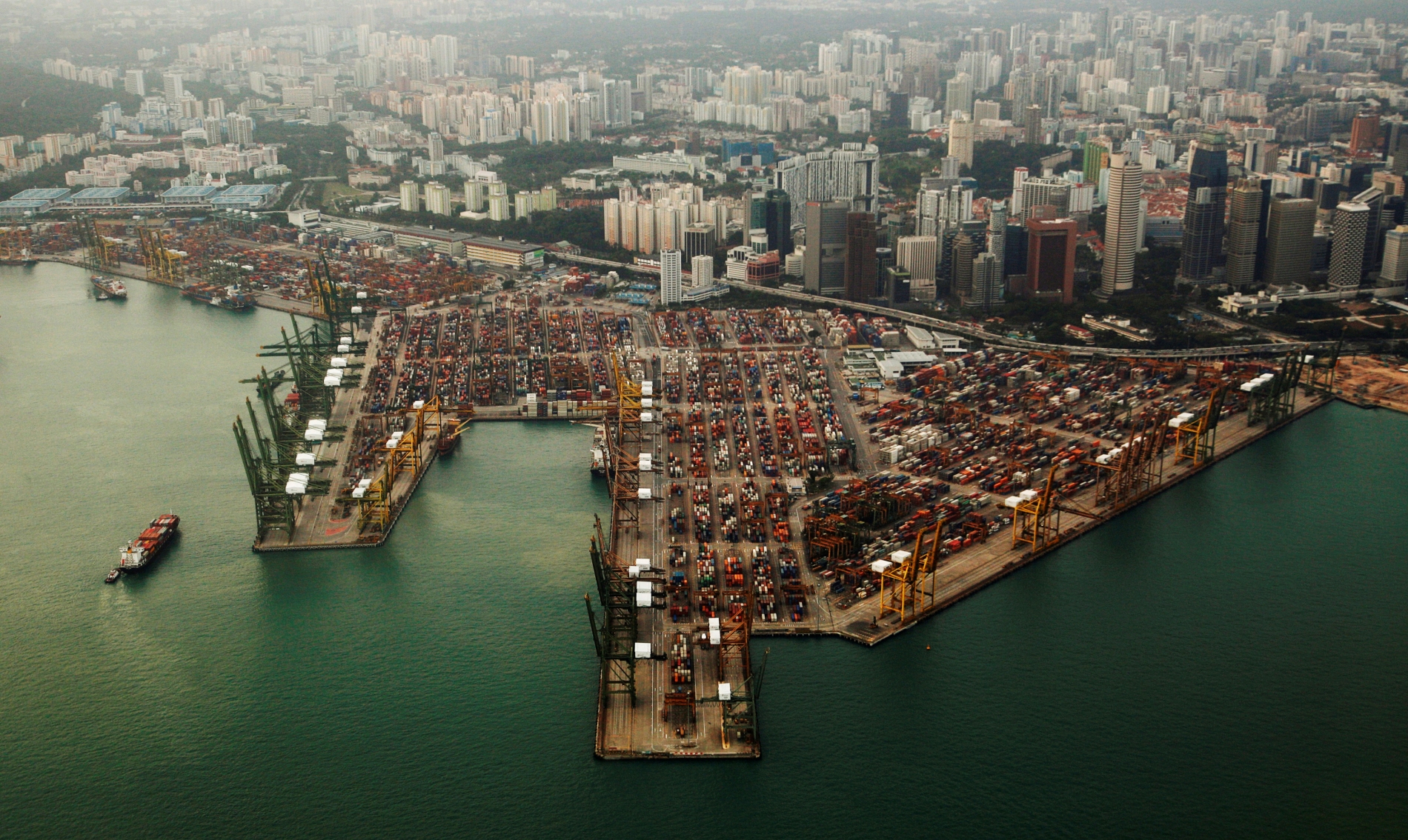
By 2023, ASEAN accounted for more than 20% of American imports of electrical goods, while China’s share fell from more than 40% five years earlier. According to the IMF, the change extends beyond the diversion of trade through third countries; data show an increase in domestically generated value added across ASEAN economies, alongside their continuing reliance on Chinese inputs.
South-East Asia is playing a bigger role in manufacturing within global supply chains. Although tariffs have reduced some direct American imports from China, the US economy remains closely connected to Asia’s manufacturing networks. Parts of those networks have responded by redistributing production and sourcing activities across the region. The difference between economic decoupling and supply chain diversification is important: decoupling seeks to reduce economic ties themselves, whereas diversification aims to limit dependence on any single source.