What would regime change in Iran mean for Russia?

Moscow and Tehran cooperate militarily to an extent, but bilateral trade is low, and Russia doesn't consider Iran a strategic ally

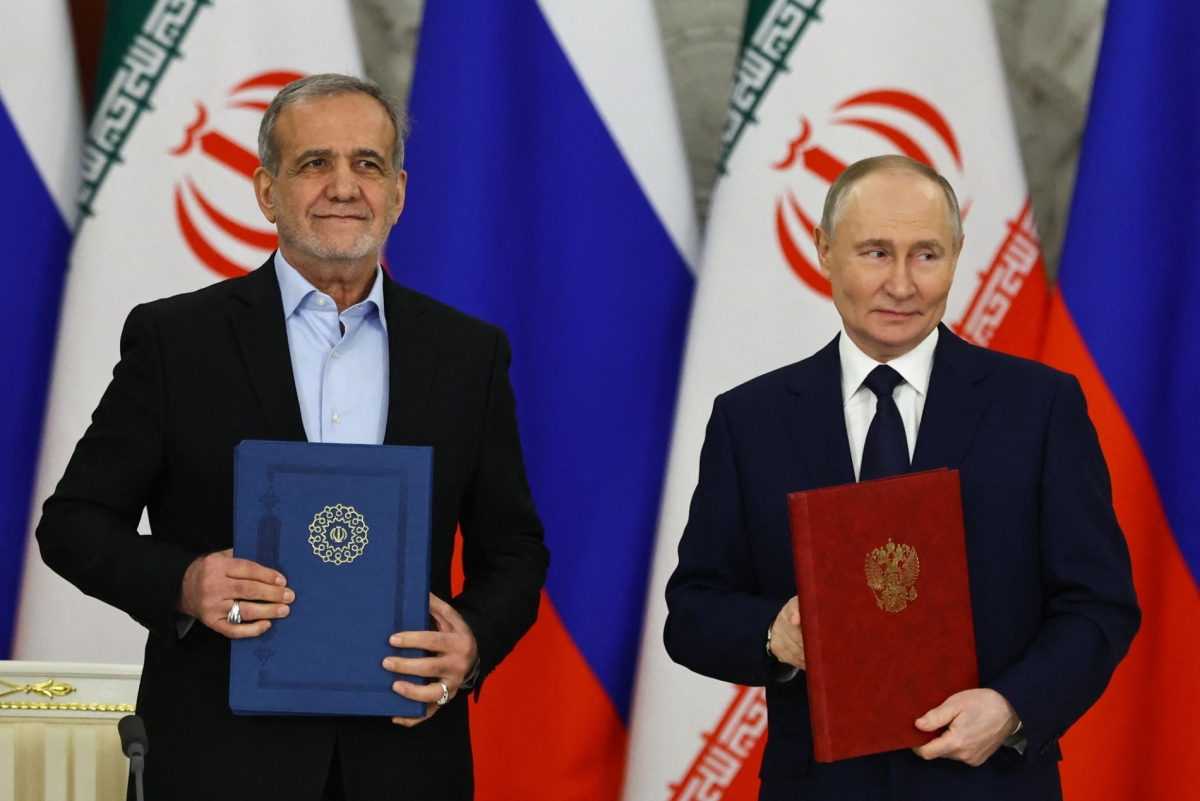
Russian President Vladimir Putin and his Iranian counterpart Masoud Pezeshkian after signing the association treaty in the Kremlin on 17 January 2025.
AFP
Russian President Vladimir Putin and his Iranian counterpart Masoud Pezeshkian after signing the association treaty in the Kremlin on 17 January 2025.

What would regime change in Iran mean for Russia?

The United States’ Armed Forces (USAF) are moving all their pieces into position for a strike on Iran, but what kind of strike and to what end remain to be seen. Troop compositions are sufficient for a strike to eliminate Iran’s civilian and military leadership, for example. Intelligence has been increased, submarine and surface naval ships are being deployed, and aircraft are being moved to airfields in the region.

Yet there are big questions that remain unanswered. What are the goals of this buildup? What level of force will be needed? And will any intervention involve Israel? In retaliation, Tehran would likely launch medium-range ballistic missiles against facilities in Israel and possibly against US bases in the Middle East, so anti-missile systems are being activated to intercept them.

One option is for the US and Israel to prolong the pressure on Iran with their combined military threat, exhausting Iranian troops and harming the Iranian economy. Both the US and Israel bombed Iran from the air during the so-called 12-day war in June 2025 and did so with impunity after Israel clinically disabled Iranian air defences at the start of the operation. Iran’s response was to launch hundreds of ballistic missiles, but the vast majority of these were shot down in mid-air.

Had Tehran not sought to de-escalate that brief war, its armed forces would have chosen to strike the refuelling tankers that made it possible for Israel to operate over Iranian skies so far from home. In any new conflict, however, that may change, so the US will keep its main forces at a distance and protect its ships from Iranian missiles. US military bases in the region are within range, as is Israel and Gulf oil infrastructure. Iran’s supreme leader, Ayatollah Ali Khamenei, recently said, “The Americans should know that if they start a war, this time it will be a regional war.”
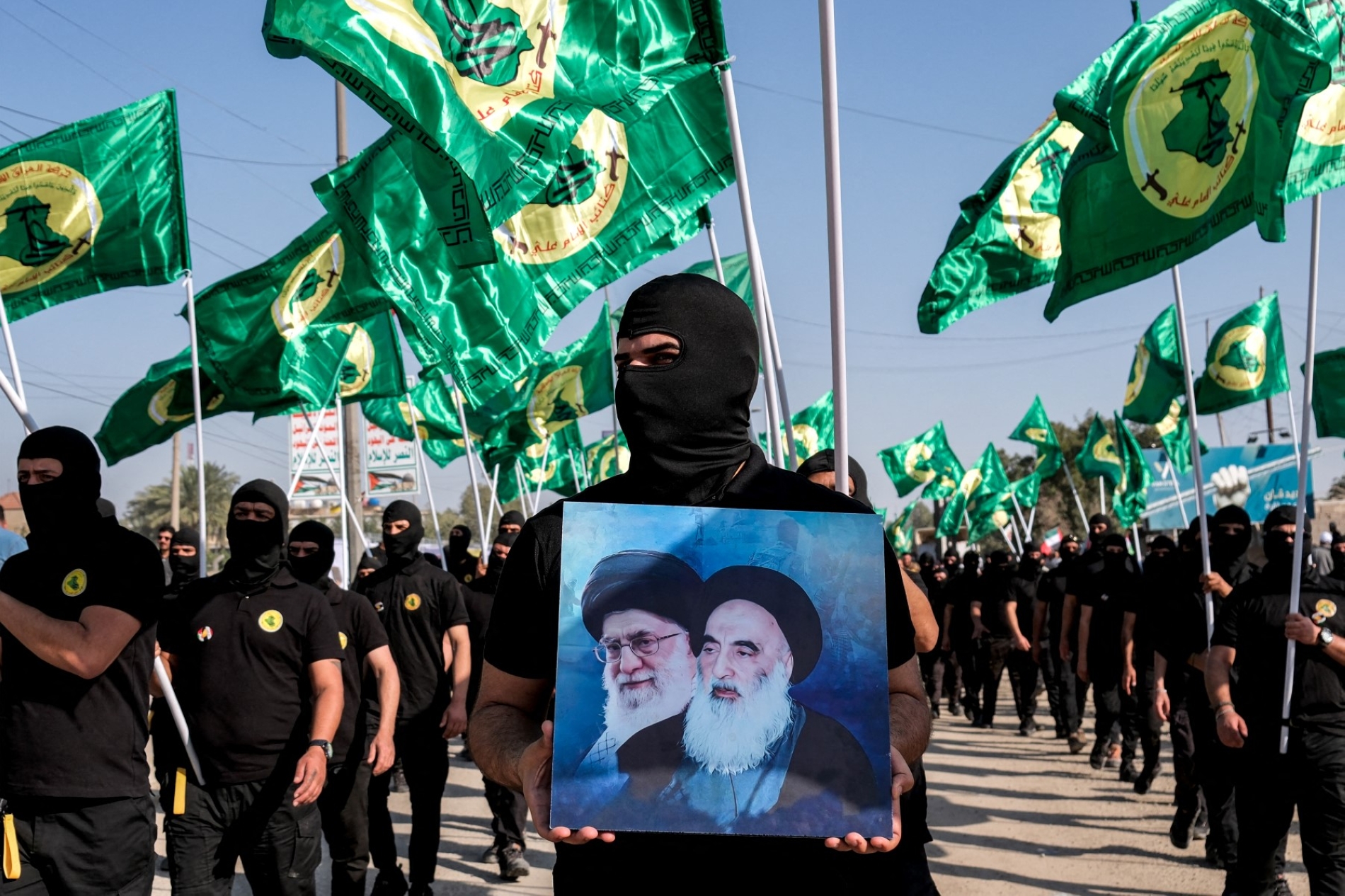
Murtaja Lateef / AFP
A PMF member holds a picture of Iran's late and current supreme leaders Ayatollah Ruhollah Khomeini (R) and Ali Khamenei to mark annual Quds (Jerusalem) Day commemorations in Baghdad on 5 April 2024.

Uneven contest

Iran has assets in Iraq in the form of proxy forces, including Harakat Hezbollah al-Nujaba, Kataib Hezbollah, and the Badr Organisation. Saraya Awliya al-Dam, a pro-Iranian group in Iraq, showcased its underground base with tactical missile launchers, which include Iranian AbabilArman guided missiles with an 86km range. Yet the combined American-Israeli military might is so great that few expect Iran to win.

Decapitating Iran’s military and political leadership cannot be ruled out, but it is clear that this alone would not necessarily lead to regime change, especially given the weakness of the Iranian opposition. Furthermore, the Islamic Revolutionary Guards Corps (IRGC) will have seen how US forces intervened in Venezuela last month and taken measures to protect against a similar scenario in Iran. That may even involve purging all Iranian reformers.
The Americans should know that if they start a war, this time it will be a regional war

Iran's supreme leader Ayatollah Ali Khamenei in January 2026

What would another US-Israeli strike against Iran's leadership mean for Russia, which kept its distance during the 12-day war, merely condemning American actions? These days, Moscow is trying to demonstrate a more active involvement in supporting the Iranian regime, which provides the Russians with drones for use in Ukraine. Russia also helped Iranian security forces disperse the demonstrators last month.

In addition, Russian military transport planes (the An-124-100 and Il-76TD) have been delivering military cargo to Iran, as have Chinese planes. Photos of Mi-28 attack helicopters have been posted on social media last month. In December, photos surfaced of dozens of Russian Spartak armoured vehicles arriving in Iran. Such deliveries are a drop in the ocean given what would be needed to counter an American-Israeli assault. Still, hardware is better than diplomatic rhetoric.

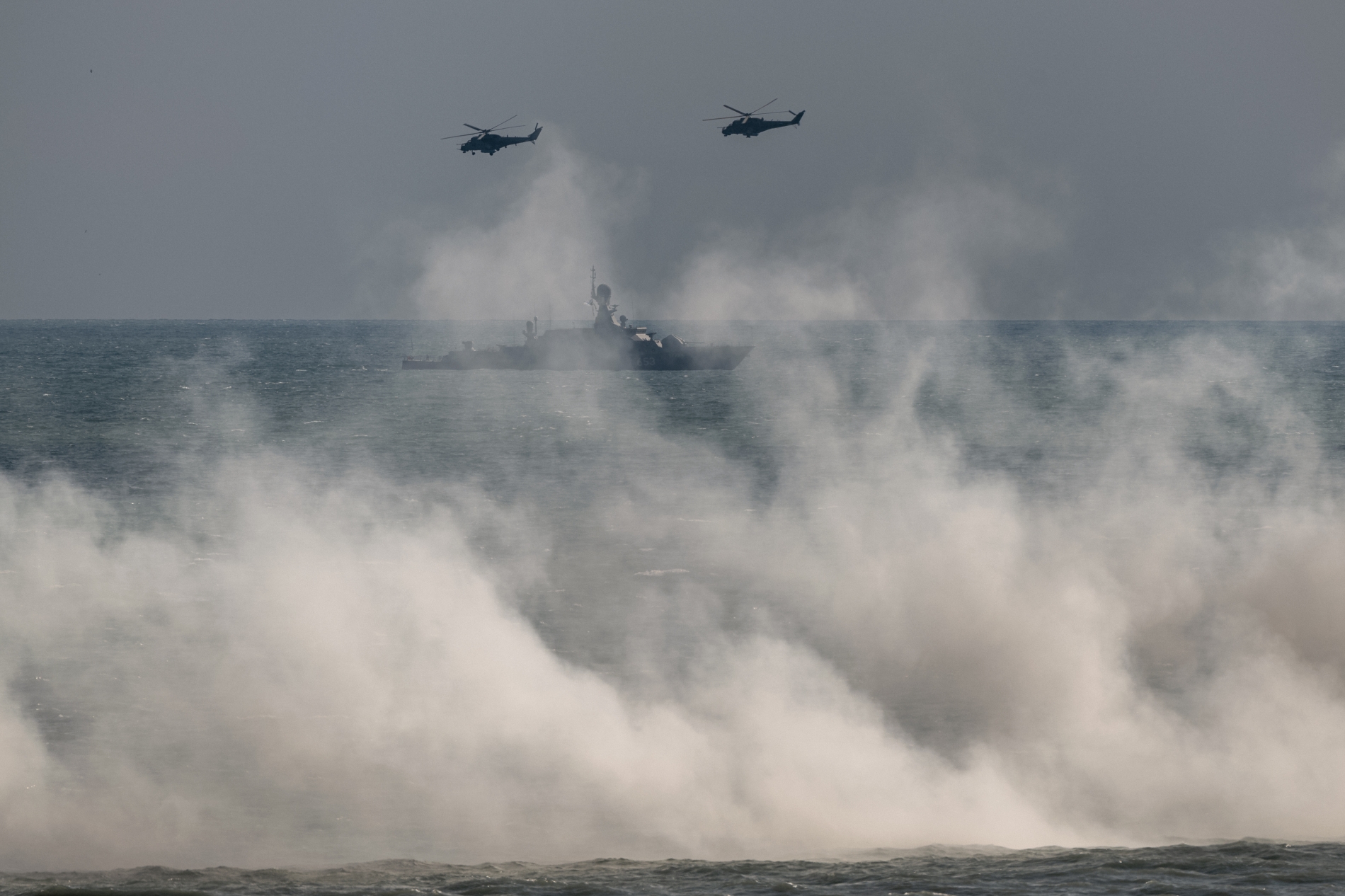
AFP
Russian army helicopters fly above the Caspian Sea on 23 September 2020, during the "Caucasus-2020" military drills gathering China, Iran, Iran, and Myanmar troops, along with ex-Soviet Armenia, Azerbaijan and Belarus.

Fair weather allies?

The Iranian media report that joint naval exercises between Iran, China and Russia will be held in mid-February in the northern Indian Ocean, in a symbolic act of the allies' military and political support. This will be their eighth such drill since 2019. The three states certainly have common interests. Russia and Iran face similar challenges when it comes to Western sanctions and their effect on trade. In terms of selling its oil, Moscow has learned from Tehran's experience of circumventing Washington's net.

Although Iran and China are informal coalition partners of Russia in their confrontation with the West, the depth of their relationships should not be overstated. Bilateral trade between Russia and Iran is low, only $4.8bn in 2025, when compared to Russia's trade with the United Arab Emirates ($12bn), for example.

For Russia and China, the main risk of regime change in Iran is the risk of a power vacuum and the collapse of the trade corridor, which is due to run through the country, around which the ideological justification of Russia's presence in the Middle East and beyond has been built over the past years. Moscow treats Tehran as a tactical ally, but in no way a strategic one, not least because of Iran's religious component.

This week, the Kremlin said Russia was still trying to de-escalate tensions around Iran and had offered to store Iran's enriched uranium. Kremlin spokesman Dmitry Peskov described this as "the removal of certain irritants for a number of countries". For the ayatollahs, will America prove to be the biggest irritant of them all? Watch this space.

font change