Israel’s election may not end its political crisis

With a complex election setup and the deep polarisation that has plagued Israel in recent years, expect prolonged political deadlock

Pete Reynolds

Israel’s election may not end its political crisis

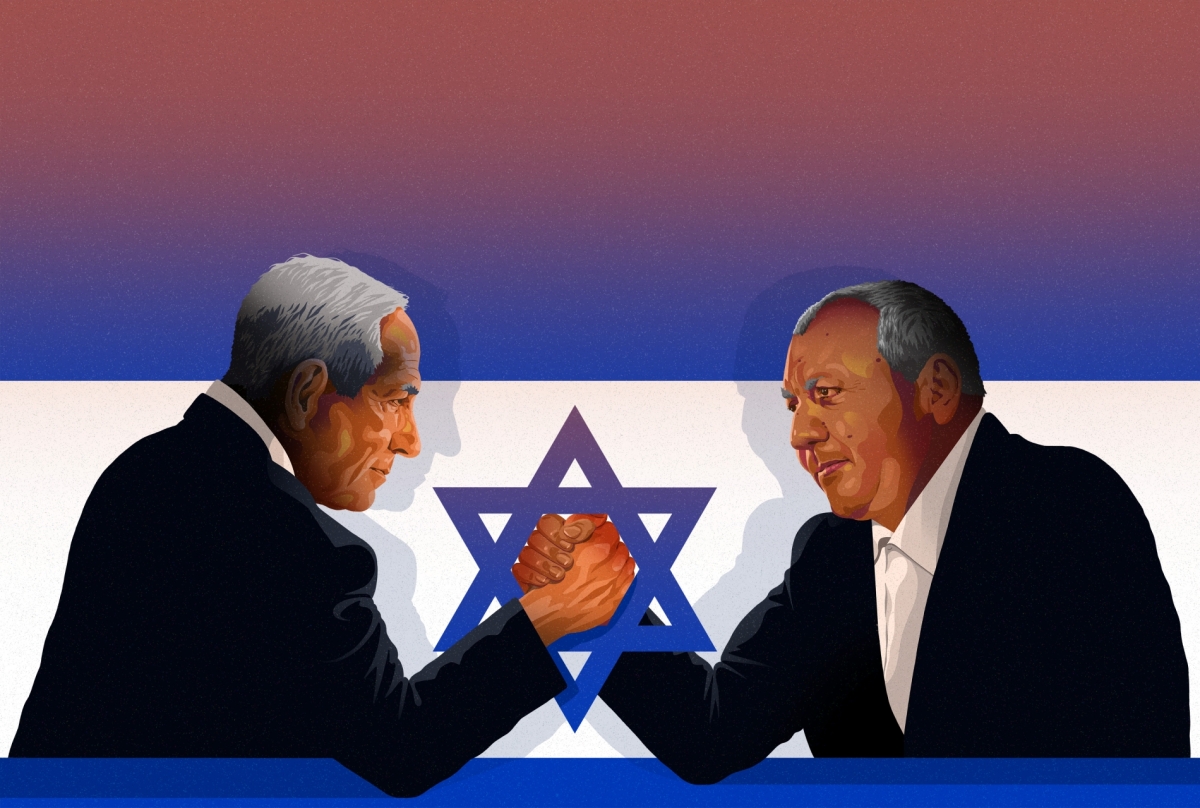
The 27 October elections in Israel—the first since the October 7 2023 attacks—could very well end in a disappointing impasse. Many observers (and Israelis themselves) may want a decisive outcome, but the election setup and the deep polarisation that has plagued Israel in recent years could mean a prolonged deadlock is now the most likely outcome. This means that while Benjamin Netanyahu’s opponents could secure more votes, they might still struggle to form a government.

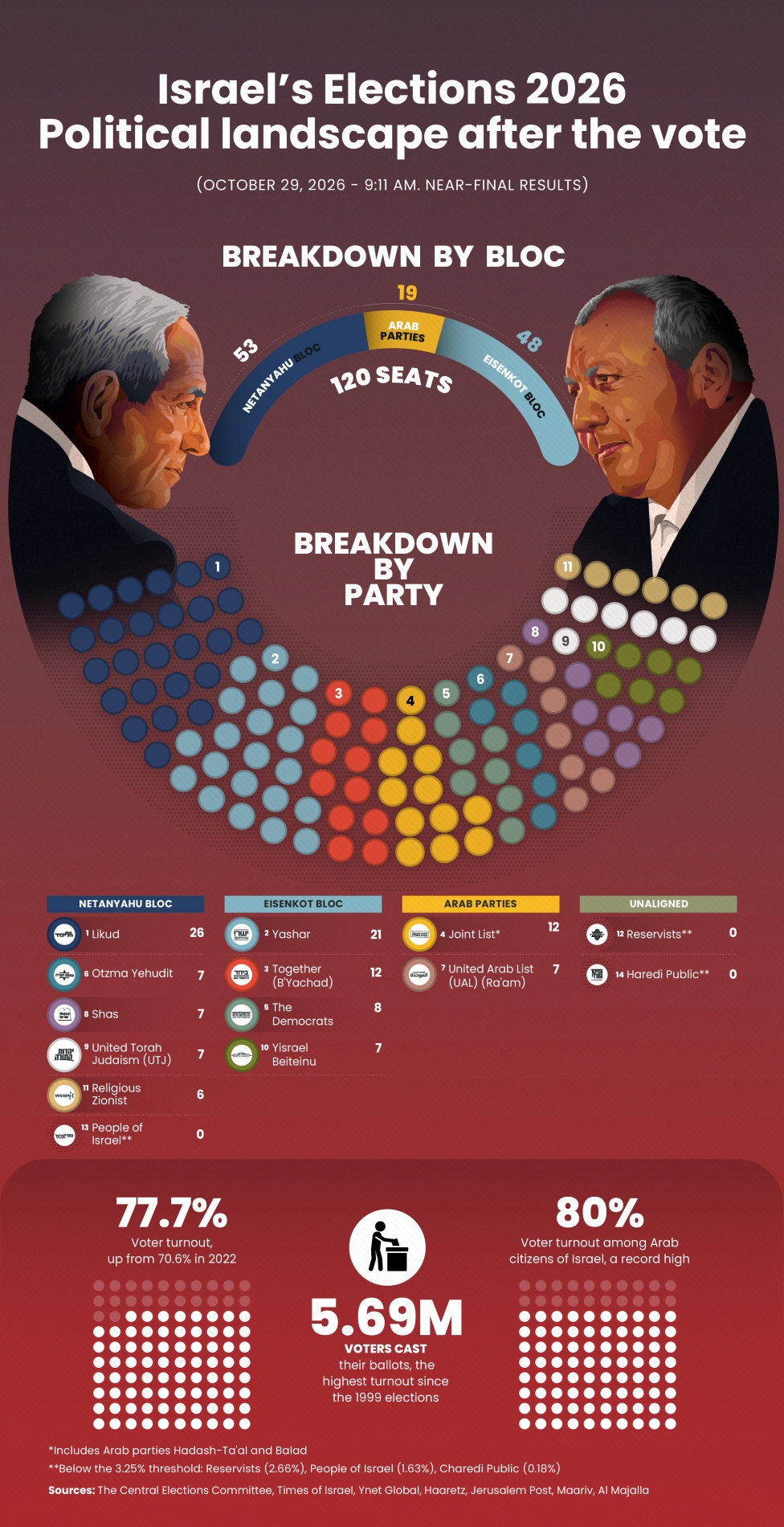
Early counts suggest that is the situation: his bloc is well short of 61, and his rivals are further from it than the polls promised. With 85% of ballots counted, the Netanyahu-led right-wing coalition holds 53 seats, while a possible opposition coalition led by former Israeli army chief of Staff Gadi Eisenkot is poised to hold 48 seats, with Arab parties securing 19 seats overall. While numbers are likely to change slightly in the coming days, this does mean neither side has an obvious path to the 61 seats needed to form a coalition. This is a recipe for deadlock because no government will have a stable majority without Arab partners, or without poaching a party from the other side.

Paradoxically, this is the first time in decades that an Israeli parliament and government served out a full term without collapsing into early elections. Yet this milestone masks a deeper paralysis: four years of endurance have done nothing to resolve the country's polarisation, leaving both blocs struggling to assemble a viable 61-seat majority. Perhaps more accurately: This endurance is partly due to the country's growing political polarisation. The ruling coalition had bitter, long-lasting internal quarrels, yet they knew they would lose if they let their differences lead to early elections. Fear of the other side has become the glue that ties coalitions together.

The election could consequently deliver several different kinds of change. A clear opposition majority would produce a government committed to investigating October 7, expanding military service, and restoring institutional restraints. A narrower result would force its leaders to reconsider the partners they have excluded. Prolonged deadlock would leave Netanyahu in office while his opponents argued over which promise to break—potentially giving Netanyahu opportunities to manoeuvre and entice some of them to join him.

The central question is whether Israel’s demand for political change can overcome the boundaries that have made change so difficult over the past years.
AFP
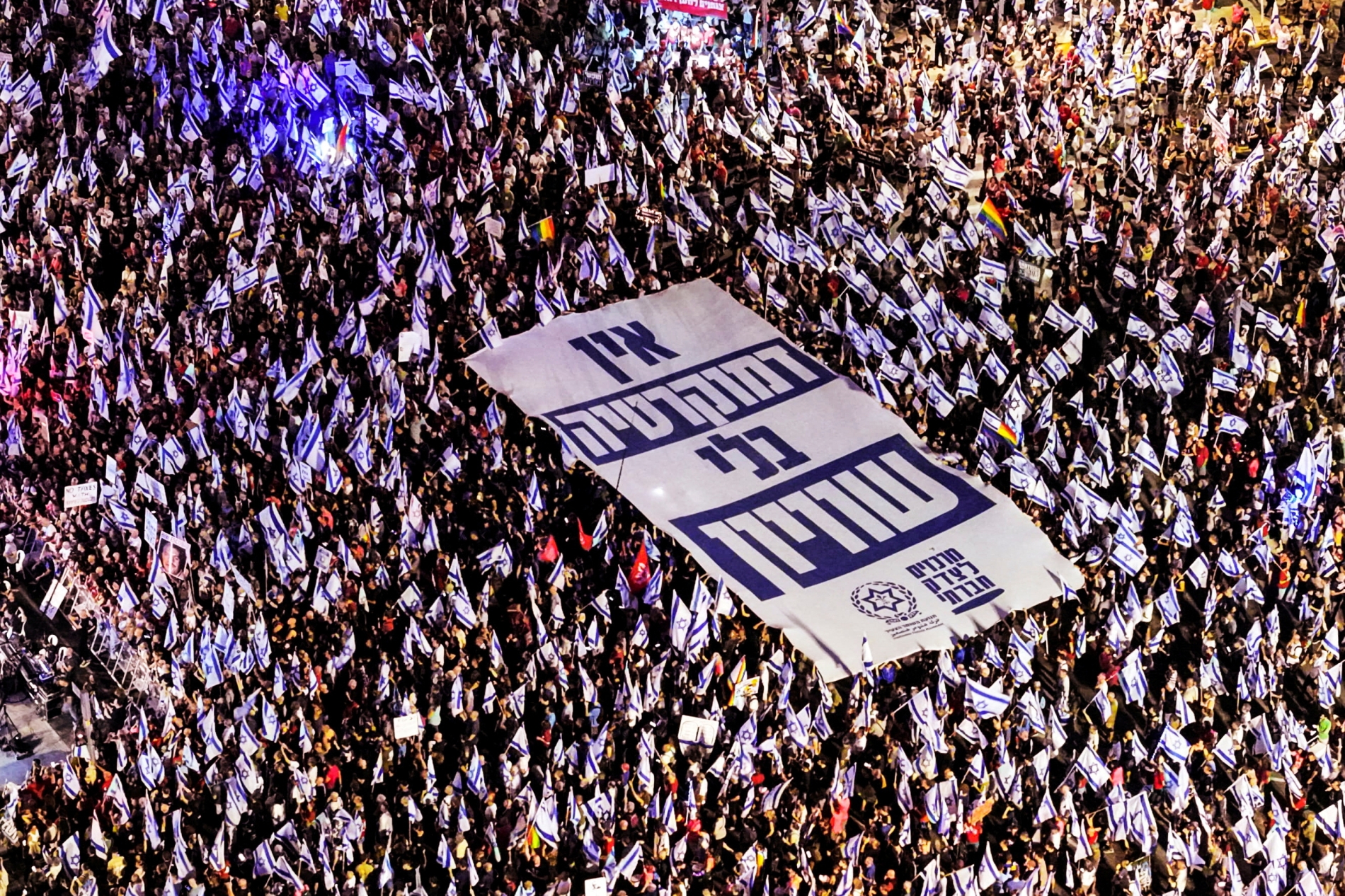
Demonstrators in Tel Aviv against judicial changes imposed by the Netanyahu government.

Years in the making

Israel’s current crisis is the culmination of compounding domestic shocks. In early 2023, the governing coalition launched a sweeping judicial overhaul, triggering the largest street protests in the country's history. Lawmakers pushed ahead by curbing the Supreme Court’s oversight powers, only for the court to narrowly strike the measure down in an unprecedented constitutional standoff.

The trauma of October 7 temporarily froze these domestic fault lines, bringing opposition figures Benny Gantz and Gadi Eisenkot into an emergency war cabinet. Yet wartime solidarity soon gave way to familiar political manoeuvring. Centrist allies quit the government over strategic drift, former rivals reconciled to shore up Prime Minister Benjamin Netanyahu’s majority, and far-right factions repeatedly leveraged coalition ultimatums to extract concessions. What began as a constitutional battle has evolved into an ongoing struggle over political survival and national cohesion.

The right-wing coalition's ultimate test came from internal ideological disputes regarding Haredi military conscription. Pressure peaked in July 2025 when both factions of the religious United Torah Judaism (Degel HaTorah and Agudat Yisrael) pulled out of the government over stalled draft exemption legislation, followed immediately by minister resignations from Shas, another Jewish religious party. Though Netanyahu managed to preserve the government until its formal term ended, the crisis transformed the 2026 election from a routine parliamentary race into a foundational debate over Israel's democratic institutions, social contract, and national security architecture.

Far from a cliché, compounding institutional crises and existential security challenges have converged to make this election a defining moment in Israel's history.
Israel is choosing between two radically divergent visions for its democratic institutions, its regional alliances, and its wartime recovery

The missing majority

An unforgiving mathematical reality governs Israel's national election. Under its nationwide proportional representation system, the entire country votes as a single district to fill the Knesset's 120 seats.

The three main television polls published Friday give Netanyahu's coalition 50 seats, 11 short of a majority. His opponents do better, but not by enough. The "change bloc" led by former army chief Gadi Eisenkot was projected at between 52 and 56 seats in every survey. It has ended up lower, at 48. Polls have, notoriously, underestimated some votes, and this time they did: Likud has 26 seats in the regular-ballot count, against 21 in Channel 12's final poll, and the Arab parties have 19 against roughly 14 in that poll. Turnout also hit 77.7%, the highest since 1999. Though many of these numbers, including the participation rate and the number of Arab seats, are historic, they don't make breaking out of the deadlock easier. But those numbers mean one of the two sides will have to give for either to form a government.

On paper, a majority of parties do oppose Netanyahu. In practice, the opposition has promised not to count about a fifth of them. Three of the four opposition parties reject governing with Arab parties, and Avigdor Lieberman, a veteran politician and founder of the Yisrael Beiteinu party, rejects even their tacit support for a minority administration. He has also excluded the ultra-Orthodox parties, though Eisenkot has left room for a deal with them. The Haredi camp is hedging: a Shas source said that if Eisenkot is wise, he will form a government without taking the portfolios Shas cares about, and that "if there is a reasonable draft law, maybe we will join later. 

For their part, Arab parties are split over whether to join the government or support it from the outside. Mansour Abbas' Ra'am party notoriously joined the short-lived Bennett-Lapid government in 2021, and some other parties have at times shown they could join Zionist opposition parties to stand against Netanyahu. But a partnership, even a discreet one, remains taboo and will likely give Netanyahu opportunities to fire across the opposition's bow. Abbas himself said on election night that "with these numbers there is no government," while noting that both blocs are talking to him, "even the right doesn't boycott us."

Diana Estefanía Rubio
Political landscape after Israeli election

Brutal electoral math

Another key metric is the electoral threshold. To win, a party must clear a strict barrier: 3.25% of all valid votes cast. The consequences of this arithmetic are important. A faction that falls just a handful of votes shy of the line gets zero seats, discarding every ballot cast for it and raising the bar for rival coalitions to secure a 61-seat governing majority. This threshold trap creates an existential game of musical chairs, forcing fragmented parties to merge, sign tactical surplus-vote pacts, or withdraw entirely before election day. Eleven lists cleared the bar in the regular-ballot count.

In many ways, the Israeli political battle is as much a struggle between major parties and figures (Netanyahu vs Eisenkot) as it is a fight by smaller parties to survive brutal electoral math—with their fate potentially shaping the broader coalition chances for each side.

With these high-stakes mechanics, both camps have radically reshaped their ranks in the run-up to the 2026 election. Prime Minister Benjamin Netanyahu's right-wing bloc anchored itself around a broadened Likud, reinforced by absorbing Gideon Sa'ar's faction to expand its parliamentary base. Alongside Likud stand its traditional Ultra-Orthodox partners—Shas and United Torah Judaism—and a nationalist flank led by Itamar Ben-Gvir's Otzma Yehudit and Bezalel Smotrich's Religious Zionist Party. Netanyahu may hope those far-right parties have an untapped reserve of supporters not reflected in the polls. That hope was partly met: Ben Gvir's Otzma Yehudit has 7 seats and the Religious Zionism-Zehut slate 6, so both cleared the threshold despite the failed merger.

Yet coalition unity remains fragile. Fearing that split far-right slates could fall below the cutoff and squander crucial ballots, Netanyahu pushed aggressively to engineer a pre-election merger between Ben-Gvir and Smotrich. Ben-Gvir flatly refused, wagering his faction's independent momentum against the risk of electoral oblivion.

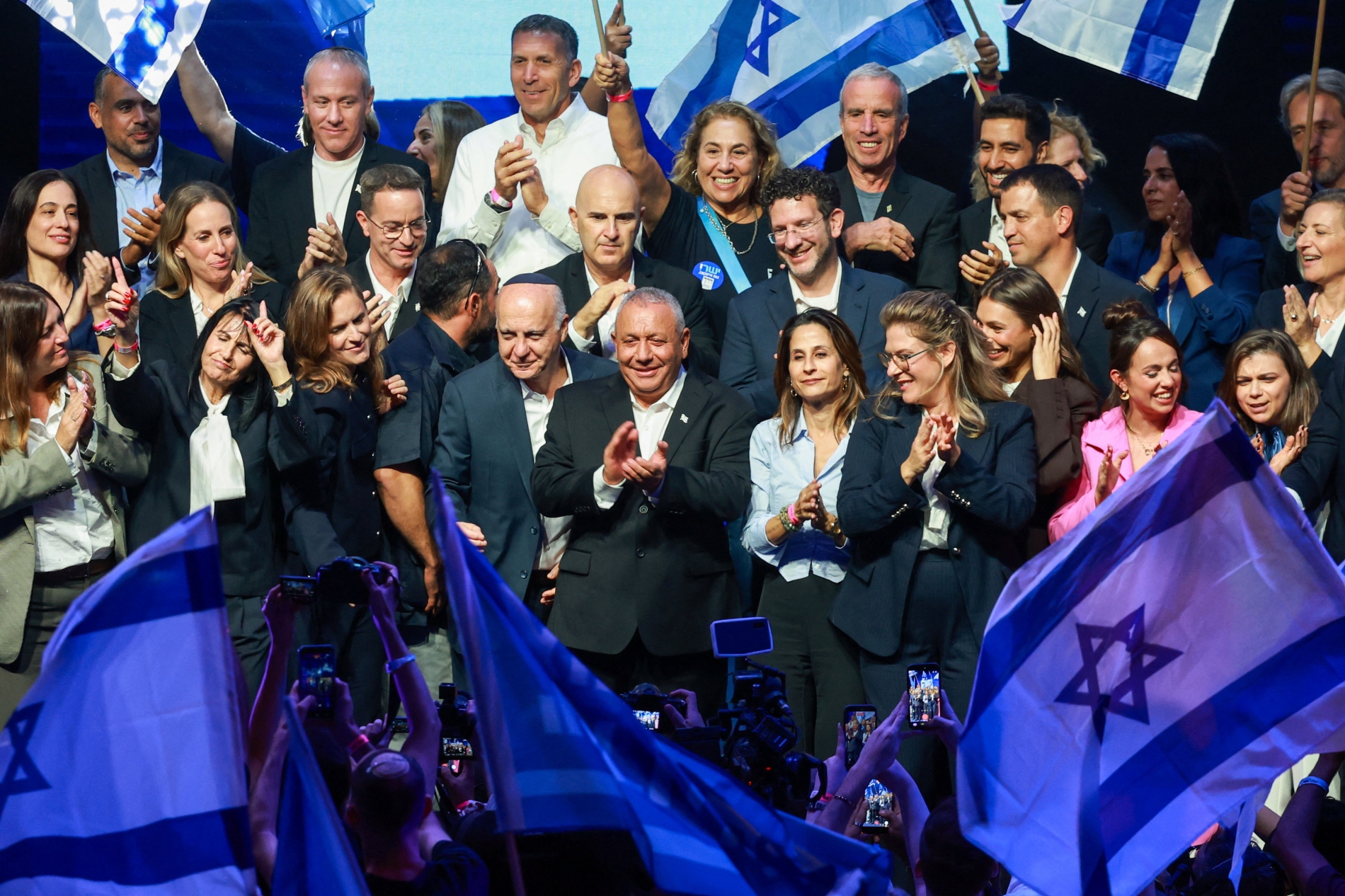
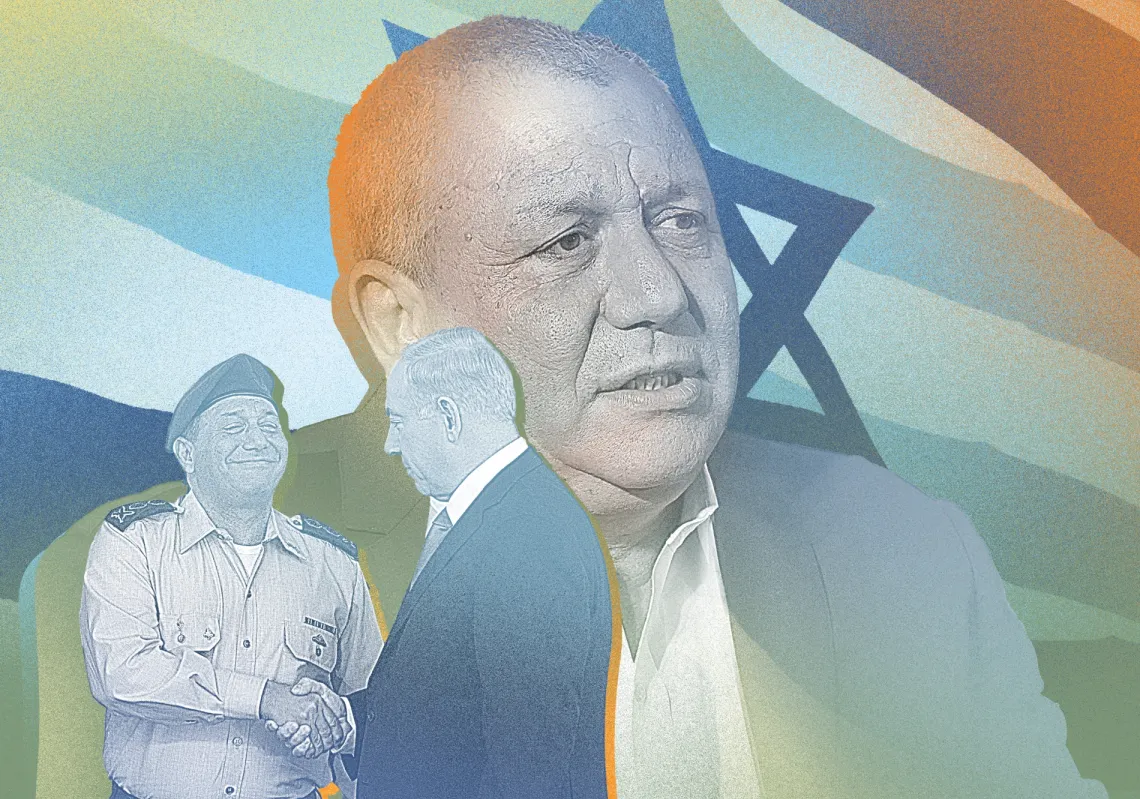
Across the aisle, the anti-Netanyahu camp undertook historic mergers to prevent vote wastage and mount a unified challenge. The centrepiece of this effort is a joint ticket headed by former Prime Minister Naftali Bennett and Yesh Atid leader Yair Lapid, who pooled their political capital on a shared slate. Notably, Bennet has been spearheading the campaign, while Lapid is (likely deliberately) taking a back seat, as the party likely seeks to attract right-wing voters disappointed with Netanyahu. Despite these efforts, the Bennett-Lapid alliance only has 12 seats, well behind Eisenkot's 21, leaving the former Israeli army chief of staff in charge of manoeuvring against Netanyahu.

GIL COHEN-MAGEN / AFP
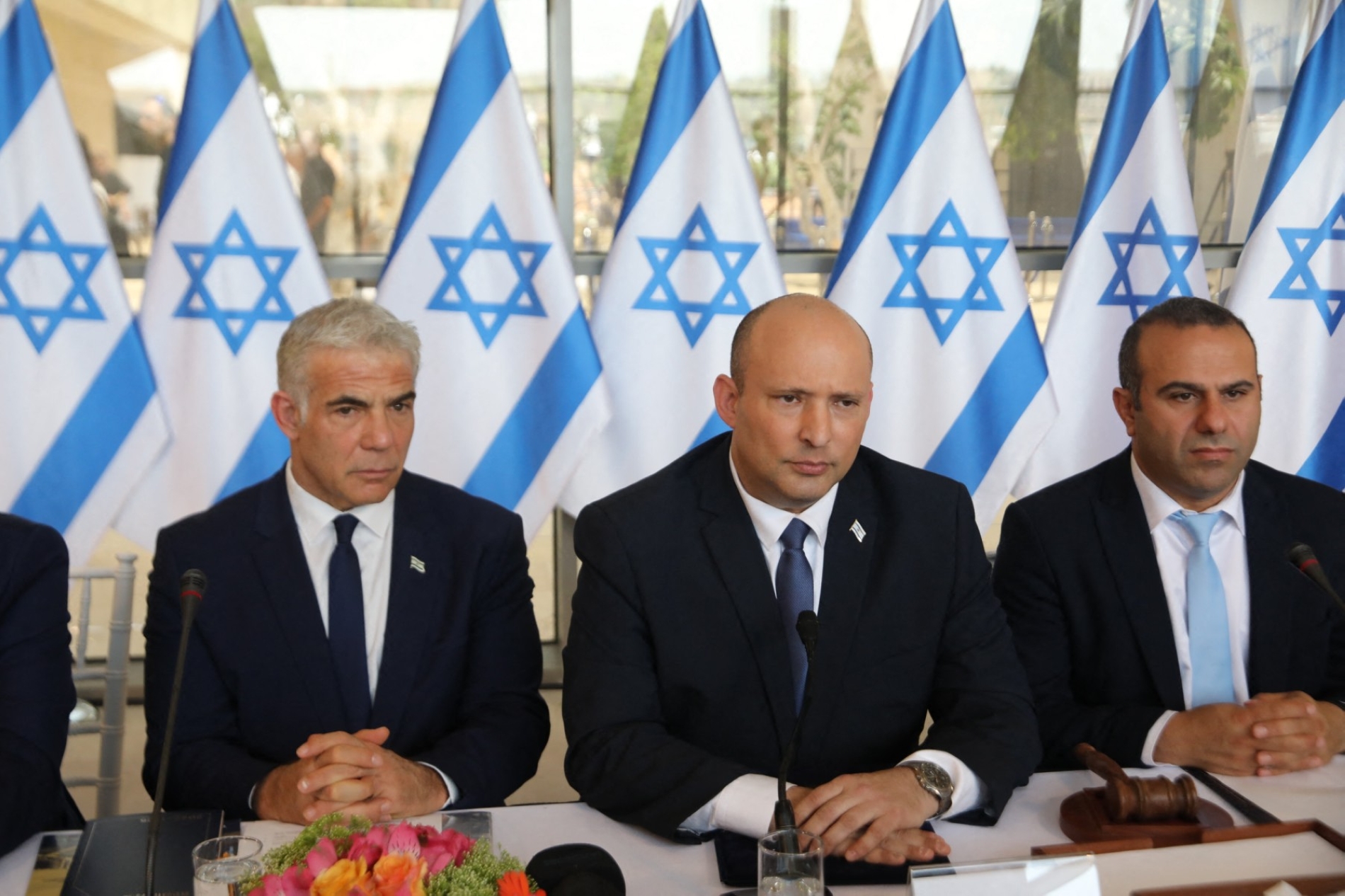
Israeli Foreign Minister Yair Lapid, Prime Minister Naftali Bennett, and Cabinet Secretary Shalom Shlomo attend a weekly cabinet meeting in Jerusalem on 29 May 2022.

On the Zionist left, the historically fragmented Labour and Meretz parties joined forces under Yair Golan to launch The Democrats. This revitalised left-wing union gave historic parties a new coat of paint.

Elsewhere, former military chief Gadi Eisenkot launched his own reform-minded list, while Lieberman maintained his secular-nationalist bastion. The harsh calculus of the threshold claimed its highest-profile casualty when Benny Gantz abruptly pulled his party from the ballot after merger talks foundered, bringing a dramatic close to his electoral efforts and showing how unpredictable Israeli politics are—a few years ago Gantz was a rising star; now he is no longer on the electoral map. To prevent cannibalising one another's support, the five major opposition leaders signed a rare non-aggression pact, pledging to halt cross-party attacks and coordinate joint turnout operations.

Arab representation navigated intense legal drama before reaching the ballot. The Central Elections Committee initially disqualified both Mansour Abbas's pragmatic Islamist faction, Ra'am, and a reunited Joint List. In a familiar institutional showdown, the Supreme Court unanimously overturned the bans, allowing both slates to mobilise their constituencies. They did: Arab turnout rose sharply, and the two slates together won 19 seats in the regular-ballot count, nearly double their previous representation. This gives Arab parties opportunities to weigh in, in a significant way, in Israeli politics.

These numbers may well reflect a willingness by Arab Israelis to do so and play a more active role in shaping the country's future. However, this will require breaking some taboos: Yet this demands breaking taboos: isolated—whether by self-exclusion, Zionist boycott, or both—Arab parties will be bystanders rather than kingmakers. Mansour Abbas has joined an opposition government in the past, and even shown some willingness to talk to Netanyahu before that, but his party alone may not be enough to break the deadlock.

Underneath the tactical realignments lies a quiet generational transition. Longtime fixtures across the spectrum—including Gantz, former Knesset Speaker Yuli Edelstein, veteran Arab lawmaker Ayman Odeh, and ousted Ultra-Orthodox faction chiefs—have stepped aside or been pushed out.

Israel enters election day with two heavily fortified political blocs, each engineered to the decimal point to survive the electoral threshold. Yet this rigid math now collides with an exceptionally volatile campaign environment marked by technological disruption and pervasive security threats.

For Israelis going to the polls, the ballot box may offer clear numbers, but no long-lasting stability

Volatile campaigning

Israel's 2026 election campaign stands out as one of the most volatile in the nation's history. Digital manipulation, intense battles over surveillance, physical violence against candidates, and official curbs on press access have converged to erode public trust in the democratic process.

Despite official regulatory transparency guidelines, tracking data from the Open University of Israel's Ze Be AI research project estimates that about 13% of election-related social media content was synthetic or heavily altered, with the ruling Likud responsible for roughly a third of flagged posts. Deepfakes quickly proliferated: fabricated clips showed opposition figures embracing Arab party leaders, and far-right ministers circulated videos depicting the Supreme Court President and Attorney General being dragged through street protests.

At the same time, political campaigns pushed surveillance technology to the edge of legality. Controversies peaked after a whistleblower alleged that Likud's voter mobilisation software could use smartphone microphones to monitor polling stations and log voter identities as names were called aloud. In late October, the High Court intervened, issuing an emergency ruling that prohibited party observers from harvesting or transmitting real-time turnout data from polling sites.

Apart from the digital battles, candidates experienced overt intimidation and physical violence. Candidates across the ideological spectrum faced explicit death threats, requiring the Shin Bet to upgrade protective details dramatically. Naftali Bennett's security was doubled after an assailant hurled glassware at him in Bnei Brak; Prime Minister Benjamin Netanyahu's motorcade was struck by a glass bottle during Jerusalem protests; and candidates in the West Bank were targeted by stone throwers. Tensions escalated further when right-wing parties deployed thousands of activists to Arab polling stations under the guise of fraud prevention—a move denounced by Arab lawmakers as deliberate voter suppression—while immigration authorities barred credentialed European journalists, prompting diplomatic protests.

REUTERS/Ronen Zvulun
Former Israeli military chief Gadi Eisenkot attends an event for his Yashar party, ahead of Israel's national election in Tel Aviv, Israel, on 25 October 2026.

Three potential outcomes

Once the ballots are counted, the struggle shifts to the arithmetic of building a 61-seat majority in the 120-seat Knesset. Once the votes are tallied, parliamentary arithmetic points to three potential outcomes, each carrying profound institutional friction.

A Gadi Eisenkot-led opposition alliance could assemble a thin minority government relying on outside support from Arab factions. Given the current numbers, that path seems remote: It would require securing not only Mansour Abbas's backing, but potentially that of another party, either within the right-wing camp or within the remaining Arab Joint list. Both are long shots and may alienate at least one of Eisenkot's partners—Liberman in particular. Even if he somehow succeeds, balancing hawkish secularists and progressive leftists would leave the government inherently fragile.

Across the aisle, Netanyahu holds a stronger hand, yet his path to a majority remains precarious. He must peel away at least one party from the opposition. Reaching out to Mansour Abbas is hardly beyond him—whatever his rhetoric—though that would risk an immediate revolt from his far-right partners. More plausibly, his sights are set on the right-wing opposition. It is a long shot, but in the current arithmetic, every viable path is.

If neither bloc manages to clear the bar, the country will plunge back into familiar paralysis: Netanyahu would remain caretaker prime minister amid an unresolved deadlock, ultimately triggering another round of snap elections after several rounds of negotiations.

The outcome presents a clear fork in the road. A narrow right-wing government will almost certainly revive domestic judicial challenges, reject Palestinian statehood frameworks, and adopt an aggressive regional posture. An opposition government would pivot toward repairing ties with Western capitals, stabilising civil-military relations, tackling universal conscription, and shoring up institutional checks and balances.

Whether through a hardline right-wing majority or an unstable opposition alliance, Israel is choosing between two radically divergent visions for its democratic institutions, its regional alliances, and its wartime recovery. After voting, the country has received neither clear numbers nor lasting stability. It will now enter a familiar phase of Israeli politics, where promises must be broken for a new government to form.

font change