The US is learning the wrong lessons in Iran

Tactical excellence can never salvage strategic incompetence

Motorists drive past a billboard in Tehran depicting Trump drowning in the Strait of Hormuz on 24 August 2026.
AFP
Motorists drive past a billboard in Tehran depicting Trump drowning in the Strait of Hormuz on 24 August 2026.

The US is learning the wrong lessons in Iran

Although the conflict in Iran and the Strait of Hormuz is far from over, analysts are already rushing to declare what lessons should be learned from it. An emerging genre of security policy articles highlights the various logistical and tactical shortcomings of the US operation against Iran: a lack of preparation for disruptions in oil and fertiliser shipping, insufficient magazine depth in precision munitions and interceptors, a general failure to prepare effectively to counter cheap one-way attack drones, insufficient minesweepers, and so on.

These are useful lessons that may help the United States prepare for future conflicts, but they are not the fundamental cause of the country’s failure in the Strait of Hormuz. Even if some or all of these concerns had been addressed long before the conflict, it is hard to see how they might alter the Trump administration’s failure to achieve its initial war aims of regime change, the destruction of Iran’s long-range strike capability, or major alterations in Iranian policy toward nuclear weapons and regional proxies.

While greater magazine depth and preparedness for oil shortages might have enabled a longer bombing campaign or a greater degree of economic pressure, that is no reason to suppose that seven months of bombing or blockade might achieve what nearly six months thus far have not. Strategic failure, leaving Iran with a freer hand to pursue nuclear ambitions, a far greater degree of control over the Strait of Hormuz, and consequently a greater degree of influence over the Gulf states, now seems the most likely outcome of this military debacle.

The US military remains remarkably capable, demonstrating even in this poorly conceived war technical capabilities that no other military can currently match, projecting military force more than 7,000 miles from American shores, and seizing control of Iran’s skies with the apparent casual ease the world has become accustomed to in America’s wars.

The resulting damage has been remarkably lopsided, with the United States suffering at least 18 dead and more than 600 wounded against Iranian losses that almost certainly number well into the thousands, though a precise total is not known. In short, even with failures of planning and logistics, the US military has shown that it remains remarkably dangerous.

No amount of technical excellence, however, can make up for the strategic incompetence of demanding that the military accomplish the impossible. US President Donald Trump has demanded not one impossible task of the military, but three, and then reacted with shocked anger when it failed.

ATTA KENARE / AFP
Commuters drive past an anti-US billboard referring to President Donald Trump and the Strait of Hormuz, installed on a building at the Valiasr Square in Tehran on 10 May 2026.

The first of these impossible tasks was the administration’s stated aim of achieving regime change without any ground operations. Achieving a strategic victory entirely through airpower has been the coveted aim of independent air forces around the world ever since Italian theorist Giulio Douhet predicted in 1921 that future wars could be won with bombers alone, even going so far as to suggest in 1928 that just 300 tonnes of bombs dropped on a mid-sized country could end a war in a month.

The thesis that wars can be won entirely from the air is now one of the most thoroughly tested in all of modern industrial war, and 40,000 tons of German bombs dropped on London during the Blitz merely hardened the British will to resist. The 2.5 million tonnes of bombs the Allies dropped on Germany during World War II in return inflicted serious damage and imposed stark choices on Adolf Hitler’s regime, but they likewise did not force it to collapse and indeed seem to have reinforced public commitment to the war.

The 8 million tonnes of bombs that the United States dropped during the Vietnam War likewise accomplished little and may even have been broadly counterproductive, serving to secure the civilian populace’s support for communist war aims while alienating the American public.
Strategic US failure, leaving Iran with far greater control over the Strait of Hormuz, now seems the most likely outcome of this military debacle.

It may be impossible at any level of bombing short of nuclear use to collapse a regime from the air. The closest that any operation has ever come was the NATO campaign against Serbia under Slobodan Milosevic, but even there the bombs stopped dropping in June 1999, while Milosevic's regime fell to mass demonstrations in October 2000.

The chances of the Iranian regime collapsing entirely through the application of airpower were slim to none, so the next impossible thing demanded of the US military was to neutralise Iran's ballistic missile and drone capacity, also entirely from the air. But this mission—disabling mobile launch capability with minimal ground forces—has also been tried repeatedly before and has also never succeeded.

In WWII, both American and British air forces made substantial efforts to shut down V-1 flying bomb and V-2 rocket production and launches through an extensive bombing campaign, codenamed Operation Crossbow, but they could not stop the launches. It was simply too easy to harden or conceal production and launch sites.

The advent of precision munitions has not changed this calculus, but it has been offset by the emergence of mobile launch systems. Infamously, efforts to take out Iraqi Scud launchers from the air during the Gulf War were unable to produce even a single confirmed destruction. Israel likewise has spent two decades running extensive air operations over Gaza and southern Lebanon to prevent Hamas and Hezbollah rockets from being fired at Israeli territory, but only ground operations in both areas were able to silence the rockets.

DPA
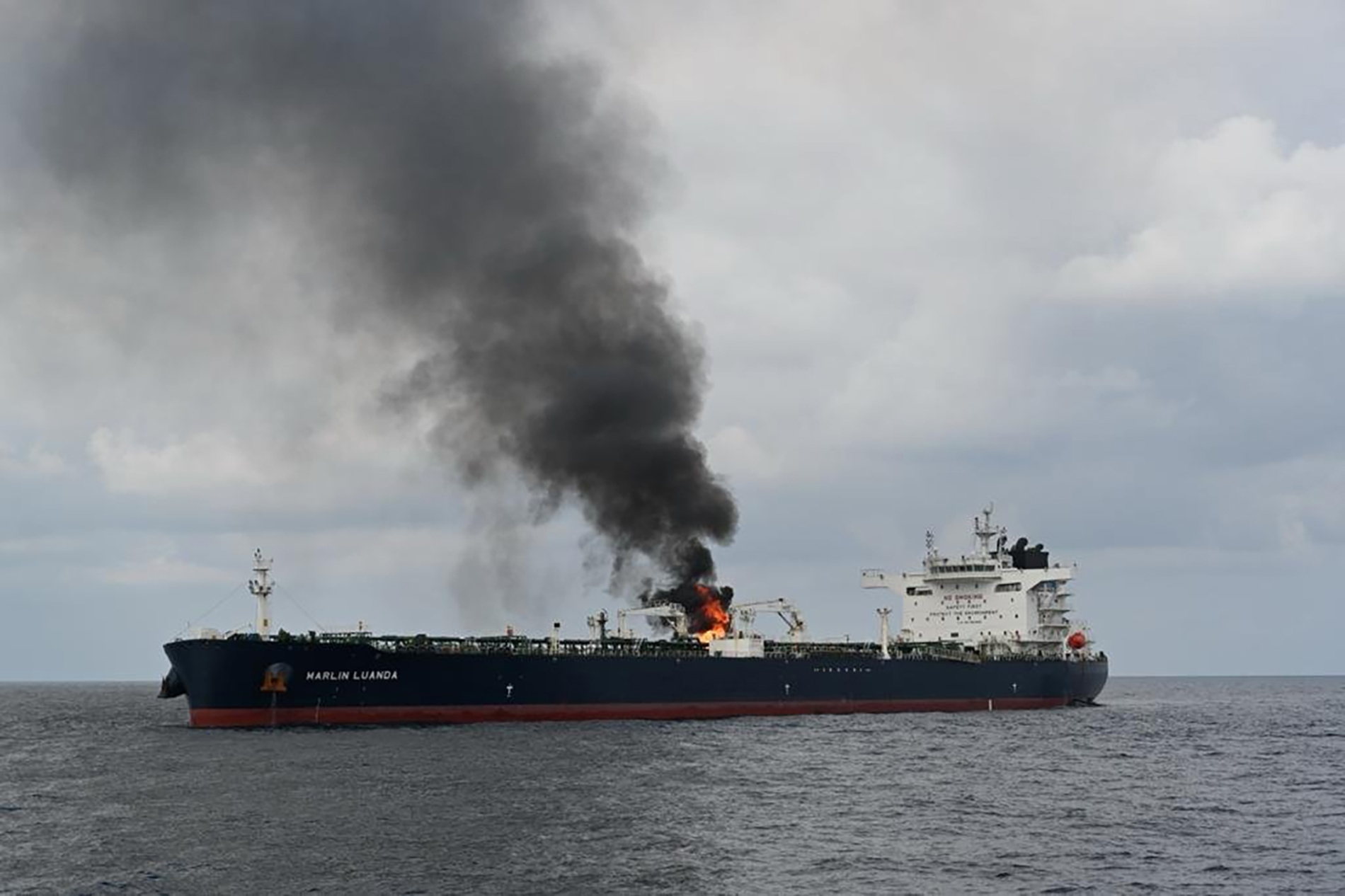
Fire breaks out on the vessel "Marlin Luanda" in the Gulf of Adenafter being struck by an anti-ship missile launched from Houthi-controlled territory in Yemen.

Multiple coalitions of countries have attempted to silence Houthi missiles and drones fired from Yemen, yet the launches continue even now. Even with precision munitions, it does not seem possible, from the air alone, to destroy enough mobile launch systems, which can fire from concealment and then swiftly move into new locations, to end a drone or rocket campaign. As with regime collapse, stopping the rockets appears to require ground troops.

The Trump administration's final fallback appears to be simply running nearly perfect missile defence over much of the Gulf region to prevent Iran from damaging the infrastructure of the Gulf Cooperation Council countries, upon whose hospitality the US military effort relies. Greater investment in cost-effective interception methods, such as those in use in Ukraine, and the deployment of more short-range air defence might well have enabled the US military to intercept a greater percentage of Iranian attacks.

Yet in an environment where drones and ballistic missiles remain much cheaper and quicker to produce than the means to intercept them, it was always likely that Iran would eventually saturate defence capacity in the region. One more impossible task could not rescue the failure of two others.

If the US military required a wake-up call to the dangers and opportunities posed by drones, as well as long-standing procurement problems for things like frigates, minesweepers, and hardened aircraft facilities, that call has been delivered. But this was not a war lost in the halls of the US Defence Department; it was lost in the halls of the White House.

AFP
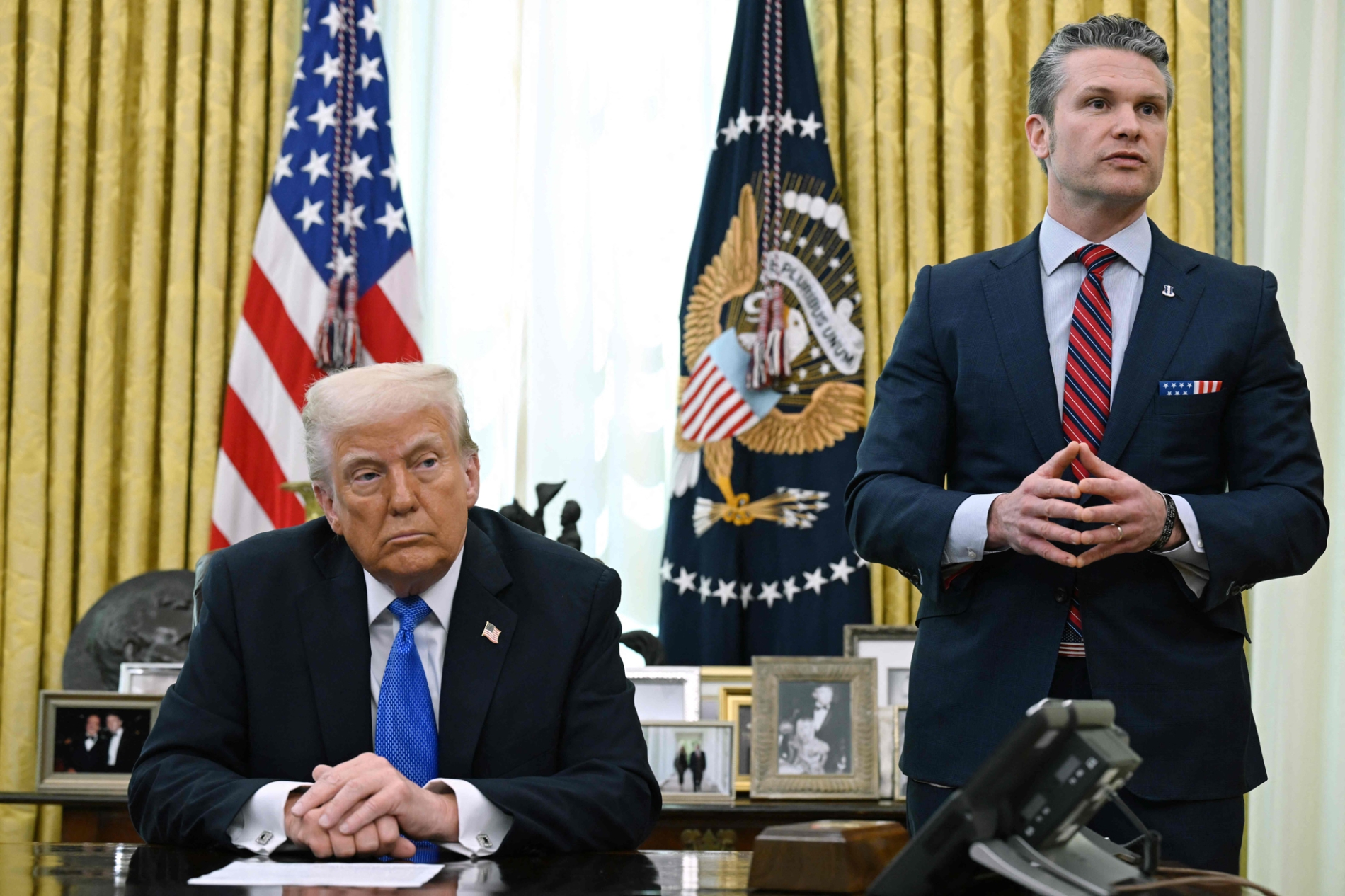
US President Donald Trump and Secretary of Defence Pete Hegseth during an event in the Oval Office of the White House in Washington, DC, on 21 March 2025.

If Trump was unable to see the peril in demanding the US military accomplish the impossible, it was the duty of his defence secretary to make him aware. Of course, Trump did not select an experienced and capable defence secretary, but a loyal toady, made only more loyal by his manifest incompetence, in the form of Pete Hegseth.

Hegseth, in turn, has gone to great lengths to purge the senior ranks of anyone likely to offer a contrary opinion. The US officer corps has never excelled at delivering unwelcome news to political decision-makers, but Hegseth's approach meant the Pentagon was never going to push back against presidential ineptitude. Reporting suggests that the chairman of the Joint Chiefs of Staff, Gen. Dan Caine, made a token effort to signal the difficulty before being drowned out by Hegseth's boosterism.

All of this was predictable, and indeed much of it was predicted. Thus, while the immediate blame for the debacle in Iran attaches to Trump and his incompetent advisors, the ultimate blame must lie where no politician will admit it: with the voters. It was the choice of a plurality of American voters to return Trump, a man manifestly incompetent, manifestly incapable of absorbing unwelcome or contrary information, manifestly interested in surrounding himself with loyal yes-men, to the White House.

It turns out that electing the leader of the most powerful military on the planet is not the same as selecting the most entertaining host of a reality show. Reports about lessons learned are doubtless already being penned within the Pentagon. Yet as the strategic fallout, from elevated oil prices to depleted US resources, of this predictable and disgraceful failure continues to mount, the question is whether the American voters have realised that no amount of military excellence is sufficient to insulate them from their own poor choices at the ballot box.

font change