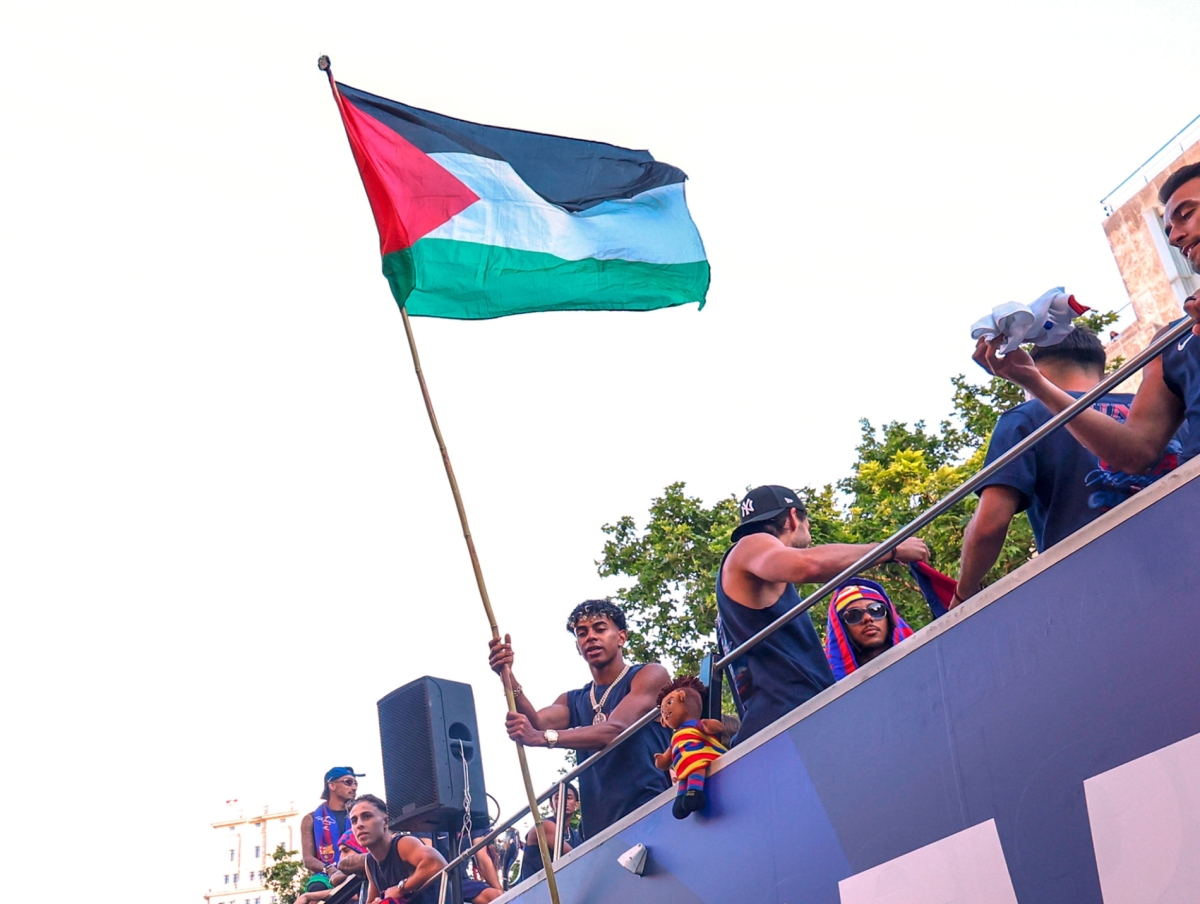

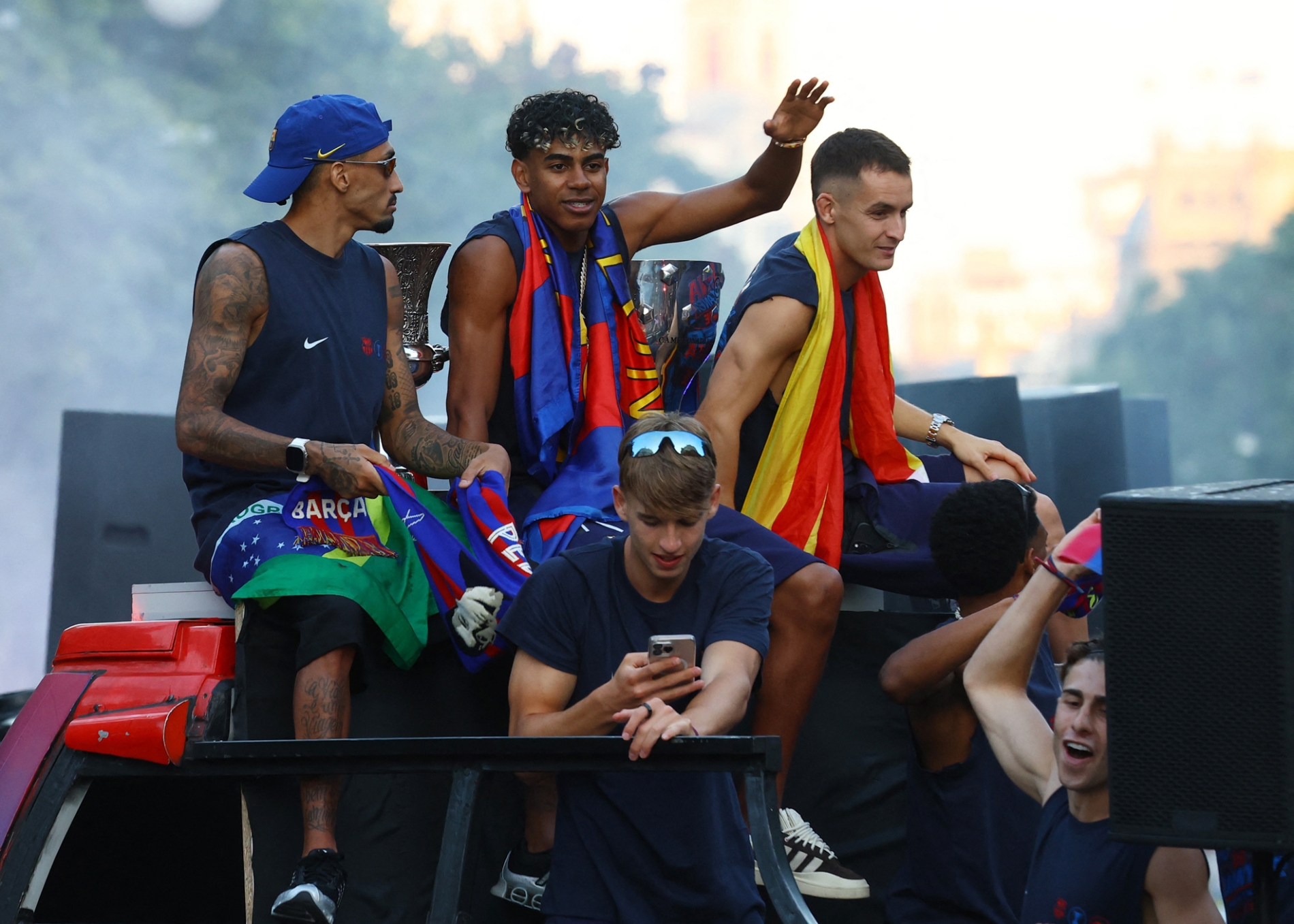
After Barcelona football club won the Spanish league title earlier this month by beating arch-rivals Real Madrid, the victorious team’s best player, Lamine Yamal, raised the Palestinian flag during the victory parade, images that were beamed across the world. Aged just 18 but already one of the best players in the world, Yamal is the idol of millions, so the image had a humongous impact.
From the very heart of the Western image-making system, with all its fluidity, came a radical protest against that system—a young star stepping outside the machinery of image-production and the structures that manufacture celebrity to instead embrace risk and defiance for a principled cause.
On 11 May, as spectators tuned in to the sport they follow with intense passion, Lamine Yamal forced their gaze onto an issue he—and many others around the world—is passionate about. That issue was Gaza, and Israel’s wider war against the Palestinian people.
For his part, Israel’s defence minister accused Yamal of “inciting hate” against Israel for his action, which also spooked sponsors and advertisers, turning the comfortable world of entertainment and spectacle into an awkward space. But in Europe, Yamal’s flag-waving gesture was defended, not least by Spain’s Prime Minister Pedro Sánchez, who said Yamal had “merely expressed the solidarity with Palestine that millions of Spaniards feel,” adding: “Those who believe that waving the flag of a sovereign state means inciting hatred have either lost their minds or have been blinded by their own ignominy.”
Read more: Pedro Sánchez: the Spanish PM putting Palestine front and centre
Eurovision 'controversy'
At a broader level, it has pitted the continent and its values on one side, with Israel and its supporters on the other. This was evident at the weekend during the Eurovision Song Contest finals. Israel’s participation in one of Europe’s oldest and most deeply rooted cultural festivals was already controversial, and several national broadcasters boycotted it for that reason.
Eurovision was founded in part to help reinforce European values after the divisiveness of the Second World War, and Israel’s participation had long granted it broad legitimacy, connecting it to the West and to modernity. Yet, its apocalyptic war on Gaza since October 2023, followed by its brutal war on Lebanon (to name but two), killing many tens of thousands in the process, has forced European governments to condemn Israel's actions. Hundreds of thousands of Europeans across the continent have regularly taken to the streets to condemn what they and the United Nations have called a genocide.
For many, the values associated with this iconic musical competition do not align with Israel’s actions. This is perhaps most deeply felt by Generation Z—a demographic cohort born between 1997 and 2012, of which Lamine Yamal belongs. They have grown up in a digital era but are nevertheless morally attuned.
But in fact, Yamal's age is what makes his gesture of solidarity so notable. When someone in the public eye puts their head above the parapet and supports the Palestinian cause, it is often when their career is well and truly established—in other words, when they feel safe. Yamal’s career is just getting started. It is this conspicuous departure from calculation that is increasingly becoming a trait of Gen Z.
A question of courage
In The End of Courage, the French philosopher Cynthia Fleury writes of societies that have lost the capacity to practise courage through the accumulation of conformity and fear. Fleury does not approach courage as a form of romantic heroism; she describes it as the human capacity to accept the moral cost of one’s positions at the heart of the public sphere. This description applies to Yamal.
For some, there is a fear that governs sport and the Western media, which imposes a silence and cold neutrality over the public outrage against Israeli actions in Gaza, the West Bank, and Lebanon. Yamal waving the Palestinian flag was historical and symbolic. It will also be long-lasting, creating a dilemma for social media algorithms. As a phenomenon, it generated engagement, produced profit and fit seamlessly into the economy of the image. Yet for corporate types, it brings an uncomfortable politics into sport by highlighting an ongoing massacre.
Modern stardom dictates that the star must serve as a reflection of the dominant image projected by major financial and commercial institutions, and must always behave as a polished brand, always ready for consumption. This is a tightly controlled structure, and the star is typically removed from anything beyond this, including from their own personality, identity, values, and positions. Yamal showed that acts of moral courage can be part of a star’s public persona.
Increasingly isolated
And while Israel has grown used to controlling and winning the global PR battleground, it suddenly looks to be standing on shaky ground. On social media, Israeli voices are increasingly isolated, despite their attempts to whitewash Israel's image.
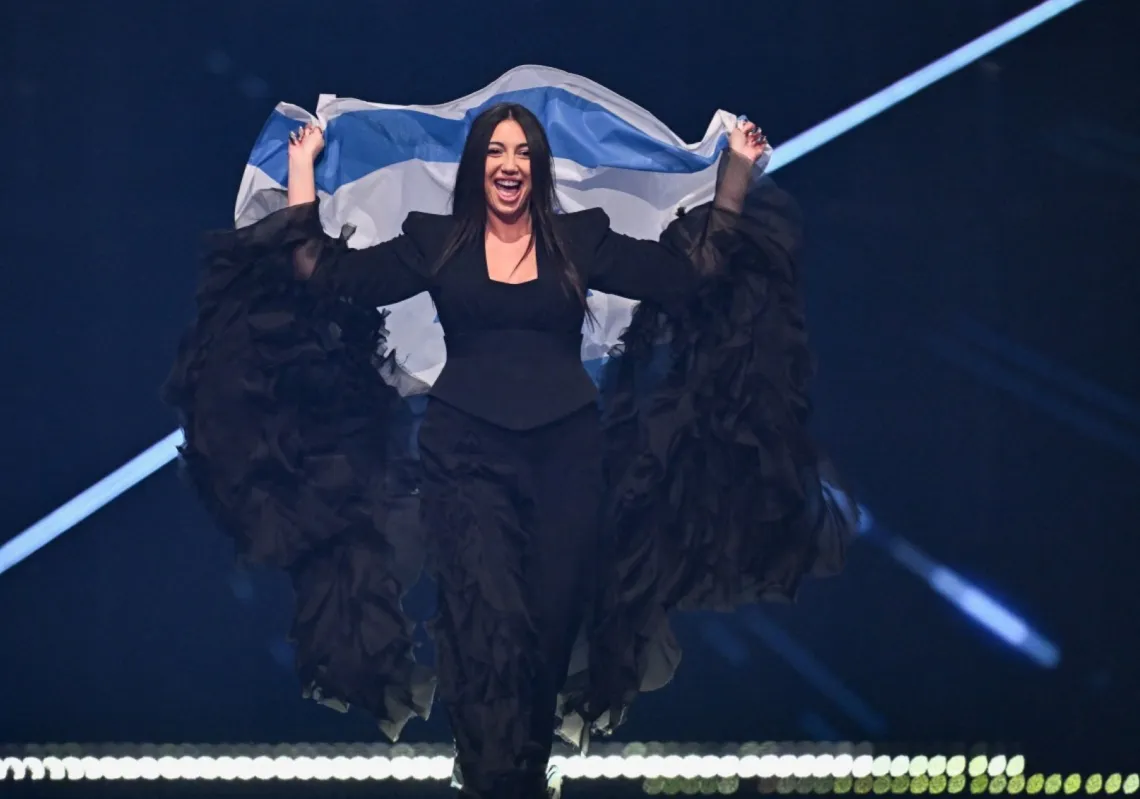
The Eurovision Song Contest final in Austria on 16 May brought this discrepancy to the fore. Tens of millions of viewers could hear the loud booing from the audience when the Israeli contestant took to the stage. Of course, disgruntled spectators were upset about Israel being allowed to participate despite its disturbing actions in Gaza and the broader Middle East, but, in fact, Israel's participation has been controversial since it first joined the contest in 1973. Critics questioned why a country located in the Middle East should be allowed to take part in a competition literally called Eurovision—the geography clearly stated in the title.