Pedro Sánchez: the Spanish PM putting Palestine front and centrehttps://en.majalla.com/node/330986/profiles/pedro-s%C3%A1nchez-spanish-pm-putting-palestine-front-and-centre
Pedro Sánchez: the Spanish PM putting Palestine front and centre
His argument is simple. He wants Europe to defend international law consistently, ensuring it is applied not only in the case of Ukraine but also in Gaza.
ANDER GILLENEA / AFP)
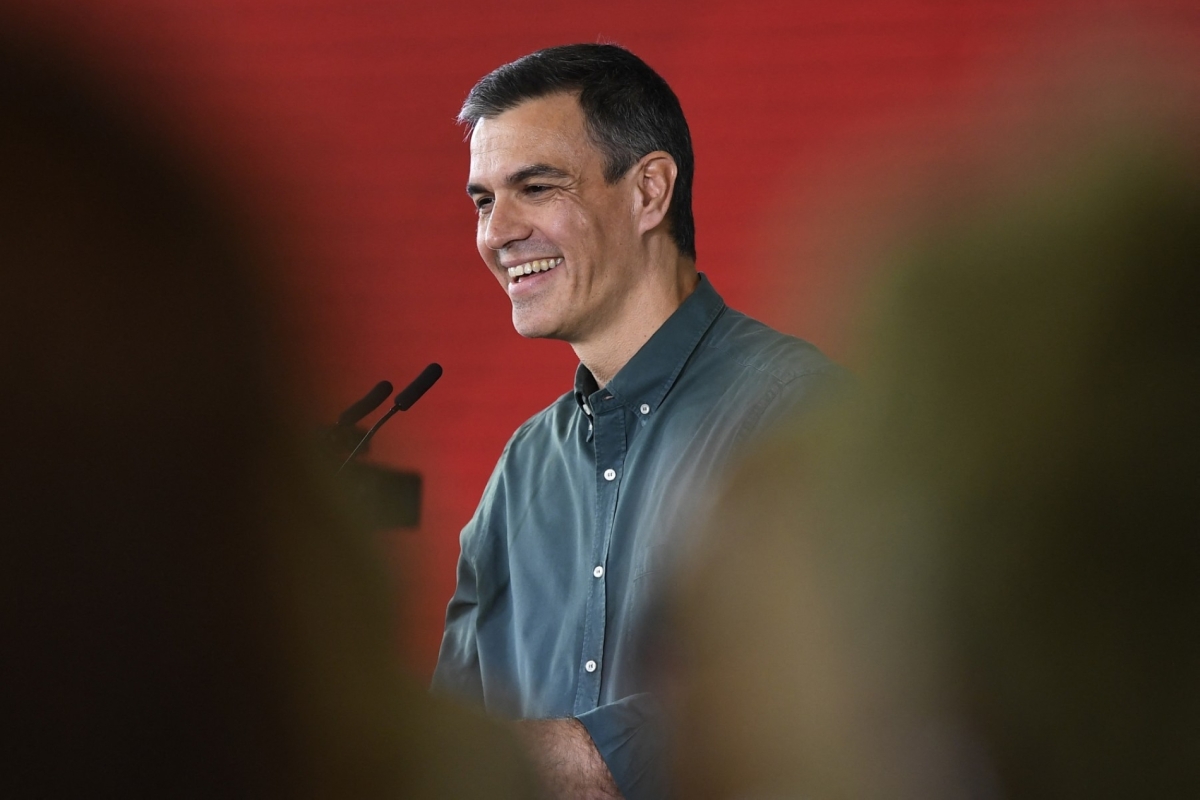
Spanish Prime Minister Pedro Sanchez smiles as he delivers a speech during the Basque Socialist Party (PSE) closing campaign meeting in Bilbao on 19 April 2024, ahead of regional elections in the Basque Country.
Pedro Sánchez: the Spanish PM putting Palestine front and centre
Pedro Sánchez has rarely looked like a politician destined for durability. His critics have repeatedly written him off as opportunistic, strategically reckless or dependent on fragile alliances. Still, the Spanish prime minister has become one of Europe’s most enduring social-democratic leaders, navigating party revolt, electoral setbacks, coalition instability and attacks from the Spanish right. His political profile is defined less by ideological purity than by instinct, adaptation and a capacity to turn vulnerability into authority.
That instinct explains why Sánchez has emerged as one of Western Europe’s most vocal leaders on Palestinian statehood. Spain recognised the State of Palestine on 28 May 2024, with Norway and Ireland, presenting the move as a contribution to peace, a defence of international law and a rejection of diplomatic paralysis. Sánchez insisted that recognition was neither an act against Israel nor an endorsement of Hamas; instead, it was a step towards a viable two-state solution.
For Sánchez, Palestine has become more than a foreign policy file. It has become a measure of Western consistency. His argument is simple: if Europe invokes international law to defend Ukraine, it cannot abandon the same language in Gaza. In July 2024, he warned against double standards, insisting that international law must apply beyond geopolitical convenience.
Spain's public opinion has historically been sympathetic to the Palestinian cause, shaped by its Mediterranean orientation and left-wing anti-colonial traditions
Rise to power
This stance has deeper roots. Born in Madrid in 1972, Sánchez joined the Spanish Socialist Workers' Party, PSOE, in 1993. His official biography presents him as an economist, party leader and prime minister since June 2018; the more telling story is how he climbed through a party that later tried to cast him aside.
Sánchez first became PSOE leader in 2014, at a moment of crisis for Spanish social democracy. The party had been damaged by the financial crisis, austerity, corruption fatigue and the rise of Podemos, the anti-austerity party that challenged PSOE from its left. Spain's two-party system, dominated by PSOE and the conservative People's Party, was breaking apart.
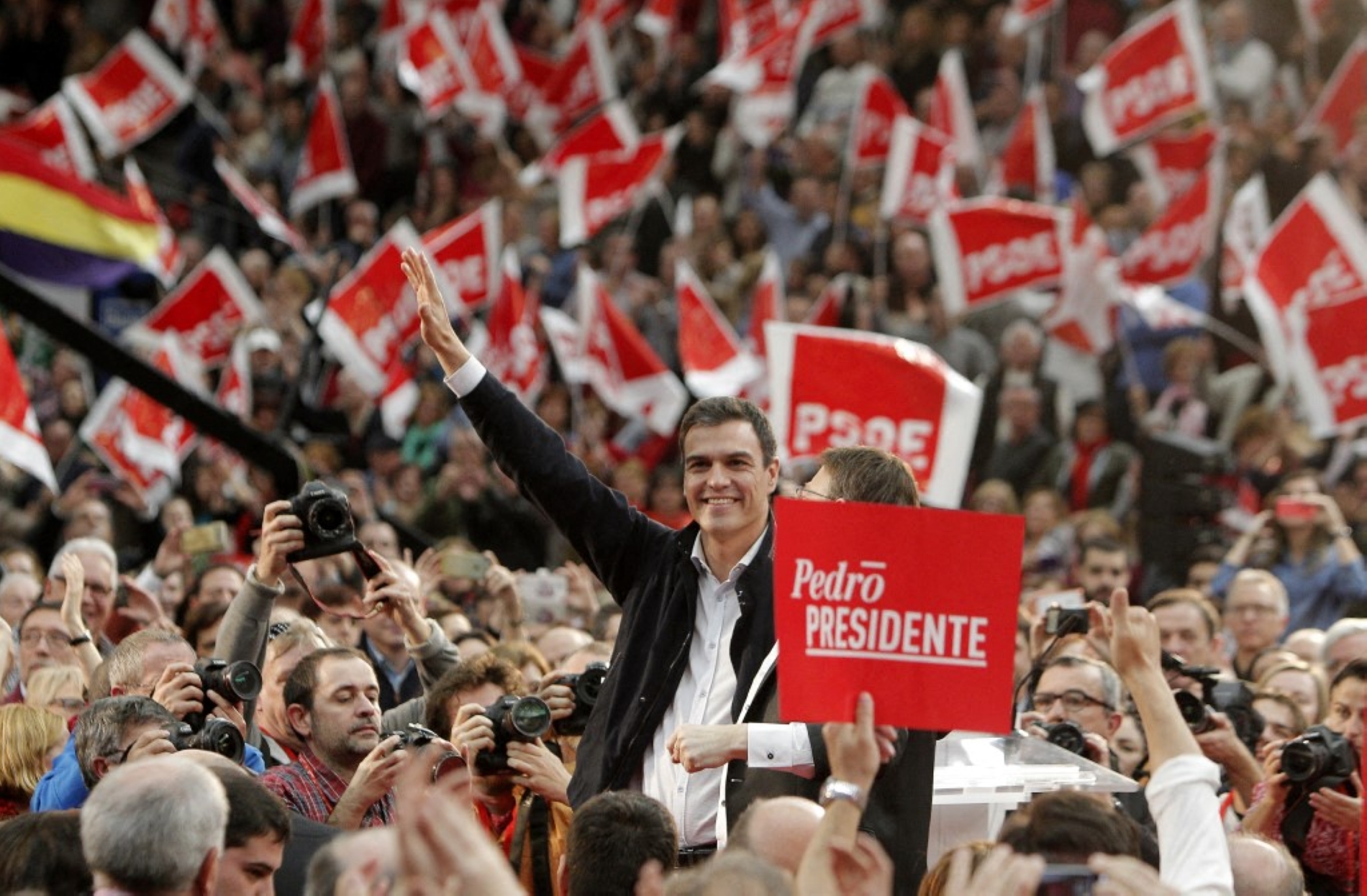
Spanish Socialist Party (PSOE) leader and candidate in the 20 December general elections, Pedro Sanchez raises his fist during a campaign meeting at the Fuente San Luis satdium in Valencia on 13 December 2015.
After the inconclusive elections of 2015 and 2016, he refused to facilitate a conservative government led by Mariano Rajoy, Spain's then-prime minister and leader of the People's Party. Senior PSOE figures pushed back, prompting his resignation as party leader in 2016 and leaving him apparently finished.
He was not finished. In one of the defining episodes of modern Spanish politics, Sánchez appealed directly to party members and won back the PSOE leadership in 2017. He returned as the embodiment of a membership revolt against the party hierarchy. That experience hardened his political style. Sánchez presents himself as a defender of democracy against reactionary forces, while also operating with unusual flexibility.
In 2018, he became prime minister after a no-confidence motion against Rajoy following a corruption scandal involving the People's Party. He took office with a tiny parliamentary base and converted weakness into opportunity. Since then, he has governed by relying on minority arrangements, coalition deals and parliamentary arithmetic that would have destroyed others.
The paradox of Sánchez is that he is a committed European social democrat whose political longevity has also depended on pragmatism with parties beyond PSOE's traditional comfort zone. His governments have relied on support from Sumar, a left-wing electoral alliance and PSOE's junior coalition partner, as well as regionalist and pro-independence parties, including Catalan forces that many Spanish voters distrust.
His 2023 return to power required a controversial amnesty for people involved in Catalonia's failed independence process, provoking accusations that he was trading constitutional principles for office. "Sanchismo" is both an ideology and a method, combining progressive language with tactical endurance.
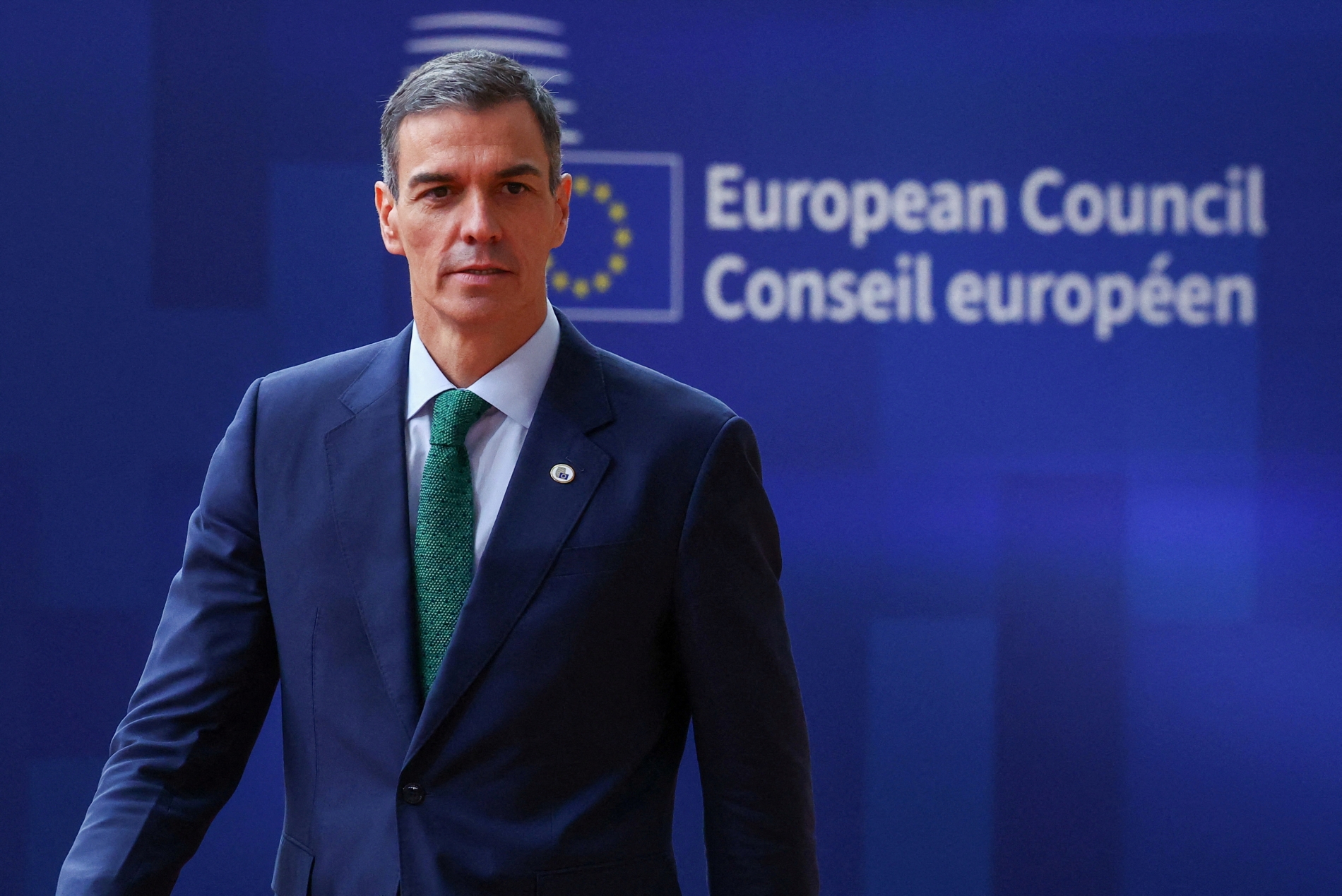
Spanish Prime Minister Pedro Sanchez arrives to attend the European Union leaders' summit in Brussels, Belgium, on 26 June 2025.
Sánchez's ideology is best understood as European social democracy adapted to an age of fragmentation. He believes in welfare, labour protections, gender equality, green transition, European integration and a more active state. This does not make him an old-style socialist tribune. He is managerial, television-ready and comfortable with institutional language. His politics is therefore moralised and strategic, seeking to occupy the space between technocratic competence and anti-authoritarian resistance.
Palestine as Europe's test
Palestine fits this ideological architecture. Spain's recognition of Palestine allowed Sánchez to connect international law, anti-war sentiment, Europe's credibility, Spain's Mediterranean identity and the defence of multilateral diplomacy. It also gave him a foreign-policy arena in which to distinguish Spain from more cautious Western European powers. Sánchez saw an opening for Spain to lead from a place of diplomatic conviction, coordinating with Ireland and Norway while encouraging others to follow.
Sánchez's response has hardened as the war in Gaza has continued. Spain joined South Africa's case at the International Court of Justice concerning the application of the Genocide Convention in Gaza, filing a declaration of intervention in June 2024. In 2025, Sánchez went further, announcing a stronger arms embargo on Israel and a ban on imports from illegal settlements.
The language was unusually forceful for a Western European leader. Sánchez accused Europe of failure over Gaza and argued that double standards threatened the West's global standing. This was not only humanitarian rhetoric; it was a geopolitical argument. In his view, Europe cannot ask the global south to defend international norms in Ukraine while ignoring Palestinian suffering.
That argument has resonance beyond Spain, especially in Latin America, the Arab world and parts of Africa, where Western appeals to rules and rights are often viewed against the memory of colonialism, intervention and unequal enforcement.
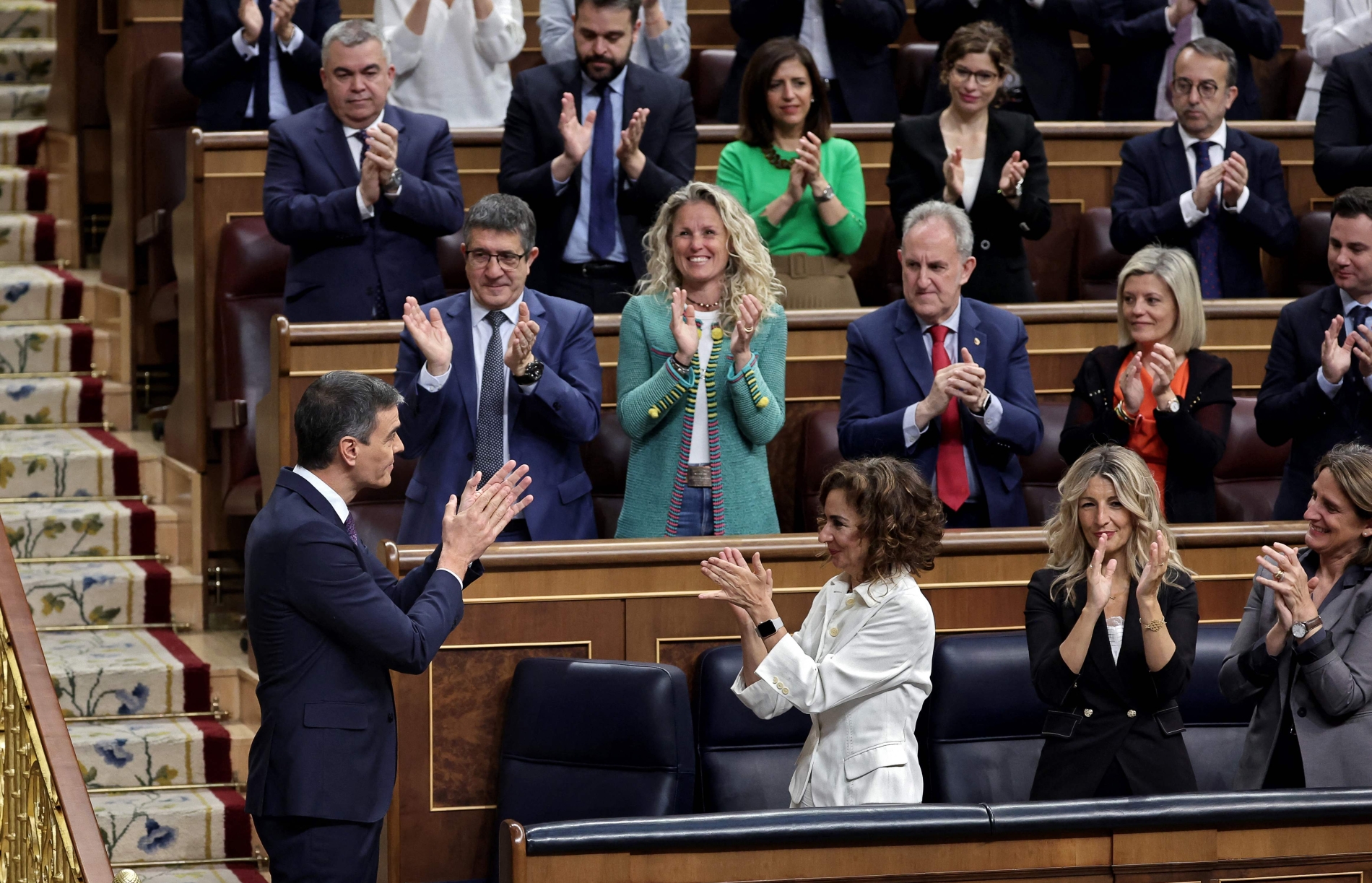
Spain's Prime Minister Pedro Sanchez is applauded by MPs after delivering a speech to announce that Spain will recognise Palestine as a state on May 28 at the Congress of Deputies in Madrid on 22 May 2024.
In line with public opinion
Domestic politics also explains the force of Sánchez's approach. Spanish public opinion has historically included sympathy for the Palestinian cause, shaped partly by Spain's Mediterranean orientation and left-wing anti-colonial traditions. Within Sánchez's coalition, the left has pressed for a harder line on Israel. Taking a firm line on Palestine, therefore, serves ideological and coalition purposes, reinforcing his progressive credentials and differentiating him from the Spanish right.
Reducing his Palestine policy to domestic calculation would still be too narrow. Sánchez has repeatedly shown that he sees foreign policy as a stage on which Spain can act above its conventional weight. His government has sought to cast Spain as a bridge between Europe, Latin America and the Mediterranean, and as a defender of multilateralism amid growing disorder. Palestine allows Sánchez to claim that Spain is doing more than following European consensus; it is helping to shape it.
In 2025, Sánchez imposed a stronger arms embargo on Israel and a ban on imports from illegal settlements.
Not without critics
This values-led diplomacy carries risks. Israel has reacted angrily to Spain's recognition of Palestine and subsequent measures. Spanish conservatives accuse Sánchez of damaging relations with allies and using foreign policy to distract from domestic scandals. Critics also argue that moral consistency is easier to proclaim abroad than to practise at home, where fragile parliamentary alliances feed accusations of institutional opportunism.
Those criticisms will not disappear. Sánchez remains a polarising figure, with strengths and weaknesses that are inseparable. The same flexibility that enabled him to revive PSOE and keep the right from power also fuels charges that he will pay almost any price to remain in office. His moral clarity on Gaza exposes him to accusations of selective indignation, while his Europeanism can appear to opponents as a language of virtue used to conceal strategic calculation.
Here, the political significance of his position on Palestinian statehood becomes clear. It is not simply a diplomatic act from Madrid. It is an expression of Sánchez's broader identity as a social-democratic, Europeanist, combative, morally framed, and pragmatic politician. He has turned Palestine into a question of Middle Eastern peace and of Europe's self-image. For Sánchez, the issue asks whether the rules-based order is a principle or a slogan.
Sánchez may not be the most ideologically pure leader in Europe, nor the least controversial. He has become one of its most revealing. His politics shows how modern social democracy operates in a fractured age through coalition, confrontation, moral argument and institutional agility.
On Palestine, those traits have converged. The result is a Spanish prime minister who has made recognition of Palestinian statehood more than a symbolic afterthought, turning it into a defining feature of his international profile.