F-35 vs J-35: the US-China fighter jet contest

China’s J-35 is more than a new stealth fighter. It represents Beijing’s attempt to challenge the global dominance of the Lockheed Martin F-35 Lightning II.

Raven Jiang

F-35 vs J-35: the US-China fighter jet contest

In early May, Chinese state television aired footage of the export version of China’s J-35AE fighter jet, in a display that carried more weight than routine military publicity. For many observers, the message was deliberate: Beijing wanted to show that its new stealth fighter was no longer confined to the laboratory or the exhibition hall, but was moving closer to becoming a viable export platform.

The timing added to its significance. Reports have linked the aircraft to Pakistan, widely regarded as the leading candidate to become the first foreign buyer of the J-35AE. If those assessments are borne out, this would be more than another arms deal. It could carry Chinese stealth technology into the centre of South Asia’s air-power balance. Pakistan is not an average customer of China, but a close military partner whose defence arsenal depends heavily on Chinese systems. Any sale would therefore mark a further elevation in the defence relationship between Beijing and Islamabad.

The larger question, however, is whether the J-35 can become a serious rival to the American F-35. A similar silhouette, or even the broad category of ‘stealth fighter’, tells only part of the story. The F-35 is more than an aircraft designed to evade radar. It is a full combat architecture built around sensors, data fusion, electronic warfare, and integration with a wide network of allied forces and military systems.

The J-35 family belongs to a different stage of development. It represents China’s accelerating effort to develop a multi-role stealth fighter, with an air force version (the J-35A), a carrier-borne naval variant, and an export model in the form of the J-35AE.

What is the J-35 fighter?

The J-35 is China’s latest effort to develop a family of fifth-generation stealth fighters, smaller and more adaptable than the country’s heavy J-20. Beijing is no longer looking to build its stealth air power around a single aircraft. It wants a platform that can serve with the air force, operate from aircraft carriers, and, in time, possibly be sold abroad. The J-35, therefore, should be understood as a family rather than a single aircraft.

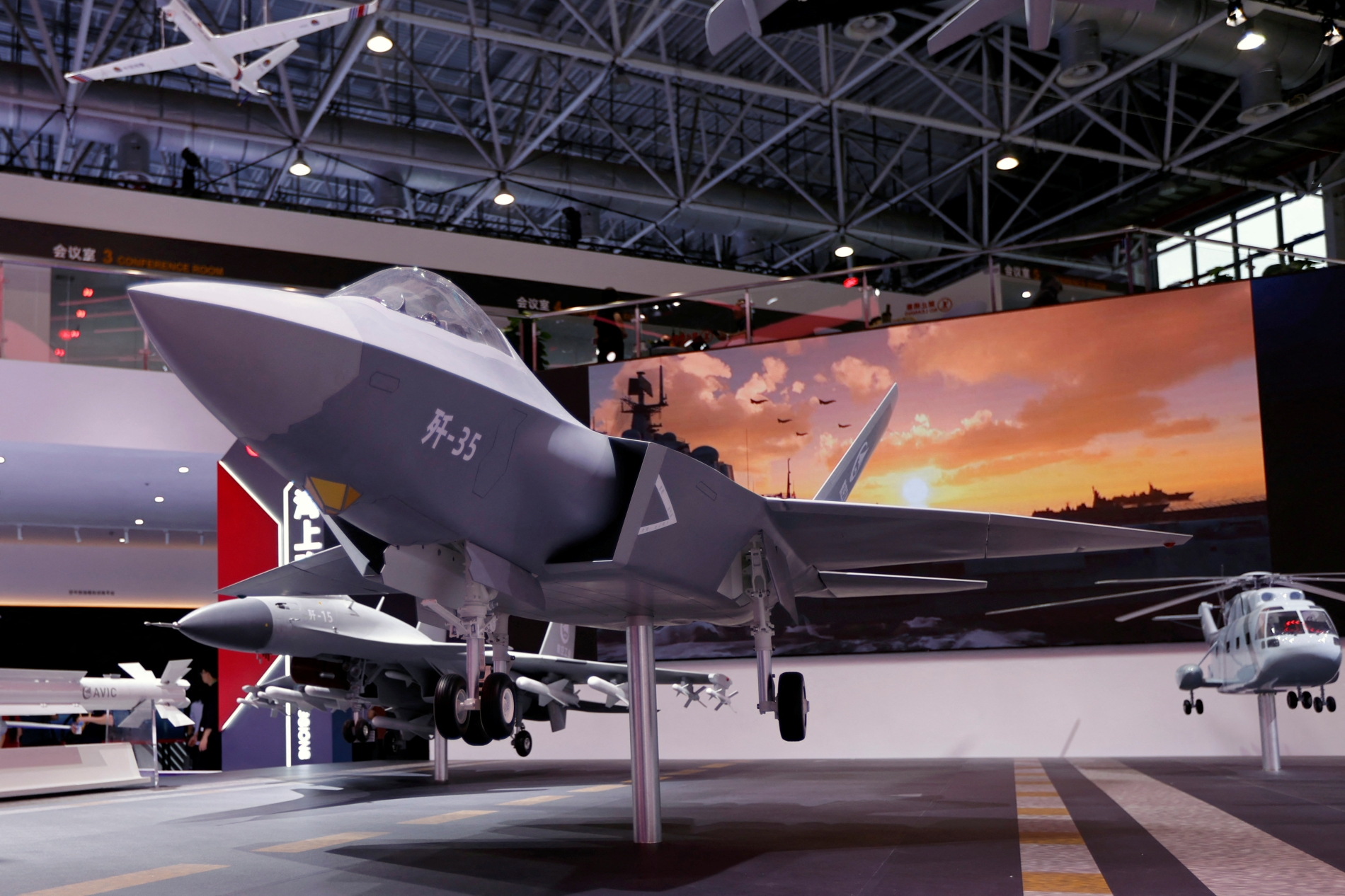
The specifications presented so far place the J-35 in the medium-sized stealth fighter category. Powered by the WS-13 engine, it can reportedly reach Mach 1.8, with a combat range of about 1,200km and a flight ceiling of 16,000m. Its weapons configuration is designed to alternate between stealth and load capacity: internal weapons bays for missions requiring a lower radar signature, and external hardpoints for when heavier firepower is needed. Its advertised arsenal includes medium-range air-to-air missiles, supersonic air-to-ground missiles, and deep-penetration bombs.
REUTERS
A scale model of the Chinese J35 aircraft at the China International Aviation and Aerospace Exhibition.

China is also presenting the aircraft as more than a low-observable airframe. In addition to enhanced stealth, the J-35 incorporates systems associated with fifth-generation combat, including AESA radar, an electro-optical targeting system, known as EOTS, and a distributed aperture system, or DAS, for optical early warning. These features are meant to give the aircraft a role as an integrated platform for combat, targeting, and situational awareness, rather than a stealth design carrying conventional avionics.

The J-35A matters because it would give the Chinese air force a second stealth fighter alongside the J-20. That points to a division of labour inside China’s future stealth fleet: a heavy, long-range aircraft on one side, and a medium-sized multi-role fighter on the other. Even so, the aircraft’s real capabilities remain difficult to assess from the outside. Key questions remain open, including the final engine choice, radar performance, data-fusion capacity, electronic warfare systems, and the degree of stealth it can maintain in combat conditions.

The naval version may prove the most strategically consequential. It is tied to China’s aircraft carrier ambitions, especially the Fujian, which is equipped with an electromagnetic catapult. Once operational, the carrier-borne J-35 will allow China’s navy to move beyond reliance on the non-stealth J-15 and towards a more advanced naval air wing, potentially combining stealth fighters with early-warning aircraft such as the KJ-600.
The J-35 is appealing to states that want stealth capability but cannot gain access to the F-35, or prefer not to depend on the US defence gate

The export-oriented J-35AE is the most relevant to the current debate. Its appearance on CCTV bearing the AVIC logo rather than Chinese military markings suggested Beijing was presenting it as a product for foreign buyers. The message was clear: China wants a place in the global market for stealth combat aircraft, long dominated by the US through the Lockheed Martin F-35. Even so, export versions may differ from domestic models, particularly in sensitive areas such as radar, electronic warfare, software, and data-fusion architecture.

How they differ

Comparison between the J-35 and the F-35 Lightning II is not simply a comparison between a Chinese aircraft and an American one. It is a comparison between a Chinese programme still seeking its full operational shape and a US system that has already matured into a global military ecosystem.

On paper, the two aircraft may appear close. The J-35 is reported to reach about Mach 1.8, slightly faster than the F-35, while their estimated combat ranges are broadly comparable. Yet in fifth-generation warfare, these figures tell only part of the story. The decisive questions are different: which aircraft detects first, which processes and fuses information faster, and which can fight more effectively inside a wider military network. 

AFP
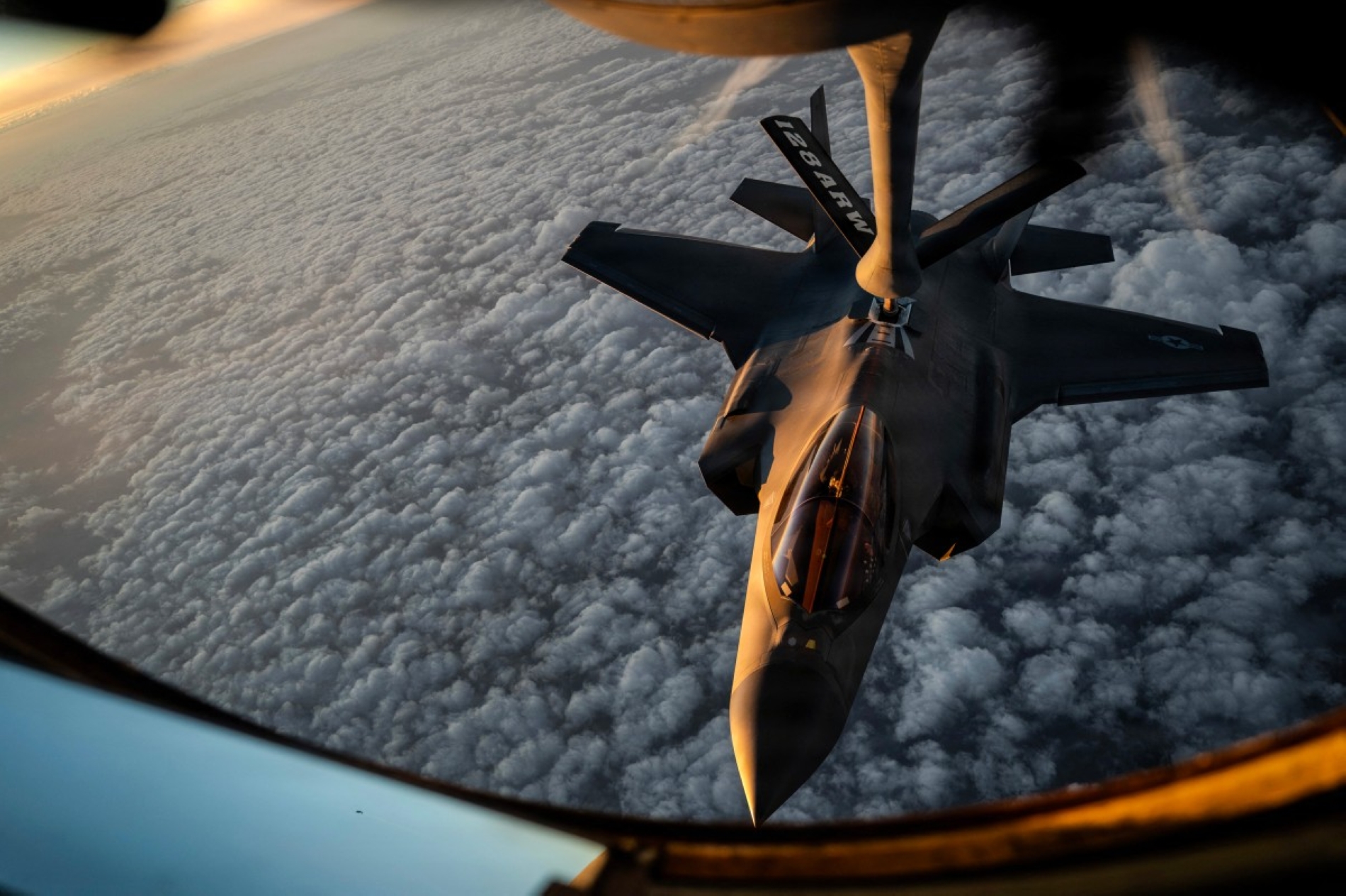
A US Air Force KC-135 Stratotanker refuels an F-35A Lightning II aircraft during "Operation Epic Fury" within the US Central Command area of ​​responsibility.

The clearest distinction is maturity. The F-35 is already in operational service with the US and a large circle of allies and partners. That reach gives the F-35 a significance beyond the airframe itself. It comes with training systems, maintenance chains, software updates, munitions, logistical infrastructure, and a vast operational community. The J-35 has no such international user base. China is its developer and likely principal operator, while Pakistan is widely seen as the most plausible first foreign recipient. So far, however, no announcement has turned that prospect into an operational fact.

A second gap lies in data fusion and electronic warfare. The F-35 was conceived as both a combat aircraft and an information platform. Its strength lies in combining radar, electro-optical targeting, DAS, and electronic warfare into a single operational picture for the pilot. That architecture helps the aircraft detect threats, jam hostile systems, issue warnings, and survive in contested air-defence environments.

The J-35 appears to carry comparable elements, including AESA radar, EOTS, and DAS. Yet the presence of advanced components does not, by itself, create a fifth-generation combat system. The harder task is to make those systems work together quickly, reliably, and within a broader network of aircraft, ships, satellites, ground stations, and command structures. On that front, the F-35 retains a clear advantage in software, processing speed, and integration with other forces. The electronic warfare capabilities of the J-35 remain far less visible to outside observers.

The contrast also extends to weapons and mission range. While the J-35 appears designed around standard air-to-air and strike roles, the F-35 is already integrated with a far broader family of munitions, including air-to-air missiles, air-to-ground munitions, anti-ship weapons, guided bombs, precision glide bombs, and direct-attack munitions. Some variants also carry a nuclear role. This gives the US aircraft greater flexibility across missions ranging from deep penetration and precision strike to maritime attack and strategic deterrence. The F-35 family is also already operational with multiple allied air forces and navies, while the J-35 family is still moving through the stages of unveiling, testing, refinement, and marketing. 

AFP
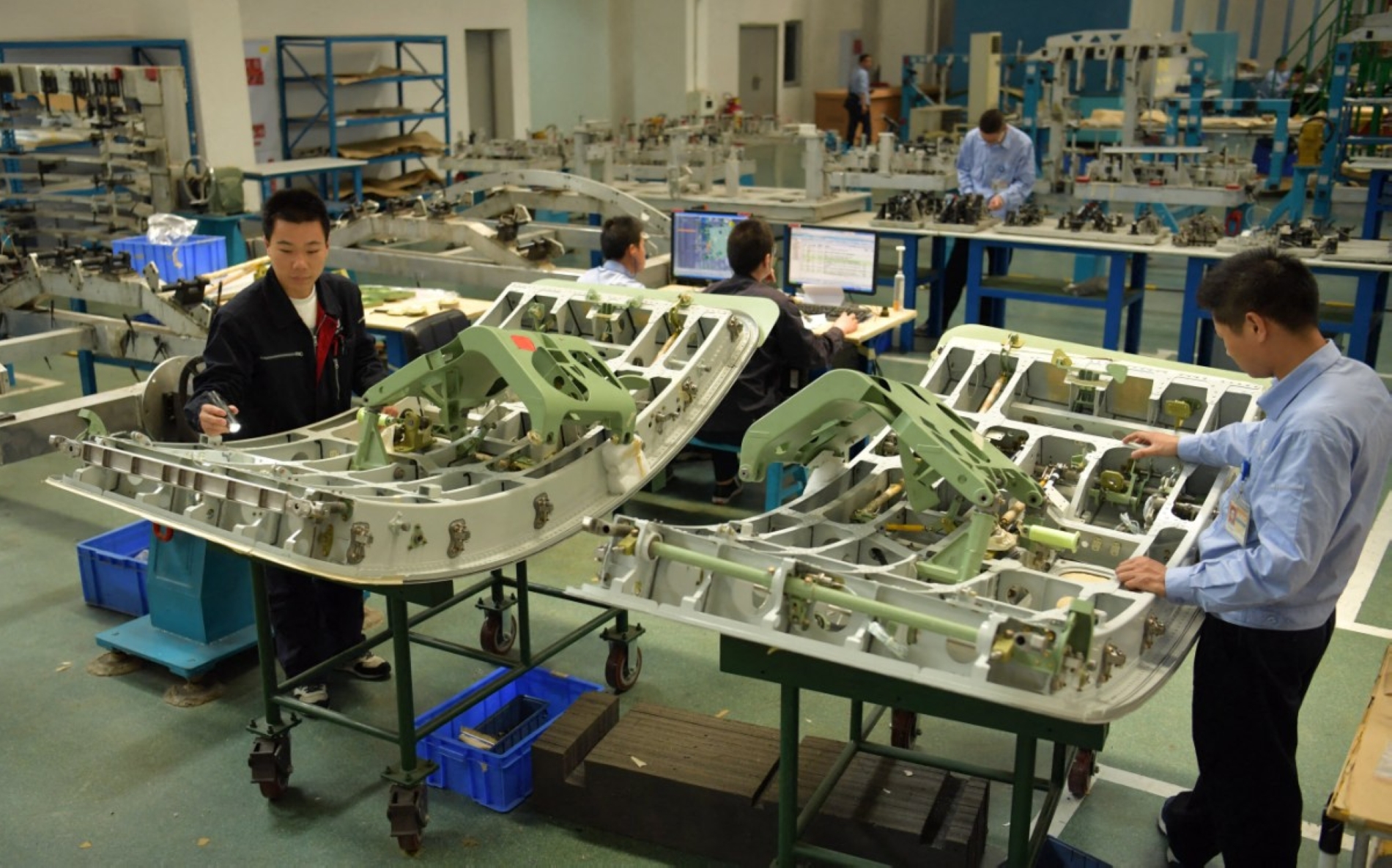
Technicians are working on the door panels of China's third C919 passenger jet at the Chengdu Aircraft Manufacturing Plant in Chengdu, Sichuan Province, southwest China.

The engine is another critical measure. The F-35 relies on a single powerful engine that has been tested across years of operational use. The J-35 adopts a twin-engine design, which may offer a safety advantage, particularly for the carrier-borne version operating over open water. Even so, China still has to demonstrate that its engines can match Western standards for durability, reliability, maintenance cycles, and long-term performance. In military aviation, the engine is never a secondary detail. It shapes the aircraft's real performance, sortie rate, operating cost, and ability to serve at scale over many years.

For these reasons, the J-35 is unlikely to displace the F-35 among Washington's allies. Countries that joined the F-35 programme bought far more than a fighter jet. They joined a US-led system of training, maintenance, weapons integration, software support, and strategic alignment. 

The J-35's importance lies elsewhere. It may give China a way into a parallel market: states that want stealth capability but cannot gain access to the F-35, or prefer not to depend on the US defence gate. In that sense, the contest is larger than aircraft performance alone. The F-35 embodies the reach of American military influence. The J-35 may become China's bid to construct an alternative sphere in the fifth-generation fighter market.

font change