Iranian Kurdish camps in Iraq wait in the wings

Al Majalla visits camps in northern Iraq hours after they were bombed by Iran or Iran-backed Iraqi militias. For many of the groups here, the hour has come for change.

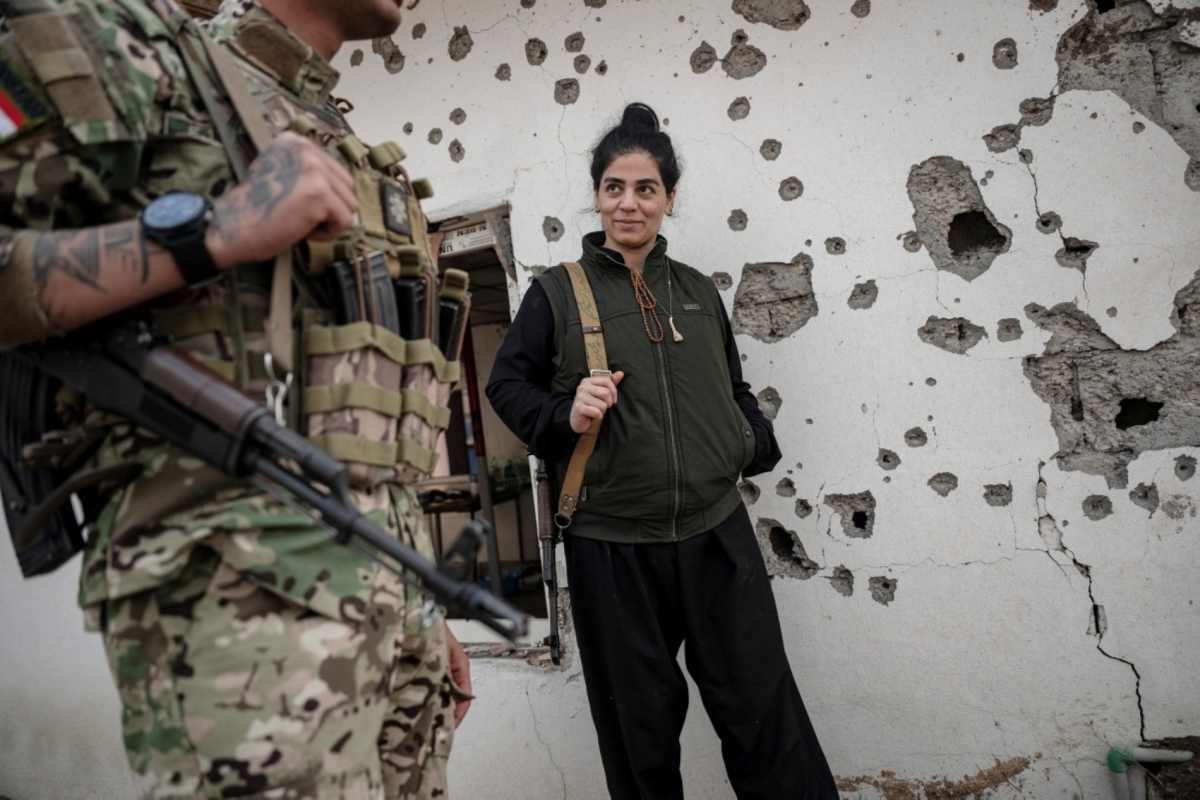
A member of The Organisation of Iranian Kurdistan Struggle stands in front of a shrapnel-scarred wall of a damaged building, following an Iranian drone attack on their base near Erbil on 9 March 2026.
OZAN KOSE / AFP
A member of The Organisation of Iranian Kurdistan Struggle stands in front of a shrapnel-scarred wall of a damaged building, following an Iranian drone attack on their base near Erbil on 9 March 2026.

Iranian Kurdish camps in Iraq wait in the wings

Dressed in military fatigues, with a personal weapon slung at her side, Afsana Rahimi greeted us with poise and calm assurance at the main gate of Topzawa camp, a settlement for Iranian Kurds north-east of Mosul, a big and ethnically diverse city in northern Iraq. Her short hair was neatly drawn back, revealing light makeup. Around her stood several armed Peshmerga fighters. The fighters are Kurdish. ‘Peshmerga’ translates as ‘those who face death.’

Rahimi is a senior figure in Sazmani Khəbati Kurdistani Êran (the Organisation of Struggle of Iranian Kurdistan, or OSIK) and urged us to move carefully through the camp. Two days earlier, it had come under rocket attack. Investigations have yet to determine whether the strike was launched by Iran’s Islamic Revolutionary Guard Corps (IRGC) or Iraq’s powerful Popular Mobilisation Front (PMF) factions, who are aligned with Iran. The PMF’s headquarters lie no more than 30km from the camp.

After fleeing Iran eight years ago, Rahimi joined OSIK’s camps. She felt that Iran had become a country of erasure, where the things she once hoped for—civil liberties, democracy, Kurdish rights, gender equality—were being steadily extinguished, as was her hope that change might still be won through legitimate political struggle. She sees this as the cause of a generation that has all but gone.

Crossing the border

Rahimi is among the dozens of young Kurdish women and men born in the 1980s and 1990s who severed their ties to Iran and made their way to the autonomous Iraqi Kurdistan, where they joined the camps and compounds of Kurdish parties. Some of these camps were set up more than 40 years ago, when armed confrontation intensified between the Kurdish nationalists and Iran’s newly established clerical regime, which had just overthrown Shah Mohammad Reza Pahlavi.

When the IRGC crushed armed Kurdish groups in Iran in the late 1980s, assassinating several Iranian Kurdish political leaders who were living in Europe, thousands of Kurdish fighters settled in Iraq in the border camps. In time, they were granted residency rights and political asylum. Topzawa is one of the dozens of camps established to house Kurdish fighters.
AFP
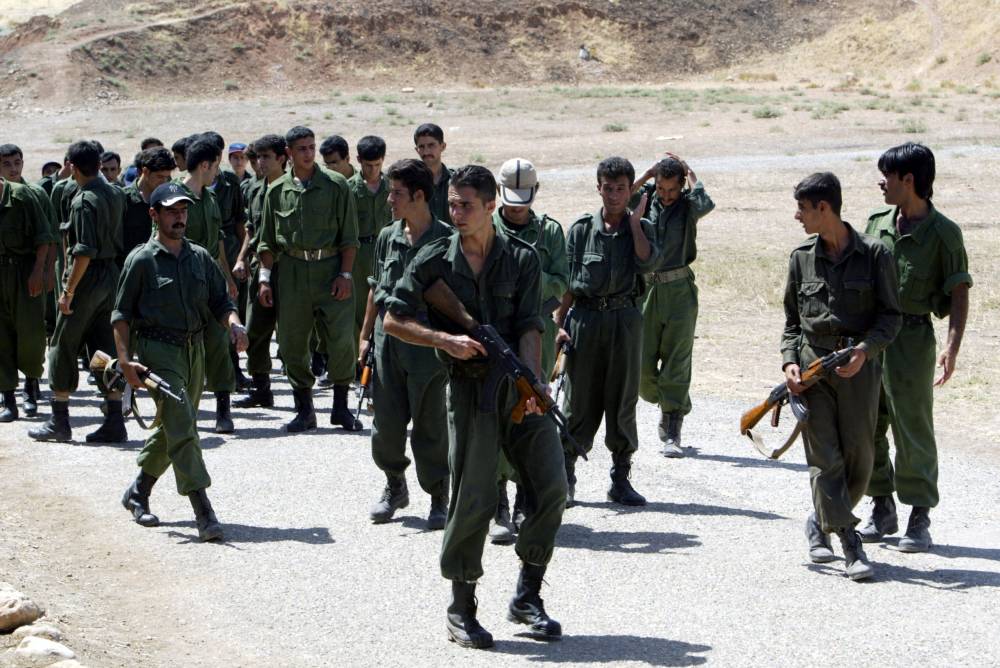
Peshmerga of the Democratic Party of Iranian Kurdistan (PDKI) march during military training at camp Koysancak in Sulaymaniyah in Iraq

Every camp or compound is affiliated with an Iranian political organisation. Administratively and politically, Topzawa falls under OSIK. The political arrangement between the Kurdistan Regional Government and the Iranian Kurdish parties allows these groups freedom of political activity, administration rights within the camps, and permission to carry light arms for the camps’ protection. Beyond that, they are bound by the broader security agreements between Iran and the Kurdistan Region.

Topzawa had been home to nearly 300 civilian families. Most are related to OSIK fighters and leaders, but some are entirely civilian households. It houses several residences for young men and women who have joined OSIK’s ranks, but in recent days, its civilians largely left, as the camp came under aerial bombardment.

‘Made locally’

During our visit, Al Majalla saw the cratered attack sites. One missile landed near the party’s logistics hall. Shrapnel tore across the surrounding area for 50 metres. The second attack was by drone and targeted the camp’s main meeting hall, falling 10 metres away. Party officials told Al Majalla that it struck precisely during the Ramadan iftar, when OSIK’s leadership customarily gathers in the hall.

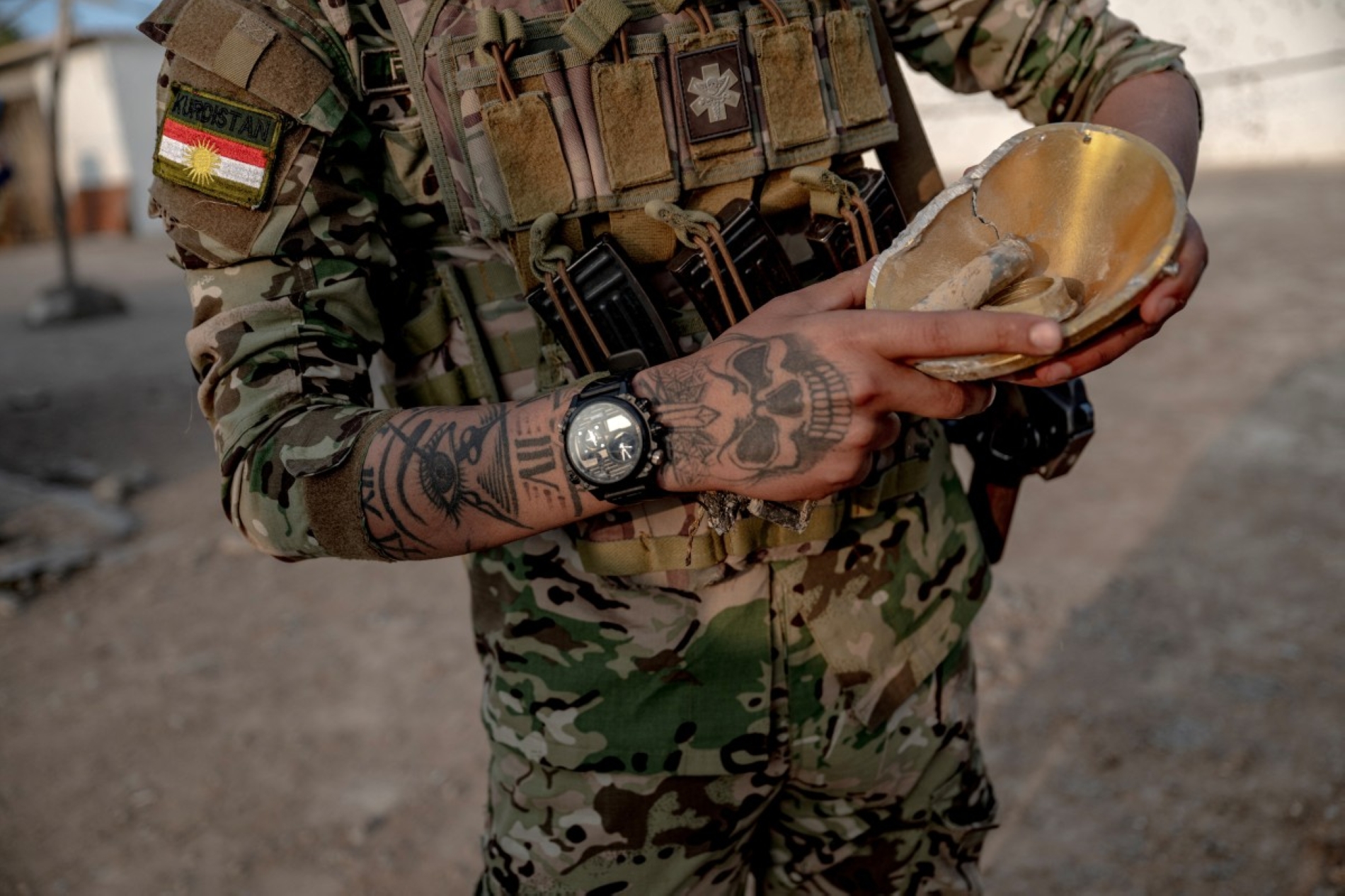
We were shown fragments of the drone used. Of medium size, it was crudely assembled from simple components and fitted with an explosive payload which the camp’s security officer estimated at no more than 20kg. Does he think it came from the Iraqi PMF? “Judging by the type and scale of the devices used against the camp, they were undoubtedly made locally,” he says. “They do not belong to the class of missiles and drones produced by recognised manufacturers, including Iranian companies.”

Where did it come from? “Both devices approached from the south-west, from the Nineveh Plain between us and the city of Mosul, an area controlled by the PMF,” he explains. “The Shabak Brigade is deployed in the areas of Bashiqa, Bahzani, and Bazwaya, north and east of Mosul. Brigades affiliated with Harakat al-Nujaba are stationed around the town of Bartella. Not far from there, close to Mosul, there are also brigades and bases controlled by Kataib Hezbollah. This is tightly organised and well disciplined. It is the most closely bound to directives issued from Iran.”

An OSIK leader says the party has been in direct contact with the Kurdistan Region and the Peshmerga during the bombardment, and that these in turn were in close contact with the Iraqi army and with Iraq’s federal government in Baghdad. Kurdish leaders were told that a response would be inevitable if attacks continued from the Nineveh Plain targeting Erbil, oil interests in Dohuk, and Iranian Kurdish camps.
REUTERS/Ahmed Saad
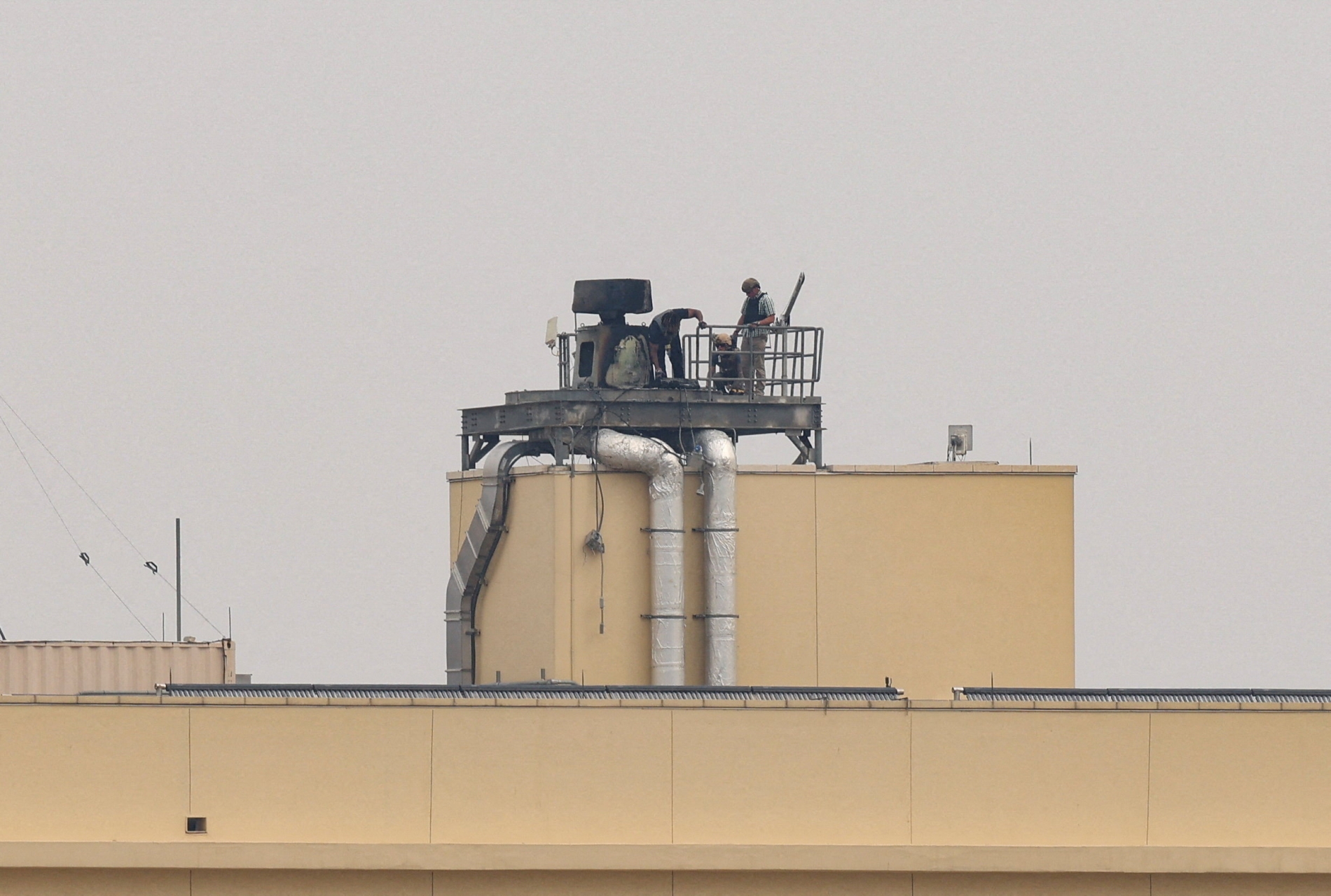
US soldiers inspect a site at the US embassy, after Iraqi security sources said it was hit in a missile attack, in Baghdad, Iraq, on 14 March 2026.

It later transpired that the Iraqi army evacuated several PMF bases and deployed its own forces in their place, after pressure from the Kurdistan Region. Iran-aligned militias have attacked certain American interests within areas controlled by the Iraqi federal government, including the Victoria logistical base near Baghdad International Airport, which is used by international coalition forces. It was near here that the Americans assassinated Qassem Soleimani, the former Iranian commander of the IRGC’s elite Quds Force, in January 2020.

The latest pretext

In Rizgari, beside the camp, local residents were asked about their fears following the attack and the possibility of fighting the PMF, which is not far away. Their answers, in general, affirmed Kurdish solidarity and the need to protect both the camp and the Kurdish fighters in the name of brotherhood. “The Iranian Kurdish fighters are merely the latest pretext for targeting us,” says Mam Giro, a retired electricity worker.

“Campaigns of Arabisation and efforts to drive us from our lands in the Nineveh Plain began in the 1960s. This region then became a theatre of confrontation between the Peshmerga and the Iraqi army in the 1970s and 80s. Later, extremist organisations, above all ISIS, used it as a launching ground for attacks on Kurdish areas. Today, the PMF carries out much the same practices, even if the pretext now is the presence of Topzawa camp for the Iranian Kurds. Only a few months ago, they targeted oil refineries and warehouses storing essential supplies in this area. They want to manufacture pretexts for encircling the capital, Erbil.”

Iranian Kurdish politician and fighter Hama Jabbar Wakili echoes Mam Giro’s account. His family had suffered displacement for decades, he says, moving from one camp to another along Iran’s border with Iraq, then towards Türkiye. They now live under the PMF's shadow.

“During the Iran-Iraq war (of 1980-88), and because of the stance our Iranian Kurdish political parties took towards that conflict, our camps came under countless attacks by the IRGC,” he says. “When we tried to move them away from some of the more dangerous areas, we found ourselves caught up in the Turkish army’s conflict with the Kurdistan Workers’ Party (PKK). Before long, the fires of Kurdish division and the internal Kurdish war in the Kurdistan Region in the mid-1990s were closing in.”
Reuters
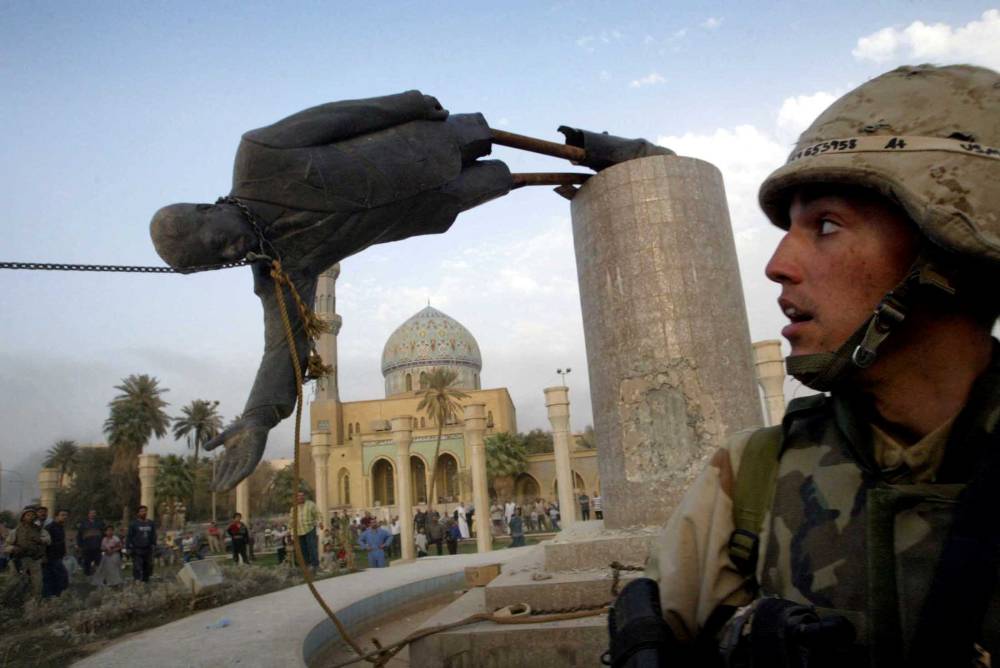
A US soldier watches as a statue of Iraq's President Saddam Hussein falls in central Baghdad's Firdaus Square, in this file photo from 9 April 2003.

Life in the camps

After Saddam Hussein was removed from power in Iraq in 2003, Wakili says Shiite parties came to power. “They embraced a strategy of complete subordination to Iran and subjected us to every form of pressure, including the recent security agreement between the two states, which came wholly at our expense and drove us from all the places where we had long been settled. What happened to Topzawa camp and many others is painfully familiar, but it will continue until the fall of the current regime, because the Iranian regime knows full well that we wield real influence among Kurds in Iran, who are the most prepared to expel the regime’s forces.”

In normal times, life in the camp revolves around social and cultural activities, but it also houses OSIK’s leaders who aim to shape public affairs through politics and the media, whilst building and maintaining alliances. Topzawa camp has enjoyed a long period of stability. Together with the Kurdistan Region’s economic development in recent years, this has enabled many of its residents to work, study, and even travel.
The Iranian regime knows full well that we wield real influence among Kurds in Iran, who are the most prepared to expel the regime's forces

Iranian Kurdish politician and fighter Hama Jabbar Wakili

Baba Sheikh Husseini is OSIK's Secretary-General and is expected shortly. In the meantime, meals are distributed to the Peshmerga fighters who have been guarding the camp. They eat sandwiches filled with chicken and fried potatoes. "Fighters' provisions in food and clothing are meagre, scarcely enough to meet their daily needs," says the supervisor. OSIK "has no regular funding and no fixed resources of any kind," he explains. "Our needs are met through donations. We're under severe strain because of the transfer of hundreds of families outside the camp. This requires logistics and financing. It will affect our most basic needs here."

No other road

Simko is a fighter in his late 30s who came from the village in West Azerbaijan province in north-west Iran, near the predominantly Kurdish city of Urmia. "My father was a shepherd," he says. "We owned livestock, which we raised through the winter and spring, then sold in early summer. Over the years, the surrounding steppes dried out and turned barren. Even Lake Urmia itself. Once one of the largest freshwater lakes in the world, it began to wither away, destroying the livelihoods of tens of thousands of Kurdish peasants and farmers in the plains between the lake and the Turkish border."

AFP
Iranian workers in the workers' square in the centre Sulaymaniyah, Iraqi Kurdistan on 5 October 2022.

People had no money and no job, he says, and were abandoned by the Iranian state, which only supported Azeris, not Kurds. "The political system regarded the Shiite Azeris as closer to it than the Sunni Kurds," he says. "I joined the fighters of OSIK around four years ago. When Iranian intelligence, the Ettela'at, arrested my elderly father and subjected him to every form of psychological and physical torture, he said: 'No road remained before my son but this.'"

Simko could not get any meaningful education, he says. "Our village had a one-room primary school that opened only half the week. My father had to sell nearly half our livestock so some of my brothers could attend primary school in Urmia in the early 1990s. They were taught in Persian and Azeri, forbidden even to speak Kurdish. While working as a porter in Urmia, I came to know members of Kurdish parties, among them OSIK. In time, I became part of the civil networks inside Iran. In 2021, I joined the party's camps here in Kurdistan."

Fighting for a future

Simko's story resembles that of his comrades, bound by a shared hope of living a safe, bearable life. They are bitter at what they describe as policies of "cultural and political annihilation" practised against them by the Iranian authorities. Amin, a fighter in his 40s, said his grandfather was a fighter in the Peshmerga forces in the 'Republic of Kurdistan' that was proclaimed in the Kurdish city of Mahabad in 1946.

"When that republic collapsed, my grandfather was killed in the armed confrontations," he says. "My father was five years old. He later became a fighter in the Kurdistan Democratic Party of Iran and joined the Kurdish leader Abdul Rahman Ghassemlou throughout the armed struggle of the 1980s. I remained here in Iraqi Kurdistan with my mother and sister. My father died in the mid-1990s. Now I too am a fighter in the Kurdish forces."

Like others, he is aggrieved at the way Kurds have been treated. "All these years, there has never been an amnesty, no national reconciliation, no serious attempt to grant the Kurds reasonable political and cultural rights. Beyond its deceptive sweet-talk, the state regards us as enemies and never hesitates to crush us. Dozens of our relatives and friends who remained in Iran were imprisoned or executed. Kurds make up no more than 10% of Iran's population, yet they account for half of the regime's victims."

أ.ف.ب
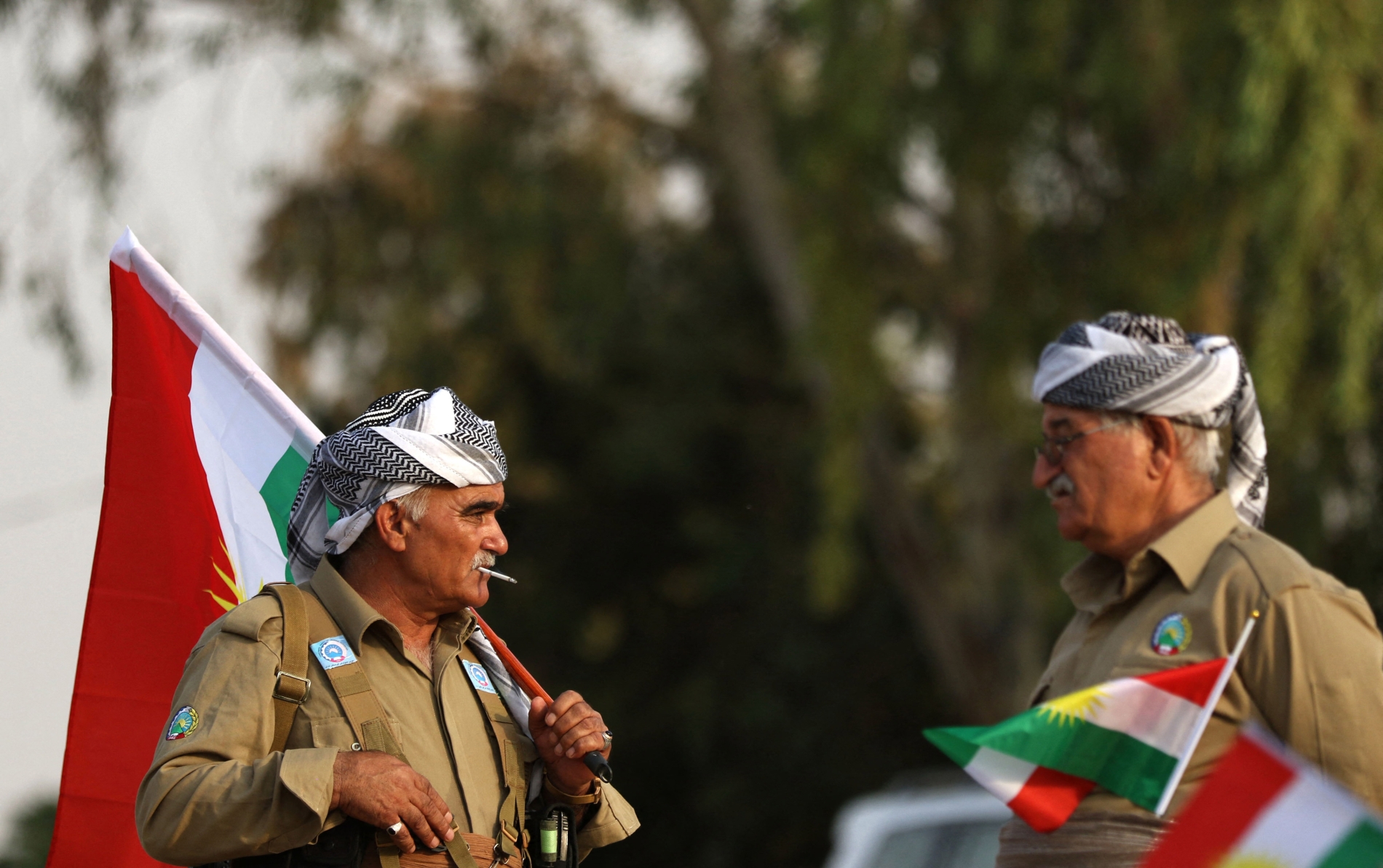
Two members of the Iranian Kurdish Peshmerga, affiliated with the Kurdistan Democratic Party of Iran, urge people to vote in the independence referendum in Baharka, north of Erbil, on 21 September 2017.

Historical lens

In what remains of the camp's command room, we meet Baba Sheikh Husseini, wearing similar clothes to those of his fighters. Accompanied by two fighters, he is a man in his early 60s, in traditional Kurdish dress and carrying no weapon, who seems younger than his years. He has fought in the Peshmerga for four decades. In 2004, he succeeded his father, Sheikh Jalal Husseini, who founded OSIK in 1980, drawing on a blend of conservative Sunni religious thought and Kurdish nationalist sentiment in response to Ali Khomeini's Islamic Revolution in Iran.

Spread across the city of Marivan in Kurdistan province in western Iran, the Husseini family is one branch of the well-known Kurdish Barzanji family, from which Sheikh Mahmoud al-Hafid descended. He led the first Kurdish uprising in Iraq in 1919, launched from the city of Sulaymaniyah. Through this historical lens, Baba Sheikh Husseini speaks about "the long erosion of the (Iranian) regime's military power and of the instruments through which it has dominated Iranian society," when asked about the impact of the US-Israeli war on Iran.

"What is already plain is the diminishing capacity of the regime's agencies and institutions to regulate every aspect of life, especially in the peripheries. This is its most vulnerable moment, when it is most exposed to collapse. During this war, it has lost more than prestige. It has lost the instruments and nervous system through which repression inside Iran was administered." He speaks of deprivation and of "a society no longer able to endure the consequences of the regime's policies, which display not the slightest capacity for change from within".

He believes that the regime's fall is a matter of when, not if. What replaces it is the key question, he says. The regime's survival would push Iran into a phase of "general putrefaction," says one of his team, not unlike Iraq in the 1990s, when the Iraqi regime was ostracised by the international community. Husseini is cautious and warns against any political or military Kurdish initiative in which the consequences have not been carefully considered, urging Kurds to learn from history.

OZAN KOSE / AFP
A member of The Organisation of Iranian Kurdistan Struggle shows pieces of an Iranian drone that had reportedly attacked their base near Erbil, in Iraq's northern autonomous Kurdish region, on 9 March 2026.

Fomenting discord

The OSIK leader also warned that Tehran would seek to foment discord between Kurds and Azeris in the west of the country, where they often live alongside one another, and called for open dialogue between political leaders on both sides, with a view to jointly administering these areas without acute ethnic polarisation. The regime has spent more than 40 years cultivating ethnic tensions in Iran, he says, but this can be countered, adding that Kurdish leaders were trying to establish contact with the Azeri nationalist movement, whose leaders are based in Azerbaijan.

Also important is the pact linking OSIK to the opposition National Council of Resistance of Iran, which is associated with the Mujahedin-e Khalq. Under that agreement, the Council recognises the right of Iran's Kurds to self-rule in their own regions and does not oppose recognition of an independent Kurdish political identity within Iran. By contrast, Husseini thinks the Shah's US-based son, Reza Pahlavi, wants to inflame ethnic fears of Kurds in Iran, something his father did.  

The Iranian regime's control over agencies and institutions that regulate every aspect of life has already begun to diminish, especially in the peripheries

Baba Sheikh Husseini, Peshmerga fighter

He wants Kurds to have self-rule across their regions, while at a national level, he says Kurds must enjoy representation equal to that of other communities in Iran, adding that this cannot be achieved under a monarchy or sectarian religious dictatorship. In short, his hope is for the establishment of a democratic republic in Iran. He denounces Iran's attacks against Gulf states and the Kurds of Iraq, arguing that the political, economic, and developmental models of Gulf states could be a model for a future Iran.

On the same day that Al Majalla visited Topzawa camp, the Coalition of Political Forces in Iranian Kurdistan held its first coordinating meeting to discuss events unfolding in the country. At that meeting, it adopted a shared slogan and visual identity, while also moving towards a rotating leadership structure, giving it a collective command shaped by common agreement. The future of Iranian Kurds could be taking shape.

font change

Related Articles