The six noble gases countries are fighting over

Odourless, colourless gases such as helium, neon, radon, argon, krypton, and xenon power key industries. They are rare, difficult to extract, and hugely valuable, yet largely under the radar.

Al Majalla

The six noble gases countries are fighting over

In the race for 21st-century technological dominance, most of the talk about resources has focused on critical minerals, by which most assume these to be physical substances. But among the most strategic resources are not just rare metals but also noble gases. Rare and inert, these are chemically aloof, largely non-reactive elements, and highly sought after.

Together with metals, they are, in many ways, the unseen engines of the technological revolution. ‘Rare earth’ dominates headlines owing to its role in industries such as electronics and high-end manufacturing, but noble gases are fast entering a parallel battle, given their irreplaceable importance in medicine, scientific research, and cutting-edge technologies.

China first imposed restrictions on noble gas exports back in 2023, amid its escalating trade war with the United States, a year after Russia halted its own exports in 2022, in response to Western sanctions over its invasion of Ukraine. The trade war and focus on new technologies have led many to ask what makes these gases so valuable and why they have become such a focus of geopolitical contention.

Resisting interaction

The term ‘noble gas’ (or ‘edelgas' in German) was coined by the chemist Hugo Erdmann in 1900 to describe elements with very low reactivity. The word ‘noble’ (‘edel’) reflects their chemical reticence—resisting interaction in the same way that noble metals like gold and platinum resist corrosion and transformation.

These colourless, odourless, non-flammable, and rarely reactive noble gases occupy Group 18 of the periodic table. Scientists generally agree on six: helium (He), neon (Ne), argon (Ar), krypton (Kr), xenon (Xe), and radon (Rn). Some include oganesson (Og); others exclude it due to its synthetic nature and distinct chemical behaviour.

The gases exist as single atoms rather than molecules, and have extremely low boiling and melting points, allowing them to vaporise or freeze at temperatures close to absolute zero. Most are extracted from the atmosphere through liquefaction and fractional distillation (which separates gases by their boiling points), but some require alternative sources. Helium is derived from natural gas fields, for instance. Radon is a by-product of the radioactive decay of radium and thorium, and neon can be harvested during steel manufacturing processes.

Varied applications

Thanks to their chemical stability and distinctive physical characteristics, noble gases play vital roles in advanced technology, healthcare, scientific research, energy, and space exploration. Helium (in liquid form) is essential for cooling ultra-low temperature devices, such as MRI machines and superconductors used in nuclear fusion research. When combined with oxygen (as heliox), it is used to treat respiratory conditions such as asthma and chronic obstructive pulmonary disease (COPD).

HENRY NICHOLLS / AFP
Neon signs are seen displayed inside "God's Own Junkyard", a warehouse of neon artworks and signage in East London on 17 January 2025.

Neon, meanwhile, is best known for its vivid glow in signage and lasers, but in liquid form it also serves as a coolant in cryogenic systems. Argon is used to fill incandescent and fluorescent light bulbs, support spectroscopic analysis, preserve food in packaging, and weld stainless steel. In medicine, liquid argon is used in cryosurgery to eliminate tumours and in laser procedures to seal blood vessels.

Krypton is used in specialised lighting and in the propulsion of certain rocket engines. It also powers high-precision instruments, including Geiger counters and scintillation detectors. Xenon is valued for its use in medical anaesthesia, high-intensity white lighting, and surgical lasers. Groundbreaking research in 2023 highlighted its potential in treating post-traumatic stress disorder (PTSD) by targeting receptors in the brain. Radon is used in small amounts for radiotherapy in cancer treatment.

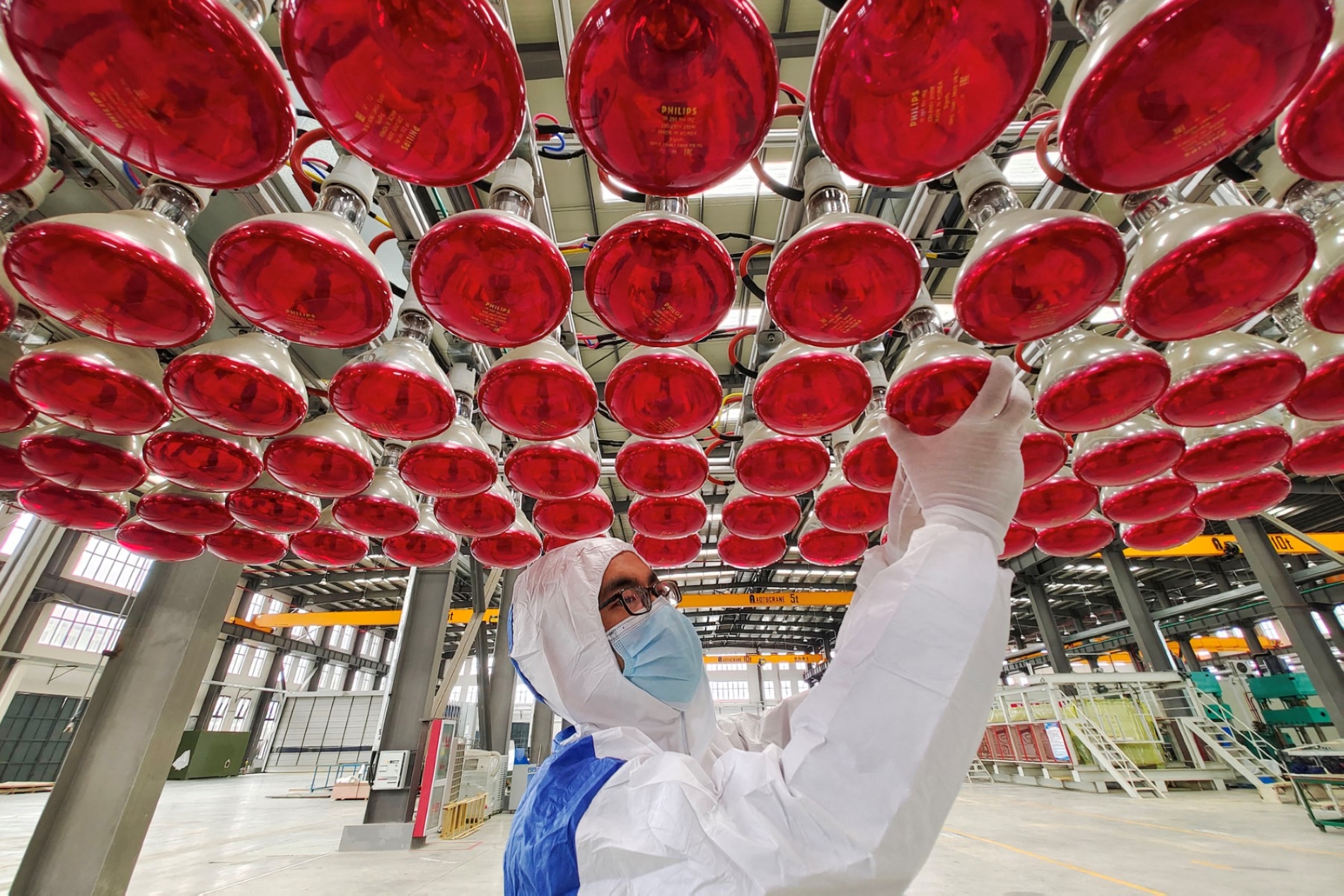
China first imposed restrictions on noble gas exports back in 2023, amid its escalating trade war with the US. In 2022, Russia halted its own exports.

Indispensable but scarce

Noble gases are now indispensable, but their scarcity, fragmented supply chains, uneven geographical distribution, and surging demand mean that they are now at the centre of an economic and geopolitical tussle between the world's most powerful nations. Ukraine once accounted for nearly half the world's high-purity neon, used in semiconductor production, but war in hubs such as Mariupol and Odessa forced key facilities like Ingas and Cryoin to close. The resulting shortage led to 400% price hikes.

Those who need neon are now exploring alternative sources. A by‑product of steel manufacturing, neon is captured through specialist processes that extract it from industrial emissions. It is critical for lasers used in photolithography, the process that underpins semiconductor fabrication for smartphones, computers, electric vehicles (EVs), and consumer electronics. Tech giants such as TSMC and Samsung have sometimes struggled to secure neon supplies, delaying production cycles. This has led to investment in recycling technologies to recover neon from existing industrial processes.

Helium, already rare on Earth, is obtained as a secondary product of natural gas extraction. The United States and Qatar collectively control nearly 80% of global production. In 2023, reduced output from American facilities, combined with maintenance at Qatari plants, triggered a global helium shortage, driving prices up by up to 30%. The gas is essential for cooling superconducting magnets in MRI machines, aerospace technologies, and scientific research. 

REUTERS/Aziz Taher
A street vendor sells helium balloons at a market ahead of Eid al-Fitr in the port city of Sidon, Lebanon, on 20 April 2023.

Protecting resources

China is one of the world's largest producers of xenon and krypton, accounting for around 30% of global output. Xenon is used in medical anaesthesia, ion propulsion systems for satellites, and high-intensity lighting, while krypton is used in window insulation and airport lighting systems. Recent Chinese export restrictions drove prices up and forced Western nations to seek alternatives elsewhere.

European firms are also adapting. The UK-headquartered Linde, which is the world's largest supplier of industrial gases, announced a partnership with ExxonMobil in 2023 to develop new, lower‑emission production technologies for noble gases. Price surges driven by conflict and market instability have dealt a blow to high-tech manufacturing sectors, raising the cost of consumer electronics and delaying EV rollouts.

These pressures have spurred the development of gas recycling technologies—especially for helium and neon. Japanese companies, for instance, have engineered systems to recover neon during semiconductor fabrication. Yet high operational costs and the complexity of the required infrastructure stymie its widespread deployment.

In a bid to diversify supply, Canada and Australia announced plans in 2024 to develop helium-rich natural gas fields, aiming to reduce dependency on the US and Qatar, while some Middle Eastern nations, such as Saudi Arabia, have begun exploring atmospheric extraction of krypton and xenon.

AFP
This photo, taken on 20 April 2023, shows a technician testing xenon lamps at a company in Ningbo, in China's eastern Zhejiang province.

Alliances and outlook

With global tensions high, regional alliances are increasingly being used to secure noble gas supply chains. Down the line, technological innovation could reduce reliance on these elements altogether, as rising environmental scrutiny prompts firms to adopt more sustainable extraction methods, which may help ease market pressures in the long run.

In the meantime, market forecasts suggest robust growth in the years ahead, but valuations differ wildly. One projection valued the noble gas market at $45.37bn in 2024 and projected it would expand to $62.56bn by 2032, with a compound annual growth rate of 4.1%, while a report from Global Industry Analysts valued the 2024 market at just $3.1bn. The disparity stems from valuation methodologies. Some are confined to specific gases or narrow industrial uses, while others encompass wider applications and derivative products.

Regardless of the true figure, the cost of not having access to these noble gases for technology and manufacturing firms could far outweigh their sale price. The world leaders hurling sanctions and threats know this only too well.

font change