No stranger to a world in flux, the West's alliance has grown since the Cold War. It has fresh challenges from an old foe and a new global power to address.
Both Moscow and Kyiv have several moves left to alter the war's outcome. The ability to do so largely depends on the commitment of resources and the will to fight.
The deep divisions within British politics in 2024 suggest it will add to the instability of the Western alliance as it grapples with major challenges from mass migration to the Ukraine war.
The Ukraine war has shrunk Russia's ability to export weapons, but Western sanctions and Moscow's damaged global image have also made importers more reluctant to buy Russian arms.
Kyiv now controls state-of-the-art armour. Its strategies will determine if the hardware can help change a complex war under skies it does not control, or if the arrival is just symbolic.
Moscow's edge over Kyiv has been its naval power, as Ukraine has virtually no navy. But over the past few weeks, a successful Ukrainian offensive has helped tip the scales in the conflict.
It can be argued that Russia's war on Ukraine started in 2008 when it invaded Georgie. Al Majalla explains why the South Caucasus is an important missing piece of the discussion.
Erdoğan's visit shows that, though Russia may be diminished, Putin is still able to put pressure on the Turkish president and flex his muscles. Al Majalla explores the complicated dynamics at play.
The global community was hoping that the Sochi summit could revive the Black Sea grain deal but no such progress was made. Al Majalla outlines what the two leaders discussed in Sochi.
There was visible warmth when the US and Syrian presidents met in the Oval Office last month, with some even speculating a Trump visit to Damascus. But there is much to do before that happens.
Following the unprecedented attacks on Qatar, Gulf leaders have pledged to forge a unified defence front, marking a historic shift from cautious neutrality to collective security
What began as a locally rooted trade in coca leaves and opium evolved into a transnational system of cartels that challenged governments, corrupted institutions, and destabilised countries
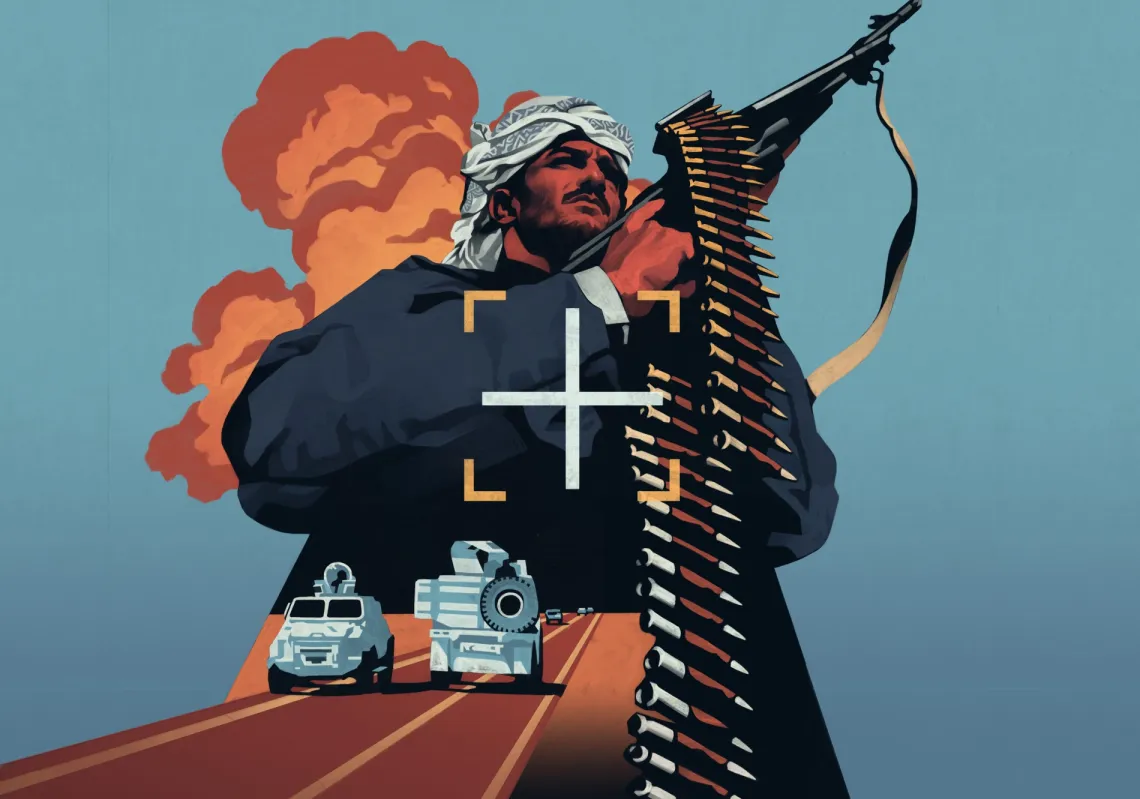
When Israel killed a Hezbollah military chief in late November, one GBU-39 bomb failed to detonate, leaving Washington worried that its adversaries could reverse engineer it
With her collection 'Con' having won Spain's 2025 National Poetry Prize, the Galician writer spoke to Al Majalla about the process of creation as she works on her first novel.