How fibre-optic drones are reshaping warfare

Small, low-cost, and difficult to jam, they give traditional defence systems little time to respond

Sara Padovan

How fibre-optic drones are reshaping warfare

In modern warfare, communication and the ability to command and control events are as important as ever, but new technology has also brought new threats and new countermeasures. One of today’s most prevalent warfighting tools is drones, but these can be jammed using electronic signals. As a workaround, armies have developed drones linked to the ground by a thin fibre-optic cable which can stretch for 30km.

While they may therefore be tethered, their advantage is that they are immune to interference. Standard drones use radio frequencies that can be blocked or scrambled, but fibre-optic drones bypass this entirely, ensuring that communication continues. Communication a vital system that regulates the rhythm of battle and turns the chaos of combat into calculated action. The drone’s slender thread links it to its operator, guaranteeing an uninterrupted flow of commands and images. It enables real-time decision-making.

The use of wires dates back to the 19th century, to the dawn of industrial warfare, with armies using the telegraph and later the field telephone to transmit orders through cables stretched between positions and trenches. This provided a decisive advantage, since such communications were far harder to jam or intercept than wireless signals, which remained primitive and vulnerable to intrusion. The core idea—transmitting a signal through a physical medium—remained embedded in military thinking for decades.

During the Cold War, this concept evolved into a more complex form with the emergence of wire-guided missiles. A soldier could fire a missile and continue steering it through a thin cable trailing behind it until it reached its target. This offered high accuracy and near-total resistance to electronic jamming. Such systems represented an important transitional stage between traditional ground communications and modern digital technologies.

Early in the 21st century, military institutions such as the US Defence Advanced Research Projects Agency (DARPA) sought to revive the idea through projects for fibre-optic-controlled munitions, but none developed to operational use. During Russia’s invasion of Ukraine, however, electronic warfare became more important. Jamming systems began to proliferate along the frontlines, whether mounted on vehicles or carried by individual soldiers. This left wireless drones vulnerable.
AFP
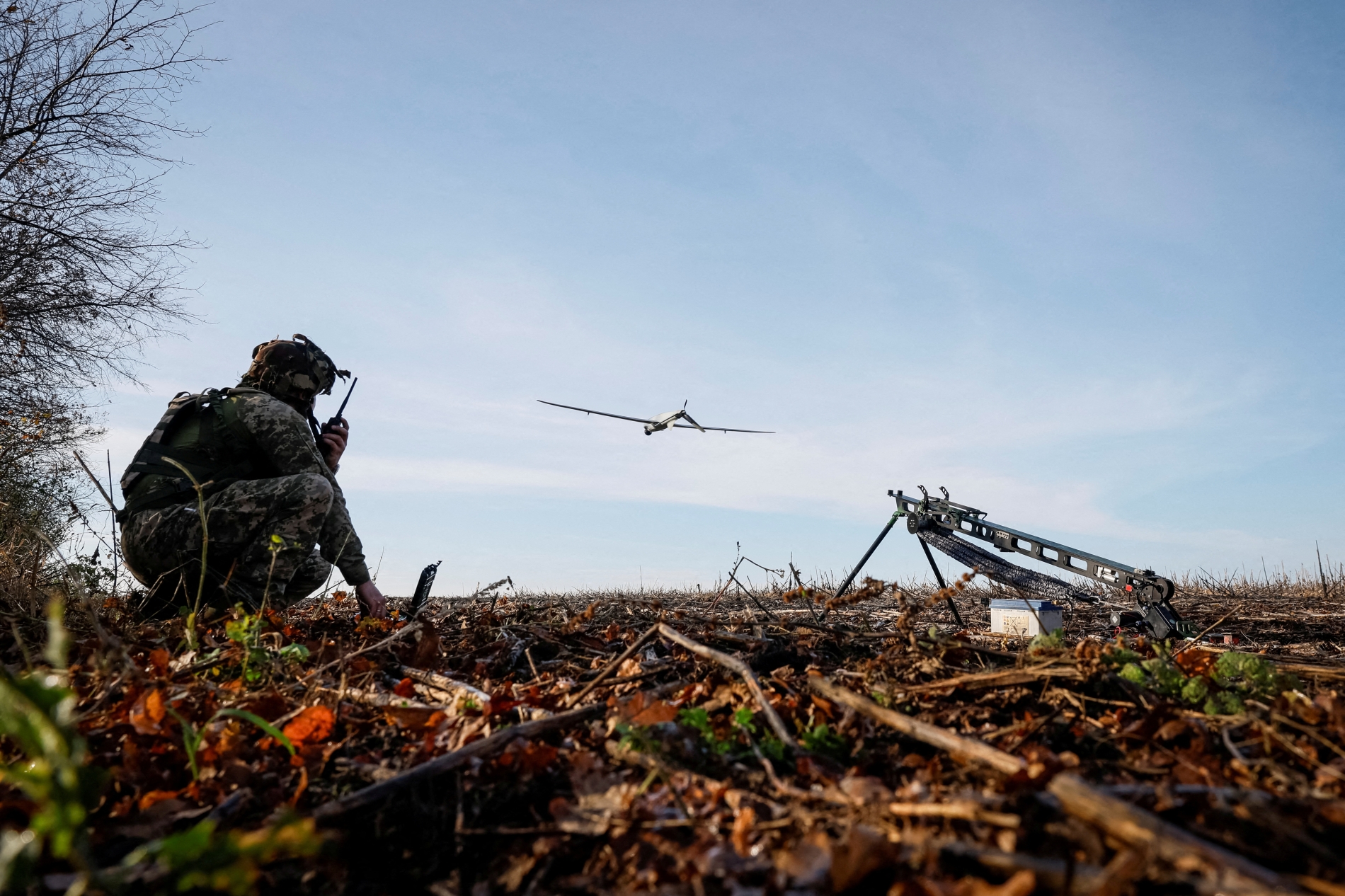
A Ukrainian soldier launches a Shark drone amid the Russian offensive on Ukraine.

Old solution, new guise

An old solution, therefore, returned in a new guise, as both Russia and Ukraine began using drones on a fibre-optic cable trailing behind them in flight. There are now signs that wired drones are being used by the Lebanese militia Hezbollah against Israeli targets. For Israel, these drones pose a challenge. Small, low-cost, and difficult to jam, they give traditional defence systems little time to respond. Yet their advantage is also a vulnerability: the cable that protects them from jamming is a point of weakness if it is cut or becomes entangled.

Fibre-optic-guided drones are essentially a direct development of small first-person-view (FPV) drones, although they differ radically in their communications mechanism. Instead of relying on radio waves or wireless video links, they use an ultra-fine cable that unspools behind them during flight. The cable is released gradually from a small reel and remains connected to the command centre until the moment of impact. They generally operate at low altitudes to avoid detection. Performance is linked to cable length: a 10km spool alone can weigh around 2.3kg.
Instead of relying on radio waves or wireless video links, fibre-optic drones use an ultra-fine cable that unspools behind them during flight

There are precedents in the history of weaponry, such as the wire-guided missiles of the Cold War, including the American BGM-71 TOW missile. These were tube-launched, optically tracked, and wire-guided. Before that, there was the French SS.10 missile in the 1950s, followed by other systems such as ENTAC and HOT. All relied on the same principle: keeping the weapon connected to its operator, who could correct its course until the moment of impact.

The fibre optics themselves are not a closed military technology but a material widely used in civilian communications networks, such as for carrying the internet. They consist of fine strands of glass or plastic that transmit data through high-speed light pulses. Although relatively easy to obtain, the real challenge lies in engineering, specifically in designing a light and efficient spool that allows the cable to flow smoothly during flight, without being cut or impeding the drone's movement.

WIN MCNAMEE / AFP
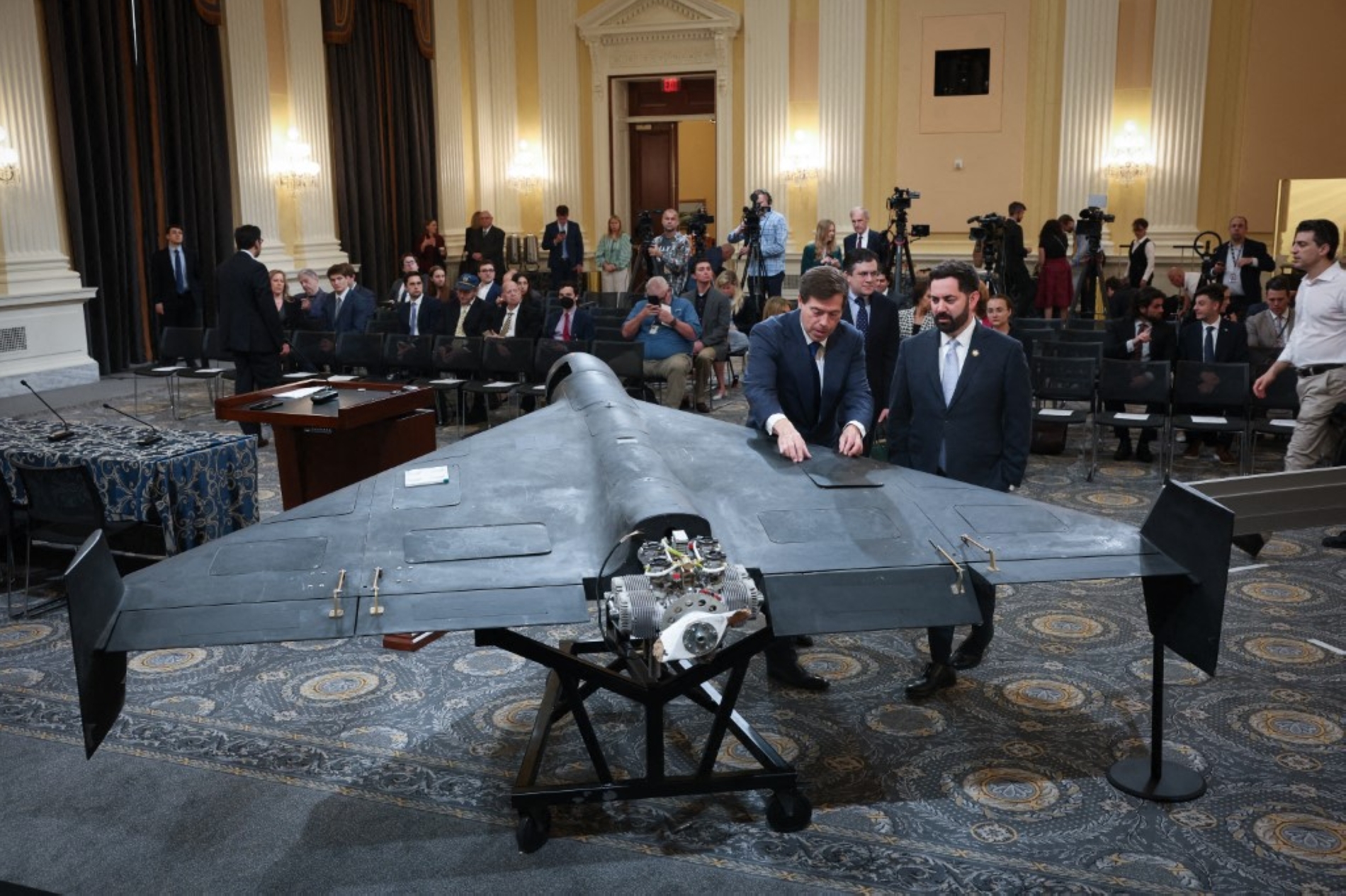
Mark Wallace (L), CEO of the non-profit United Against Nuclear Iran, talks with Rep. Mike Lawler (R-NY) next to a Shahed 136 military drone during a press conference on Capitol Hill on 8 May 2025 in Washington, DC.

Cheap and dangerous

The novelty in the Ukraine war lay in adapting an old wire-linked concept to a small, relatively low-cost drone operating in a combat environment saturated with jamming. When communication is wireless, an adversary can disrupt the signal, sever the video feed, or confuse navigation systems. When it runs through a direct physical cable, electronic jamming loses much of its potency, and its effect is sharply diminished.

Their cost varies according to the type of platform, the length of the cable, the camera's resolution, battery capacity, the size of the explosive payload, and the method of manufacture. Even so, they are still far cheaper than missiles or advanced munitions. Some cost no more than several hundred dollars if built using commercial components, 3D printing techniques, and a limited quantity of explosives. Models with longer cables and higher-quality components cost more, yet this is still low-cost warfare in which a simple weapon can threaten targets far more expensive and complex.

Fibre-optic drones are especially dangerous in close-combat environments, such as when used against tanks, armoured vehicles, troop positions, observation posts and even the jamming devices themselves, but the cable that grants the drone its protection may snag on trees, buildings, power lines, rubble, or debris.

It also adds weight, reduces manoeuvrability, and makes the drone's flight path more sensitive to obstacles. The longer the cable, the greater the potential range, but the heavier it becomes, and the greater the risk of it tangling or breaking. For that reason, these drones are less suited to dense urban areas, forests, or complex terrain filled with obstacles.

REUTERS/Ayal Margolin
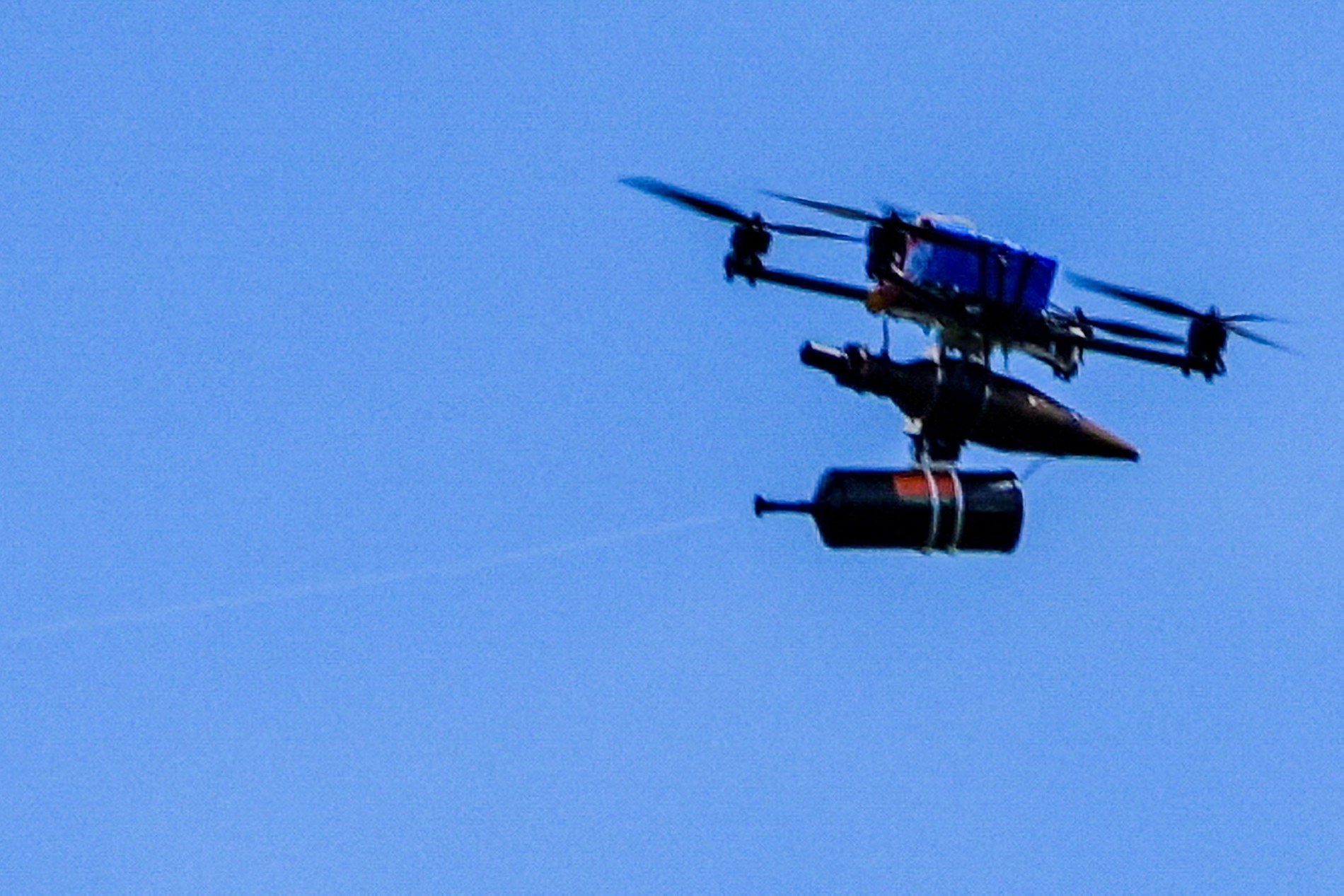
An FPV (first-person view) drone with a fibre optic cable flies over the border from Lebanon to Israel as it is seen from the Israeli side of the border, on 19 May 2026.

Tactical innovation

On 13 April 2026, the first clear field indication that fibre-optic drones were being used in Lebanon emerged when one came down in the garden of a home in the Israeli town of Kiryat Shmona after crossing from Lebanese territory. Further indications followed on 26 and 28 April that this type of drone had been used in attacks targeting Israeli forces in southern Lebanon and areas near the border. According to published accounts, the attacks killed one soldier and injured ten.

For Israel, it adds to an existing spectrum of threats that includes short- and medium-range rockets, shells, anti-tank weapons, and conventional drones. Defending against fibre-optic drones requires physical solutions and close-range interception. As a result, Israel has strengthened the physical protection of vehicles and positions using nets and metal cages to reduce the impact of attacks upon collision. If the drones cannot be disabled, then at least they can be prevented from reaching their target.

These drones are not a radical transformation in the nature of warfare, but a tactical innovation to circumvent a specific problem within a complex combat environment. The spread of drones drove the development of electronic warfare as a means of stopping them, and fibre-optic drones now bypass that solution. Every threat generates a defensive response, and every defence produces a new method to overcome it. Around the world, teams will currently be designing ways to stop fibre-optic drones. No doubt their ideas will be coming to a theatre of war soon.

font change