The environmental crisis is rooted in a deeper crisis of civilisation. Addressing it requires an honest probe of our ideas on progress, freedom, wealth, and happiness
The environmental crisis runs deeper than population growth, poor resource management, or a lack of appropriate technologies. At its heart lies a philosophical and cultural crisis, rooted in humanity’s understanding of itself and the natural world, and in the meanings we attach to freedom, progress, beauty, wealth, happiness, knowledge, and civilisation.
What kind of culture has brought us to this point? What mindset has made the depletion of nature appear a triumph of civilisation, mastery over its resources a measure of human power, ever-growing consumption a sign of prosperity, and material accumulation proof of success and happiness?
For centuries, nature has been treated as something to extract raw materials from, rather than an interconnected ecosystem governed by cycles, balances, and limits, in which future generations also have a stake. And yet the conflict between humans and nature was not inevitable. It arose from a development model that reduced nature to a resource for exploitation, while reducing human beings to producers and consumers in a system organised around accumulation.
This way of understanding the world is reflected in the very concepts through which modern civilisation defines human aspirations and measures its achievements. Freedom, progress, happiness, wealth, and knowledge have gradually acquired meanings that place increasing emphasis on control, expansion, possession, and consumption, often at the expense of responsibility towards the natural world. To understand the underlying causes of the environmental crisis, we need to look at how the meanings of certain concepts have changed over time.
The sun sets behind the Statue of Liberty on 3 July 2025, in New York.
Freedom vs entitlement
The first concept to explore is freedom. At its deepest, freedom meant liberation from superstition, ignorance, and fear, and the right to think, question, dissent, and seek truth. Nowadays, it has increasingly been associated with the power to act, exercise control, own property, and invest, often without accepting responsibility for the consequences. Economically, it has come to mean freedom for markets to expand, capital to move, corporations to extract resources, and individuals to consume. Against this backdrop, nature is consequently viewed as an obstacle to economic freedom rather than a condition of its survival.
Personal and economic freedom is important. But if the freedom comes to mean the unrestricted entitlement to use resources without regard for others’ rights, including those of generations yet unborn, then a line has indeed been crossed.
German philosopher Hans Jonas addressed this question in The Imperative of Responsibility. He argued that humanity’s growing technological power to alter the world must be matched by an equally far-reaching moral responsibility that extends beyond our contemporaries to future human life and the natural world. Freedom is not simply the ability to do whatever lies within our power; it also requires recognising what we should refrain from doing and what we have no right to exhaust or destroy. Without such responsibility, freedom becomes another form of domination.
Progress vs production
A second concept is progress. Its modern definition equates it with increased production, accumulation, and technological expansion, as well as the conversion of nature into marketable goods and services. Quantitative growth remains a principal measure of success, even when it destroys forests, soils, water, and ecosystems or leads to increased waste and pollution.
Not everything that can be produced deserves to be made, extracted, or consumed
The central question has shifted. Instead of asking whether we produce what people need, we increasingly ask: how can we produce more, sell more, open new markets, and create new needs through fashion and advertising to keep production growing?
Here, the meaning of progress becomes subjective because while societies may produce more than ever before, they are becoming less capable of securing the conditions future generations need to live.
Walter Benjamin challenged the linear view of history as inevitable progress. In Theses on the Philosophy of History, he warned that civilisation's supposed advance can conceal a succession of catastrophes that disappear from the victors' accounts. His warning is particularly urgent today: not everything that can be produced deserves to be made, extracted, or consumed. Material wealth does not necessarily improve human wellbeing. Progress that destroys the conditions of its own survival consumes the future in the name of the present.
Perhaps one of the most troubling consequences of a culture centred on ownership and consumption is the way it has redefined happiness itself. In many cultures, happiness is associated with contentment, serenity, moderation, and inner fulfilment. Consumer culture, however, has increasingly tied it to acquiring more possessions, experiencing the latest novelty, and an unsatiated desire for more.
Mainland Chinese tourists loaded with shopping bags walk past a designer brand shop in the Tsim Sha Tsui area of Hong Kong, on 15 November 2004.
Consumer culture places the emphasis on wants over needs. Products quickly lose their appeal, fashions become outdated, and the latest technology is soon replaced. Consumption therefore perpetuates a sense of inadequacy and an endless desire for more, rather than providing lasting contentment.
As early as the late 19th century, philosopher and economist Thorstein Veblen criticised the phenomenon of conspicuous consumption, whereby goods are acquired not only for their utility but also for the social status and purchasing power that their ownership displays. In his analyses of consumer society and liquid modernity, sociologist Zygmunt Bauman explored how desires, identities, and ways of life become increasingly transient, shaped by rapid change and obsolescence.
In To Have or To Be?, Erich Fromm distinguished a life based on possession and acquisition from one grounded in being, creativity, experience, and relationships. Possessions do not necessarily enrich our inner life; abundance can conceal emptiness. Fromm saw the growing drive to own, extract, produce, and consume as an existential problem that could threaten humanity's survival.
What price does nature pay for a conception of happiness that can never be satisfied? Every new desire requires materials, energy, and water, as well as production, transport, and marketing; discarded products further increase the waste burden. Consumer culture thus depletes resources while eroding our capacity for satisfaction.
Perhaps we need to free our understanding of happiness from its perpetual association with buying and owning, and rediscover pleasures that leave no waste behind: the pleasures of knowledge, contemplation, creativity, friendship, and communion with nature. We must also recover an appreciation of things that endure and acquire meaning with the passage of time.
Perhaps the freest person is the one whom the market can no longer persuade that happiness requires ever more possessions, rather than the one who can afford to buy everything they desire.
"The Rock," a 228.31-carat, pear-shaped white diamond, estimated to be worth between $20mn and $30mn; Geneva, Switzerland, on 6 May 2022.
Wealth vs contentment
Then we have the concept of wealth. In consumer culture, it has become associated with the limitless accumulation of possessions. Yet who is truly wealthy: the person who possesses everything, or the one who needs nothing?
Epicurus distinguished necessary desires from boundless ones whose satisfaction cannot guarantee happiness. Seneca likewise observed that abundance does not free us from want. Their insights point towards freedom from the tyranny of possession, not towards poverty or the rejection of material comfort. Wealth may lie in being able to do without many things while retaining what is essential to one's humanity. Intellectual and spiritual fulfilment, contemplation, learning, creativity, and meaningful relationships can be more enduring forms of wealth than accumulation.
Perhaps we need to move away from an economy built on the perpetual expansion of needs towards a culture that restores the value of sufficiency: having enough to live with dignity, without exhausting the resources on which others, the natural world, and future generations depend. Nothing is objectionable about possessing what is necessary to secure human dignity and wellbeing. The danger arises when acquisition becomes an end without limits, and a person's worth is measured by what they own rather than who they are, what they contribute, and what they leave behind.
The philosophy of sufficiency distinguishes between what people require to live with dignity and the endless artificial desires encouraged by consumer culture
Information vs knowledge
Any attempt to develop a new culture must also reconsider what knowledge itself means. We live in an age of unprecedented information and data accumulation. Artificial intelligence can now process vast quantities of both, connect them, and discern new patterns. Yet has this made us any wiser? Does our ability to gather and analyse information necessarily mean that we understand the world more deeply?
A fundamental distinction exists between possessing information and possessing knowledge, and another between knowledge and wisdom. Information can accumulate indefinitely, but wisdom demands discernment, reflection, contextual understanding, and an awareness of the limits of what we know.
Martin Heidegger distinguished between a technological approach to knowledge that treats the world as a standing reserve, ready for use, and a more open, contemplative relationship with existence. His critique of modern technology concerned not the tools themselves, but the mode of thinking that reduces everything, including human beings and nature, to resources available for exploitation and use.
We must therefore resist reducing knowledge to its immediate economic value. It need not always be transformed into a product, a technology, an investment opportunity, or increased output. Knowledge has value in its own right, as do contemplation and the pursuit of questions whose immediate purpose is neither profit nor control.
Perhaps the most important step towards a new culture of knowledge is to restore the virtue of intellectual humility: to acknowledge that what we know is far less than what remains unknown, and that nature is a world of relationships, interactions, and complexities that exceed our capacity to fully comprehend or predict with certainty.
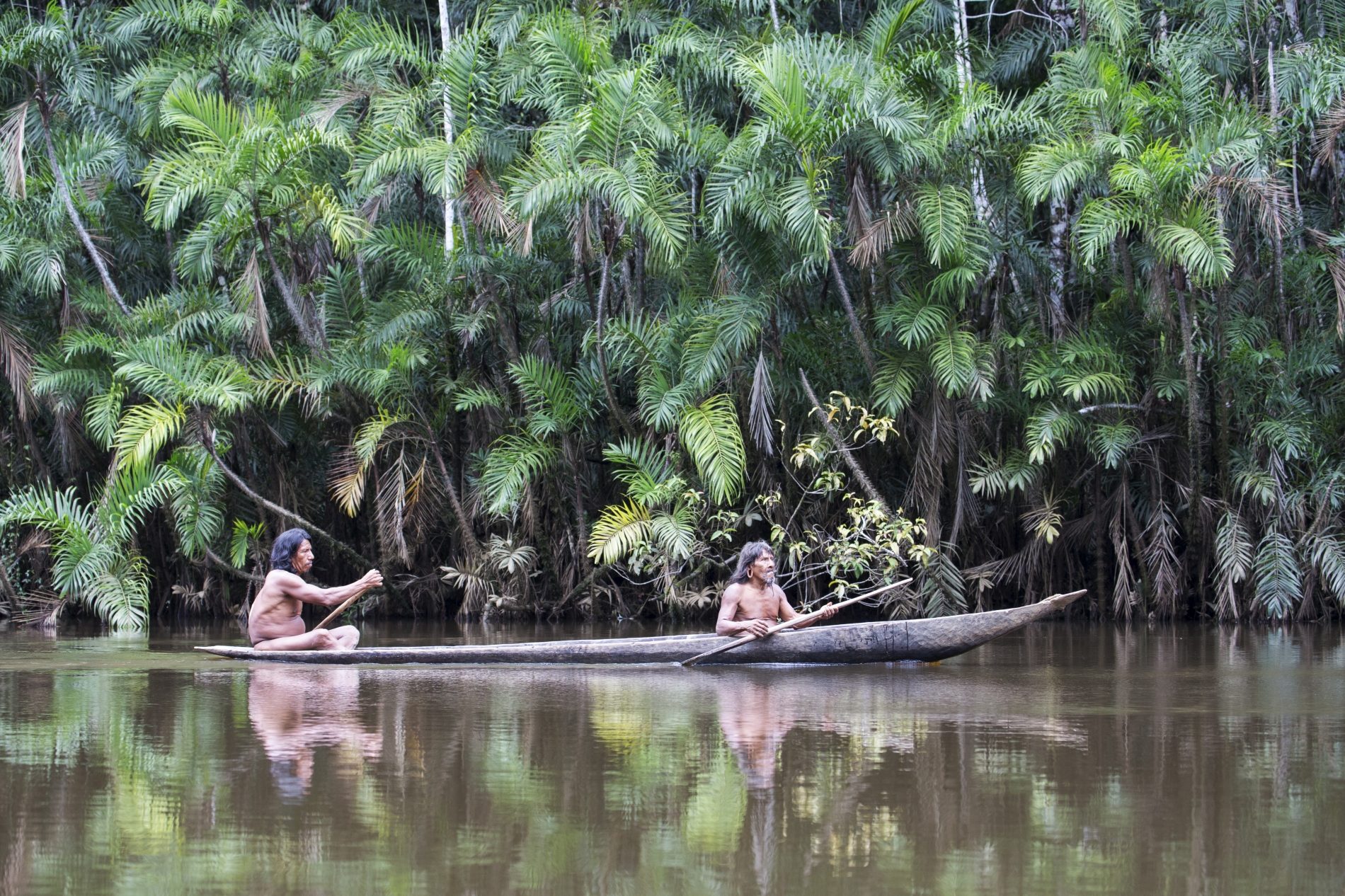
Huaorani Indians on the river in Ecaduor's Amazon jungle in Yasuni national park.
How we treat others
One of the deepest changes required may be in how we understand identity and the relationship between the self and the Other. Many conceptions of identity have rested on asserting the self, distinguishing it from others, and drawing boundaries between the individual and those perceived as outside it.
In some of its political and cultural expressions, identity has become a means of fostering hostility towards others and justifying exclusion, conflict, and even war. Yet could we conceive of identity differently? Could the self become less enclosed within its own boundaries and better able to recognise itself through the Other?
Such a conception preserves the self and its distinctiveness while recognising that human beings do not develop in isolation. Identity also takes shape through our relationships, responsibilities, and the recognition we receive from others. The self is never entirely self-sufficient; it forms and transforms through encounters with other people.
The French philosopher Emmanuel Levinas offers an important perspective, placing the relationship with the Other at the heart of ethical responsibility. The Other is not merely someone who differs from me, or someone against whom I define myself. Their very presence calls me to assume an ethical responsibility that extends beyond my personal interests. Martin Buber, who developed the philosophy of dialogue, distinguished between the 'I–It' relationship, in which we treat the Other as an object, and the 'I–Thou' relationship, founded on mutual recognition and genuine encounter.
An echo of this understanding appears in the African philosophical concept of Ubuntu, which expresses the inseparable relationship between individual humanity and the humanity of the community, emphasising that we cannot realise our full humanity in isolation from others.
Applied to politics and relations between societies, these ideas allow us to imagine an identity founded on recognising others as partners in existence and a shared destiny, free from the impulse to exclude or dominate them. And who could be better placed than Arabs to develop this way of thinking, given that the Arabic concept of huwiyya (identity) points towards huwa (he) rather than ana (I)? Such a shift could help ease conflicts rooted in insular identities and the desire for domination, opening the way towards a culture of peace grounded in difference, pluralism, and mutual recognition.
Nature itself teaches us that diversity sustains unity. An ecosystem cannot survive if one of its constituent parts seeks to eliminate all the others. Why, then, should we not learn from ecological diversity when organising our social and political relationships?
A New Zealand fur seal pup swims in coastal waters at the Kaikoura seal colony in Kaikoura on 18 October 2026.
One bountiful ecosystem
Overcoming the conflict between culture and nature requires restoring our understanding of nature as an integrated living system, rather than a collection of separate resources to be bought, sold, and extracted. Water is more than a quantity to be stored or sold; forests are more than sources of timber; soil is more than land available for production; and biodiversity is more than a stock of species to be exploited. Each is part of a wider cycle of life, and any ill-considered interference with that cycle can reverberate throughout the system.
Through his concept of 'deep ecology', the Norwegian philosopher Arne Næss challenged the view that nature derives its value solely from its usefulness to humanity. He called instead for recognition of the intrinsic worth of living beings and natural systems. The American ecologist and philosopher Aldo Leopold, in A Sand County Almanac, likewise extended the sphere of ethical concern to encompass soil, water, plants, and animals, arguing that humanity is a member of the biotic community rather than its absolute master.
These ideas invite us to reconsider the very concept of human rights. Our understanding of those rights must extend beyond the people alive today, embracing, in both ethical and legal terms, the entitlement of future generations to clean water, pure air, healthy soil, biodiversity, and the resources essential to life.
No generation can claim the right to consume resources and destroy the natural systems those who follow will depend on, simply because it possesses the economic, political, or technological power to do so. Intergenerational responsibility must become more than an admirable ethical principle. It should guide legislation, economic policy, urban planning, and natural resource management. Resources are not the absolute property of whichever generation has access to them. They form part of ecological systems whose life cycles and capacity for renewal must be respected, and form part of a natural inheritance that should remain available to those who come after us.
What we need today is neither a return to the past nor a rejection of science, technology, or the achievements of modern civilisation. We need to redirect those achievements and establish a new relationship between knowledge, freedom, progress, happiness, and nature. We need a culture that values sufficiency and stewardship, regards diversity as a form of wealth, recognises intellectual humility as a virtue, understands freedom from excess as liberation, embraces difference as a source of enrichment, and sees responsibility as a condition of freedom.
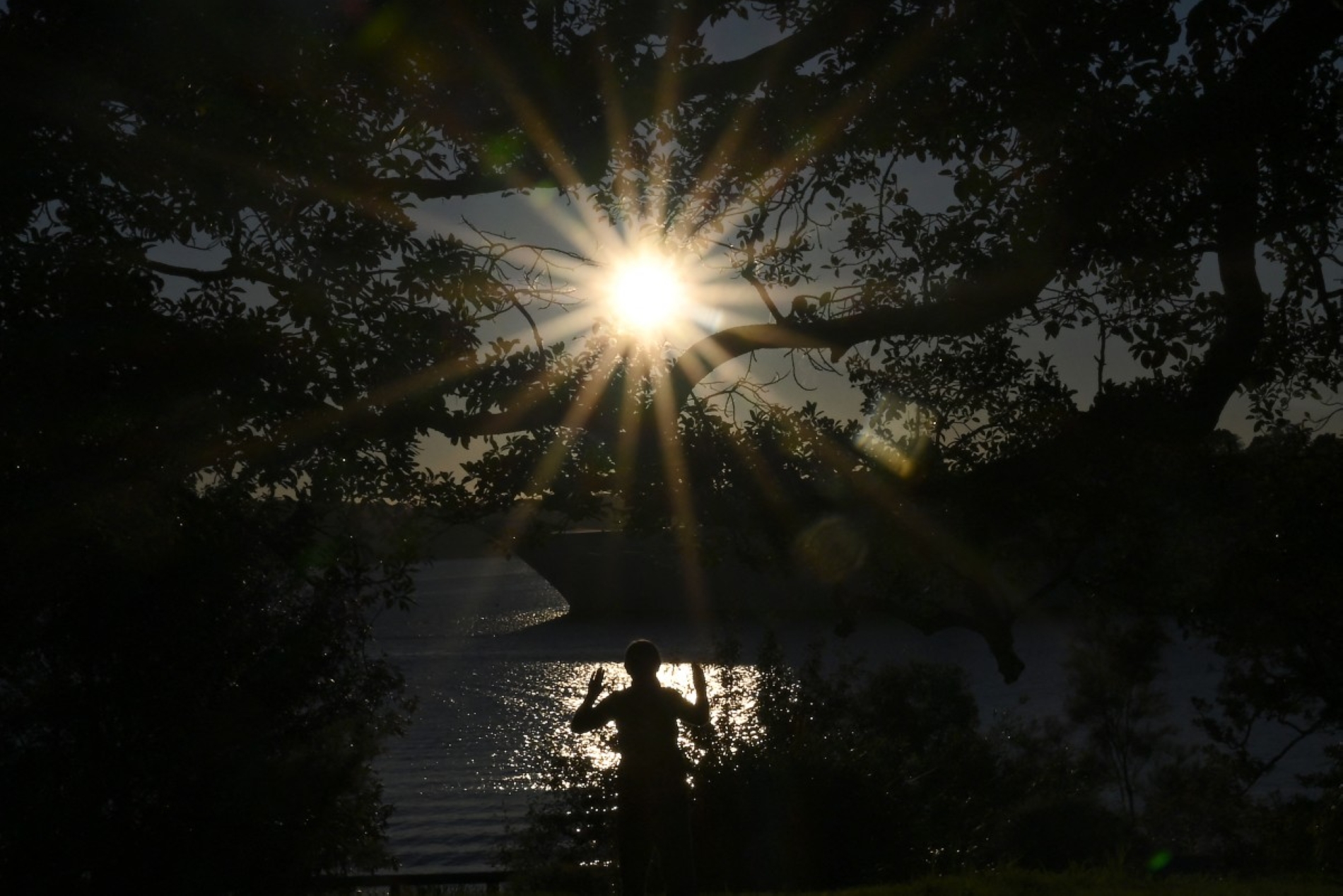
A woman practises yoga as the sun rises over Sydney Harbour on the winter solstice and International Day of Yoga on 21 June 2026, marking the shortest day of the year in the Southern Hemisphere.
Philosophy of sufficiency
A philosophy of sufficiency does not call for compulsory austerity or the deprivation of societies of their essential needs. It asks us to distinguish between what people require to live with dignity and the endless artificial desires encouraged by consumer culture. It also calls for a reconsideration of wellbeing, measured by the quality of our lives, the health of the environment that sustains them, and the time available for knowledge, human relationships, contemplation, and creativity, rather than simply by how much we consume.
Perhaps the most important measure for redefining civilisation and progress is our ability to resolve conflicts without resorting to violence and weapons. It is also our ability to manage differences without exclusion or the denial of others, and to distribute resources without turning human need into an opportunity for exploitation and domination.
A civilisation that can settle its disputes only through war can scarcely claim to represent the ultimate model of progress. Nor can one that destroys in a matter of hours what nature may need decades or centuries to restore, or undermines the conditions necessary for life in the name of defending its interests. This remains true, no matter how formidable its technological, military, and economic power.