Can Yemen’s military gains help revive its oil exports?

With fighting in the south-west, cross-border attacks against Saudi Arabia, and no political settlement in sight, crude shipments are unlikely to resume any time soon

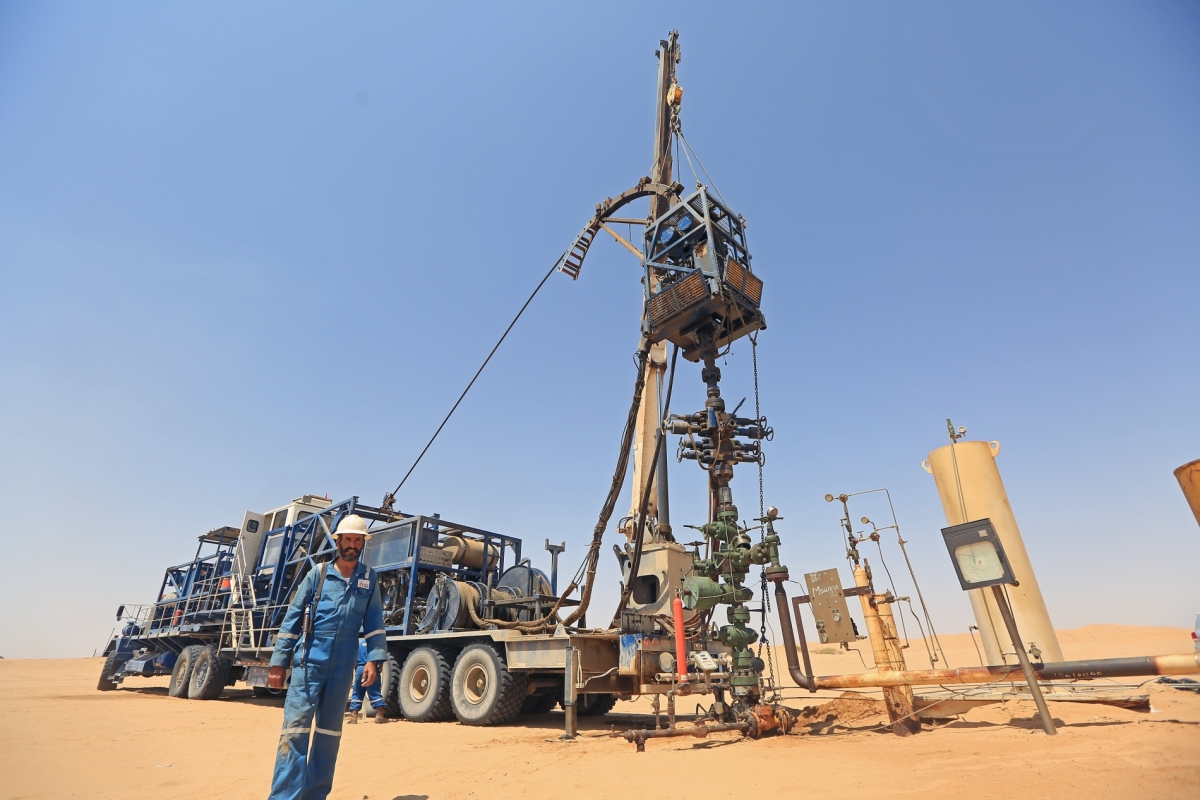
Drilling and exploration machinery in Yemen's Marib desert, in September 2020.
Reuters
Drilling and exploration machinery in Yemen's Marib desert, in September 2020.

Can Yemen’s military gains help revive its oil exports?

The internationally recognised government, represented by the Presidential Leadership Council under Rashad al-Alimi, has launched a major counter-offensive to recapture territory lost to the Houthi militia in September, and fierce fighting continues. The government says it has regained strategic positions along the western coast, particularly around the Bab al-Mandab Strait and Mocha, while making advances on several fronts in Taiz, but government control over all of Yemen remains some way off. The Houthis still hold the capital, Sanaa, and vast areas in the north and west.

For a country that needs economic help, government battlefield advances could strengthen its efforts to revive crude oil exports. Yemen holds significant oil reserves, but the situation has made it impossible to extract and export them in volume.

Still, oil is on the minds of leaders. On 20 July 2026, Alimi announced that crude exports from government-controlled areas would resume, following their suspension in the wake of Houthi attacks on export terminals in Hadramawt and Shabwa in October 2022. The money raised will pay salaries, finance public services, and support economic stability, he said.

Before exports ground to a halt, oil was Yemen’s principal source of foreign currency and government revenue, accounting for around 70% of the latter. Production began in 1986 at 10,000 barrels per day (bpd), with exports rising rapidly thereafter. It brought in the foreign currency needed to finance imports, sustain public finances, and support the balance of payments, helping to ease pressure on foreign exchange reserves and the national currency.

Yemen’s oil industry entered its golden age around the turn of the millennium, production hitting 400,000 bpd in 1999, before peaking at 457,000 bpd in 2002. But structural, political and security challenges then contributed to a decline, as did natural depletion in major fields like Marib and Masila, together with insufficient investment and exploration. Combined, this led to the rising cost of developing remaining reserves.

Repeated attacks on pipelines and oil installations disrupted production, and the outbreak of civil war in 2015 saw foreign companies withdraw. Production, maintenance, and investment were all adversely affected, and vital infrastructure was damaged. Although output recovered partially from 2016, it remained well below pre-war levels.

Fighting resumed in 2022, when the Houthis attacked export terminals, bringing crude shipments to a halt. Producers now had no secure, commercially viable export outlet. Companies declared a ‘force majeure’ and suspended or curtailed exploration and production operations across most concession areas.

Production dropped to 51,400 bpd in 2022, then to 22,000 bpd in 2023, and 19,000 bpd in 2024, according to the International Monetary Fund (IMF). These are paltry figures for a country with proven oil reserves of around three billion barrels (estimated in 2009, according to historical data cited by the Energy Research Unit).
REUTERS/Ali Owidha
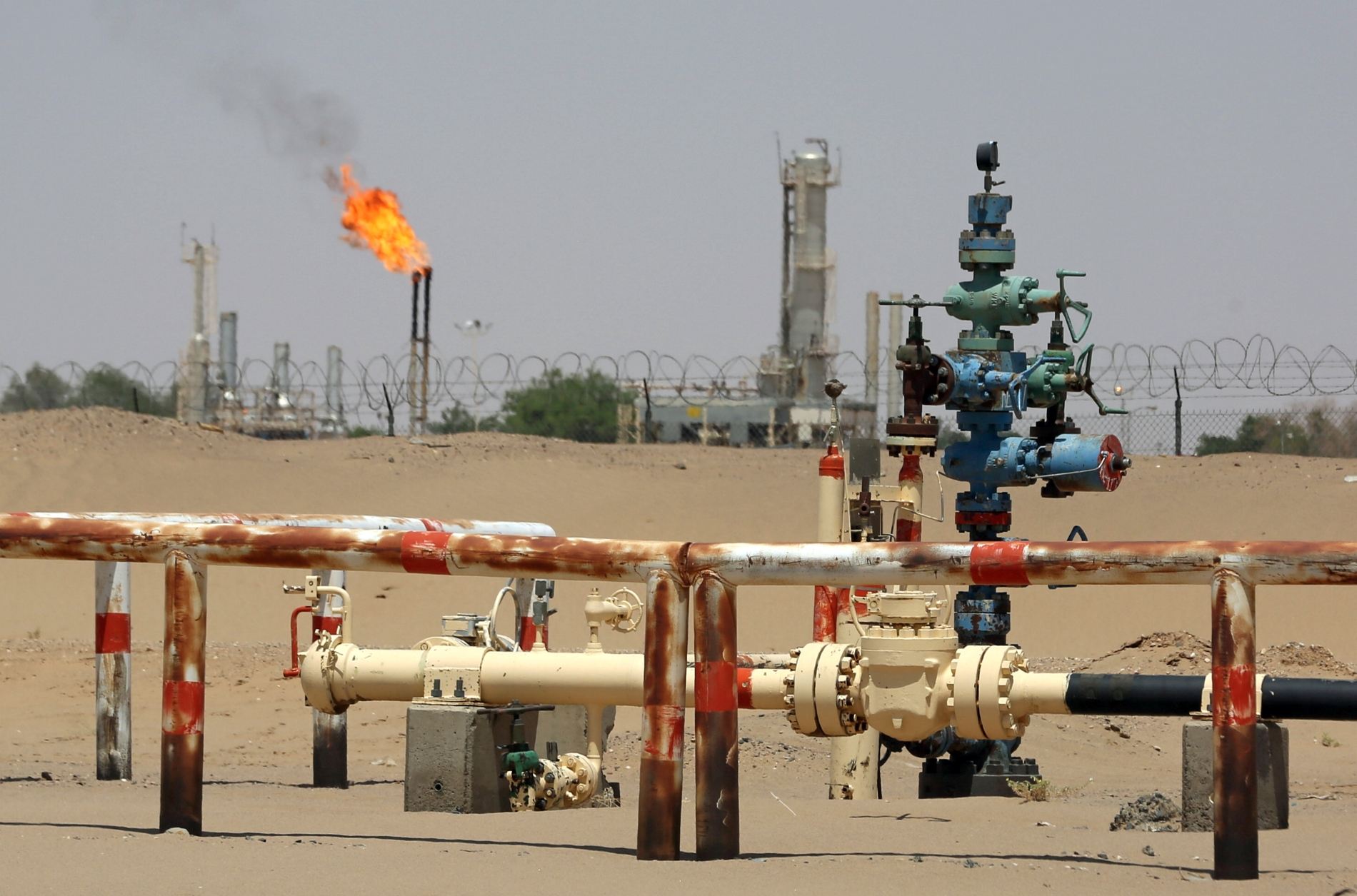
A view of the Safer oil refinery in Marib, Yemen, on 30 September 2020.

In the ground

Oil production is currently concentrated in two principal sedimentary basins: Sayun-Masila in Hadramawt and Marib-Shabwa (also known as the Sabatayn Basin). These are two of Yemen’s 12 sedimentary basins. According to Yemen’s Petroleum Exploration and Production Authority, the country has 105 oil concession blocks, of which 13 are producing. Other basins and prospective areas remain largely unexplored and have yet to enter commercial oil production.

In October and November 2022, the Houthis intensified their attacks on oil export terminals in government-controlled areas, targeting Rudum (also known as Nashima) in Shabwa, and Al-Dabba in Hadramawt. At Al-Dabba, two drones targeted the Nissos Kea tanker on 21 October as it prepared to load two million barrels of crude. The attack followed a threat against another tanker, the Maran Canopus, whose owner later decided not to let the vessel enter the port.

Although the attacks caused no significant casualties or material damage, they effectively halted oil exports. Tankers chose not to berth at Yemeni ports, and further strikes in November prevented other vessels from loading crude. A December 2022 report by the Economic Studies and Media Centre, titled The Flames of War Spread East to the Oilfields, concluded that the attacks on Al-Dabba and Rudum had extended the conflict to oil export terminals in government-held territory.

The Houthi attacks may have been intended to secure their demands over a share of national oil revenues. During truce negotiations, Houthi representatives demanded that oil and gas revenues be used to pay public-sector salaries in areas under the group’s control, including those of military and security personnel affiliated with the movement. The government rejected that demand. The Houthis also sought a share of crude export revenues, which was also rejected by the government in 2022.

With the suspension of oil exports, Yemen's economic and humanitarian difficulties deepened, with rising prices, further currency depreciation, worsening poverty, and an erosion of purchasing power, as the Houthis warned oil companies, oilfield service providers, and shipping firms to cease all activity or risk attack. The warring parties therefore reached an impasse, as Yemenis suffered.
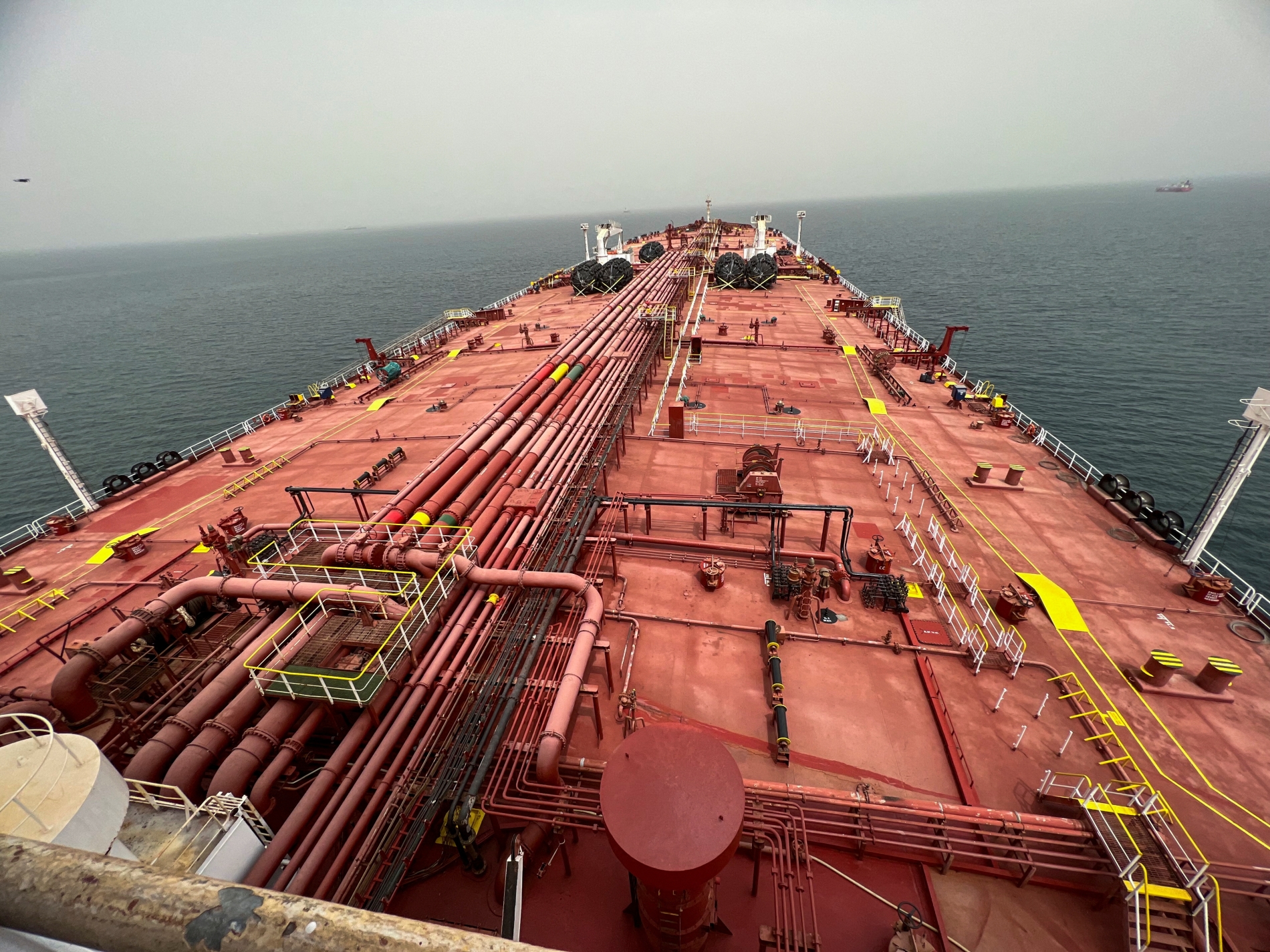
Reuters
The oil tanker "Nautica"—to which the cargo of the decaying floating storage unit "FSO Safer" was transferred—arrives at the port of Hodeidah on Yemen's Red Sea coast, on 17 July 2023.

Ports and oilfields

Since seizing Sanaa in 2014, the Houthis have sought to extend their territorial control towards the country's main oil-producing regions, particularly Marib, Shabwa and Hadramawt, but the main oilfields remained beyond their reach. A Houthi offensive against Marib in 2021 failed. This kept one of Yemen's most important oil- and gas-producing regions out of Houthi control, denying the group export revenues (it was after they failed to seize the main producing fields that the Houthis targeted export infrastructure, attacking Al-Dabba and Rudum in late 2022).

The Houthis did, however, retain control of the Red Sea ports of Hodeidah, Ras Isa, and Salif. Through these ports, they collected customs duties, taxes, and other levies on imported fuel, while also exercising considerable control over the trade in petroleum products within their territory. Oil thus became an instrument in the struggle for power, extending its significance beyond the revenue it generated.
Resuming exports will remain difficult so long as the Houthis can strike Yemeni ports, as they did in 2022 when they attacked Al-Dabba and Rudum

Mustafa Nasr, chairman of Yemen's Economic Studies and Media Centre

In July 2026, Yemen's oil minister Mohammed Abdullah Bamqa said the government was targeting an initial export capacity of 60,000 bpd from the PetroMasila, Al-Oqla, Jannah Hunt, Safer, and Calvalley operations, while also drawing on accumulated crude stocks. Bamqa said more than 1.7 million barrels are in storage, ready for export.

He explained that the ministry had instructed producing companies to prepare timetables for increasing output by 25%, with the possibility of doubling output at certain fields later. In September, Rashad al-Alimi said foreign oil companies were interested in resuming operations and disclosed that repairs to damaged oil facilities had been undertaken by the government at a cost of $40mn.

The government began the technical, administrative, and logistical preparations needed to restore the export system to operation. On 21 July, Prime Minister Shaya Mohsen al-Zindani convened a meeting of the Supreme Committee for Crude Oil Marketing in Aden. With Central Bank Governor Ahmed Ghaleb in attendance, the committee discussed what was practically needed to restart shipments, which are needed to pay public-sector salaries and provide essential services.

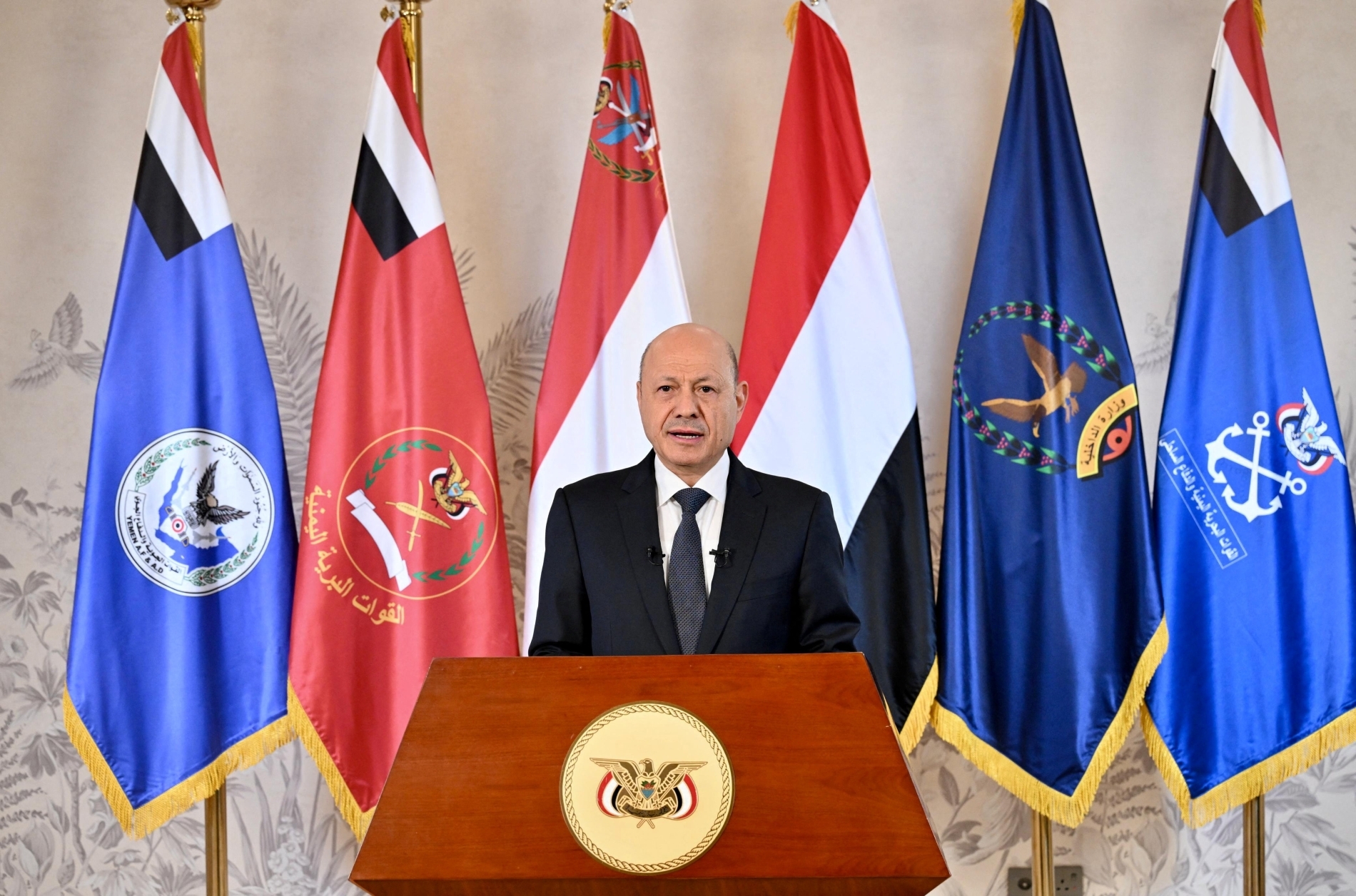
Reuters
Yemeni President Rashad al-Alimi delivers a televised address to the Yemeni people from Riyadh, Saudi Arabia, on 4 October 2026.

Problems remain

On 23 July, Bamqa said his ministry had a plan to protect oil installations and export terminals, adding that the government was awaiting formal notification from the contracted company before exports could begin. Others are less optimistic. "It is difficult for the government to resume oil exports," said Mustafa Nasr, chairman of Yemen's Economic Studies and Media Centre, speaking to Al Majalla.

"Doing so requires protecting production facilities and export terminals from attack, which is currently impossible given the latest escalation. Unless the balance of power shifts in the government's favour, any such announcement amounts to little more than wishful thinking. In my view, the announcement was intended to embarrass the Houthis and show that they are preventing the Yemeni people from benefiting from oil revenues, and that they are responsible for the suspension of oil exports. In practical terms, resuming exports will remain difficult so long as the Houthis can strike Yemeni ports, as they did in 2022 when they attacked Al-Dabba and Rudum."

With fighting in Yemen's south-west, Houthi threats to oil exports, cross-border attacks against Saudi Arabia, and no political settlement in sight, the country's crude shipments are unlikely to resume any time soon. The acute funding shortage contributes to an already severe humanitarian crisis, with 22.3 million people (including 12.2 million children) in need of aid and protection.

Internationally pledged money has largely failed to materialise. By the end of September, only 19% of the required $2.16bn had been provided. The Office of the UN High Commissioner for Refugees said the rapid escalation of hostilities along Yemen's western coast in recent weeks has displaced more than 100,000 people and forced thousands more to seek safety across the Bab al-Mandab Strait in Djibouti.

Retaking territory along Yemen's western coast and around Bab al-Mandab this month has strengthened the government's security position, but doesn't automatically mean that the country's principal oil export terminals will resume operations. The terminals central to government export plans are along the Arabian Sea, notably Al-Dabba in Hadramawt and Nashima in Shabwa.

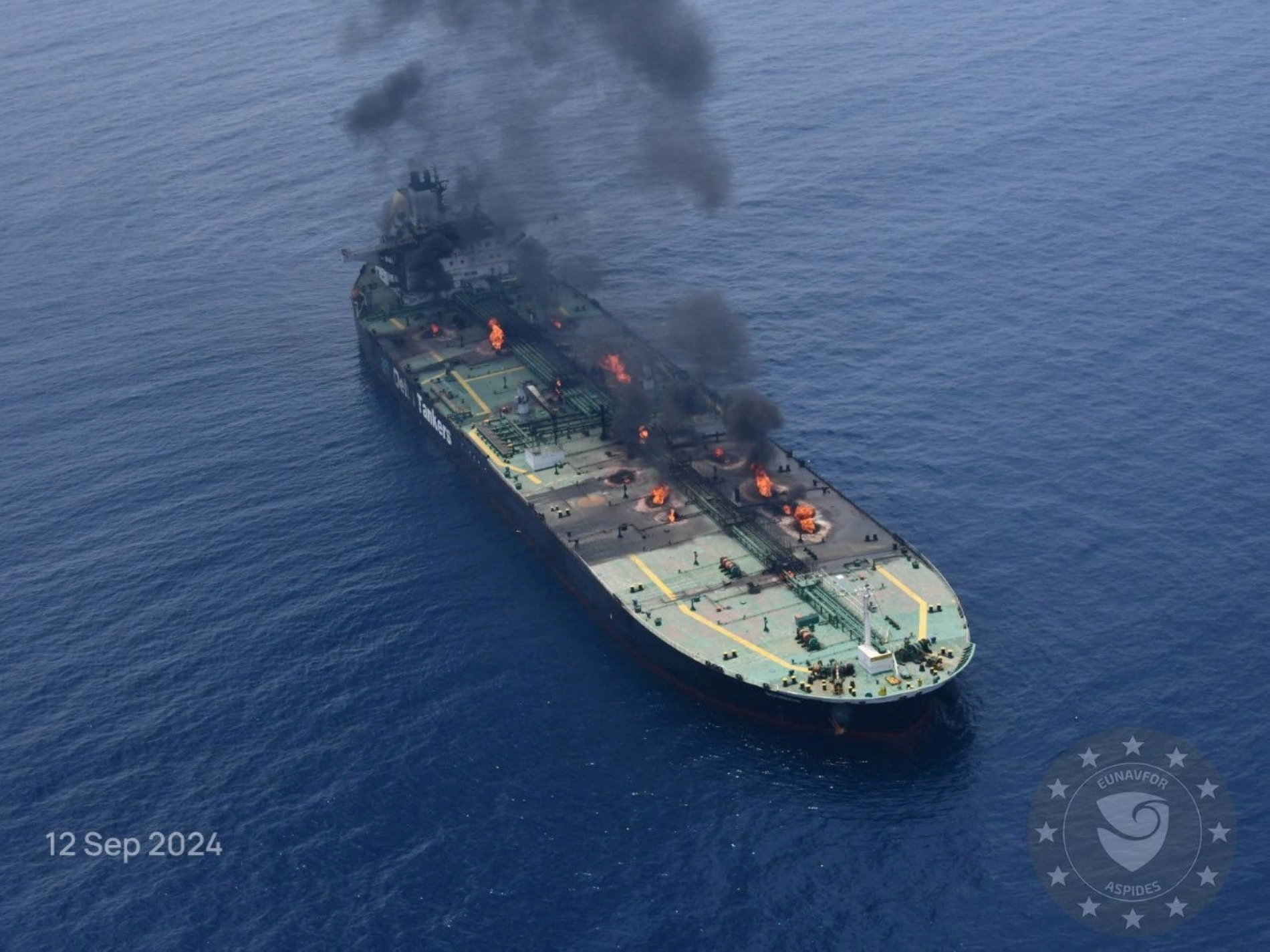
EUNAVFOR ASPIDES/Reuters
Flames and smoke rise from the Greek-flagged oil tanker Sounion after an attack by Houthi militants on the Red Sea in August 2024.

Lose-lose to win-win

There are few private-sector enthusiasts. Tensions in the Red Sea and Bab al-Mandab Strait (related to the Houthis) have increased the risks associated with shipping and maritime insurance. According to S&P Global, the volume of crude oil and condensates passing through Bab el-Mandeb fell to 1.5 million bpd in August, from 3.14 million bpd in July, as tankers avoided the region. So, even if the government brings its oilfields and export terminals back online, it will still need to secure its facilities, secure insurance cover for tankers, and reduce shipping and insurance risks sufficiently to make exports commercially sustainable.

Even if all problems related to the Houthis disappeared overnight, the government would still need to negotiate. Local authorities in the semi-autonomous region of Hadramawt want to restore oil shipments but demand a 20% share of export revenues, with a clearly defined programme and guarantees before shipments resume. The country is currently in a lose-lose situation, but its leaders need to look for a win-win over oil, the Houthi attacks on oil facilities and export terminals having cost it around $7.5bn since October 2022, according to figures submitted to the UN last year.

The latest edition of the World Bank's Yemen Economic Monitor describes an economy facing persistent difficulties, having contracted again in 2025, before the latest round of fighting. The spring 2026 edition of the report, titled Swimming Against the Tide, shows that real gross domestic product (GDP) declined by 1.5% in 2025 and was projected to contract by a further 0.5% in 2026.

Pressure on public finances in government-controlled areas also intensified. Government revenues fell to 5.6% of GDP in 2025, compared with 8.6% in 2024, primarily due to declining external grants. The situation on the ground means that Yemen's oil reserves still sit in the ground. In a world that needs energy, and in a country that needs money, that is a sorry state of affairs.

font change

Related Articles