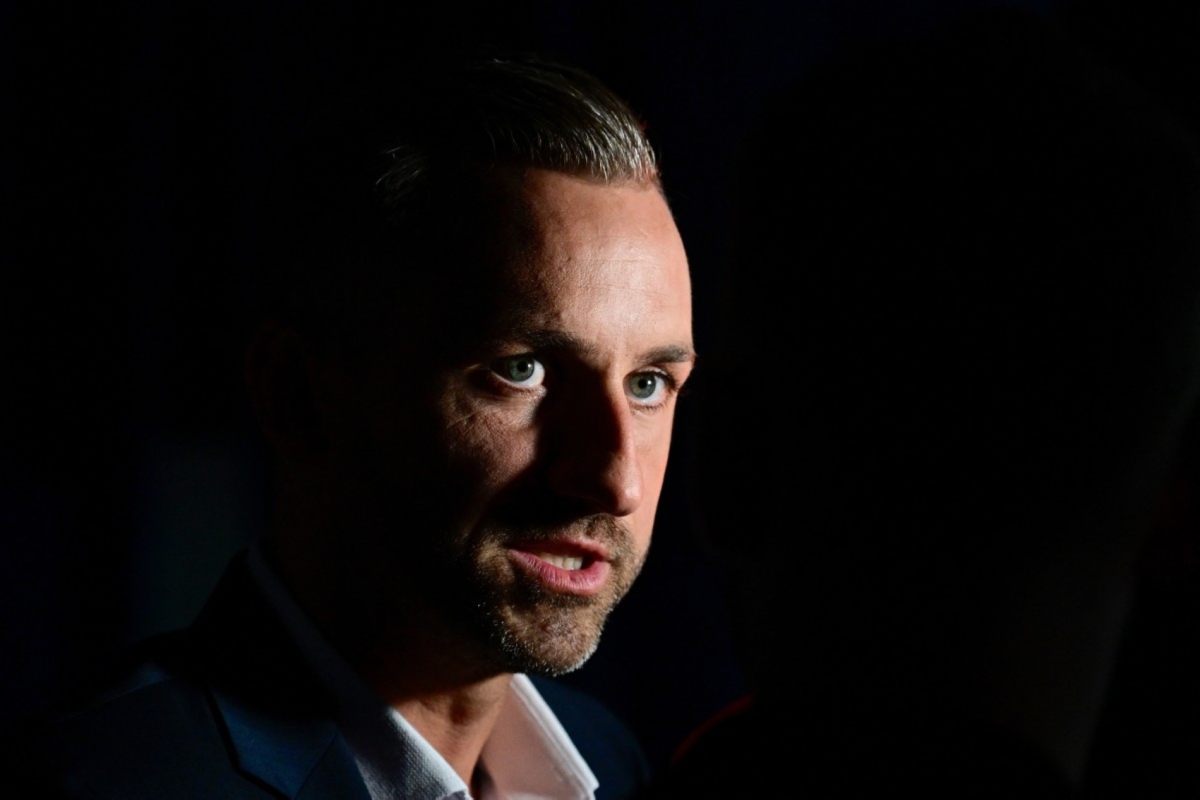
Ulrich Siegmund: the disarming right-winger making waves in Germany

The media-savvy AfD candidate led his party to victory in Saxony-Anhalt, bringing it within reach of power for the first time since World War II

Ulrich Siegmund, top candidate in the Saxony-Anhalt state election for the far-right Alternative for Germany (AfD) is pictured during Saxony-Anhalt's state elections in Magdeburg, eastern Germany on 6 September 2026.
JOHN MACDOUGALL / AFP
Ulrich Siegmund, top candidate in the Saxony-Anhalt state election for the far-right Alternative for Germany (AfD) is pictured during Saxony-Anhalt's state elections in Magdeburg, eastern Germany on 6 September 2026.

Ulrich Siegmund: the disarming right-winger making waves in Germany

It has been quite a week in far-right European politics. Reform UK, a party that only recently (according to the polls) seemed set for government, met for a conference in Birmingham, which hosted Jordan Bardella, president of National Rally.

At around the same time, men wearing balaclavas to hide their identity and dressed in black from top to toe turned up in their hundreds in Dover, bringing the port to a standstill. A similar crowd appeared a few days later in Portsmouth. These people were not visiting the seaside to catch the last sunshine of the summer. They were protesting about boats bringing migrants from France. Bardella and Farage were promising, if elected, to stop these same boats altogether.

One might think black shirts in Dover were ominous enough. However, it was a small and little-known region of Germany that provided the biggest omen. Saxony-Anhalt is not far from Berlin. Among its sons, it can claim Luther, Handel and Nietzsche. For political hero, it can claim Bismarck. It was part of East Germany before reunification. The state is the poorest in the country, with an ageing population and a gender imbalance in favour of males. It is said that after the Berlin Wall came down, it was mostly young women who left the area in search of jobs.

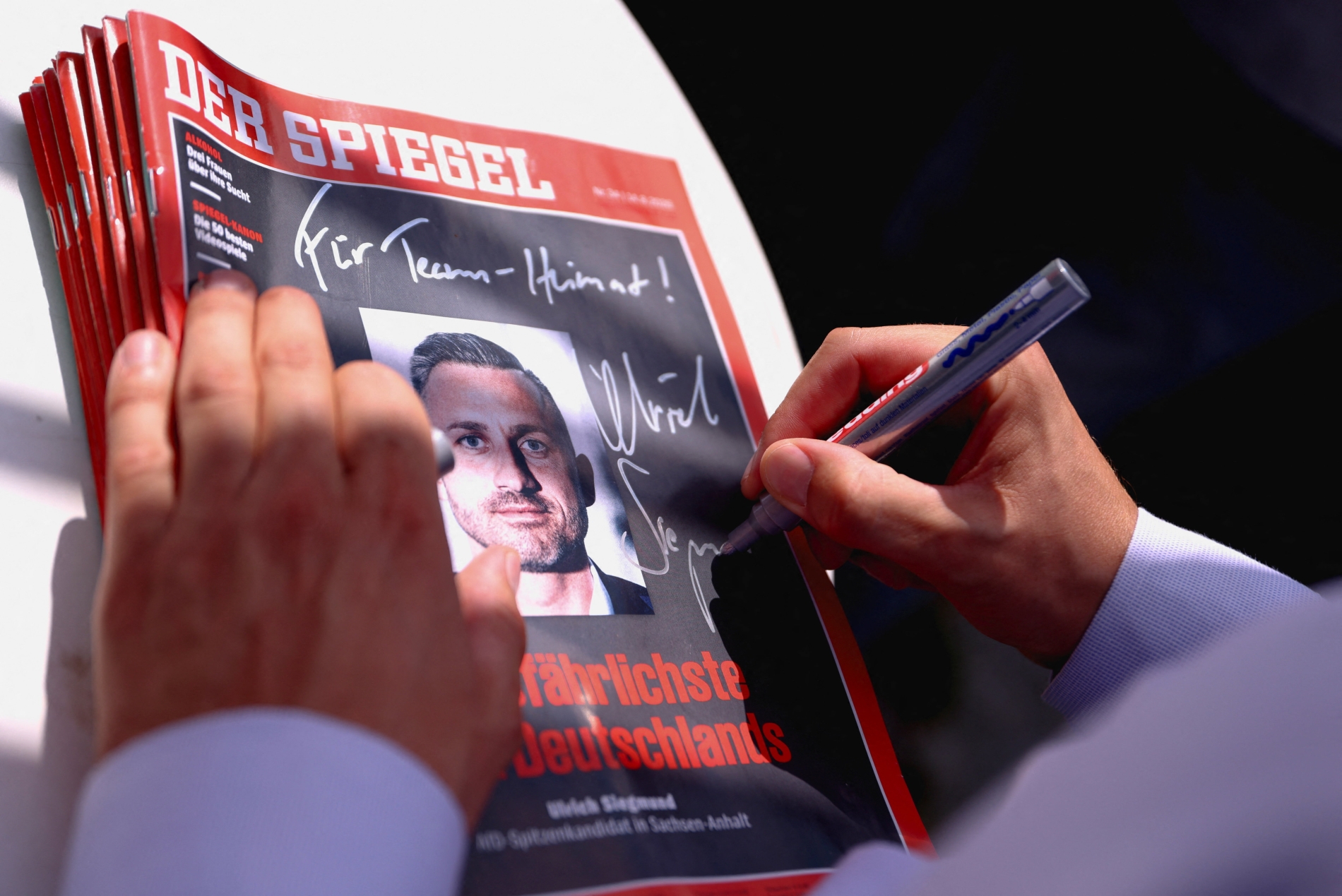
Into this economically depressed region came a young, charismatic individual born just weeks after the country was reunified. Ulrich Siegmund smiled a lot. He smiled even when he was complaining about journalists. When Der Spiegel called him the most dangerous man in Germany, he didn't take the magazine to court for libel; instead, he bought as many copies as he could afford and signed them as souvenirs for his admirers.
REUTERS/Thilo Schmuelgen
Ulrich Siegmund, top AfD candidate signs copies of the German magazine, "Der Spiegel" with his picture on the cover, ahead of Germany's Saxony-Anhalt state election, in Oschersleben, Germany, on 31 August 2026.

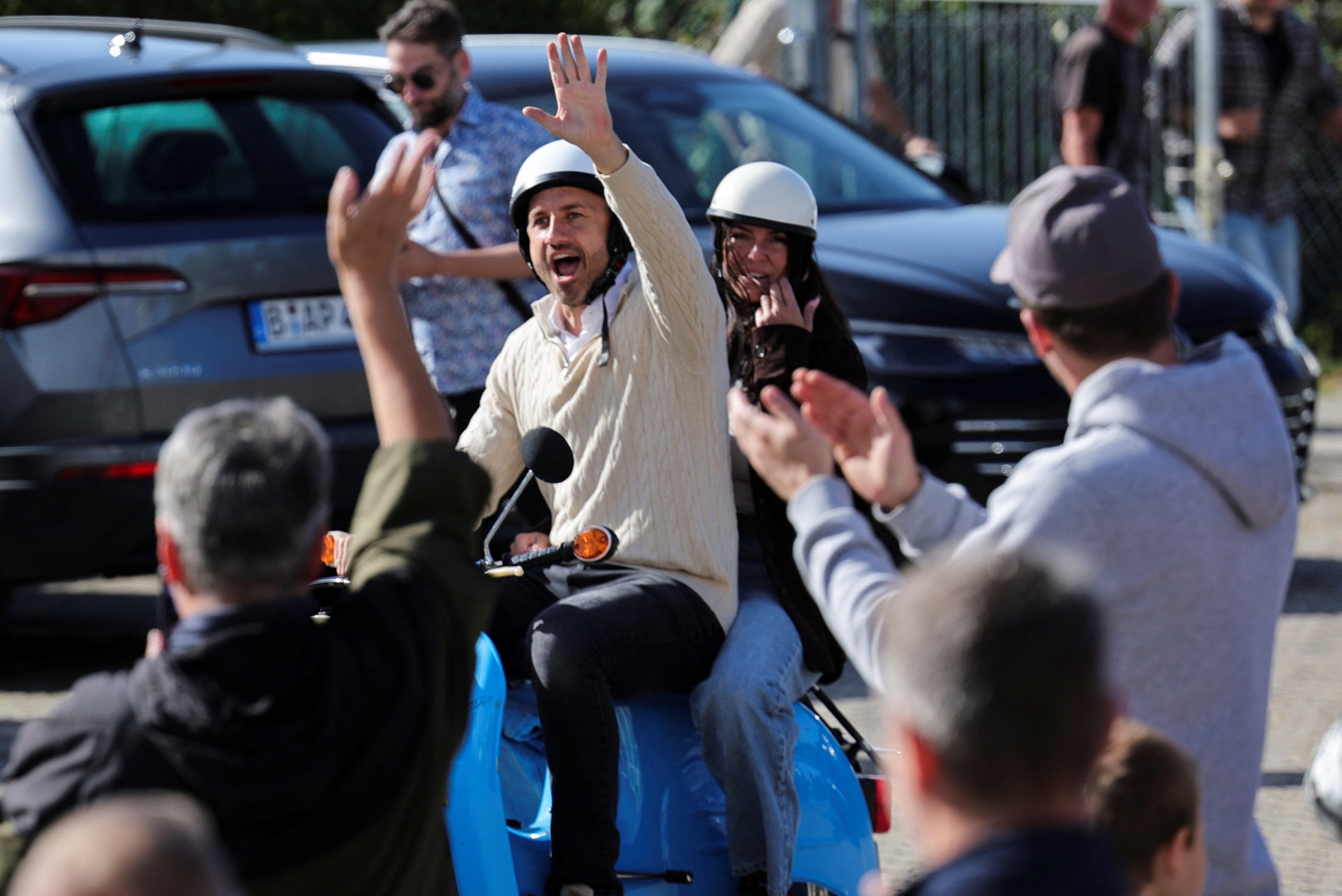
With this relaxed attitude, he has made it hard for the mainstream press to demonise him. Intimidating balaclavas are not his style. Instead, he employs charm. His favourite campaigning method is to ride around on a cute-looking vintage scooter, the kind once mass-produced in East Germany.

He is young, yet he pedals (quite literally) nostalgia for a time before the crises that led to successive waves of refugees, those from Syria, obviously, but also those from Ukraine. For Germans unhappy with economic decline and with Friedrich Merz, the most unpopular chancellor ever, Ulrich Siegmund is the opposite of dangerous. He offers a renewal of the country and permission to feel pride in its culture.

So why has his success caused such widespread anxiety in Germany? The first clause of the 100-day programme of his party, the AfD, says that “from the first moment” of being in power it will deport people it deems “irregular migrants”. That is to say, there will be wholesale deportations, including people with full citizenship. Meanwhile, migrants will be required to do menial work.

In the recent past, the party has dabbled in Nazi imagery. It has distinguished between “biological” and “passport” Germans. Such policies have rendered them too extreme even for France’s far-right leader Marine Le Pen. On the other hand, they are greatly admired by Elon Musk.
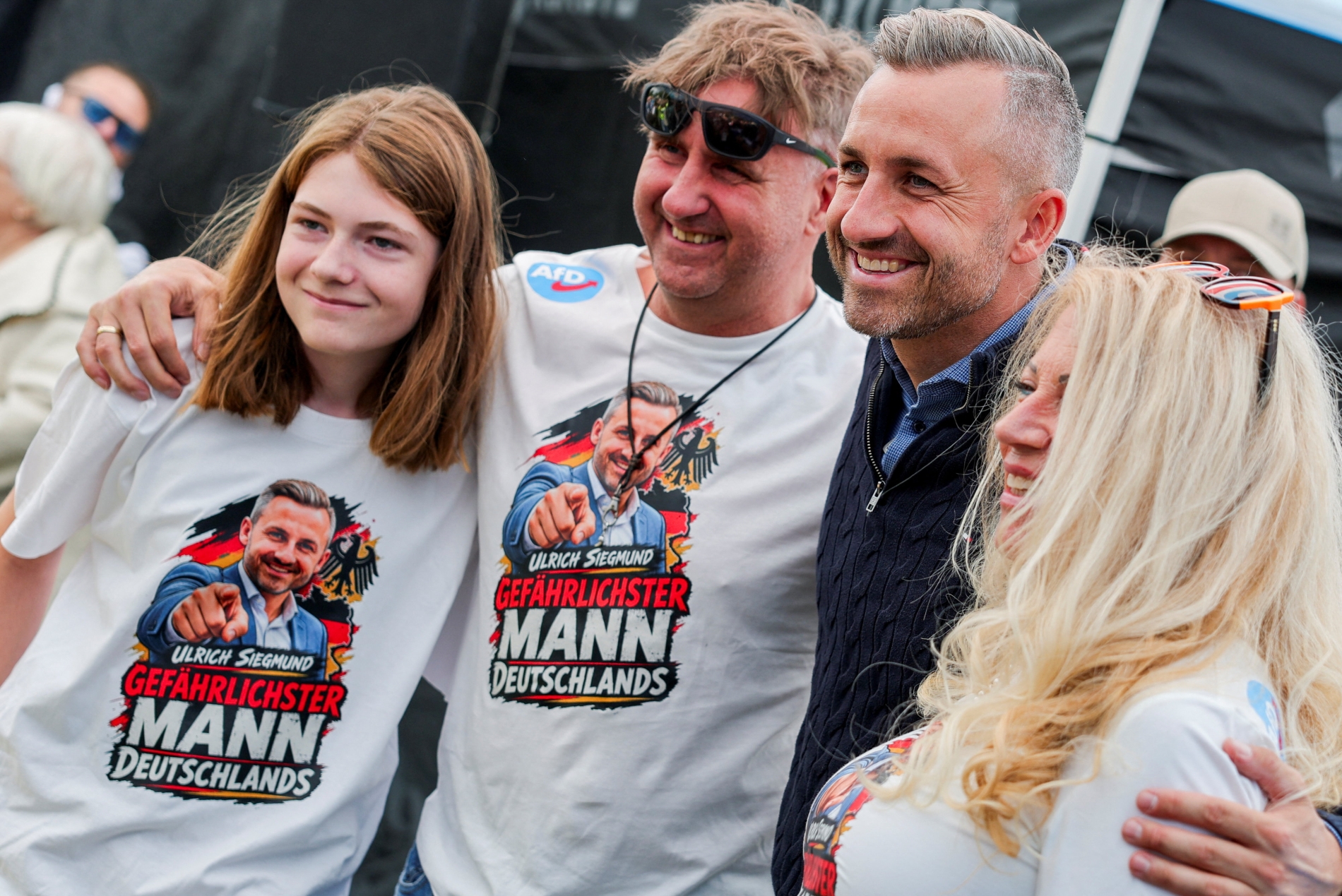
The Saxony-Anhalt vote gives AfD its most impressive result so far and hugely boosted Siegmund's visibility

The vote in Saxony-Anhalt has given the party its most impressive result so far and hugely increased Siegmund's visibility. In an electoral system designed to necessitate the formation of coalitions, the AfD managed to gain 43.8% of the vote, just three seats short of an absolute majority.

This comes at a time when they have been riding as high in the polls as Reform in Britain. Not since the Nazis almost a hundred years ago has a far-right party had such success, albeit in a state of just over two million people. When Friedrich Merz responded with a statement, he looked visibly shocked. Most Germans were not surprised, though. If anything, the chancellor's reaction only confirmed how out of touch he has become.

But Siegmund is an example of how such extreme politics can be packaged in order to gain power. Before he entered politics, this son of regular GDR workers tried to make it as a perfume salesman. He was unable, however, to persuade bus companies that he could please their customers by making their buses more fragrant. Now he is demonstrating how extreme politics can benefit from a more fragrant approach. He uses social media in a canny way to disguise the whiff of ethno-nationalism. His TikTok following is the largest of any German leader. He even has a pop song to go with the upbeat image. It contains the cheery line "We send them back now!"

That refrain offers a clue to the ideology he offers. Another clue comes from a chant that greets him at rallies. Half the crowd calls "Sieg!" with "Mond!" as the response. The "Sieg" part is a sly disguise for the Nazi greeting.

REUTERS/Fabrizio Bensch
Top candidate of the far-right Alternative for Germany (AfD), Ulrich Siegmund, and his wife, Julia Siegmund, arrive on a scooter to vote in the Saxony-Anhalt state election in Tangermünde, Germany, on 6 September, 2026.

In another example of this subterfuge, the party's leader, Alice Weidel, is often greeted by the cry "Alice fur Deutschland!" Alles fur Deutschland, meaning everything for Germany, was a popular Nazi slogan. It once got another prominent member of the party, Björn Höcke, into big trouble with the law.

But Siegmond prefers not to allude to the past. He once called Hitler's rule a low point in German history, though on another occasion he didn't feel informed enough to say the Holocaust had shown the worst of mankind.

The perfume vendor wholeheartedly supports all the national policies of AfD. Like the Nazis of old, they are in favour of 'patriotic' art, not the kind of stuff that denigrates Germany. Their aim is to put an end to German self-hatred and guilt over the war. Lessons will focus on Bismarck and what are seen as the glorious days of German history. In the spirit of patriotism, LGBTQ flags will be replaced with German ones. The new Green Deal will be scrapped: the AfD rejects climate science.

Predictably, a strain of Islamophobia permeates the party's thinking. They want to ban the call to prayer and to segregate schools so that Muslim pupils do not sit in the same class as the others. Eventually, they dream of a Germany that has rid itself of Islam altogether.

More surprisingly, perhaps, they are fervently pro-Russian. Kirill Dmitriev, Putin's special envoy and head of the Russian Direct Investment Fund, described their victory in Saxony-Anhalt as a "historic win for the pragmatic AfD". In June, he met Markus Frohnmaier, the party's foreign policy spokesman in the Bundestag, in St Petersburg. Dmitriev said afterwards: "Looking forward to building a great FUTURE together with AfD, Germany's most popular party." He said the pair discussed economic cooperation and restarting a Russia-Germany-US business dialogue. The AfD, for good measure, has pledged to reintroduce the teaching of Russian in German schools.

REUTERS/Fabrizio Bensch
Ulrich Siegmund, the top candidate for the far-right Alternative for Germany (AfD) party in the Saxony-Anhalt state election, poses for a photo with supporters and voters in Quedlinburg, Germany, on 23 August 2026.

Still, it is the concept of remigration that is the party's distinctive policy. Back in 2023, a secret meeting of far-right figures took place in Potsdam. Martin Sellner—an Austrian right-wing extremist and former speaker of the Identitarian movement—introduced his Masterplan for forcible remigration of asylum seekers, foreigners with leave to remain and non-assimilated German citizens. The meeting did not remain secret for long, and the ideas discussed there led to a sudden drop in the AfD's popularity, from which the party has since recovered.

One of the party members present in Potsdam was Ulrich Siegmund. He expressed the view that foreign restaurants should disappear from the streetscape, and it should become "unattractive" for the clients of such establishments to live in Saxony-Anhalt.

According to Leon Mangasarian in The Spectator, the most dangerous man in Germany now faces two problems. 'First, there's no money to do what the AfD has pledged, and second, German state premiers have limited powers.' He can't import cheap Russian gas and restore the Nord Stream pipeline, nor can he chuck migrants out, as both matters are decided in Berlin or the European Union.

That doesn't mean, however, that he can't get his followers to boycott the foreign restaurants.

font change