
As European economies contend with rising borrowing costs and sluggish growth, the United Kingdom faces a difficult fiscal balancing act. It has its own currency and an independent central bank, yet carries a heavy burden of public debt, mounting debt servicing costs, and increasingly limited room for fiscal manoeuvre.
But does control over its own currency give the UK greater freedom to weather economic shocks than France, or do rising government bond yields expose the limits of monetary sovereignty, even for countries with their own currency? The answer lies in the distinction between having the tools to shape economic policy and being able to deploy them without fanning inflation, weakening growth, or undermining confidence in the public finances.
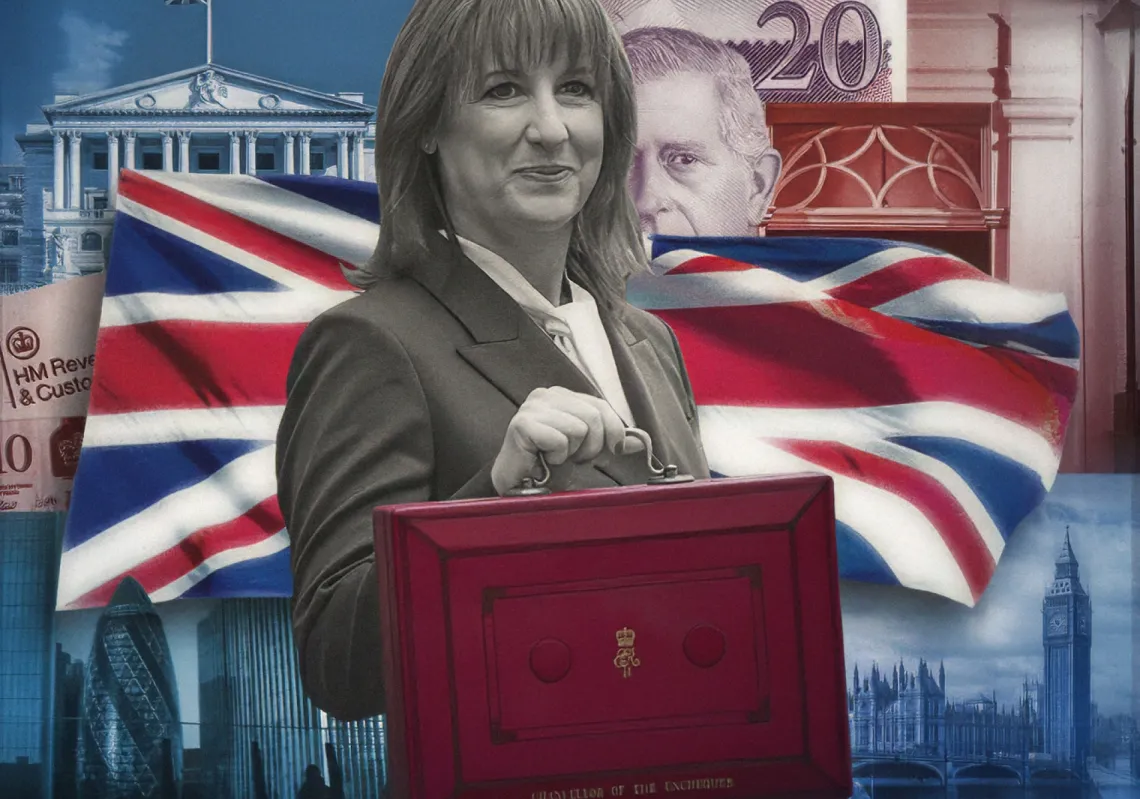
Chancellor of the Exchequer John Healey has opted to use part of the government’s fiscal headroom to cushion the economy against external shocks, rather than resort to sweeping tax increases or spending cuts. However, he has acknowledged that rising borrowing costs have made it harder for the government to abide by its fiscal rules.
According to the Office for Budget Responsibility (OBR), the government’s projected fiscal headroom against its current budget surplus target has fallen to £15bn in the 2029–30 financial year, down from approximately £24bn in its March forecasts. It is expected to recover to £22bn for the 2030 in 2030–31.
This headroom does not represent money freely available for government spending. Rather, it is the margin between the fiscal forecasts and the minimum level of surplus required to meet the government’s fiscal rule, and a slowdown in growth or higher financing costs could quickly erode this headroom. The OBR puts the probability of meeting the current budget surplus rule at just 56%, down from 59% in the 2025 budget, reflecting the uncertainty surrounding the government’s projected fiscal position.
Also impacted are the costs of the Bank of England’s quantitative tightening programme. Since 2022, the bank has been gradually reducing its holdings of bonds purchased under its earlier quantitative easing programme.

As interest rates have risen, the interest the bank pays on commercial banks’ reserves has increased, at times exceeding the income generated by some of the bonds in its portfolio. It has also incurred losses from selling bonds for less than their redemption value. Under an indemnity agreement between the bank and the treasury, these losses are borne by the treasury, adding to the pressure on the public finances and leaving the budget increasingly exposed to fluctuations in interest rates and bond yields.
Nevertheless, the government expects borrowing to decline gradually. Public sector net borrowing is projected to fall from approximately 4.4% of GDP in 2025–26 to 1.8% in 2030–31, where it is expected to remain in 2031–32. A reduction in annual borrowing, however, does not necessarily translate into an immediate or comparable decline in the accumulated debt.
According to the OBR, public sector net debt is expected to peak at 97.3% of GDP in 2028–29 before declining to 95.6% in 2031–32. Public sector net financial liabilities, meanwhile, are projected to reach 83.8% of GDP in both 2027–28 and 2028–29, before easing to 81.7% in 2031–32.
These differing trajectories underline the importance of distinguishing between different measures of public indebtedness. Reducing the annual deficit alone is insufficient to bring down the accumulated debt burden, particularly when growth remains weak and financing costs stay high.
Key indicator
Economic growth will be decisive in determining whether the government’s fiscal plan succeeds. The OBR put its 2026 GDP growth forecast at approximately 1.25%, while lowering its 2027 projection to 1%, half a percentage point below its previous estimate. It attributes the downgrade to higher energy prices and borrowing costs, both of which are weighing on consumption and investment.
The renewed rise in inflation further complicates the outlook. Consumer price inflation reached 3.5% in the 12 months to September, up from 3.1% in August, driven largely by higher fuel and utility costs. The OBR expects inflation to average around 3.4% in 2027, reaching a quarterly peak of approximately 3.8% early in the year before returning to 2% during 2028.

Furthermore, higher energy prices erode households’ real disposable incomes, increase government expenditure on welfare benefits and pensions, and raise the cost of inflation-linked government bonds. The OBR has warned that real disposable income per person will decline in the near term, with the projected level in 2030–31 falling below its March estimate.
The government now has to contend with competing demands, including restraining expenditure, protecting households and public services, and avoiding measures that could further weaken growth. If economic performance proves weaker than anticipated, tax revenues could fall, and the remaining fiscal headroom could erode before the deadline for meeting the fiscal rule.
The pound’s independence
One of the UK’s principal institutional advantages is its retention of the pound sterling and the Bank of England’s operational independence over monetary policy. This allows interest rates to be adjusted in response to domestic inflation and economic conditions. France, by contrast, operates under a common monetary policy set by the European Central Bank (ECB), which must balance the differing economic circumstances across the eurozone.
Monetary independence gives the Bank of England no licence to disregard inflation or cut interest rates without considering the consequences for prices, the exchange rate and market confidence. A flexible exchange rate can help cushion the economy against external shocks, although a depreciation of sterling could make imported goods and energy more expensive, slowing the pace of disinflation.