Ahmad Shah Massoud: the man who foresaw 9/11

An Afghan of Tajik heritage, Massoud was the enigmatic warrior who resisted the Soviets, the Taliban, and al-Qaeda. So why didn't the US back him?

Ahmad Shah Massoud smiles during a press interview at his headquarters in Afghanistan, in a photo taken on 28 June 2001.
AFP
Ahmad Shah Massoud smiles during a press interview at his headquarters in Afghanistan, in a photo taken on 28 June 2001.

Ahmad Shah Massoud: the man who foresaw 9/11

According to American journalist Steve Coll in his 2004 Pulitzer Prize-winning book Ghost Wars (about the CIA, Afghanistan, and al-Qaeda from the Cold War to 9/11), CIA “agents admired Massoud greatly,” adding: “They saw him as a Che Guevara figure, a great actor on history's stage. Massoud was a poet, a military genius, a religious man, and a leader of enormous courage who defied death.”

From 1996, after he could no longer defend Kabul against his Taliban opponents who were being armed and trained by Pakistan, Massoud led the Northern Front in north-eastern Afghanistan, defending a territory in which he embraced elements of democracy, inter-faith initiatives, and equal gender rights, allowing women to work and girls to be educated. He decreed that they did not have to wear the burqa if they did not want to and personally stepped in to stop forced marriages.

Exactly 25 years ago, on 9 September 2001, as he was trying to build an Afghan peace process, he was killed by two al-Qaeda suicide bombers posing as journalists. Within 48 hours, al-Qaeda operatives had flown planes into the World Trade Centre and the Pentagon, killing thousands. Several months before, Massoud had addressed the European Parliament. In his speech, he explained that Northern Front intelligence agents had informed him that a big attack on American soil was imminent.

AFP
An Afghan man carries a portrait of the late Ahmad Shah Massoud as others walk behind him toward a mosque in Kabul on 5 December 2001.

Big moment

Massoud’s assassination was a big moment. At the time, Russia had a new leader, a former KGB officer called Vladimir Putin, who knew that Massoud’s death was important. Years earlier, Massoud had led his compatriots to defeat Russian forces. The years that followed could have been very different had the Americans listened to Massoud. In the end, although the CIA liked him, it chose to channel funding through Pakistan, and the Pakistanis favoured others (including, later, the Taliban).

“Massoud has been killed,” said Putin in a call to US President George W. Bush on 9 September. “I am very worried.” Putin knew his politics, having been a KGB agent during the Afghan war. Indeed, Soviet forces went from fighting Massoud in the 1980s to respecting and supporting him in the months leading up to 9/11. Putin therefore sensed that Massoud had been killed for a reason. He felt something big was coming, but no one knew just how big until events unfolded on TV screens around the world.

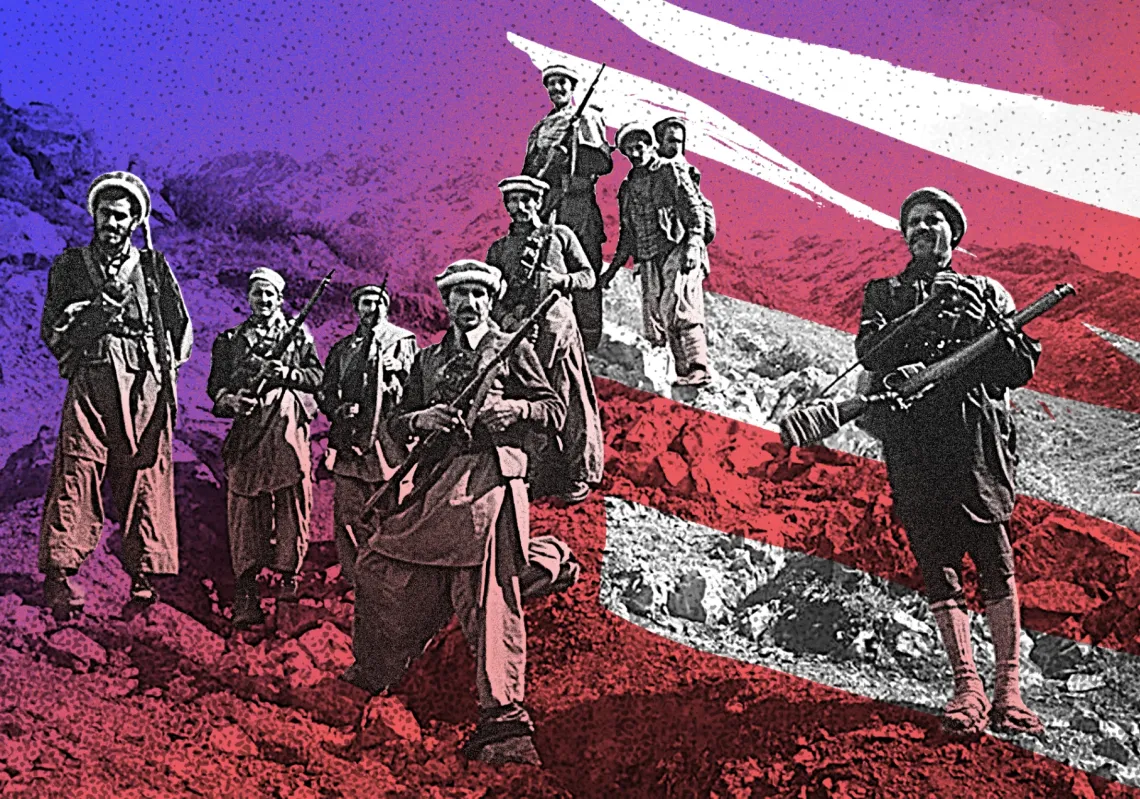
Massoud famously defeated the Soviets in five different offensives in the Panjshir Valley and later defended the valley against the Taliban. A folk hero, he was even depicted in the Hollywood film Rambo III starring Sylvester Stallone. Sandy Gall, the veteran ITV correspondent, wrote Massoud’s official biography, The Afghan Napoleon. Gall delivered messages of support from British Prime Minister Margaret Thatcher, who famously visited the Khyber Pass to urge the Afghan Mujahideen to fight the Soviets.

Massoud led the Northern Front in north-eastern Afghanistan, where he embraced elements of democracy, different faiths, and equal gender rights

Pushing towards peace

Afghanistan was consumed by civil war throughout much of the 1990s, but Massoud stood out as the only Afghan commander to really push the various warring parties towards a peace process. He was also the only commander who never left Afghanistan; his peers (like Gulbuddin Hekmateyar, Ismail Khan, and Abdul Rashid Dostum) all fled into exile at various points, living in countries such as Iran or Pakistan.

Putin was one of the Cold War warriors who respected Massoud and went on to support him against the Taliban and their terrorist allies, al-Qaeda. It was Osama bin Laden who ordered Massoud's assassination because he knew this would endear him to the country's Taliban leadership, whose support he needed, and which was about to bear the brunt of the backlash after al-Qaeda's American attack.

The British intelligence service MI6 had supported Massoud, but despite Putin's failed attempts to convince them, the Americans did not. In 2001, Putin also tried to convince the Americans to kill or capture bin Laden quickly, before something terrible happened, but it was too late, and the rest is history.

An ABC TV series, Path to 9/11, made in 2006 and based on the 9/11 Commission, showed that there were opportunities to kill bin Laden during Bill Clinton's presidency that were not taken. It showed a fictionalised version of Massoud saying: "We have him in our sights." Yet the CIA refused to authorise the airstrike, or to support Massoud in his fight against the Taliban and al-Qaeda, who together could summon tens of thousands of fighters.

AFP
Taliban fighters sit on a concrete barrier wall painted with an image of the late Afghan commander Ahmad Shah Massoud while standing guard following the Taliban's takeover of Afghanistan, in Kabul, on 28 August 2021.

Afghanistan's 'what if'

If the Americans had supported Massoud against bin Laden and the Taliban as much as they supported the Afghan Mujahideen against the Soviets, most analysts wonder if there would have even been a 9/11. Massoud not only warned the West that there was something big in the offing, but he also warned Arab states that if they did not pay attention, their Arab fighters would also return to their home countries and cause conflict there, which is something Egypt, Algeria, Jordan, and Saudi Arabia all experienced.

Down numerous online rabbit holes, there are all sorts of conspiracy theories about Ahmad Shah Massoud, such as that he helped set up al-Qaeda, but books about the Arabs in Afghanistan (including a memoir of Abdullah Anas, the son-in-law of al-Qaeda co-founder Abdullah Azzam) help dispel some of the myths. Another biography on Azzam, called The Caravan by Thomas Hegghammer, delves into the differences between Azzam and bin Laden.

The latter did not like Massoud, who considered most al-Qaeda fighters to be extremists (Azzam was killed in 1989, allegedly by bin Laden and the Pakistanis), but Prince Turki Bin Faisal, the Saudi intelligence chief at the time, wrote in The Afghanistan File that Massoud was the only national figure who thought about the bigger picture, adding that this was something the Americans either ignored or disliked.

A quarter of a century on, many American intelligence officers from that Cold War era still consider that not helping Massoud was an opportunity missed. As in the film Charlie Wilson's War, the famous Texan Congressman says to the powerful Intelligence and Defence Committees of the Senate and Congress in one of the final scenes: "We messed up the end game." Or words to that effect.

font change