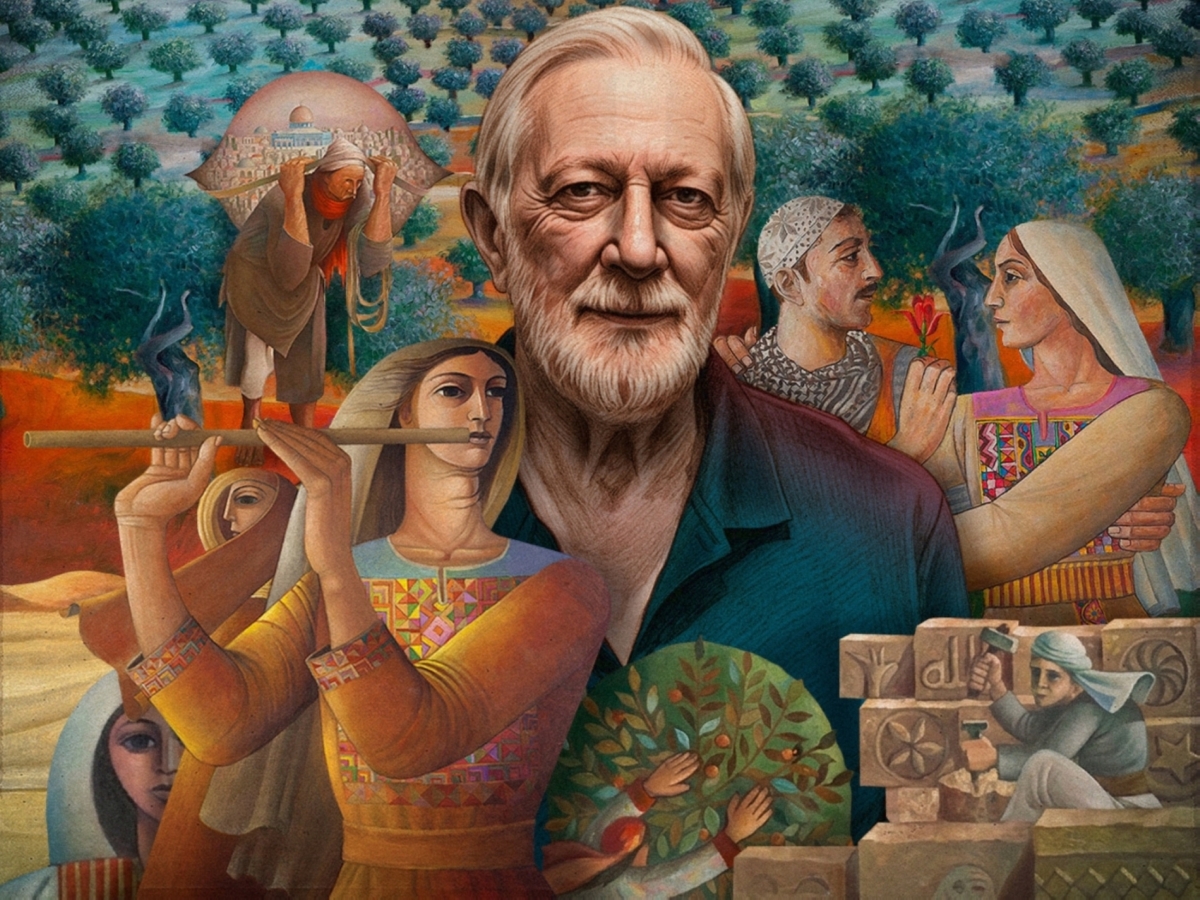

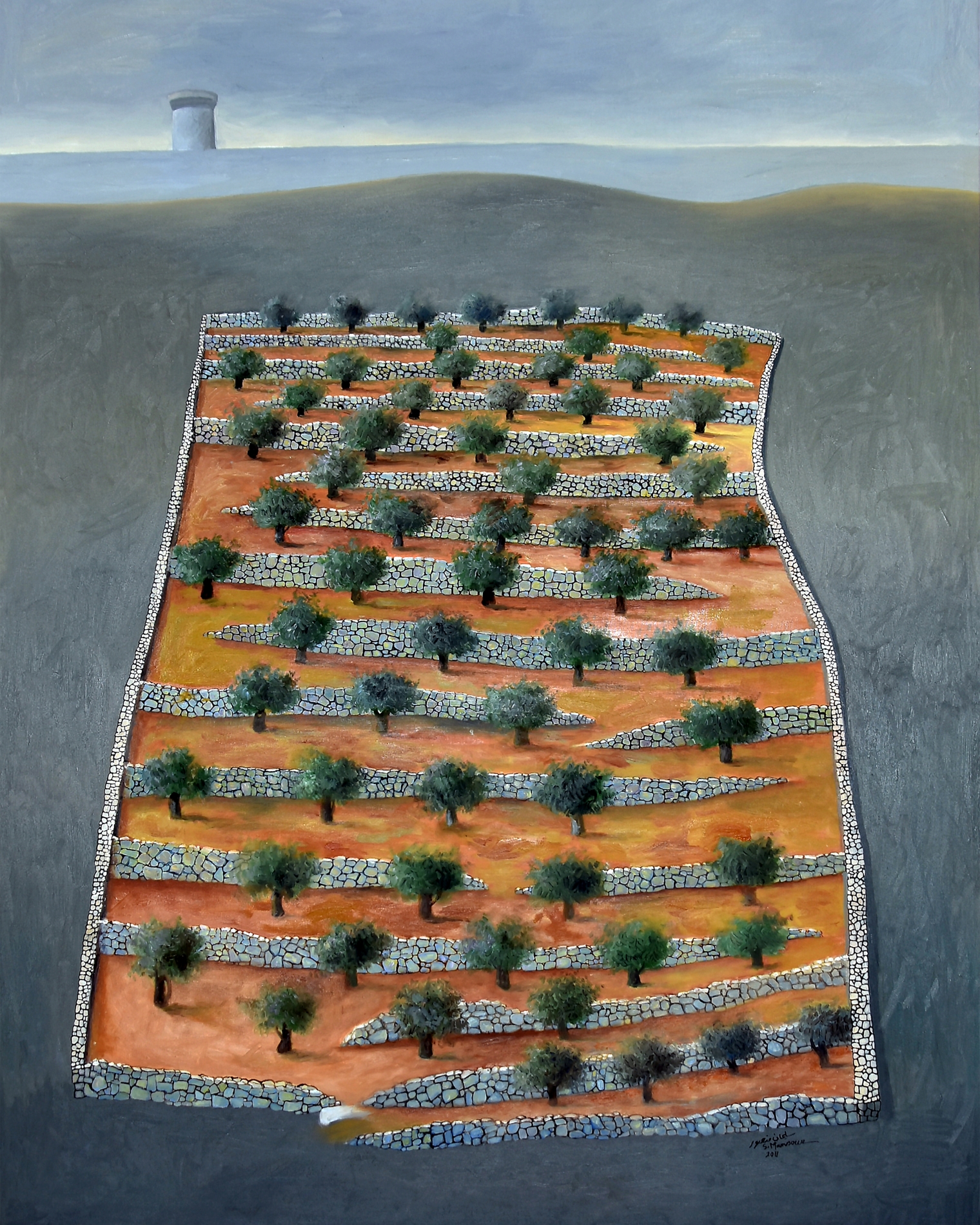
If painter and art historian Ismail Shammout returned pigments to their earthly origins, creating an art focused on Palestinian memory, then Sliman Mansour created an art that approached Palestinian identity as an existential inspiration by making earth itself the substance of his pigments. Instead of merely painting the land that had captivated him visually and emotionally since childhood, he used a product of that land (clay) to make his works after deciding to boycott art materials produced by Israel.
It soon opened onto a far broader imaginative horizon. That technical transformation led Mansour, who recently died at the age of 79, to discover a new key to Palestinian symbolism, which he conceived as a complete act, without diminution. The intellectual, technical, and stylistic elements of the artistic process became entwined, each shaping the other, until the work sought to grasp the very essence of identity. Distilled, that was the purpose of his aesthetic endeavour.
This is Palestine
Mansour lived in the West Bank and was one of the best-known Palestinian artists. He lived his entire life close to the land, albeit under occupation. He could close his eyes before a scene he intended to paint and say: “This is Palestine.” When Mansour painted, he did not follow a formula established by his predecessors. His visual vocabulary, while inspired by the world around him, contained deep within it the energy of an inexhaustible dream. It was his own dream, forever fresh, one that preserved Palestine as it was, without attaching to it any external description.
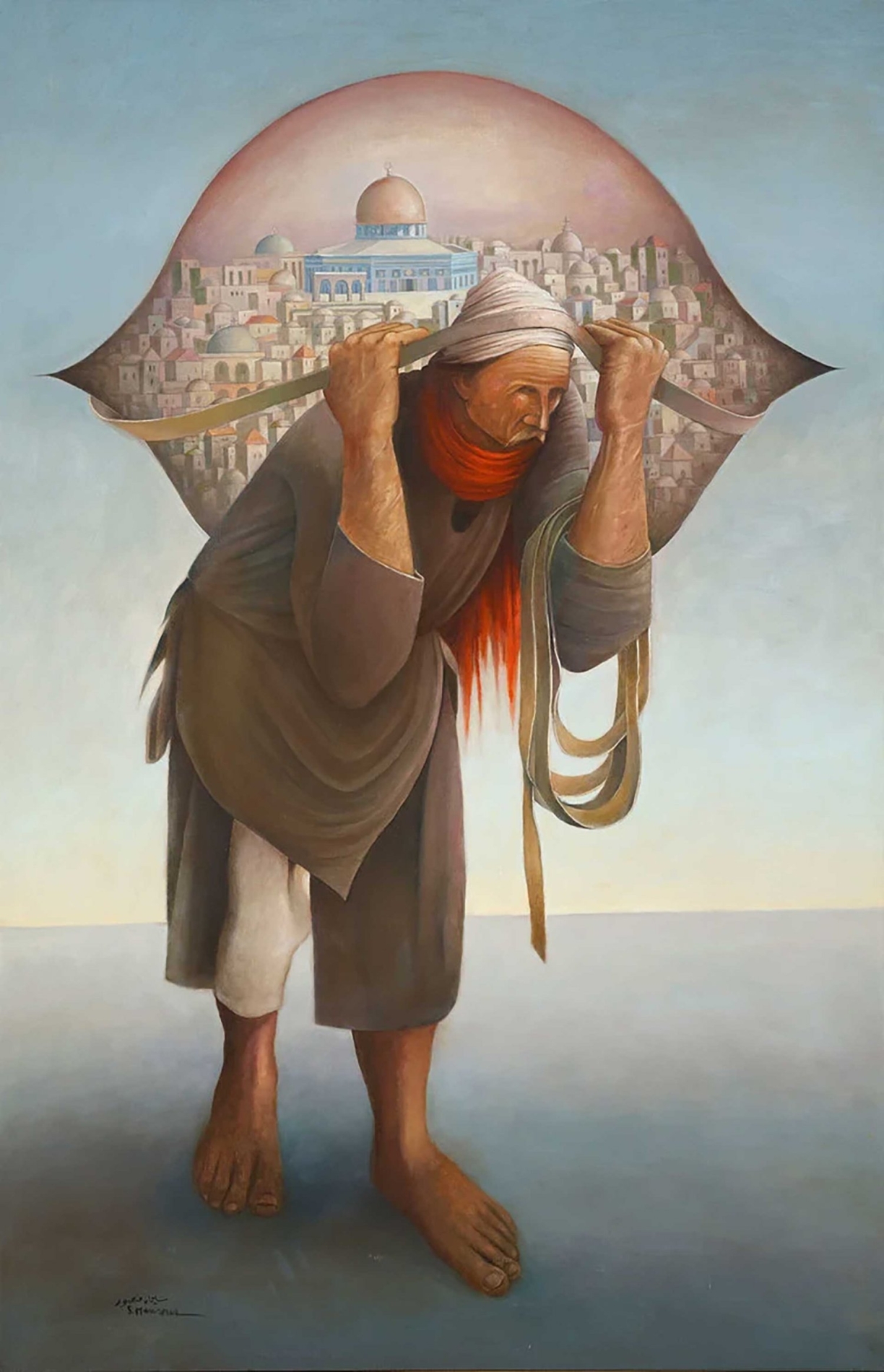
When he painted his celebrated Jamal al-Mahamel (The Camel of Burdens), he created an icon capable of continual transformation, one that could accompany the Palestinian through every place and age, regardless of political outlook or ideological inclination. The mythic language Mansour embraced drew its substance from Palestinians’ daily reality, while seeking to preserve their identity against efforts to erase it.
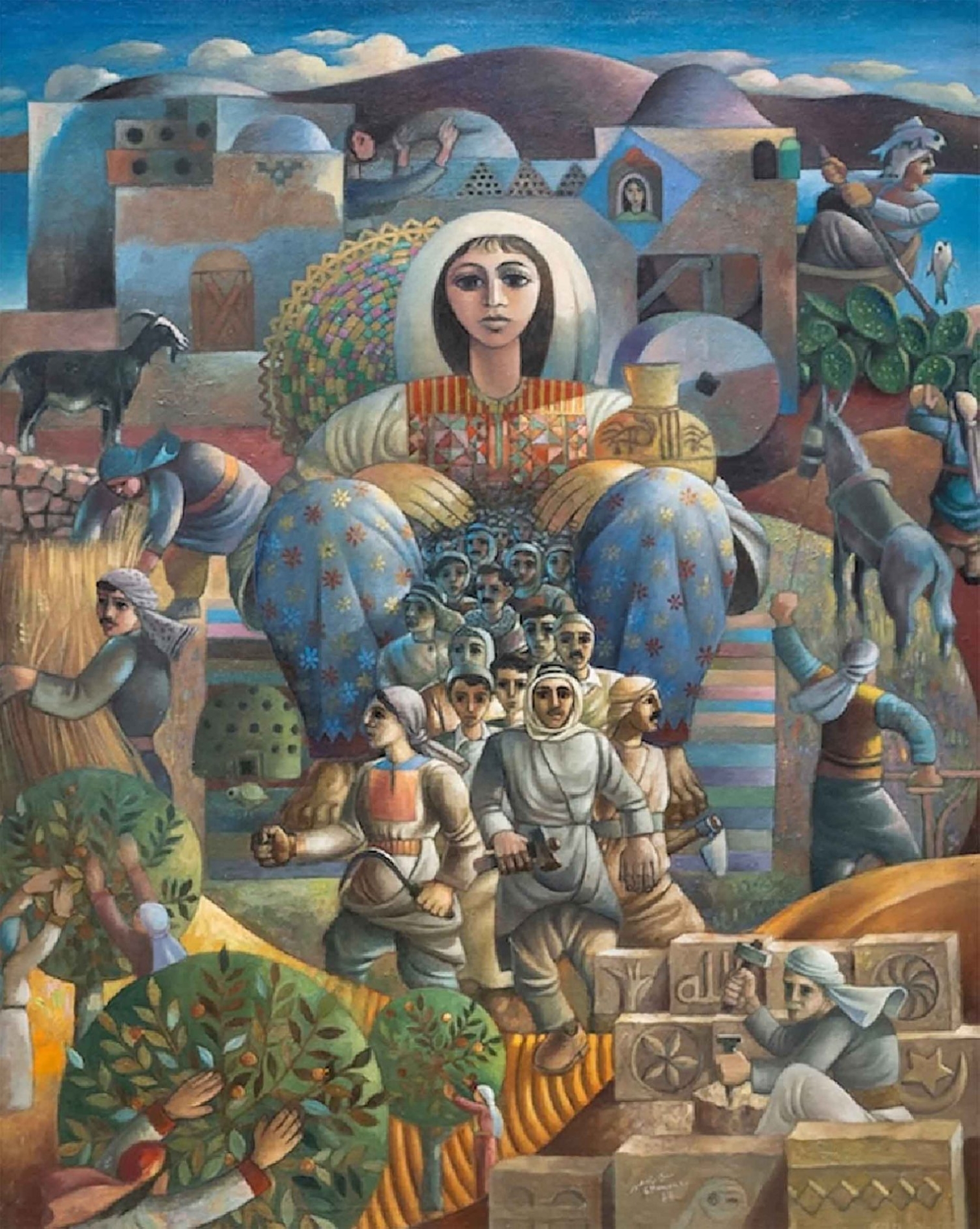
Early on, Mansour recognised the importance of national education through art. He was a teacher of a singular kind. Painting at the time was more than a means of expression; it was an act of excavation, a search for roots that remained alive. He devoted particular attention to handicrafts, especially embroidery, in which he sensed the culture of an entire people had been preserved.
Although Mansour immersed himself deeply in studying and teaching the aesthetic vocabulary of folk heritage, there is something striking about the place it occupies in his own art. It never dominates the work as a whole. It remains one component among others, secondary perhaps, yet no less present than the rest.
Discovering materials
Mansour was born in 1947 in Birzeit, near Ramallah. From 1967-70, he studied painting in Jerusalem. From 1975-82, he taught art at a United Nations women’s teacher training college and helped develop handicrafts at Birzeit University. Everything Mansour learned from life he placed at the service of his struggle for the Palestinian people. He drew political cartoons for the local press, illustrated educational books, and developed a passion for traditional crafts, learning to work with copper, enamel, wood, and ceramics, until these local materials became central to his paintings.
Discovering those materials was a revelation, as if encountering another element of national identity, but it was no easy undertaking. Abandoning ready-made art supplies meant working with neglected and unrecognised substances, restoring their intrinsic value. The aesthetic results were bound to differ, likewise the nature of the visual impact, but through his relationship with these materials Mansour sought to proclaim his national identity. He became a son of these substances, the distillation of their expressive temperament.
That affinity was reflected in paintings that wove feeling and thought, drawn from the earth and everything it yields. A remarkable harmony emerged between the painted scene and the materials from which it had been fashioned. His works exhibit a striking quality of being born of necessity or impulse, so they are free of reflex and reaction. Instead, they emerged from long periods of profound contemplation, through which Mansour gave aesthetic meaning precedence over everything else.
There is an assumption that every Palestinian scene is political. For Mansour, this was far from true. He understood what it meant to be a Palestinian painter, and he understood that Palestinian symbolism belongs less to politics than to daily life. He painted oranges and olive trees with the happiness of one who sees, rather than one who remembers with sorrow. He had no need to summon the past or turn his life into a storehouse of memory. His delight in painting, and in the world that painting opened up before him, was evident in his passion for detail.
A painter of life
Mansour painted Palestinian women as he had known them: beautiful. Their passing seemed to lend the air a different fragrance. They were never reduced to silent icons or abstract symbols. Mansour was a painter of life, one we have long yearned to know. In 1987, he founded a group called Towards Experimentation and Creativity with Vera Tamari, Tayseer Barakat, and Nabil Anani. They boycotted Israeli art materials, turning instead to coffee, henna, and clay. It was their contribution to the Intifada.
More significantly, its members reconsidered the assumptions that had long surrounded Palestinian resistance art. Those assumptions had confined art within a single expressive mould, one dominated by a direct propagandistic sensibility. At that stage, the most important task was not painting the Intifada, but creating a Palestinian art capable of revolt in its own right. It was a daring experiment, animated by the desire to establish a new foundation upon which resistance art might rest.
Mansour obstinately resisted the conditions imposed by reality, conditions that laid the groundwork for the familiar, ready-made, easily spotted Palestinian art. These works had become more collective than the very concept of art could comfortably sustain. He therefore chose to stand as an individual and never regarded himself as a 'painter of the cause,' since he felt this would deprive him of the freedom to paint as he wished.