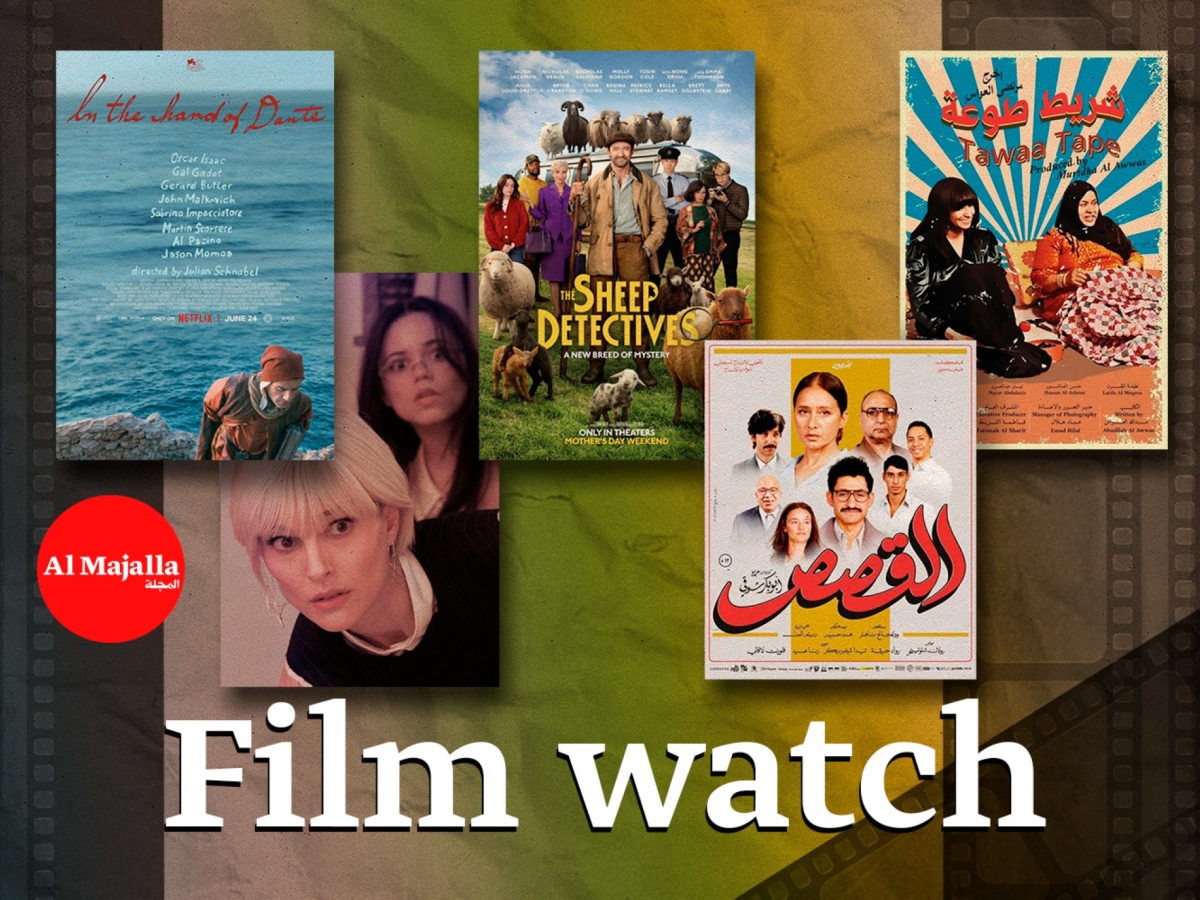

Every month, Al Majalla grabs the popcorn and settles back to watch a selection of the latest films (and occasionally a golden oldie) before offering an assessment. Within this, we cover the new releases both in Arab cinema and beyond.
Tawah’s Tape
Screenplay: Abdullah Al-Awwas
Director: Murtada Al-Awwas
Country of production: Saudi Arabia
In Tawah’s Tape, the young director Murtada Al-Awwas continues his commitment to short film, a medium that can give emerging filmmakers more control and security early in their careers. Still, this latest work is considerably longer than his previous films Farigha (about rising prices) and Qatra (about correcting children’s behaviour), which ran for seven and five minutes respectively.
With the 18-minute Ayn al-Tariq? (Where is the Road?) from 2017, Al-Awwas moved into narrative drama, following a widow and her young daughter who are forced to flee the tyranny of the woman’s brother, who refuses to accept her independence. Tawah’s Tape touches on similar themes but shows a deeper engagement with local identity and seeks to make this a parallel protagonist rather than merely a backdrop.
Inspired by true events, the film tells the story of Tawah, a young woman living quietly with her grandmother, a seamstress, when a long-awaited newspaper announcement compels her to rewind the reel of her life. Although the film runs for no more than half an hour, its production company, Al-Jinan, opted for a commercial release at Empire Cinemas in Al-Ahsa, in Saudi Arabia’s Eastern Province. More typically, short films begin at festivals and specialist film events before reaching commercial screens.
The cast includes Latifa Al-Muqrin, Hassan Al-Ashour, Nayar Abdulaziz, Lubna Boukhamsin and Ali Rajab. They help to draw the viewer into an intricate sequence of shifting timeframes, beginning with the heroine conversing with a friend online. Yet, the exchange appears on an old version of Windows running on an equally antiquated computer, placing the scene almost a quarter of a century in the past.
A page from Al Riyadh newspaper pinned to the wall behind her takes the narrative further back still. One headline reads: ‘India officially recognises the State of Palestine... on the eve of Arafat’s visit.’ This was in the late 1980s. From there, the film unfolds through nostalgia and memory in a form closer to free association than to conventional chronological narration.
The production company says the film seeks to revive the atmosphere of zaman al-tayyibin (‘the days of the good people’), a Saudi expression broadly comparable to the Egyptian phrase al-zaman al-jamil (the beautiful old days), one long associated with the country’s artistic golden age, before its meaning gradually expanded.
In both cases, the phrase is less a fixed designation for a clearly bounded historical era than a reflection of memory itself. Its meaning shifts from one generation to another and from one historical moment to the next. A search today for ‘singers of the beautiful old days’, for example, may yield names such as Ehab Tawfik, Assala, and Samira Said, rather than Umm Kulthum, Mohammed Abdel Wahab, and Shadia, who would almost certainly have dominated the same search 20-30 years ago.
The Gallerist
Screenplay: James Pedersen, with the director
Director: Cathy Yan
Countries of production: France, United States
What makes something art? It has been asked before and will be asked again, because it acknowledges that the definition of art evolves. That is a theme in The Gallerist, a new film by Cathy Yan, in which the artistic material is the human body itself.
The story begins with an unexpected accident during preparations for the opening of an exhibition. Gallery owner Polina (Natalie Portman) is already struggling against fierce competition and the threat of bankruptcy when her assistant, Kiki (Jenna Ortega), sees an opportunity in the disaster. With only hours remaining before the opening, Kiki proposes exhibiting the dead man’s entire body as an immaculate, anonymous work of art, then selling it to a gullible collector who can transport it away.
Bodies soon start to decompose, so time is of the essence. This dark comedy scheme quickly ensnares the pair in a succession of absurd predicaments and frantic pursuits, which Yan handles with assurance and precision, giving the film a breathless rhythm. She uses long takes that fuse the glitter of the gallery with the horror of the situation, while drawing on the kinetic energy of absurdist chase films to give physical form to her characters’ obsessions.
In Yan’s earlier film Dead Pigs, she observes the transformations of a globalised society through the surreal spectacle of thousands of dead pigs drifting along a river. In Birds of Prey, she enters the flamboyant world of female superheroes, with its riotous colours and comic-book aesthetic. The Gallerist brings these two satirical impulses, social and visual, into the same frame.
Behind the glamour of the gallery circuit is a world governed by money and a system that can turn almost anything into a commodity if someone confers value on it. The motif of the socially active corpse is used in Jorge Amado’s novel The Two Deaths of Quincas Wateryell, while Egyptian director Osama Fawzy revisited a related idea in his 1999 film Paradise of the Fallen Angels.
In The Gallerist, the corpse exposes the fragile boundary between an artwork’s intrinsic value and the value assigned to it by the market. In this way, it offers a caustic critique of capitalist logic in the contemporary art world, a realm in which even a banana taped to a wall (as in Italian artist Maurizio Cattelan’s controversial Comedian) can be worth millions of dollars.
In the Hand of Dante
Screenplay: Louise Kugelberg, with the director
Director: Julian Schnabel
Countries of production: United Kingdom, Chile, Italy
Recently released on Netflix, In the Hand of Dante by American director Julian Schnabel works within a familiar narrative tradition, one that revives historical figures and texts by setting past against present. The film unfolds across two parallel worlds; one is set in contemporary New York, the other follows the Italian poet Dante Alighieri in the 14th century as he writes his immortal epic The Divine Comedy.
This structure provides the screenplay with its central dramatic premise. Adapted from Nick Tosches’s novel of the same title, it imagines the disappearance of the original manuscript of The Divine Comedy, written in Dante’s hand, and turns its theft and circulation into the centre of an increasingly complex struggle.
By setting Dante’s torment in the past against the disappearance of the manuscript in the present, the film evokes the fictional universe of Umberto Eco, particularly his fascination with lost and forged manuscripts, secluded monasteries, and the deciphering of power in its many forms. The most immediate comparison is with The Name of the Rose, whose mystery revolves around a lost work by Aristotle concealed within an enigmatic monastery.
Schnabel blends something of Eco's scholarly and historical atmosphere with the suspense of crime and mafia fiction. The effect is strengthened by cameo appearances from Al Pacino (who played Michael Corleone in The Godfather) and Martin Scorsese, who directed several mafia films. Scorsese plays a sage with such assurance that it makes you wonder what might have been had he chosen acting over directing.
Through the interwoven forces of art, violence, and faith, the film draws a striking parallel between two formidable Italian institutions: the Vatican and the mafia. Their methods of exercising power bear an unsettling resemblance. The Vatican claims spiritual authority and influence through symbols and rituals, while the mafia exerts influence through bloodshed, material power, and intimidation.
The film explores the erosion of moral boundaries once history itself becomes a sellable commodity. The Divine Comedy passes through church corridors and the hidden channels of organised crime, while criminality emerges as a shared instrument of domination and control over minds. Paradise, meanwhile, remains in the hands of those willing to seek it beyond established frameworks.
The Sheep Detectives
Screenplay: Craig Mazin, Leonie Swann
Director: Kyle Balda
Countries of production: United States, United Kingdom
After years of association with fully animated films such as Minions and Despicable Me, director Kyle Balda ventures into live-action feature filmmaking for the first time with The Sheep Detectives, combining human performance with animation. He has described the transition as the greatest challenge of his directing career. The film also marks a significant departure for screenwriter Craig Mazin, better known for crime narratives and emotionally-charged drama, with this move towards a funny family film.
A recognisable Mazin theme nevertheless remains intact: the pursuit of truth through multiple perspectives. That preoccupation finds a natural counterpart in the source novel, Three Bags Full, by German writer Leonie Swann. The story is told from the perspective of a flock of sheep whose understanding of the human world extends only as far as what they see and how they interpret it.
Within this fantastical premise, the film follows George, a shepherd (Hugh Jackman) who calls his sheep "the sweetest animals on earth". He gives each sheep a name and speaks to them as though they were members of his family. At night, he reads them a detective story. Over time, the flock becomes engrossed in these mysteries. They speculate about the identity of the murderer and eagerly await the stories' conclusions the following evening.
The game assumes a grim reality when George dies unexpectedly. The dim village policeman sees only an unfortunate accident, but the sheep are unconvinced and feel their shepherd has been murdered. Drawing upon what they have learned, they embark on their own investigation.
Inherently eccentric, Balda transforms the material into an inverted parody of conventional crime cinema. The screenplay observes the familiar rules of the classic detective story, carefully planting clues. But the process of deduction proceeds from an unfamiliar perspective, because the sheep understand the world only within the narrow limits of their own experience, one that is bounded by pastures, barns, and routines.
Much of the comedy comes when they cross these boundaries and enter the human world, such as venturing into a church. Through their eyes, we look afresh at people and their institutions. Their choices add to the irony, since few animals are more deeply associated with conformity and herd mentality.
Alongside the charm of its fantastical conceit, the film constructs a sharp comic and philosophical contrast between its two communities. While the villagers are driven by selfishness, greed, and poor judgement, the sheep have a collective awareness, an instinct for survival, and even powers of association and deduction that surpass those of the investigators. In this way, it holds a mirror up to human arrogance and mocks our claim that we alone possess reason and logic.
The Stories
Written and directed by: Abu Bakr Shawky
Country of production: Egypt
The Stories belongs to a quieter, more contemplative cinema that invests as deeply in the characters as in the story. From within a single household, the film constructs a broad portrait of Egyptian society over more than two decades, from the military defeat of June 1967 through to the economic and social transformations of the mid-1980s.
At the centre of the film is Ahmed (Amir El-Masry), a young man from a middle-class family who loves, and finds refuge in, the piano. The narrative gradually grows to encompass other family members and neighbours. The political and historical backdrop becomes a succession of turning points that reshape the characters' destinies and redirect the course of their lives.
The film brings together a large ensemble cast that performs in harmony. Nelly Karim gives a distinguished performance as the mother, while Ahmed Kamal once again demonstrates his acting qualities. Although rarely the leading man, he has developed a distinctive and familiar screen presence over four decades, such that his presence becomes part of the identity of the works in which he appears.
The idea for the film originated years ago as a short inspired by the true love story of Shawky's father and his Austrian mother, whose relationship unfolded through letters. This prompted Shawky to compare the two eras: one in which a reply might take months to arrive, and another in which it can be received as soon as it is sent.