On trade with China, Europe is fighting yesterday’s war

Brussels has finally agreed a raft of measures aimed at sectors that Beijing no longer considers to be its strategic industries

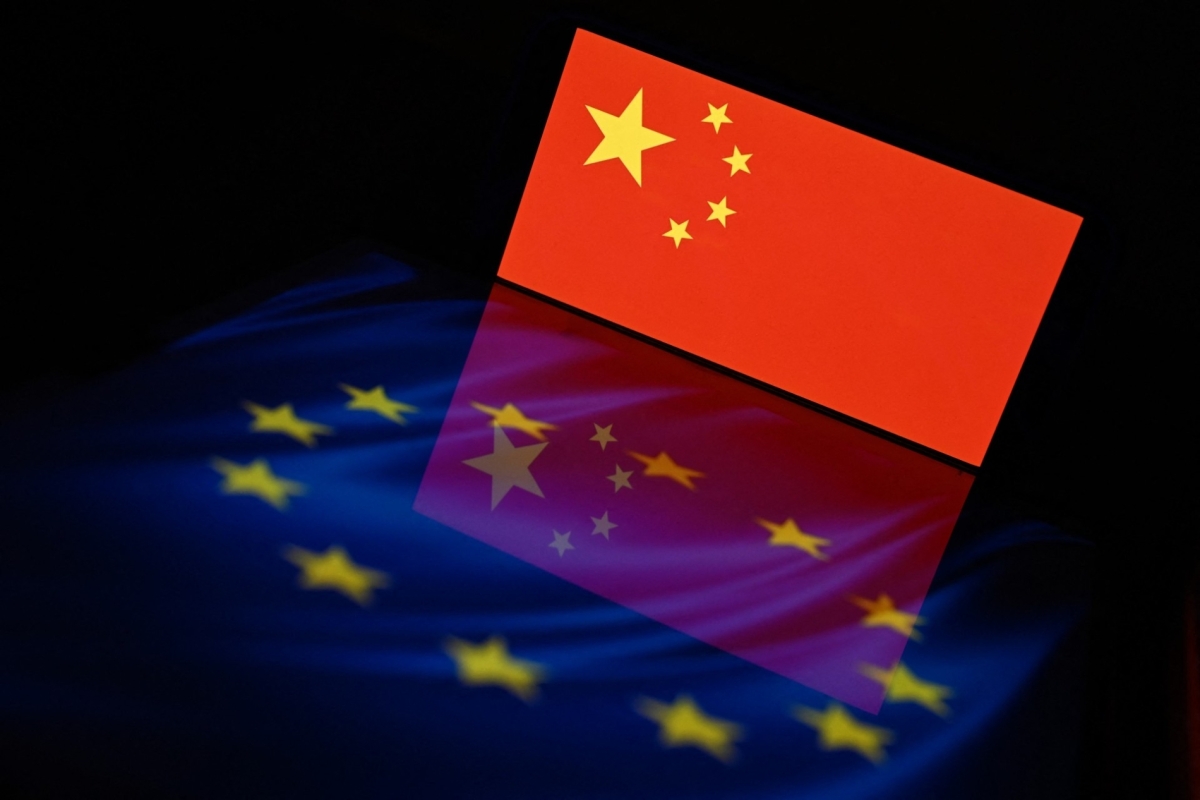
This illustration photograph shows the flags of the European Union and China displayed on screens in Brussels on 2 June 2026.
Nicolas TUCAT / AFP
This illustration photograph shows the flags of the European Union and China displayed on screens in Brussels on 2 June 2026.

On trade with China, Europe is fighting yesterday’s war

Last month China’s customs administration published a number that has ended the China trade debate in Brussels: China’s June trade surplus with the European Union reached a record $32.9bn, up 27% from a year earlier.

Underlying this dazzling export surge is the trade divergence between Europe’s two largest economies. China’s trade surplus with Germany, Europe’s industrial core, more than doubled, while its surplus with France plunged by 81%. The divergence tells a parallel story about the EU’s internal fracture, just days after the EU’s newest defensive measures took effect: a €3 flat customs charge on low-value e-commerce parcels, and a tightened duty-free quota on imported steel, both big trade categories with China.

Remedial policies

Years in the making, these EU regulatory measures may also be beside the point. Europe’s trade deficit with China ran at roughly €360bn in 2025—about €1bn a day—and has widened by double digits since. Of the EU’s 21 ongoing anti-dumping and anti-subsidy investigations, all but three are against Chinese producers.

It has imposed tariffs on Chinese electric vehicles (EVs) since October 2024, proposed an Industrial Accelerator Act to privilege European goods in public procurement, proposed a Cybersecurity Act revision that would exclude ‘high-risk’ vendors from telecoms networks, and floated an ‘overcapacity instrument’ to cap sectoral imports.

Trade Commissioner Maroš Šefčovič has set October as the deadline for a negotiated trade rebalancing, but none of these remedial policies will work, not because Europe lacks tools, but because it is aiming at targets China has already left behind. Meanwhile, Beijing’s response to the EV tariffs was calculated and paced: it gradually opened probes into European brandy, pork, and dairy products. They are politically sensitive, economically trivial, and specifically targeted at French cognac houses, Spanish pork farmers, and the EU’s subsidy programmes.

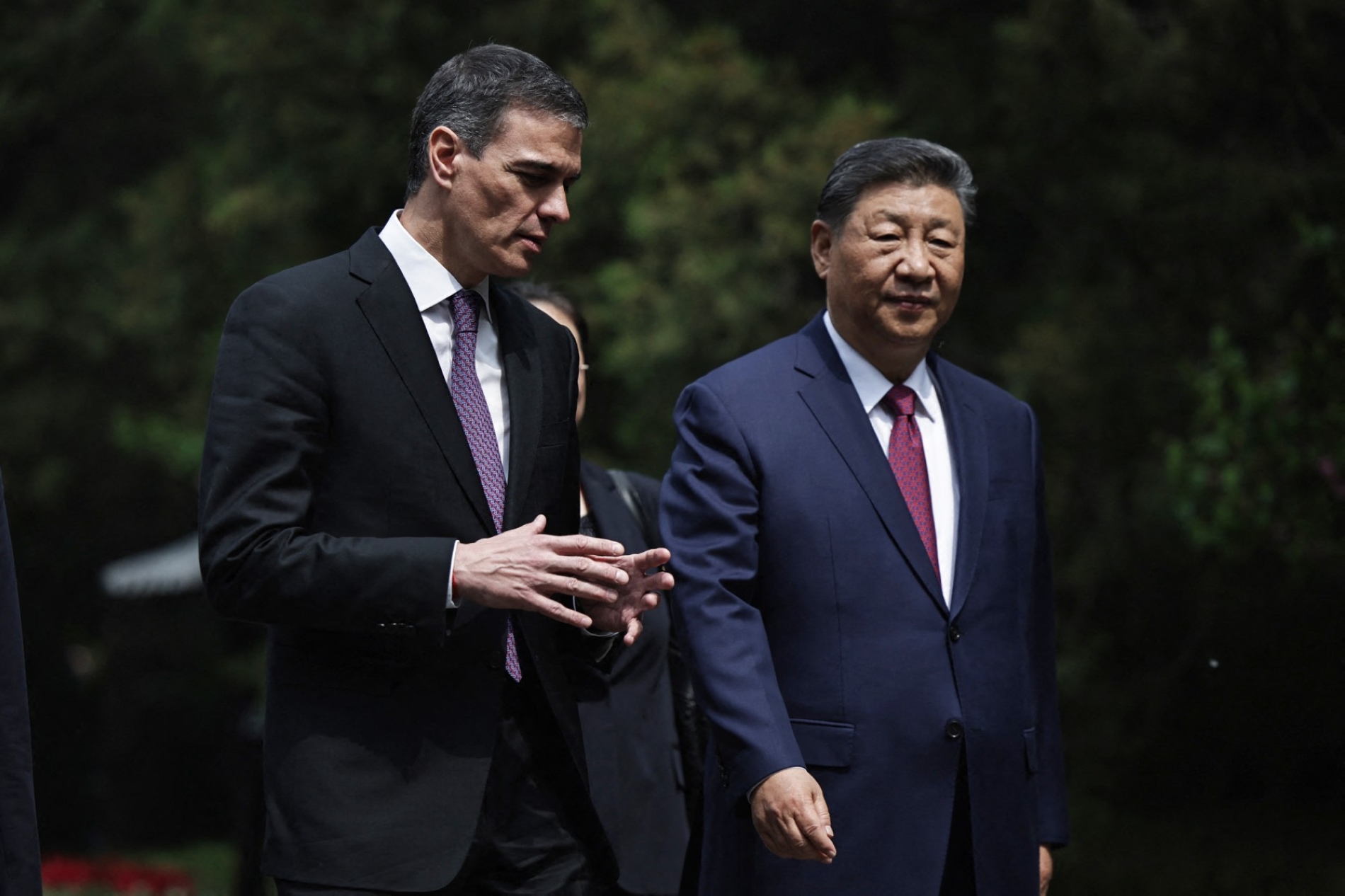
In December 2025, China quietly lowered its pork duties from an initial ceiling of 62.4% to under 20%, after Spain’s Pedro Sánchez visited Beijing and hailed China as a partner, not a rival. The message to every European capital was clear: diverge from Brussels and reclaim trade sovereignty. Critics say this amounts to ‘divide and conquer’.
ANDRES MARTINEZ CASARES / AFP
Chinese President Xi Jinping (R) and Spanish Prime Minister Pedro Sanchez (L) speak after a meeting as they walk along the gardens of Diaoyutai Guest House in Beijing on 11 April 2025.

Retaliatory ladder

Tariffs sit at the bottom of the retaliatory ladder. Above that are regulatory hurdles particular to multinational firms operating in China, such as merger reviews, competition probes, and preferential trade clauses imposed by China’s regulators that guarantee China’s supply chain security.

China’s market regulator now wields a stop-the-clock mechanism that has pushed average merger-review times past 13 months. It also now inserts supply-chain guarantees into merger approvals, as in its 2025 conditional approval of the Bunge-Viterra agricultural merger, where a clause dictates that the new company continue to supply China even during global crop shortages. Elsewhere, regulators opened an antitrust investigation into DuPont’s China business in 2024, then quietly suspended it in April 2025. The timing tracked the political climate, not evidential findings.

The top rung of measures is export controls on processed rare earths and permanent magnets, where China’s near global monopoly lets it bring European automotive and defence production to a halt within weeks. In January 2026, Beijing imposed a full minerals and materials export ban on Japan over its prime minister’s Taiwan remarks, adding dozens of Japanese firms to the sanctions lists. Europe took note.
None of the EU's remedial policies will work, not because Europe lacks tools, but because it is aiming at targets China has already left behind

Industrial vision

Beijing has built a legal architecture to formalise what used to be ad hoc. The Provision on Industrial and Supply Chain Security Law allows China to penalise foreign firms that discriminate against Chinese supply chains, while the Anti-Foreign Sanctions Law provides the statutory basis for retaliation against foreign sanctions on Chinese firms. Institutionalised, China's retaliatory trade measures are now more credible.

Beijing believes it can dissuade collective EU action by lobbying state capitals individually. The June trade data, showing Germany's surplus doubling while France's collapses, helps show that Beijing is right. The EU's defensive apparatus, whether EV tariffs, battery duties, or solar diversification, is calibrated against the Chinese industrial sectors that Beijing no longer backs with its own industrial policies or state capacity.

Since 2023, under President Xi's new industrial vision, China has pushed toward the doctrinal successor to 'Made in China 2025'. Having watched provinces duplicate one another's EV plants and polysilicon factories, he criticised over-investment and launched an all-out campaign against 'involution' (neijuan), the domestic market competition that has driven Chinese industries into structural deflation.

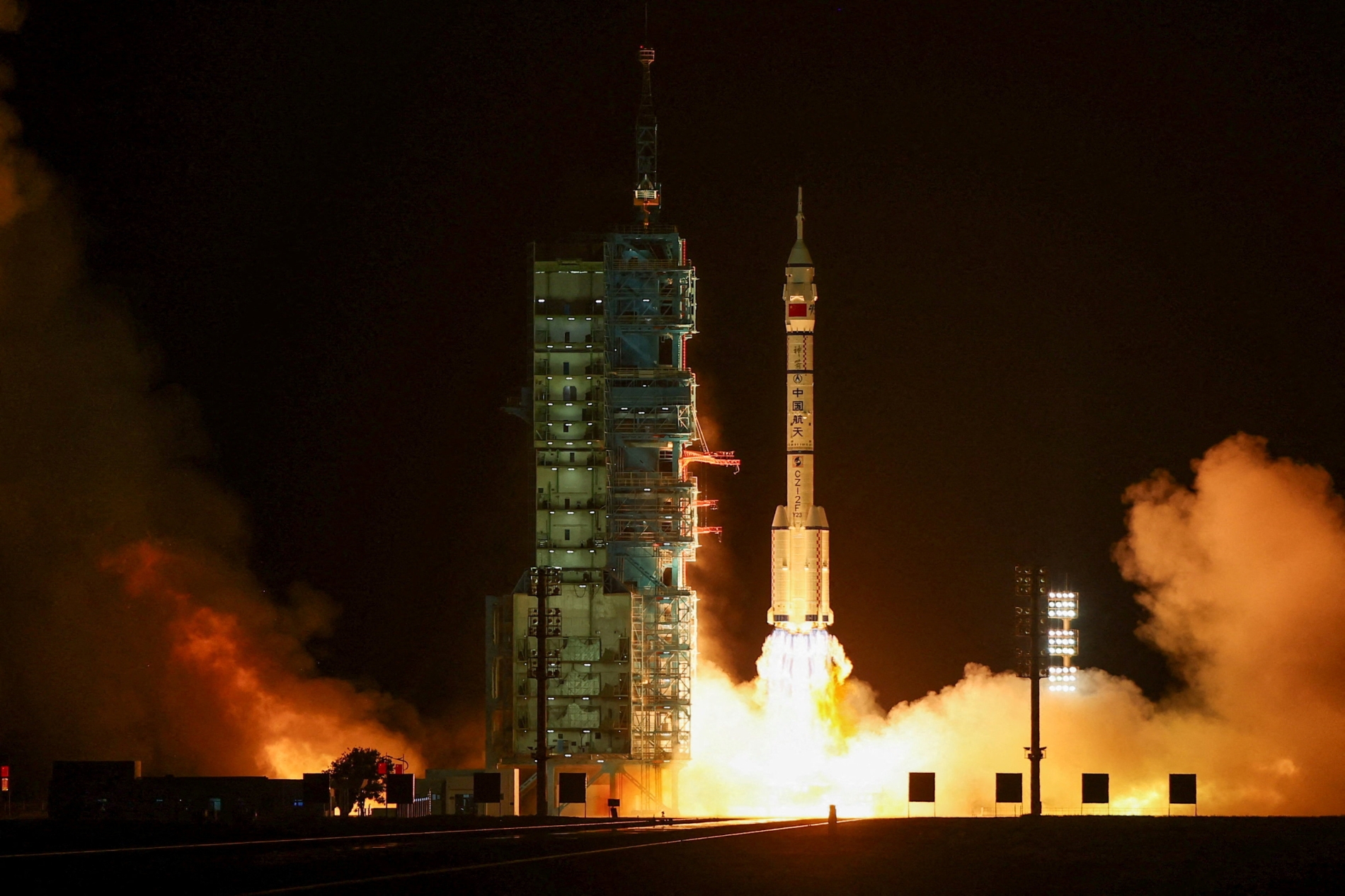
The new 15th Five-Year Plan commencing in 2026 called for doubling down on advanced manufacturing and technological self-reliance. This time, the state removed subsidies on EVs, solar, and batteries, instead investing statewide in quantum, space, low-altitude flying vehicles, and humanoid robots. Beijing wants to move away from the low-margin sectors—EVs, batteries, and solar—and once again climb the value chain.

REUTERS/Maxim Shemetov
A Long March 2F rocket carrying the Shenzhou-23 spacecraft with Chinese astronauts blasts off to China's Tiangong space station from the launchpad at the Jiuquan Satellite Launch Centre on 24 May 2026.

Future focused

The numbers offer explanation. Polysilicon capacity ran at under 40% utilisation in 2025. JinkoSolar, the world's largest module supplier, saw its 2025 gross margin compress to 2.2% and swing from a slim profit to a steep loss. Indeed, the combined losses for listed Chinese solar companies in 2025 were around $7.3bn. This is no longer an industry Beijing subsidises. Instead, it has been left to survive by itself, but investments are accelerating into humanoid robotics, AI infrastructure, biomanufacturing, and commercial aerospace.

In short, Europe is fixating on what China has already mastered, meaning it is behind the times. The EU's trade defence instruments are therefore reactionary. The bloc must respond to existing and large-scale market distortions, calculate a dumping margin, survive the parliamentary debate, and clear 27 member states. The process takes months, if not years.

By the time Brussels agrees tariffs on Chinese EVs, it is too late to have the effect it wants, and by the time it builds an overcapacity instrument for batteries and solar panels, the next exports flooding the EU market will be pharmaceuticals and chips. China can turn on a new decade of industrial policy and cultivate a new wave of industrial frontiers overnight, at an unprecedented scale.

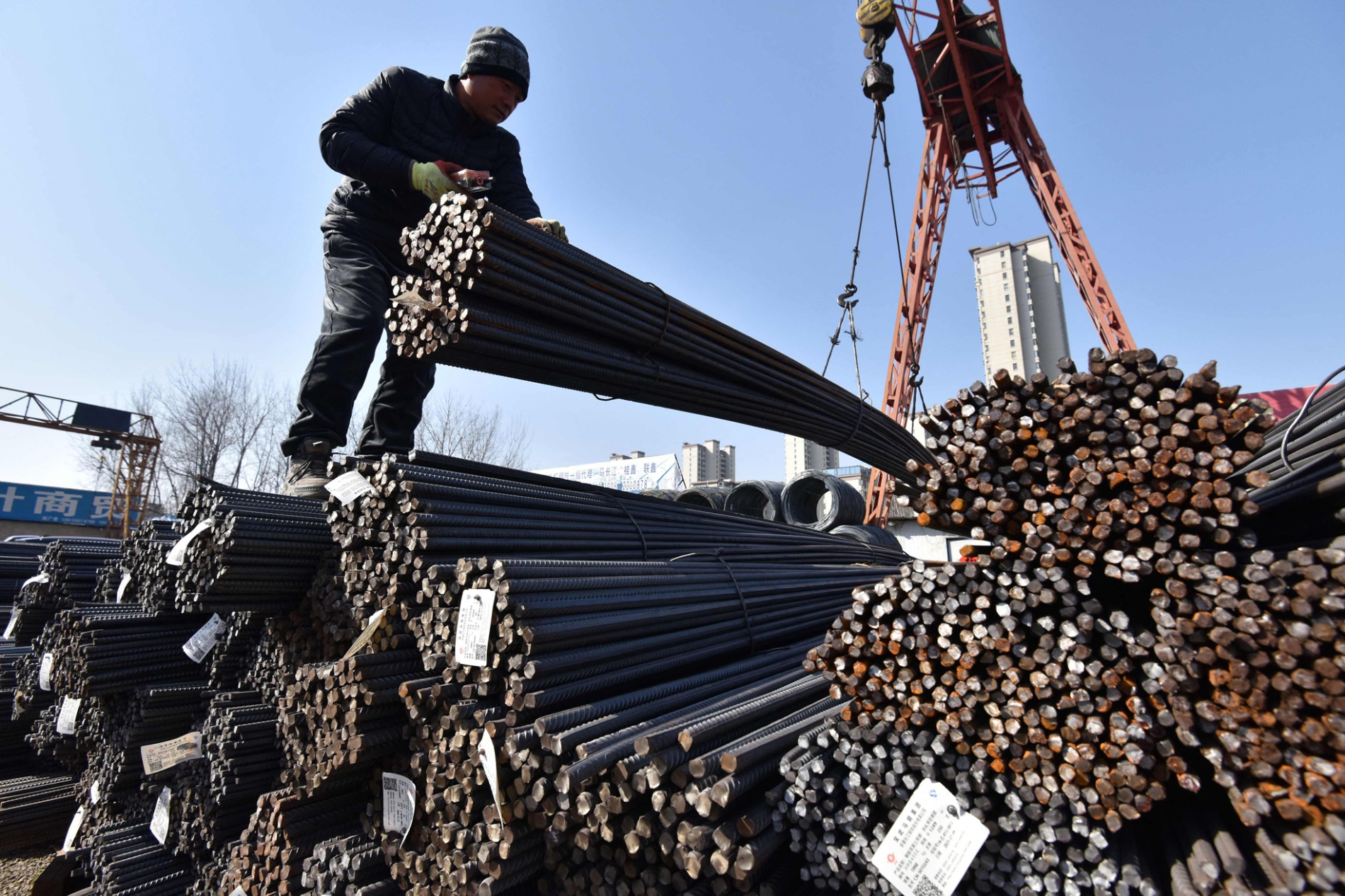
Its competitive engine is now driven by firms that survive domestic price wars to emerge scaled, cost-hardened, and execution-disciplined. They become national champions battle-tested in a cruel market, then unleash their products abroad. This is why China makes 55% of the world's steel, 70% of its lithium-ion batteries, 75% of its EVs, 80% of its solar panels, and 57% of its new commercial vessels.

AFP
A crane lifts iron bars, at a steel market in eastern China's Anhui Province, February 10, 2025.

Becoming proactive

An October deadline shows the bloc has no urgency or foresight to address Beijing's 'Made in China 2.0' through its new quality productive forces. To reposition, Brussels must abandon its reactionary sector-by-sector defence and build instruments that are competition-triggered, anticipatory, and automatic. Policy must be applied across a whole technology ecosystem before the next industrial surge arrives.

It should also aim to resolve the German question. The EU is a trading bloc whose largest economy is simultaneously the biggest loser from Chinese manufacturing exports and the most invested in the Chinese market. Beijing knows the German contradiction better than Brussels does.

In summary, Brussels has finally decided to confront China's export machine, but it is confronting the wrong one. The EU's looming measures will not reset the record trade deficit with China; they will only buy Europe more time to nestle in comfort. China has already moved on from the industries that Brussels is now targeting, and Europe has built little from within to take their place. To win a trade war, you need to be proactive. Europe's new instruments will doubtless be well-drafted, but they will also be answers to yesterday's questions.

font change