Football and art: fusing a popular sport with culturehttps://en.majalla.com/node/331689/culture-social-affairs/football-and-art-fusing-popular-sport-culture
For the hundreds of millions of fans and supporters who love the world’s most popular sport, football is more than just a game. For those who watch matches, whether on the screen or in the stadium, it is more than entertainment and spectacle. In the elite employment of rhythm, power, precision, imagination, and pace, it is more of an art.
It can capture the hearts of those who play and those who follow a team, whether they be amateurs or professionals, local or national. Over the years, the importance of football has been repeatedly demonstrated, even in times of war, with combatants downing their weapons and coming together for the occasion. Lebanon offered a vivid example of this during the long civil war (1975-90), when fighters would lay down their rifles and gather in the streets along what became known as the ‘lines of contact’ to watch matches. Political rivalries receded for two hours, creating a shared space for a people driven apart.
Immersion in both football and art—whether through creation or reception—opens the gates to an almost dream-like state, where meaning thickens and excitement quickens. In this suspended orbit, the problems of the world get momentarily forgotten. Unlike many realities of life, football offers a lucid structure, with a beginning and an end, and a firm result, whether that be a victory for one side or honours even. In a world of ambiguity and uncertainty, the surety is appealing.
In creating their art, the artist has the freedom to erase, reshape, and return. Time is more generous, allowing for the unfinished to find its final form. Creation becomes a patient pursuit of completion. A game of football can be similar, with an end result, whether that be decided by penalty kicks or a goal in extra time. This end phase of the match carries some of the game’s most charged and meaningful moments. Time seems made of another substance, forged from passion and threaded with longing.
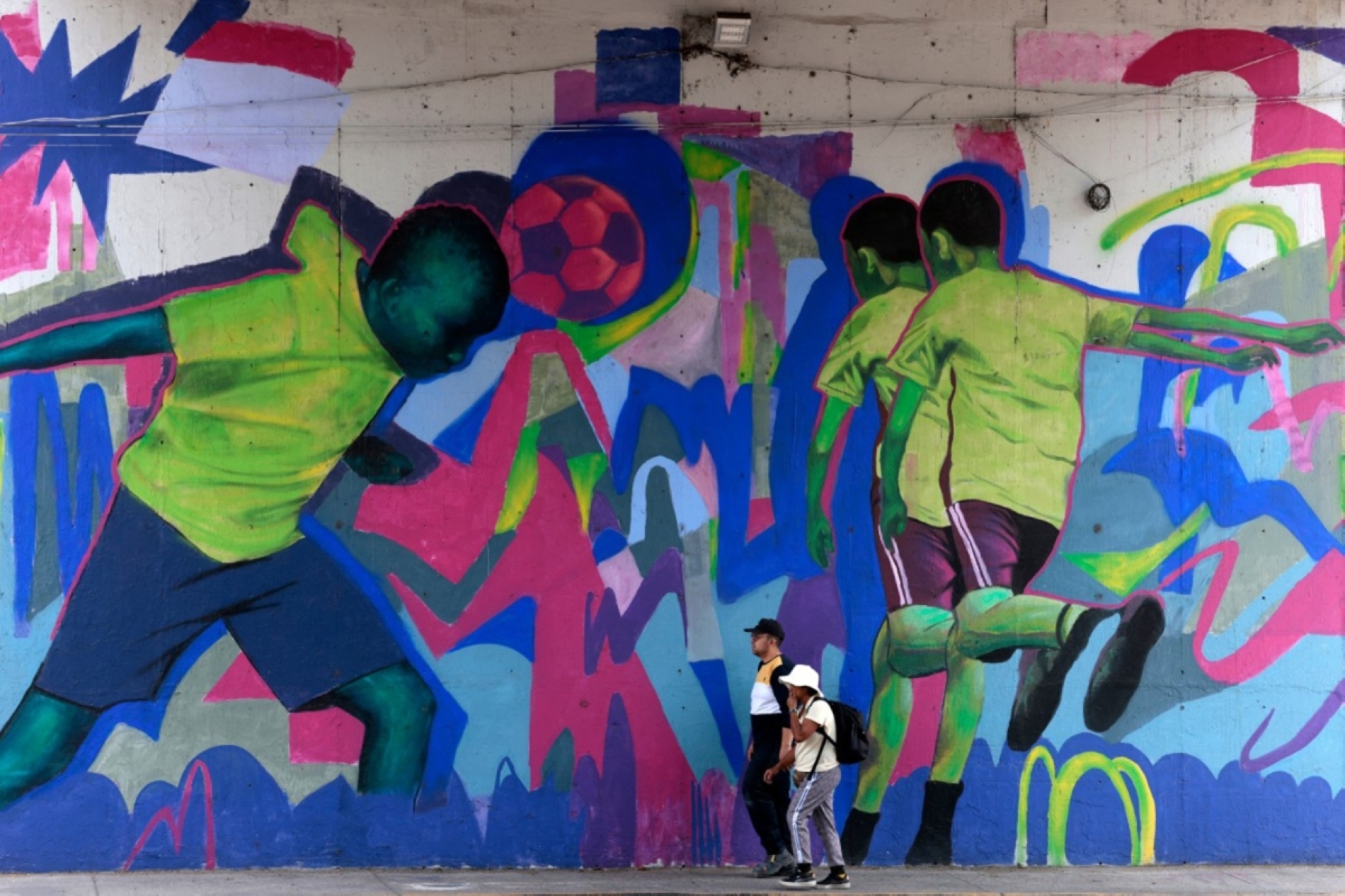
People walk past a mural of children playing football in Guadalajara, Mexico, ahead of the 2026 World Cup.
For many players, including those competing at this year’s World Cup in North and Central America, the consequences of the result can extend far beyond the match itself. In those final few minutes, perception of time shifts, and the moment expands beyond its temporal boundaries until the entire future appears suspended in a single shot.
Art, whether through painting, sculpture, street art, or installation, has played a vital role in deepening this condition and enriching it with further layers of meaning. It can preserve the spirit of the sport and the emotions that accompany it. Whereas photos and video footage of the action are both direct and fleeting by nature, fine art can carry football from the present moment into myth, iconising an action, recasting the footballer as a god or hero, and stadiums as cathedrals in which the troubles of the world vanish for a few hours.
Art lends football an air of nobility, lyricism, and symbolic depth.
Fusing football and culture
Perhaps the biggest power of fine art lies in its ability to suspend a particular instant and celebrate it with all the skill, knowledge, and passion that the artist can summon. In this spirit, Iraqi artist Dia al Azzawi produced two important works. One was titled Five Children Playing Football.
Departing from conventional sporting representations that celebrate the lightness and joy of the game, al Azzawi turned football into an artistic language for a humanist stance against war. The work was a response to the killing of four cousins who were shelled while playing football on a Gaza beach in 2014. In this way, the artist transformed an innocent childhood scene into a severe testimony to loss and violence.
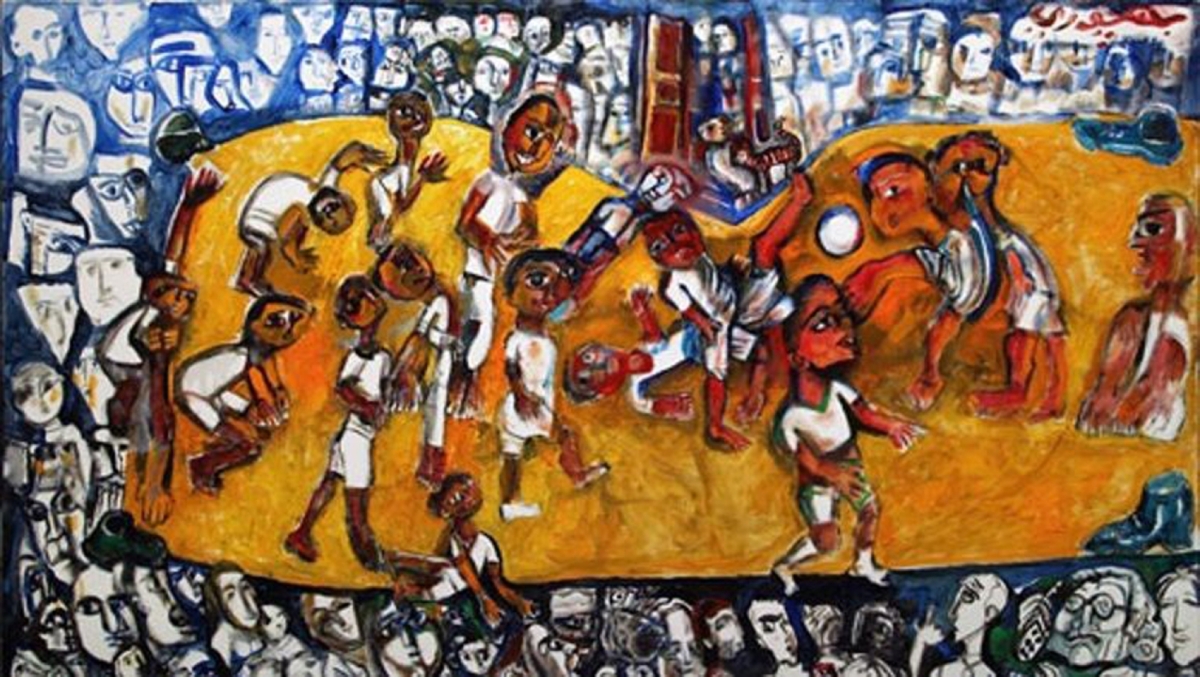
Egyptian artist George Bahgory, who is known for fusing football with popular culture in works inspired by Cubism, captured the vitality of a game he regarded as an essential element of national identity. His well-known works depict children playing football in the alleys of Cairo, as well as scenes of popular cafés during national team matches. His Cubist approach, built on multiple perspectives, helps convey the players' dynamic movement and the ball's paths in a visual language pulsing with rhythm.
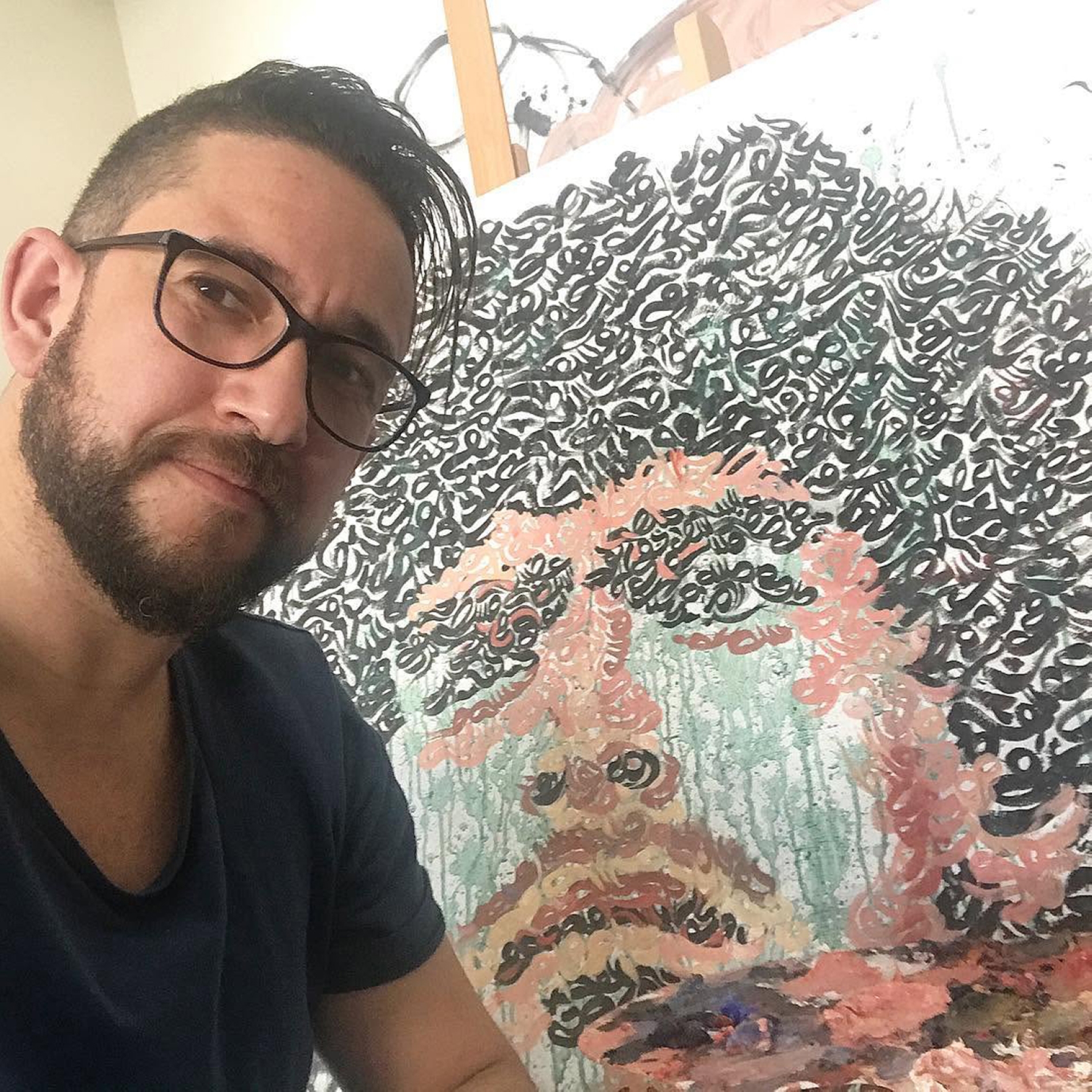
Artist Zakaria Al-Ramhani, alongside his painting inspired by Maradona's famous handball goal in the Argentina-England match.
In 2018, an exhibition titled Art and Football was held in Casablanca. It brought together 20 Moroccan artists and nearly 40 works. Among them was Zakaria Al-Ramhani, whose painting immortalised Maradona's handball goal against England in the 1986 World Cup quarter-final, the moment later becoming known as "the hand of God".
Another artist was Nabil El Makhloufi, who presented works such as Footouche, in which he explored Moroccan identity and collective emotion, while Mohamed El Baz's works centred on team dynamics and football's social impact. Yet football has not yet secured a central place in Arab fine art compared with themes such as daily life, politics, or identity. Rather, it has been more visible in illustration, pop art, poster art, and murals of the kind that set Maradona against the grey, impoverished streets of Naples, the city where he played and was idolised.
Messaging through sport
Football has stirred the imagination of artists across different practices. Lebanese duo Ashekman created large murals in Beirut that link the dynamism of football to messages of peace, reminding viewers that on the pitch, all Lebanese wear the same shirt. From Saudi Arabia, Bayan Yassin stands out for a work connected to the 2026 World Cup, combining contemporary art with visual elements drawn from local heritage in a design produced as part of a special initiative by Sports Illustrated, an independent art project to create 48 digital covers for the countries taking part in the tournament.
Likewise, renowned Saudi artist and curator Lulwah Al Homoud created a giant sand mural in the desert outside Riyadh titled Good Luck. It was a message of encouragement to the Saudi national football team—aka the 'Green Falcons'—as they travelled to America to compete in the 2026 World Cup.
Such examples reveal a close intersection between football and popular visual forms, an affinity rooted in simplicity, reach, and reproducibility, in contrast to more rarefied forms associated with oil painting or multimedia work. This convergence between illustration and football has helped transform the game into visual material driven by movement and immediacy, rather than prolonged contemplation. Football follows a different logic when it appears in painting and sculpture. There, it is treated with greater slowness and reflection, sometimes being used to pose political questions over issues such as poverty, marginalisation, and double standards.
A mythic aura
Through painting, sculpture, street art, and installation, art helps create a temporary escape from reality. Unlike the fleeting images in the media, fine art and illustration have helped confer a mythic aura on football, turning players into icons whose fame extends far beyond sport. It draws the gaze away from sombre politics towards the beauty of movement and feeling, while stadiums become almost sacred spaces.
Through this visual transfiguration, fine art and illustration give football a poetic and aesthetic dimension. At the same time, some artists seek to turn football into an instrument of political protest, a means of confronting public indifference, and a way to reveal human fragility without resorting to sensationalism or exploitation. This tendency appears in works that alter FIFA slogans or symbols, replace the ball with a bomb, or set scenes of sporting celebration beside images of destruction and refugee camps.
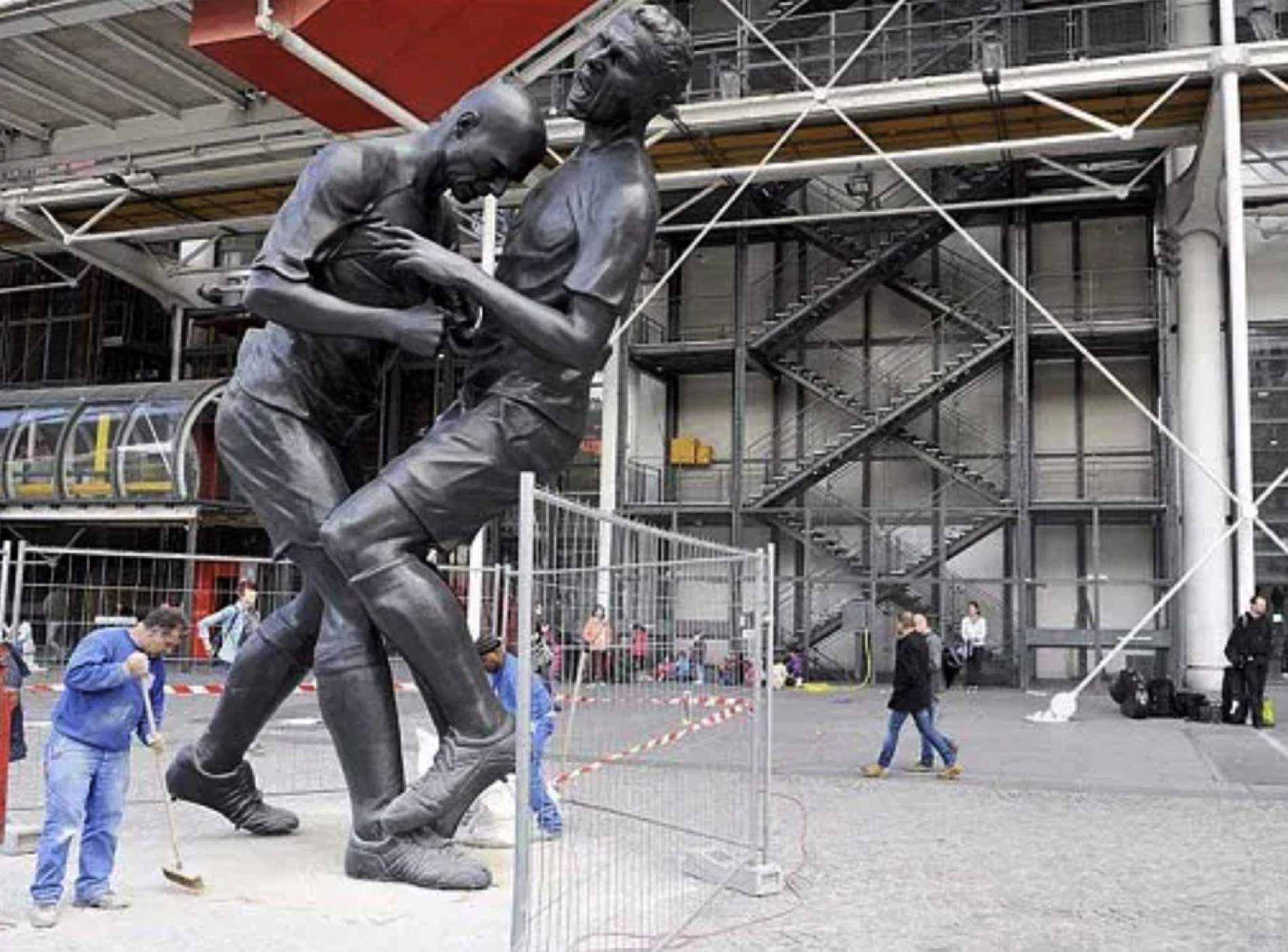
One of the most striking examples is Adel Abdessemed's monumental sculpture Headbutt, which immortalised the moment when French talisman Zinedine Zidane headbutted the Italian player Marco Materazzi in the chest during the 2006 World Cup final, in response to Materazzi insulting Zidane's family after an incident on the pitch. The work shows how fine art and sculpture intersect with street art, caricature, and graphic art to express a profound human idea: the fragility of the hero, or indeed, the fragility of the human being.
An artwork depicting Zinedine Zidane's 'Headbutt' on Marco Materazzi in the 2006 World Cup final.
This is a reciprocal exchange between art and football. Art lends the game nobility, lyricism, and symbolic depth. In return, it benefits from football's immense popularity, reaching a broader, more diverse audience and moving beyond the boundaries of traditional cultural elites.
For many people, entering a contemporary art exhibition can stir a sense of inadequacy, feeling as though they lack the knowledge needed to understand the works on display. Football helps dissolve this barrier. What once belonged to the elite assumes a popular form. Any difficulty in approaching artwork fades through their connection to the sport. This helps to explain why major museums now organise exhibitions devoted entirely to football culture. This can embody the union between culture, art, and popular passion.
The Vitruvian Ball
This fascinating overlap has produced a contemporary visual idiom marked by drama and expressive force. Perhaps the single work that best encapsulates this is a collective creation. A widely circulated digital design, it was created and disseminated by several independent designers who produced multiple versions portraying Ronaldinho as the Vitruvian Man, Leonardo da Vinci's celebrated drawing that records the ideal proportions of the human body within a circle and a square.
The arts benefit from football's immense popularity, reaching a broader, more diverse audience and moving beyond the boundaries of traditional cultural elites.
The modern versions replace the classical figure with a footballer in an outstretched pose with the ball, transforming the image into a remarkable contemporary tribute to football culture, one in which the geometry of the player's skill comes to the fore and the game rises to the rank of pure art. Across its many versions, the digital image presents the player as an artist within the field of play, in complete harmony with the web of tensions surrounding him.
It recalls Da Vinci's vision of the human being moving in proportion and balance within a circle that now seems to echo the ball itself, so that the ball becomes an extension of the body and a sign of mastery and fluid motion. This digital work may also be read as a celebration of individuality dissolving into the body of the collective, where joy in life and the capacity to invent a precise kinetic order, at the heart of a circle besieged by death on every side, become a stored delight for what the future may hold when the bubble begins to fade with the final whistle.