How art therapy helps Gaza's children process traumahttps://en.majalla.com/node/331467/culture-social-affairs/how-art-therapy-helps-gazas-children-process-trauma
In Gaza, childhood is no longer unfolding as it once did. Something has broken in the fabric of daily life, leaving children struggling to understand a world whose pace of change has exceeded their ability to make sense of it. In temporary schools, camps, and cramped rooms, words no longer explain the world for Gaza’s children.
Into this void, artists have stepped, on a mission to help recover a lost childhood. Through drawing, movement, singing, and sound, they have begun helping traumatised Palestinian children regain the ability to express themselves. In this way, art therapy tries to give what remains of childhood a chance to breathe, perhaps through story, song, or colour.
Al Majalla met three artists from Gaza to explore their field experiences in providing psychological support and guidance to children. In their work, art and therapy intersect, as creativity becomes a tool for rebuilding the child’s inner space—however temporarily—within a reality still exposed to loss and upheaval.
Storyteller Itizaz al-Ubaid’s work seeks to loosen the direct bond between the child and the traumatic event by allowing the story to serve as a symbolic passageway. She does not begin with the war, nor does she end with it. Instead, she starts with neutral elements such as nature, colour, and imagination, to create a measure of psychological safety.
“I begin from elements that give the children a sense of warmth and imagination, until a protected imaginative space takes shape before any direct expression,” al-Ubaid explains. “The war appears in the story as one ugly image among dozens of beautiful ones, and this enables me to move the child into the safe space of art.”
In this context, children are not asked to retell their experiences directly, but gently guided towards symbolic writing through letters addressed to things that point less to war than to life. “This allows feelings to come out without a harsh reactivation of the trauma,” al-Ubaid says, adding that these children have spent three years sleeping in their shoes, because they have grown used to the possibility of sudden evacuation.
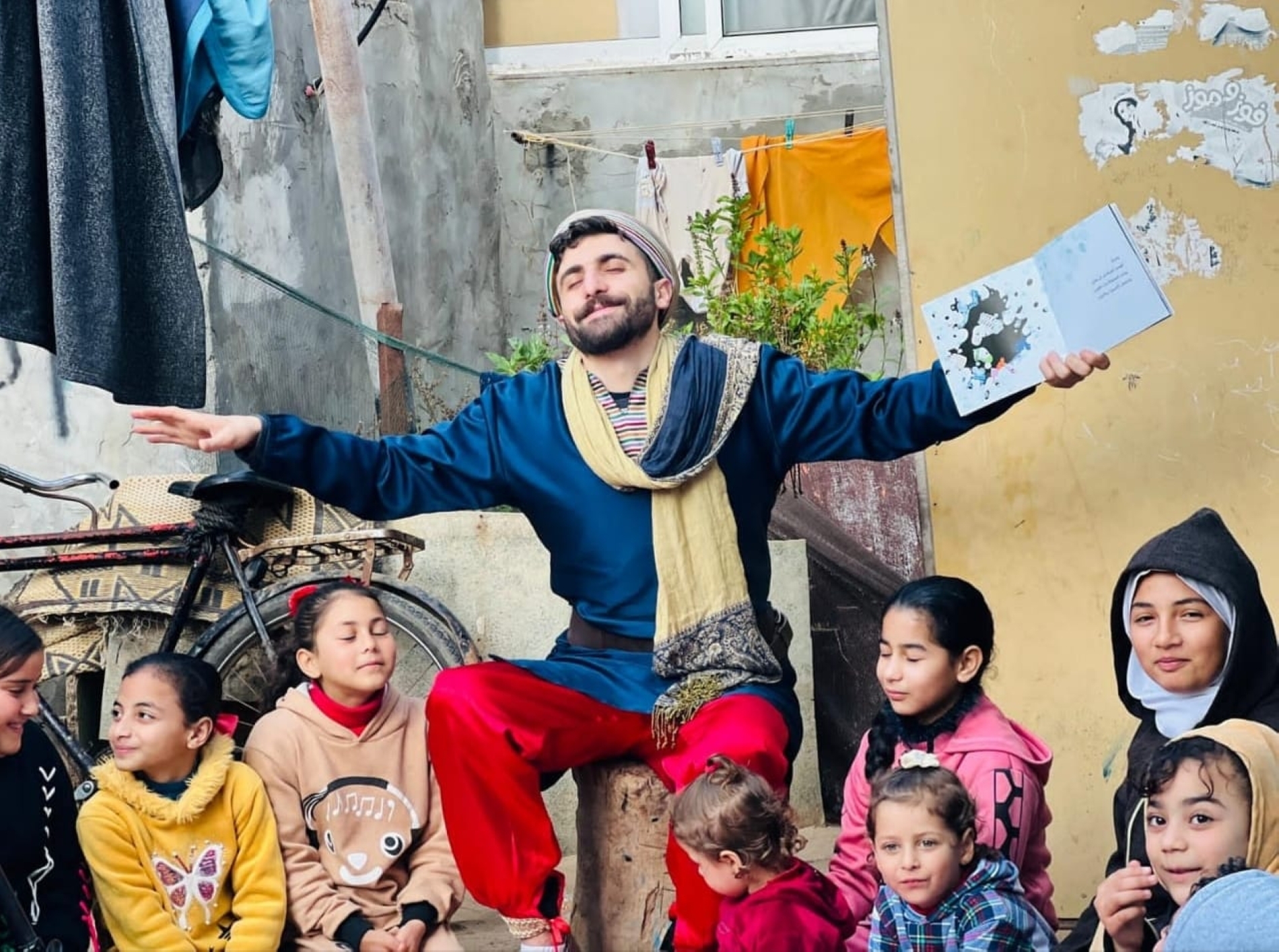
A storyteller reads to kids in Gaza.
Release valve
The tools of art become a way to dismantle their fear and mistrust of the world, but for al-Ubaid, the story cannot erase the pain of reality; it is closer to an act of reordering and symbolic release, allowing the child to control how near she gets to their own experience, and how far she remains from it.
A constant concern for facilitators during this work is the fear that a child may withdraw psychologically while recounting their story. Al-Ubaid therefore walks a fine line. “The child does not readily speak about his pain. They hide it, while fear appears on their face as though the event had just happened.”
At first, many of the children did not participate. They only listened. Then, step by step, they would gradually start singing.
Gaza singer Ahmad Abu Amsha
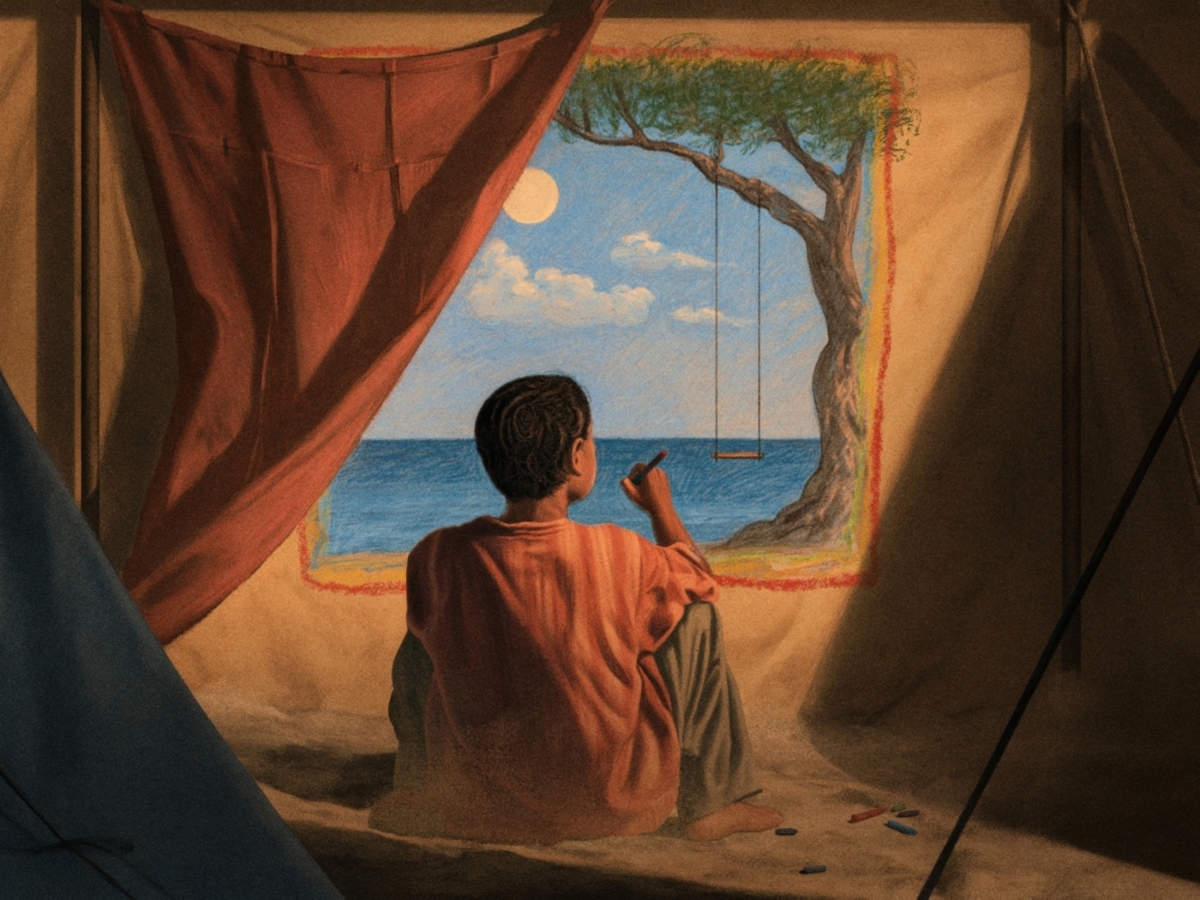
Each artistic encounter has its own subtle tools. Al-Ubaid uses story and imagination to create a parallel path through which children can cross into a safe zone while still seeing the original story within themselves. "I rely on transforming the experience into symbols such as the sky, the sea, clouds, rain, and the swing. I connect these to the child's imagination and to a moment of safety they once felt, even if only once. I walk with them slowly. Then the child speaks about their pain without naming it." In a way, it is like rescuing someone from drowning in the middle of a storm, holding them close, and gently asking them to breathe.
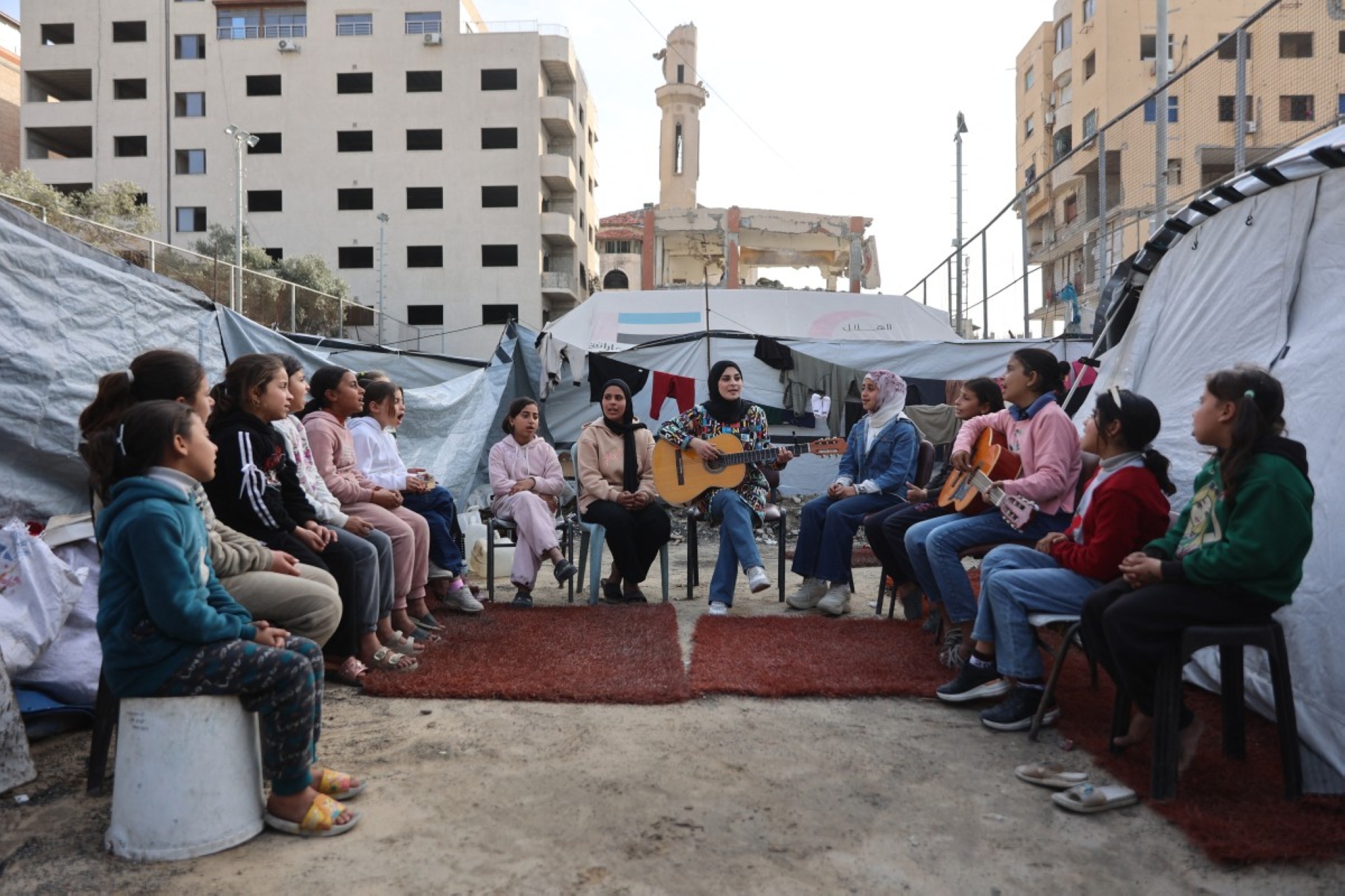
Rula Dalloul teaches displaced Palestinian children music and singing among the tents at a shelter in Gaza City, 2026.
Breaking isolation
Singer Ahmad Abu Amsha uses music to gradually break isolation and foster social integration. He thinks it offers children an accessible path towards psychological recovery through singing, playing music, and making instruments. The experience begins with the child listening in silence and ends in collective participation. Participation is never imposed at the outset; the child is free to choose whether to take part.
"At first, many of the children did not participate," Abu Amsha says. "They only listened. Then, step by step, the singing would gradually begin until they became part of the group." This gradual movement reflects an understanding of the nature of psychological trauma in children. "Silence is seen not as refusal, but as a first stage of safety." One child could not find his voice after his breath was cut short by a missile strike near his home. He needed to recover that voice through the tools of art.
The experience reveals an additional social dimension. At the beginning of the war, it was often met with doubts, given the other more immediate priorities of survival. "The first time I entered the camps, most of the families objected," he says. "They spoke with one voice: 'This is not the time for music. Let us first find our daily bread. Music does not feed anyone.' I told them that music would make a difference inside the camp. Just let me work."
Families began taking part in music rehearsals inside the camp. In his workshops, Abu Amsha used rhythmic tapping and collective singing, as well as the oud, guitar, and drum. "My aim was for the child to think about something other than war. I was like someone opening his mind and filling it with music."
He recalls a defining moment: when the sound of music rose above the buzz of the drone. "At one point, we had to stop the music workshops because the reconnaissance aircraft was so loud. But we treated the sound of the drone as a background to the singing and decided that we had to raise our voices and continue life with art, not war."
Children and parents have used unconventional materials to make striking musical instruments. Given the high prices and scarcity of musical instruments in Gaza since the war, things such as plastic pipes and reed stalks have acted as substitutes.
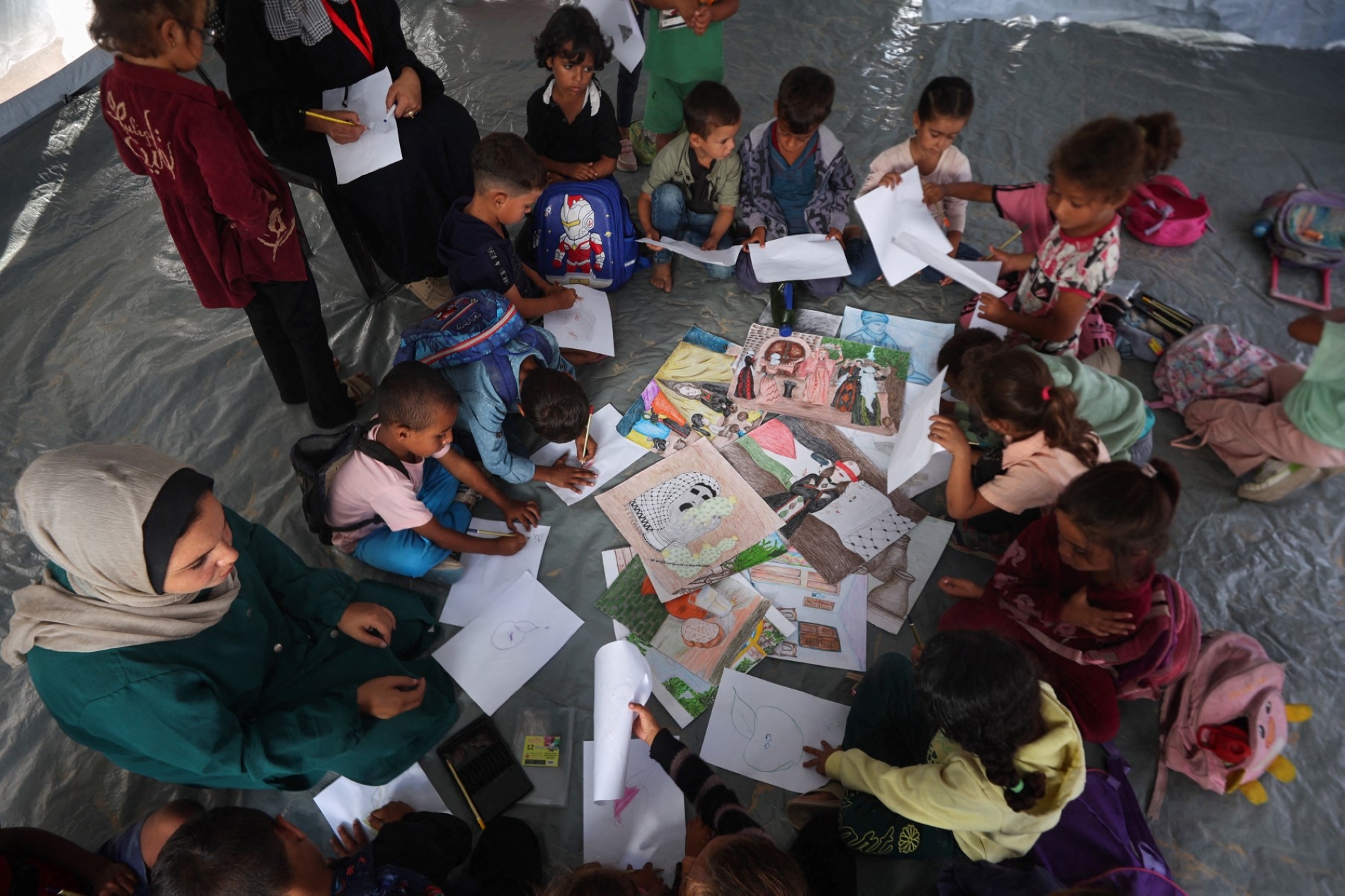
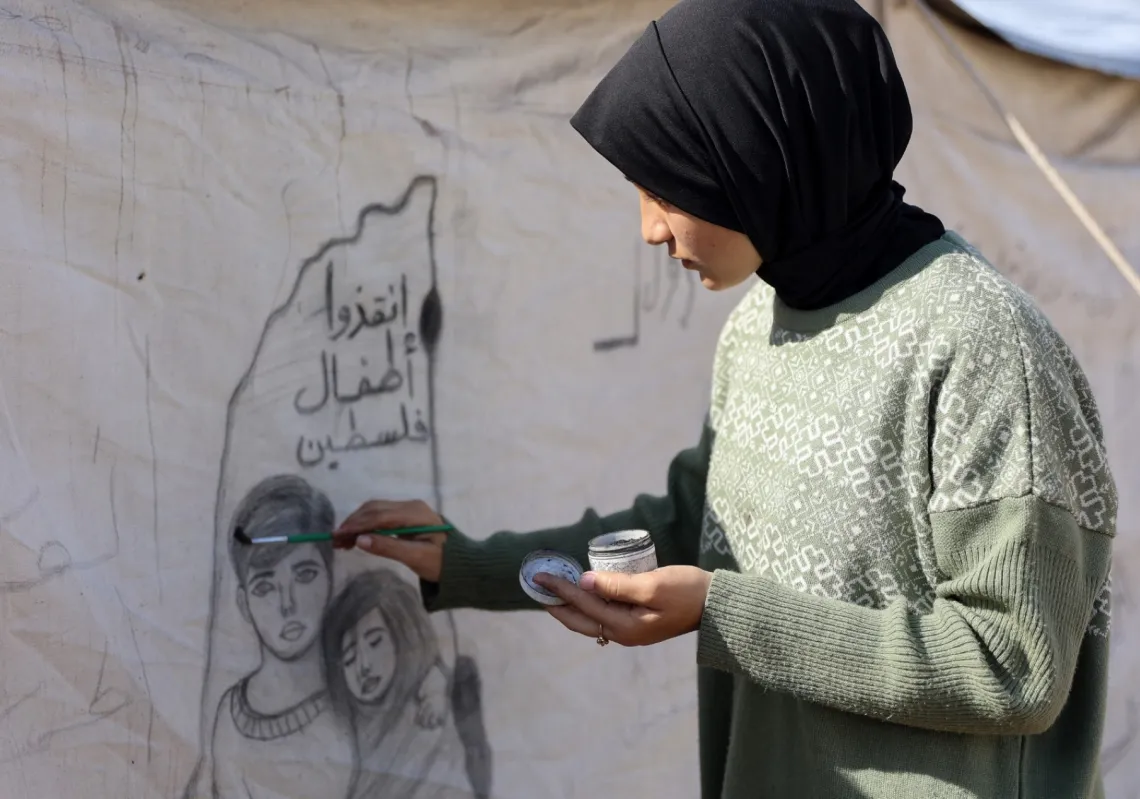
Palestinian students during an art class at a school established with UNICEF support inside a camp for displaced people in the Al-Qarara area of Khan Younis, 2025.
An outlet for expression
Visual artist Maram Saqr offers a different approach. For her, drawing is not necessarily a means of improving a child's psychological state, but rather a way to release and document that state. In her view, the value of the artwork lies not in its aesthetic outcome but in the act of expression.
One child closed his eyes before an attack in which he lost a loved one, then became afraid to open them again. Another child's eyes widened in terror at the shock of a crime committed by the Israelis in front of him. "The aim is to allow the child to release what is inside him, without requiring the drawings to turn into colours of joy," Saqr says.
"To see his feelings on paper, in colour. It is a self-healing journey. In the children's work, multiple patterns of expression appear—tangled lines, dense fields of colour, direct symbols of demolished homes, or scenes of loss. All of this reflects an inner tension that is difficult to formulate in words, so the child needs to release it through drawing." Tactile materials such as clay and modelling paste are used. Touch becomes part of the therapeutic process. Again, the final form is secondary.
Life in tents has stripped many children of their privacy, but providing a personal space for drawing and expression helps them recover a sense of autonomy and safety. "The child becomes absorbed in his drawing and colours as though he were in his own studio," Saqr says. "He forgets the tent, the noise, and people calling out to one another inside the camp… The drawings become his new privacy, something he seeks to complete. This is a form of psychological treatment through drawing."
With scarce art supplies and rising prices, Maram Saqr turned to materials from the local environment, using palm fronds, plastic bags, bottle caps, empty cans, and seashells in the drawing, modelling and collage activities. She believes that these materials "went beyond the role of substitutes," saying: "They embodied the true meaning of art. Recycling is an approach we use to teach children innovation in normal circumstances, but during the war, it helped children express themselves and affirmed that art can be born from the simplest things available."
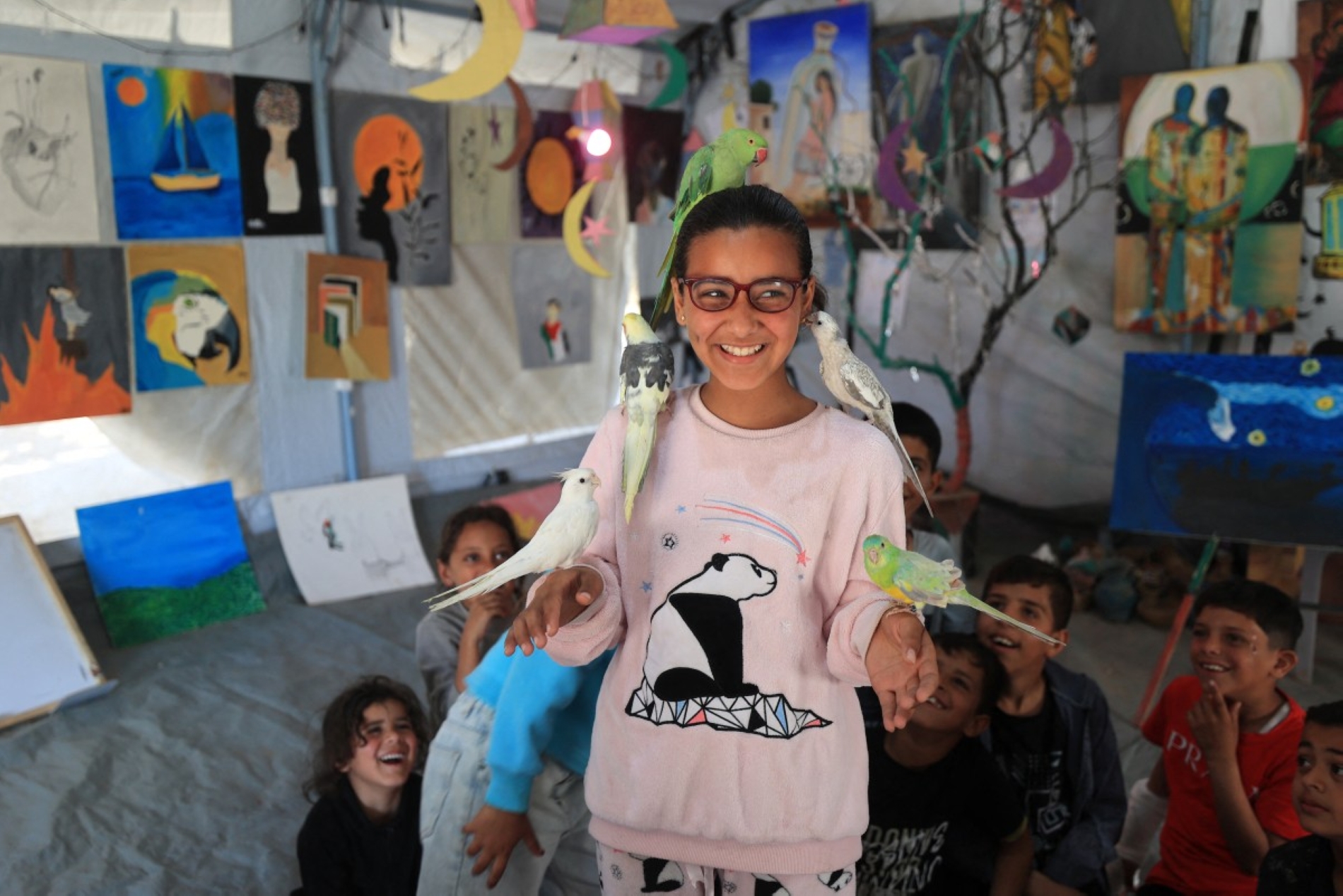
Displaced Palestinian children participate in psychosocial support sessions inside an art studio that uses pets and birds in the Al-Zawaida area in the central Gaza Strip, 2026.
Story, sound and image
The three different artistic experiences converge around the idea that the child is a maker of meaning, not a passive recipient. The difference lies in the medium. Itizaz al-Ubaid relies on symbol and written language; Abu Amsha uses sound, collective progression, and participation through singing; while Maram Saqr builds her path through visual material and touch.
This shows how art therapy is a flexible set of tools, adapted to both the context and the child. These activities often take place among tents—cramped spaces that lack calm, which hinders concentration. Despite this, art makes the difference. It draws children in, despite the harshness of their environment. For Saqr, art "creates another world among the tents," adding: "When a child becomes used to activating their imagination, it gradually becomes a path and a refuge. Art gives the child a space of safety that their present reality cannot provide."
What worries us most about the children is the buildup of repression and pressure. Through art and storytelling, we provide a path towards recovery again.
Storyteller Itizaz al-Ubaid
Abu Amsha says music "brings children together in one space and eases tension," adding: "Songs and chants have always accompanied Palestinians in their darkest circumstances, since the Nakba. The popular embrace they generate, and the unity of spirit they create, have now become part of the heritage and among the most important details of the Palestinian story."
Al-Ubaid likewise believes that storytelling "opens a window of imagination inside a closed reality," saying: "What worries us most about children is the accumulation of repression and pressure. Through art and storytelling, we provide a path towards recovery again." Multiple attempts take shape to create meaning within chaos. Giving a child space to express themselves will help them. Ultimately, however, what they need is more than stories, music, and drawing. They need to return to the school desk, from which they have been deprived for three years, and they need to do so urgently.