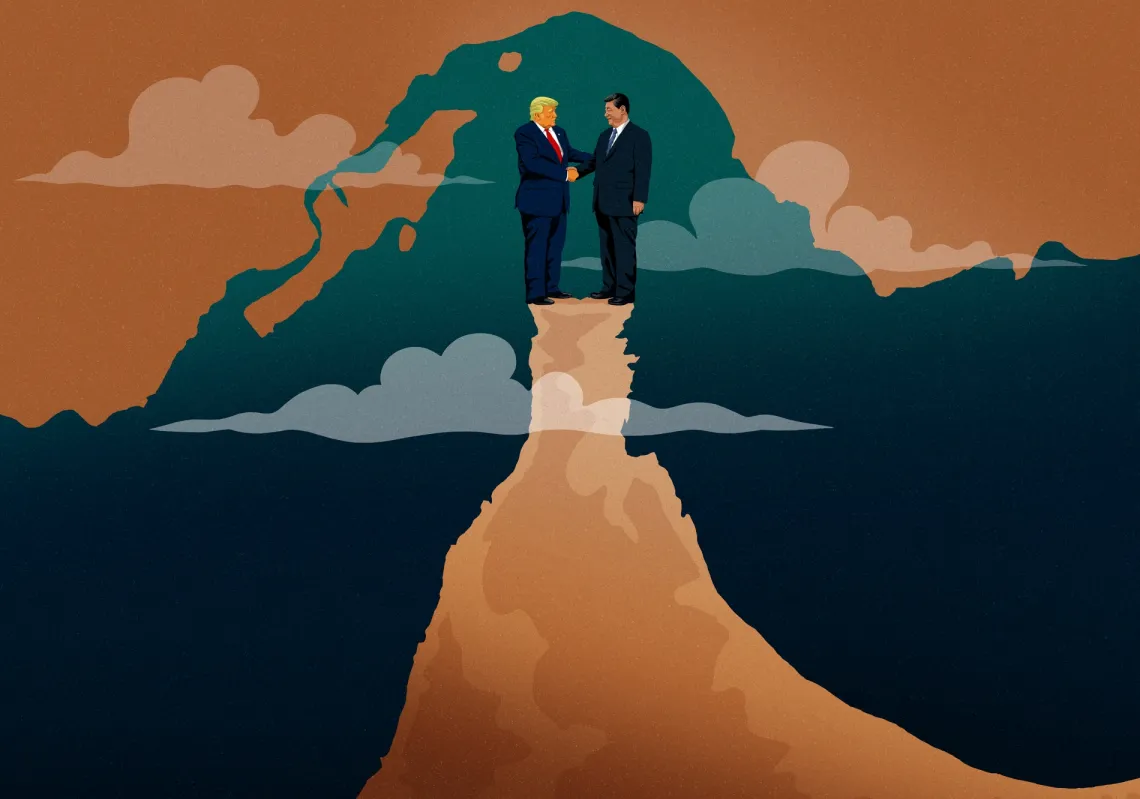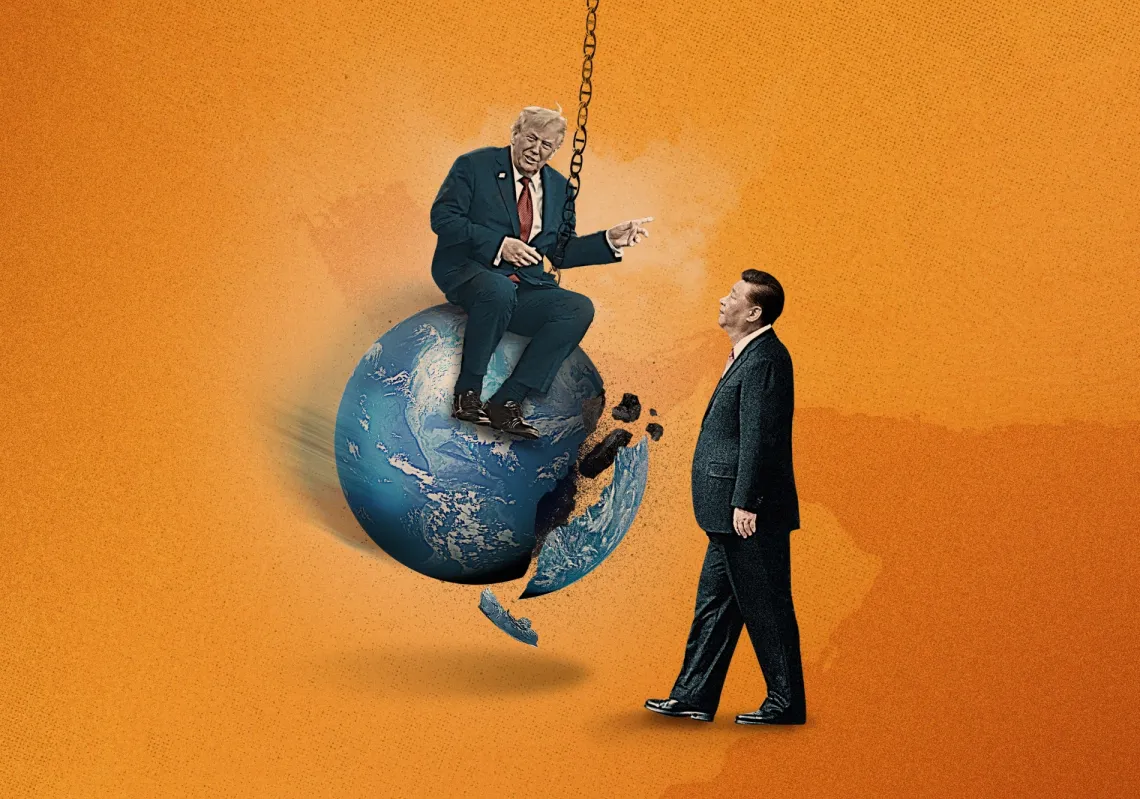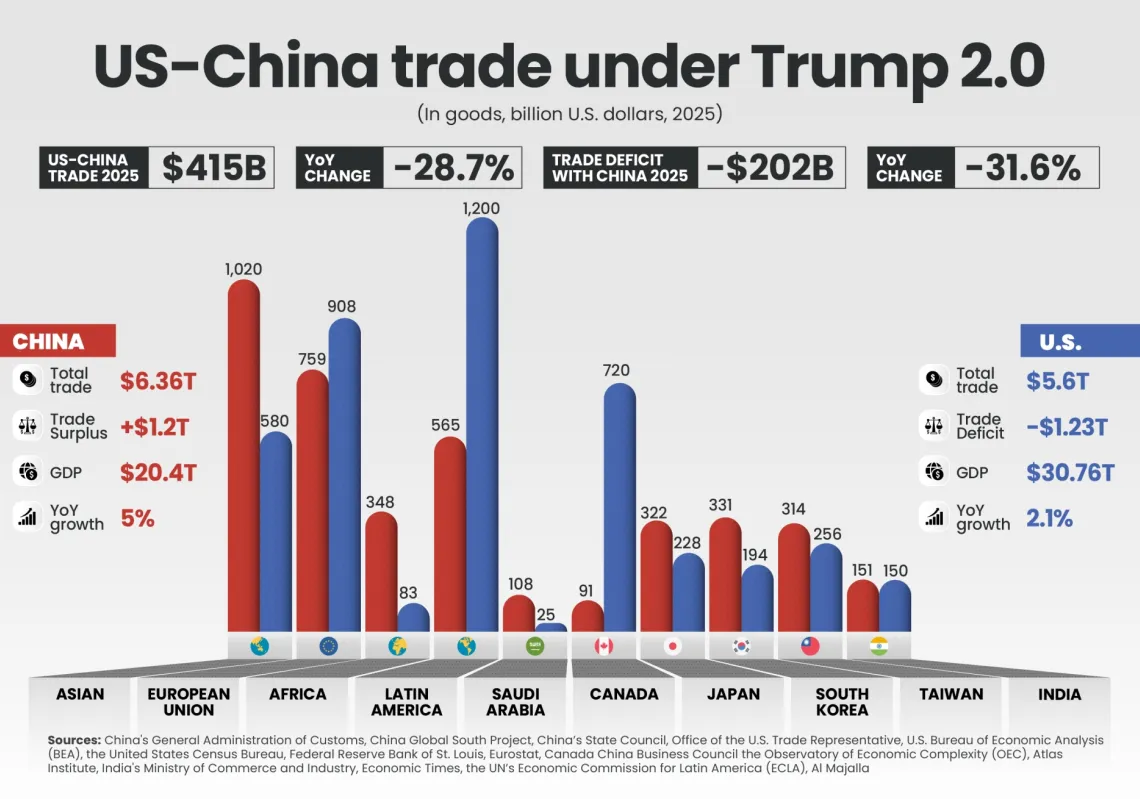

The United States appears to be on the ropes in trade negotiations with China. After taking office, the Trump administration threw down the gauntlet with Beijing, briefly imposing 145% tariffs in April 2025 and more than doubling its effective tariff rate on China to around 40% for much of the past year. Washington’s theory was that depriving China of the US consumer would force Beijing to concede on market access and bring down the bilateral trade deficit. At one point, Treasury Secretary Scott Bessent crowed that China was “playing with a pair of twos” given its dependence on exports to the United States, which clocked in around $500bn in 2024.
However, unlike most of President Donald Trump’s hapless trade war victims, Beijing punched back hard. It raised equivalent tariff barriers and leveraged China’s overwhelming dominance in the production of rare-earth minerals to choke off the supply of these critical industrial inputs, threatening US production of everything from autos to aircraft and weaponry. The United States then, in effect, cried uncle, backing down from its most severe tariff threats. This week, Washington limped into trade discussions with Beijing on 14 May, seeking an extended reprieve on China’s rare-earth export controls and headline pledges to buy more US agricultural goods and energy.
In return, the administration may have to give on dismantling some export controls on advanced technology or even diluting US support to Taiwan. Privately, members of the US administration may admit—perhaps in sotto voce—that, for now, China has economic escalation dominance.
If competition between the United States and China is the most consequential geoeconomic storyline of the 21st century, then this episode doesn’t bode well for Washington. As the economist Neil Shearing incisively argues in The Fractured Age, the global economy is inevitably, albeit gradually and unevenly, splitting into two blocs: one centred around the United States and another around China. You can see the beginnings of this fracturing in global trade and foreign direct investment patterns, which—as the International Monetary Fund has—increasingly flow between geopolitically aligned countries. And in this more competitive environment, economic warfare will be a central battlefront between the two blocs as both sides seek leverage over one another to pursue their own policy interests and push back against coercion.
Does China have the upper hand in this new, fractured world? The past year’s showdown would tell you yes, but the numbers tell a different story. In their thought-provoking analysis, Command of Commerce, former US Treasury Department official Ben A. Vagle and Dartmouth University Professor Stephen G. Brooks argue that the United States holds the high cards. The world’s most important, profitable, and sophisticated companies sit largely in the United States, and the Western bloc, and China’s own export machine is dependent upon their investments. In a sudden, all-out decoupling between China and the West, the short-run impact would hurt China’s economy 5-11 times more than the United States, according to their research, and China would face worse long-term economic scarring.
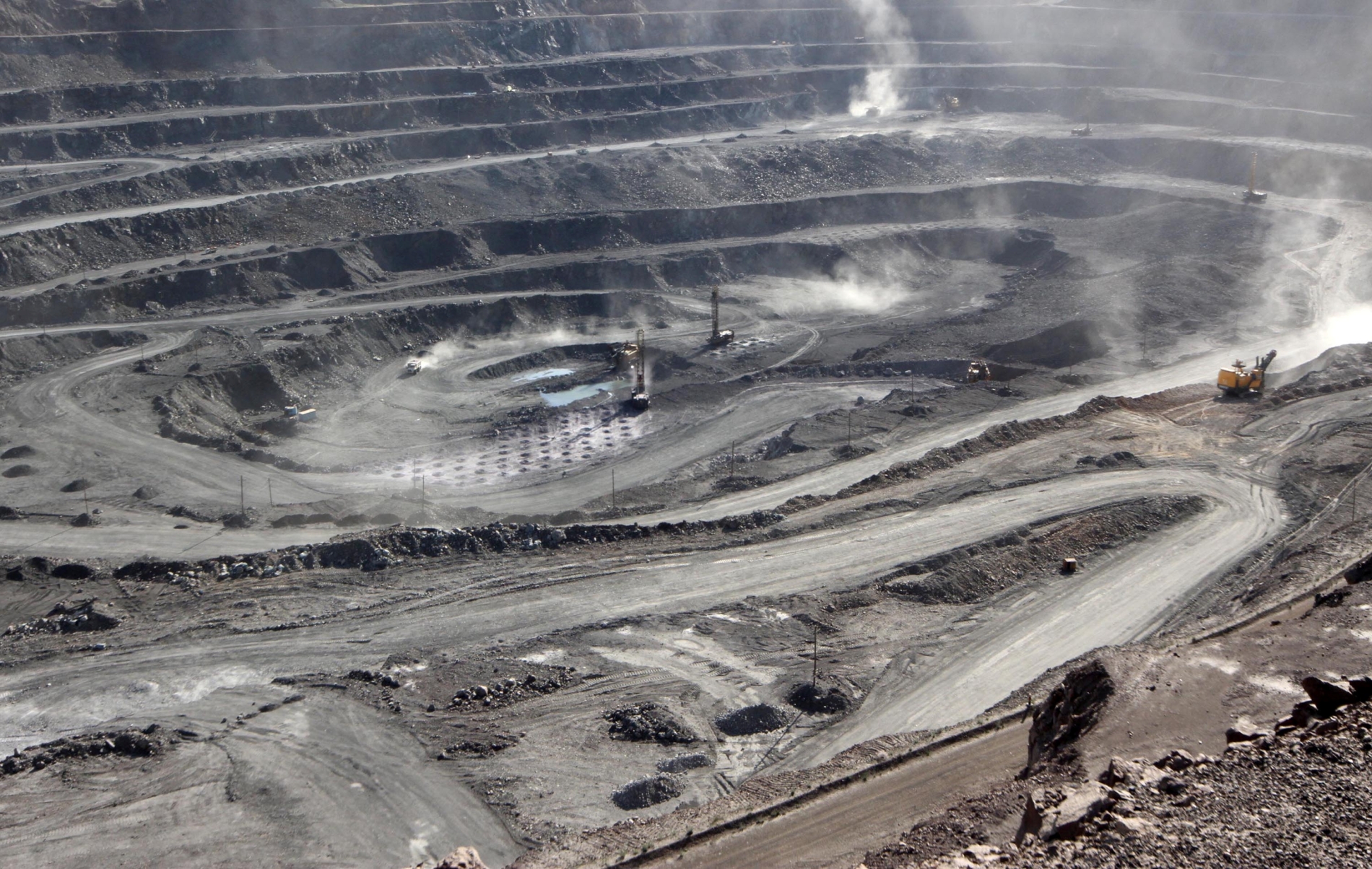
So then, why is the United States running scared of China? Part of the reason is that China has found the perfect asymmetric weapon in rare-earth restrictions that cost its economy little while inflicting major damage on US industry. Washington’s most powerful economic weapons, such as financial sanctions, would impose meaningful costs to US companies and consumers, even if they do disproportionate harm to Beijing.
Another reason is that the United States may inherently have a lower pain threshold than China, or lack confidence, due to a long history of (largely misplaced) hand-wringing over economic decline.
But a big reason is the way in which this administration has waged economic war with China: with unilateral tariffs, an especially ineffective tool, and alienating allies along the way rather than presenting a united front. The United States has more than enough leverage to push back against economic coercion and thwart Beijing from having a veto over US policy, but the task would be much easier if it kept the Western world onside.
It’s a cliché that the era of hyperglobalisation is over. Since the Great Recession, trade has largely stalled as a percentage of global GDP, after exports had surged from 20% to 30% of global GDP between 1989 and 2010. Gross global capital flows have fallen from a peak of 20% of global GDP in 2007 to around 5% today, and multilateral institutions such as the World Trade Organisation, created to help set the rules of the road and facilitate open global commerce, are on life support.
Ask what’s behind this “slowbalisation,” and commentators will provide a bundle of reasons, including increasing global conflict, rising populist tendencies, inequality, and the jolt of Trump’s second term.
But Shearing accurately points to the most potent source: US-China tensions that are unwinding decades of global integration. “The era of hyper-globalisation that defined the global economy in the early 21st century is therefore over,” he writes, adding that this is “partly because it failed to live up to unrealistic expectations ... and partly because it became a convenient scapegoat for a new generation of populist politicians. But it’s mainly because China has emerged as a strategic rival to the US.”
How will this rivalry contort the global economy into the future? Shearing argues that the world will gradually fracture more firmly into a US-led and a China-led bloc and that the US bloc will include Europe, Japan, India, Mexico, and other Western-leaning countries, but that decoupling between the blocs will only cover strategic industries, putting about 15% of global trade at risk (a relatively mild amount of fracturing given Shearing’s sweeping title).
During the Biden administration, when the book was likely written, this seemed the most plausible path. The United States was successfully pushing Europe, hesitantly but inexorably, toward joining its China-related restrictions; India was aligning more closely with the United States; and President Joe Biden’s national security advisor, Jake Sullivan, argued that US restrictions on China should constitute a “small yard, high fence.”