Will US involvement change Venezuela’s role in OPEC?https://en.majalla.com/node/329323/business-economy/will-us-involvement-change%C2%A0venezuela%E2%80%99s-role-opec
Will US involvement change Venezuela’s role in OPEC?
Its role within the group is likely to remain institutional rather than operational in the near term, but its status as a founding member continues to carry historical and symbolic weight
Al Majalla
Will US involvement change Venezuela’s role in OPEC?
Venezuela’s relationship with the Organisation of Petroleum Exporting Countries (OPEC) stretches back decades. In September 1960, Venezuela stood alongside Saudi Arabia, Iran, Iraq, and Kuwait as one of its five founding members. It was the only Latin American country at the table—and for decades the only non-Arab member—giving the organisation an early global dimension beyond the Middle East.
Venezuela’s modern oil governance was further consolidated with the creation of PDVSA—Petróleos de Venezuela, S.A.—in 1976, following the nationalisation of the country’s oil industry. PDVSA was established as a state-owned holding company to manage Venezuela’s hydrocarbon resources, oversee production and exports, and represent national interests in global energy markets.
For many years, PDVSA functioned as one of the most technically capable national oil companies in the world, combining state ownership with professional management and close operational partnerships with international oil companies. This institutional framework enabled Venezuela to sustain high production levels, integrate effectively into global markets, and play a substantive role within OPEC well into the early 2000s.
From the outset, Venezuela’s role within OPEC was shaped by both scale and strategy. With significant production capacity and a sophisticated national oil sector, Venezuela helped shape early thinking around producer coordination, market stability, and the balance between sovereign resource ownership and global supply needs.
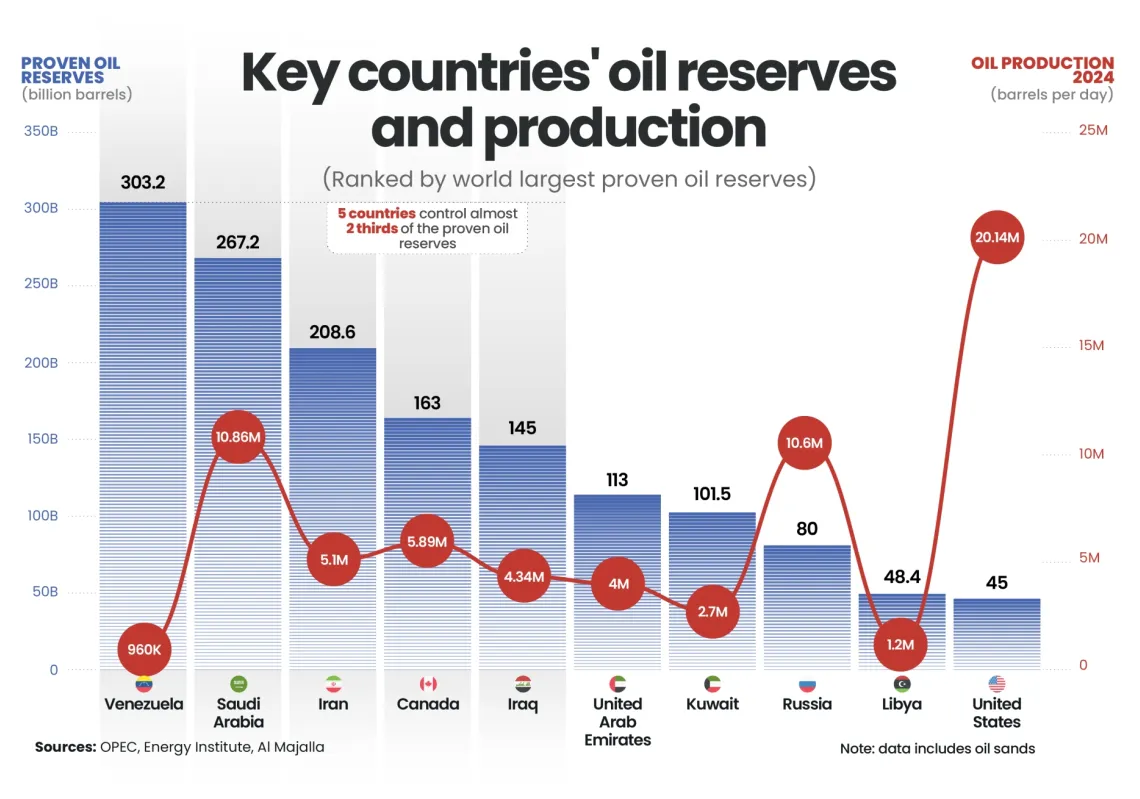
In the 1970s and early 1980s, Venezuelan output often exceeded 3 million barrels per day, and by the late 1990s, it reached an all-time high of around 3.4–3.5 million barrels per day, making it one of the organisation’s largest producers and a key voice in production coordination. However, after the 2000s, structural challenges began to weigh on output, and production fell below 2 million barrels per day during the 2010s before collapsing further amid deeper operational decline and sanctions.
This historical trajectory underpinned Venezuela’s early influence within OPEC and explains how its capacity once aligned with collective market management, even as its practical impact has diminished in recent years.
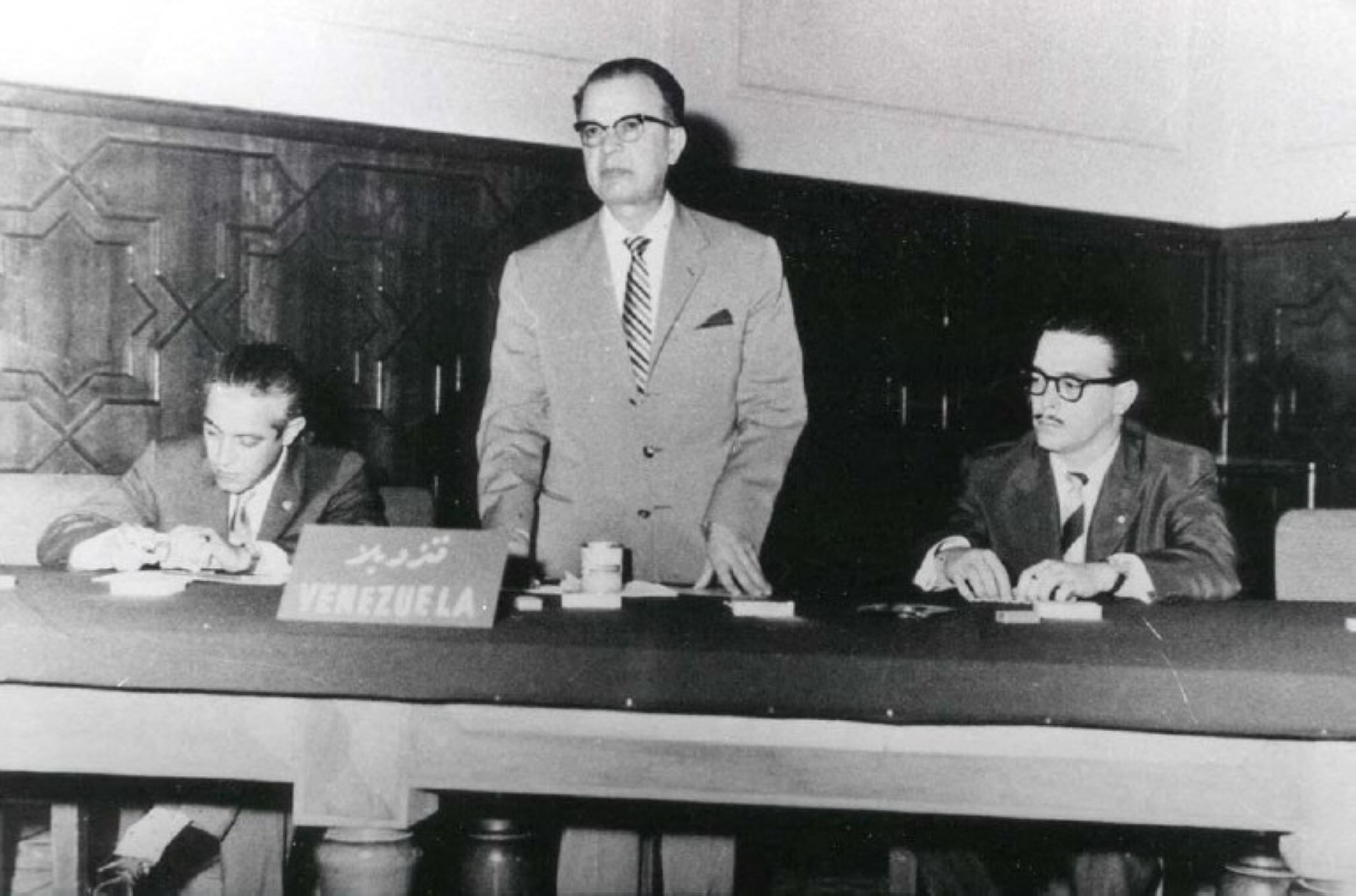
The head of the Venezuelan delegation, J.P. Perez Alfonso (C), delivers a speech on 10 September 1960 in Baghdad during the meeting of the five main world petroleum producers (Saudi Arabia, Venezuela, Kuwait, Iran and Iraq).
This position was underpinned by a functioning institutional structure. PDVSA operated as one of the most technically capable national oil companies in Latin America, alongside other major state-owned producers such as Petrobras in Brazil and Pemex in Mexico.
What distinguished PDVSA during this period was not exclusivity, but scale, international integration, and operational reach. Through partnerships with international oil companies—particularly from the United States—PDVSA attracted capital, technology, and operational expertise across the value chain. Venezuela’s engagement with OPEC during this period was therefore not merely symbolic; it reflected a genuine capacity to influence outcomes through production scale, supply reliability, and policy alignment within the organisation.
A founding member of OPEC, Venezuela helped shape early thinking around producer coordination, market stability, and balacing sovereign resource ownership with global supply needs
Turning point
That reality began to change well before the most recent geopolitical developments. Long-standing structural challenges—such as declining investment, weakened governance, and operational deterioration at PDVSA—steadily eroded Venezuela's productive capacity. A decisive turning point came in 2007, when the government moved to nationalise remaining foreign oil operations and require international partners to cede majority control to PDVSA.
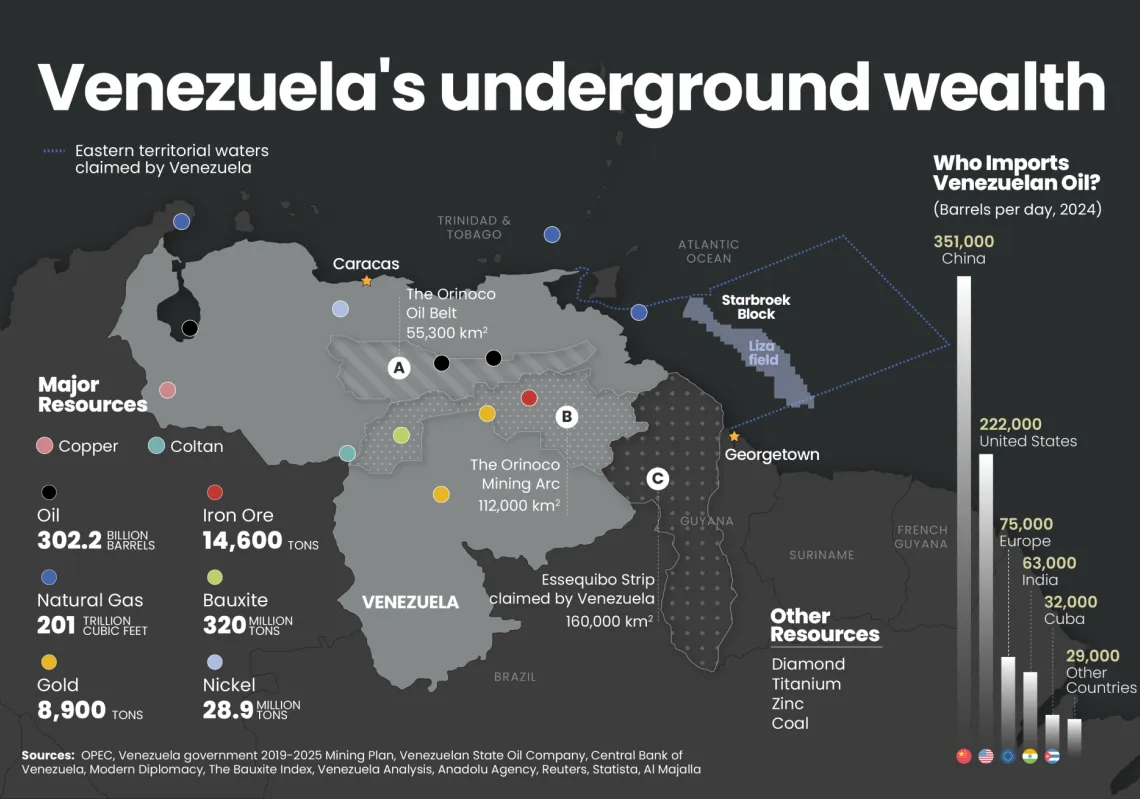
ExxonMobil and ConocoPhillips rejected the new terms and withdrew, removing critical sources of capital, technology, and operational expertise that had been central to sustaining production, particularly in the technically complex Orinoco Belt. From that point onward, Venezuelan oil output entered a prolonged structural decline that has yet to be reversed.
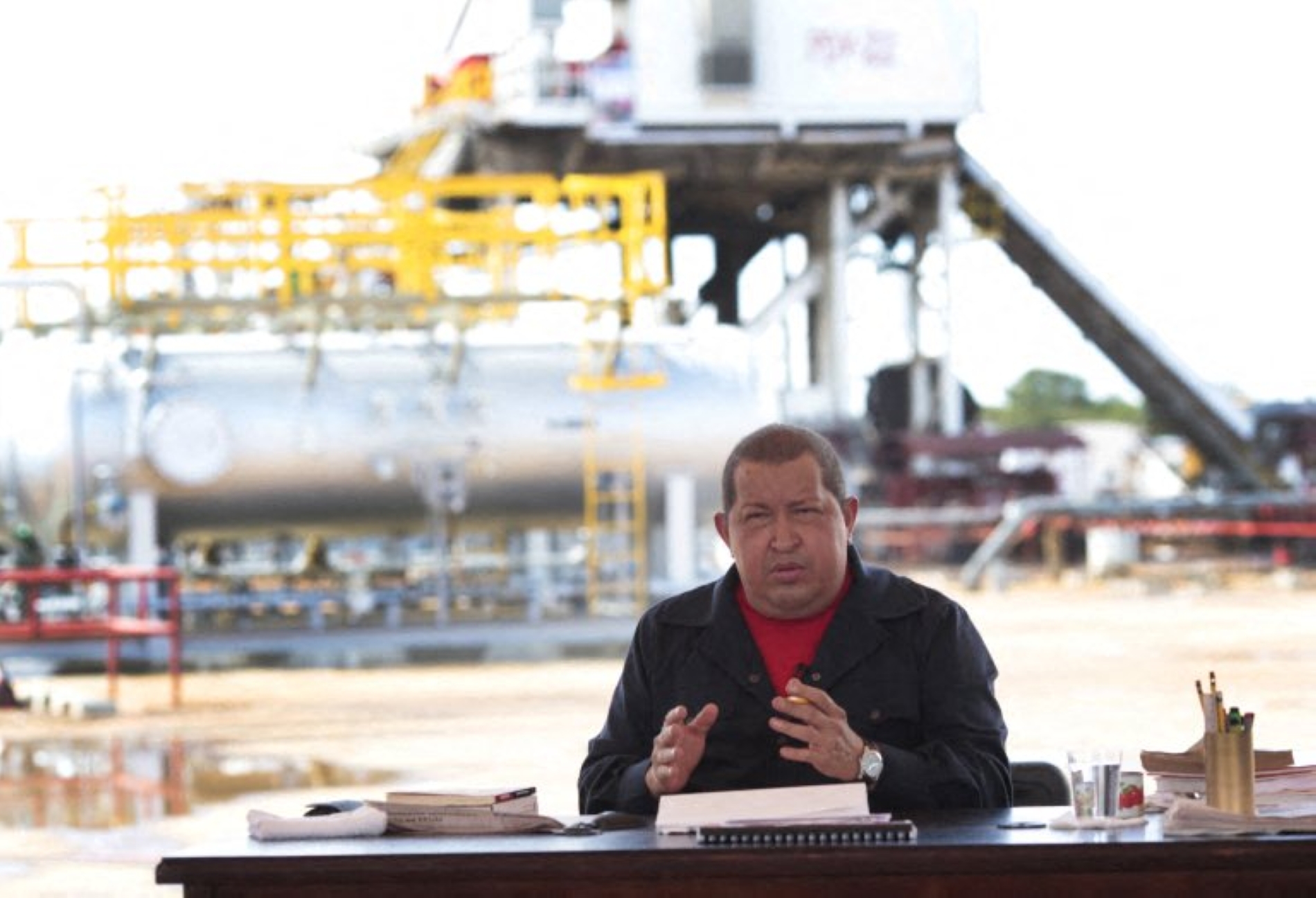
Venezuelan president Hugo Chavez speaks on his "Alo, Presidente" Sunday TV programme broadcast in the Orinoco oil Belt, Venezuela, on 8 January 2012.
Sanctions sledgehammer
US sanctions later intensified these pressures, but did not create them. By the mid-2010s, Venezuela's oil sector was already operating far below potential as underinvestment and institutional decline compounded operational losses. While early sanctions focused on individuals and financial access, the most consequential measures came in January 2019, when sanctions were extended directly to PDVSA and the oil sector, disrupting payment flows, freezing assets, and sharply limiting access to traditional export markets.
These measures forced Venezuela to reroute exports toward China and a small number of other buyers through non-standard commercial arrangements, often involving deep discounts and complex settlement mechanisms, further constraining cash flow and reinvestment.
As production collapsed under these combined pressures, Venezuela's position within OPEC also evolved. Although it remained a full member of the organisation and continued to participate in meetings and collective decision-making, Venezuela became effectively exempt from formal OPEC and later OPEC+ production quotas. This exemption was not a political choice but a practical acknowledgement that the country was producing well below any assigned ceiling due to sanctions, infrastructure decay, and lack of capital. Similar accommodations have historically been applied to other members facing exceptional constraints, reflecting OPEC's pragmatic approach to managing involuntary supply losses.
In practice, this meant that while Venezuela retained its institutional seat within OPEC, its role shifted from that of an active volume-contributing producer to a member with limited operational flexibility and marginal impact on collective supply management. The exemption from quotas did not signal disengagement from the organisation, but rather underscored how far Venezuela's oil sector had fallen from its historical capacity—and how deeply structural, rather than political, the decline had become.
Donald Trump imposed a naval blockade on Venezuela and admitted that he wants to take the country's oil and give it to US corporations:
"They took our oil rights. We had a lot of oil there. They threw our companies out, and we want it back". pic.twitter.com/JQhJRNFeIy
Today, the situation has entered a new phase. With the United States signalling potential control or oversight of Venezuelan oil sales, the discussion is no longer about sanctions alone, but about institutional representation and functional sovereignty. This is not a return to earlier periods when US oil companies operated commercially inside Venezuela. Instead, it represents a scenario in which state authority, not private capital, could shape how Venezuelan oil reaches the market.
For OPEC, this raises complex but manageable questions. OPEC is an intergovernmental organisation built on voluntary coordination among sovereign states. Membership does not require uniform political systems, nor does it mandate identical commercial structures. What matters is each member's ability to participate meaningfully in collective production management.
Historical experience suggests that political instability or external constraints do not automatically lead to withdrawal. Several members have remained within OPEC during periods of sanctions, conflict, or production collapse. What changes in such cases is influence, not formal status. Venezuela itself has remained within OPEC throughout years of declining output and limited operational capacity.
Under any form of external oversight, Venezuela's ability to shape OPEC outcomes will remain constrained by practical realities. Ultra-heavy oil requires time, capital, and stability to develop. Even with improved market access, meaningful production recovery would take years and substantial investment. This limits Venezuela's near-term impact on collective supply decisions, regardless of who manages exports.
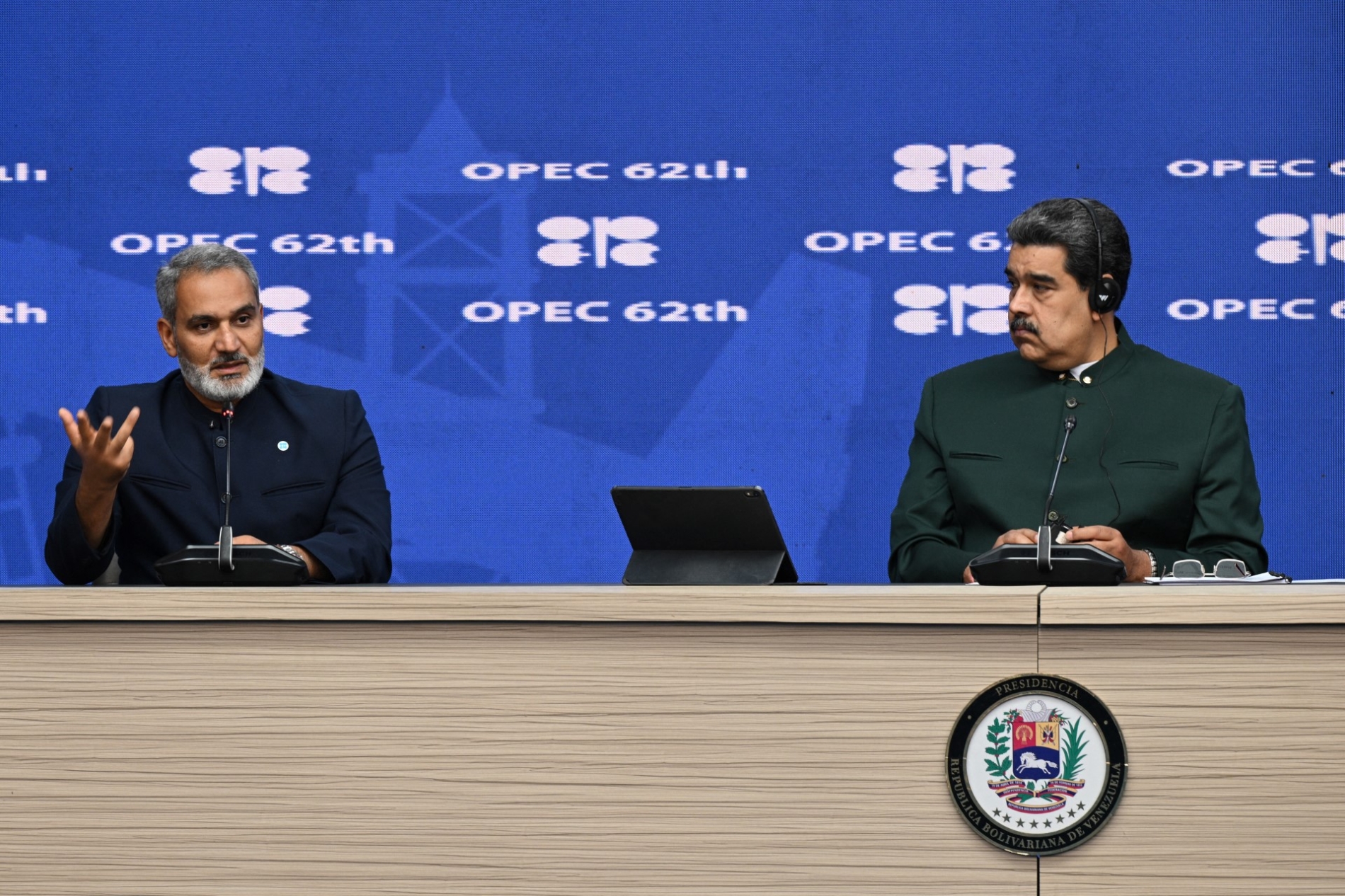
OPEC Secretary General Haitham al-Ghais (L), speaks next to Venezuela's President Nicolas Maduro (R) during a meeting at the Miraflores presidential palace in Caracas, on 14 September 2022.
Broader consideration
There is also a broader strategic consideration. The United States, despite historical tensions with OPEC, has at various points acknowledged the organisation's role in supporting market stability during periods of disruption. Maintaining Venezuela's formal place within OPEC—even as its internal arrangements evolve—may serve broader stability interests rather than undermine them.
Going forward, Venezuela's role within OPEC is likely to remain institutional rather than operational in the near term. Core production management decisions will continue to be shaped by members with scale, spare capacity, and execution capability. Yet Venezuela's status as a founding member continues to carry historical and symbolic weight, anchoring its place within the organisation even as its practical role adapts to new realities.
This moment does not mark the end of Venezuela's relationship with OPEC, nor does it signal a return to past models. Instead, it reflects a transition—one that tests how an intergovernmental organisation built on sovereignty and cooperation adapts when one of its founders faces an unprecedented restructuring of its oil governance. How Venezuela navigates this transition will shape not only its own future but also OPEC's evolution in an increasingly complex global energy landscape.