
Global oil markets are shaped not only by production powerhouses but also by countries sitting on vast untapped reserves. The contrast between geological wealth and actual output highlights how politics, investment, and infrastructure shape actual influence within the energy system.
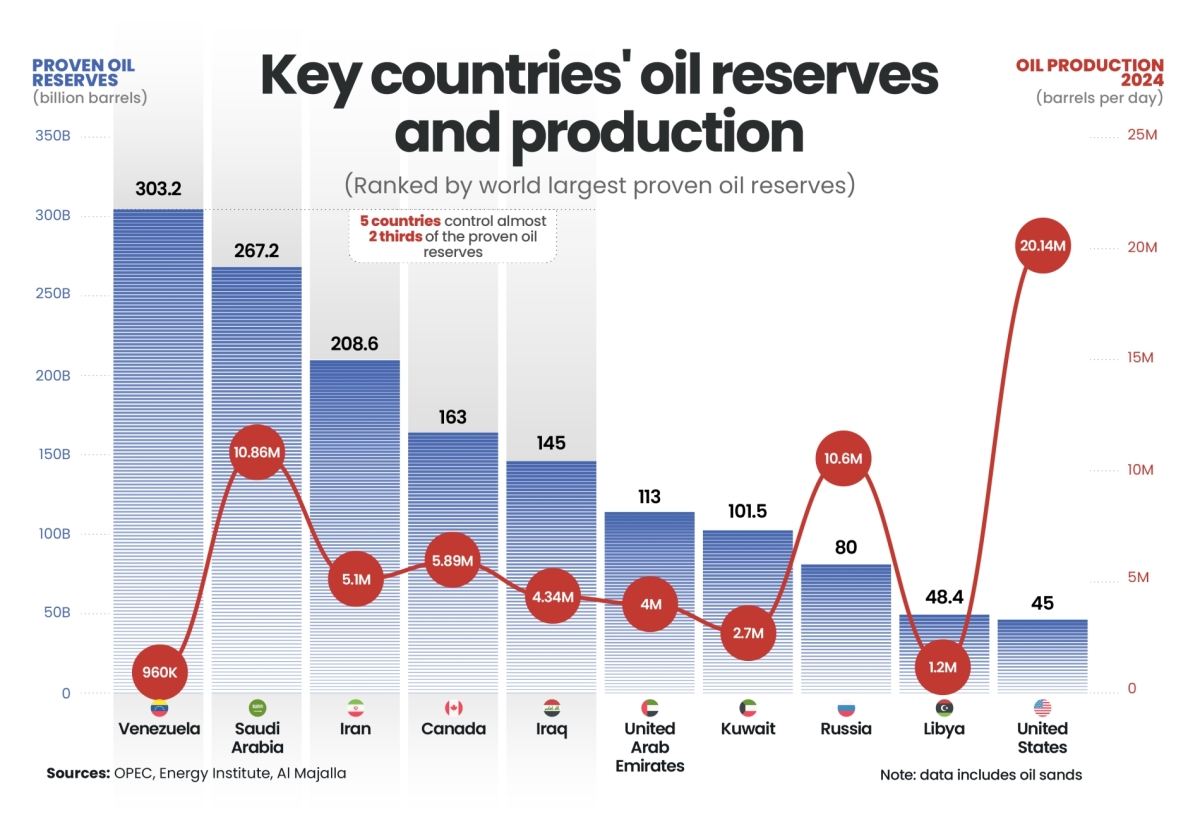
Venezuela has the world's largest proven oil reserves, estimated at 303 billion barrels, accounting for roughly 17% of global reserves. Despite this geological wealth, Venezuela’s actual output has dwindled over the decades due to Western-backed sanctions, underinvestment, and mismanagement. In 2024, the country produced less than 1 million barrels per day, ranking 21st globally in oil output.
By contrast, the United States holds approximately 45 billion barrels of proven oil reserves yet leads global oil production, producing more than 20 million barrels per day. Alongside Saudi Arabia, which pumps around 11 million barrels per day, the two countries dominate daily oil production, according to OPEC’s Annual Statistical Bulletin 2025.
Globally, five countries control nearly two-thirds of proven oil reserves. Venezuela’s reserves-to-production ratio exceeds 800 years, the highest worldwide by a wide margin. Iran, Libya, Kuwait, and Iraq also post triple-digit reserve lifespans. Saudi Arabia’s reserves could last more than 60 years at current output, while Canada’s oil sands give it one of the longest reserve lifespans among high-production countries.
A few days ago, US President Donald Trump publicly urged major oil companies to invest in reviving Venezuela’s oil industry, promoting up to $100bn in investment. Yet some executives expressed hesitation, characterising Venezuela as “uninvestable” under current legal and political conditions. Moreover, although Venezuela’s reserves are vast, its heavy crude requires costly specialised infrastructure, and rebuilding the sector will take years and significant capital.