Al Majalla lays out three possible scenarios for the war-torn country in the weeks and months ahead
ABDULRAHMAN GUMAA / AFP
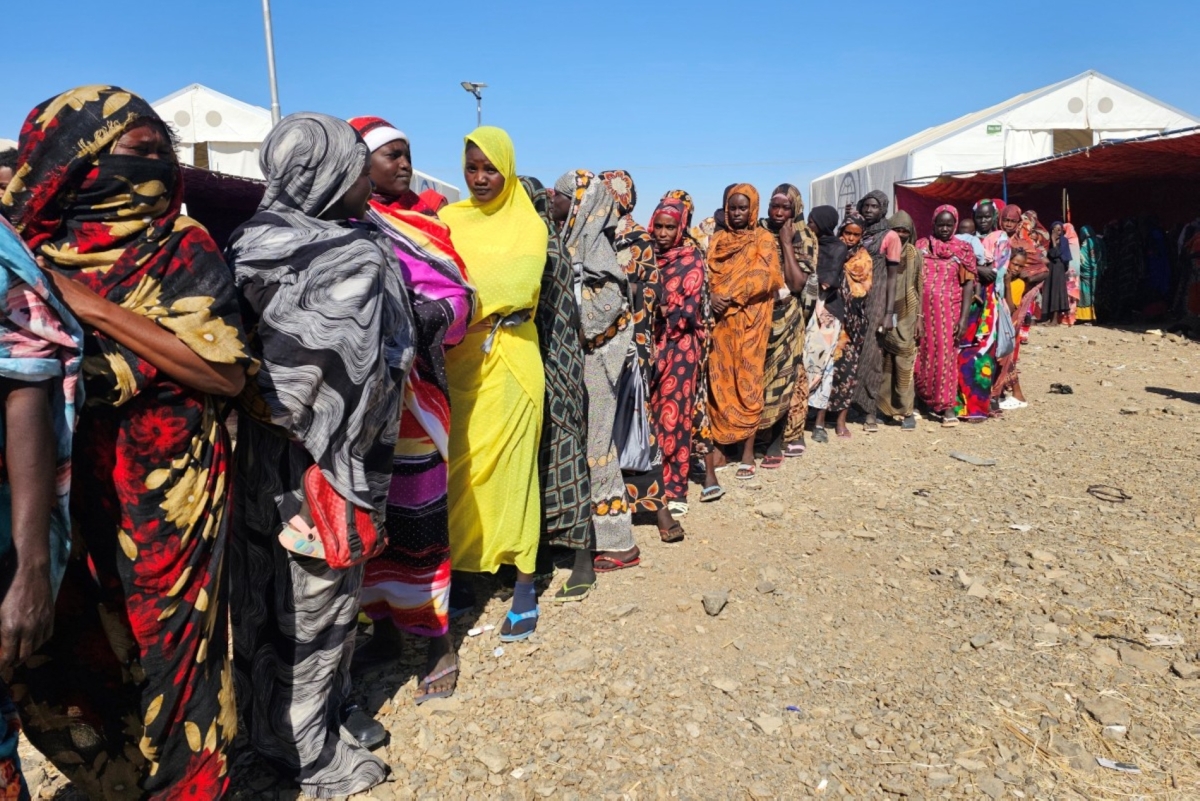
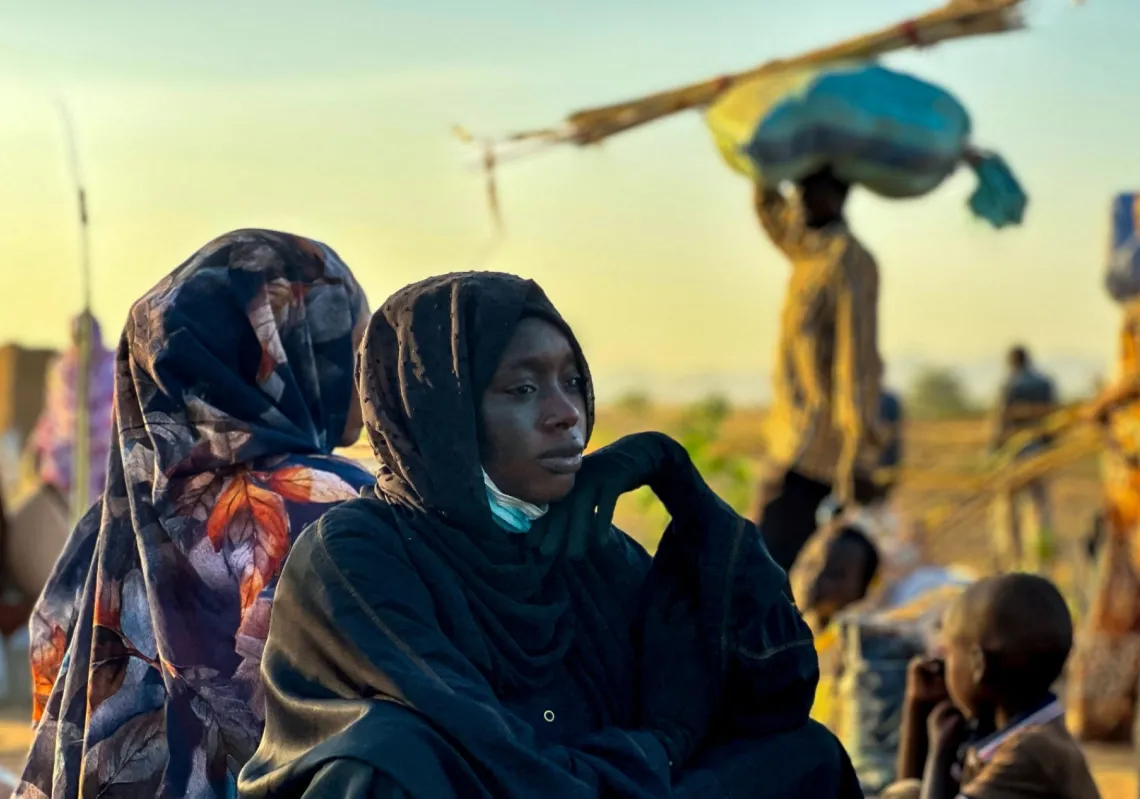
Sudanese displaced from the Heglig area in western Sudan wait to receive humanitarian aid at the Abu al-Naga displacement Camp in the in Gedaref State, some 420km east of the capital Khartoum on 30 December 2025.
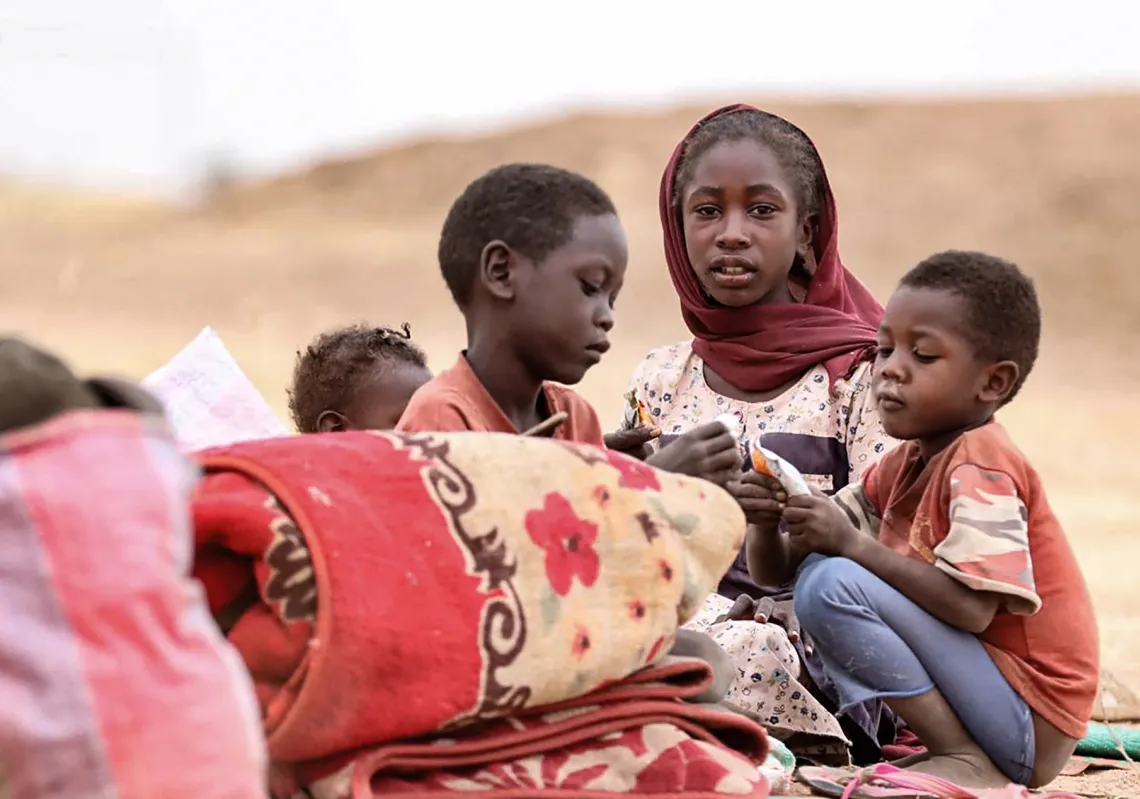
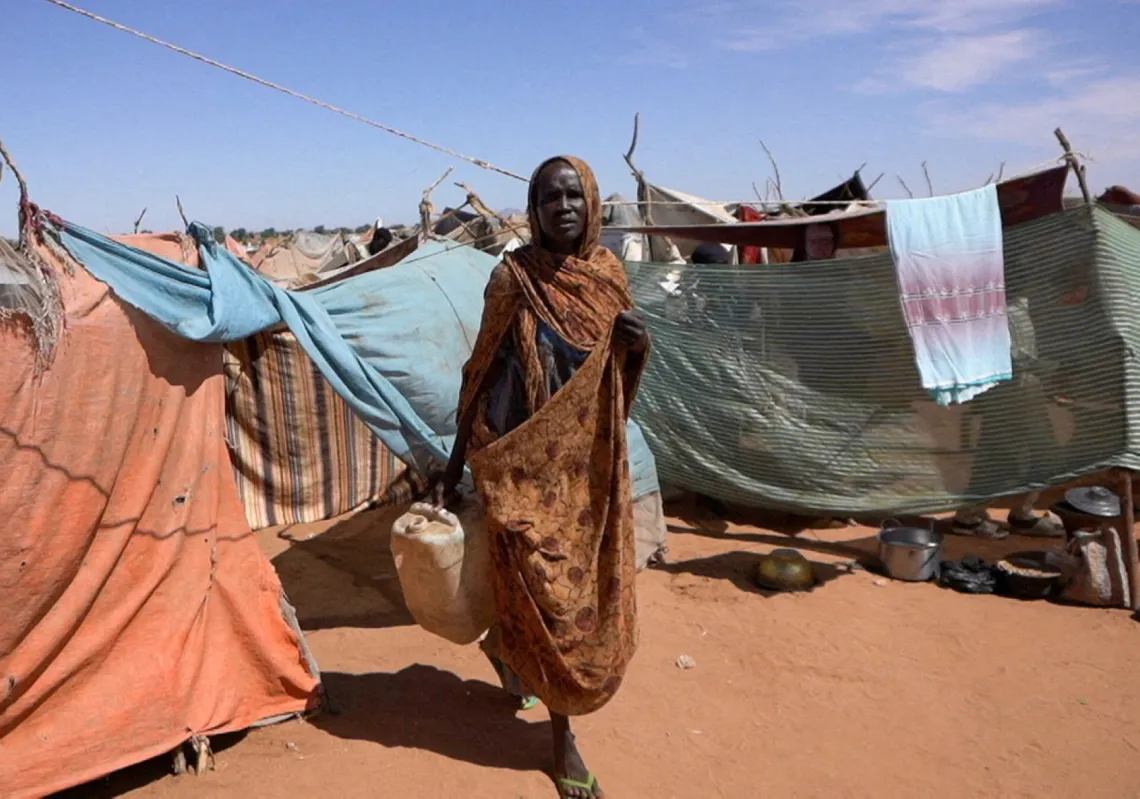
The conflict in Sudan continues unabated, with over 100,000 killed. Millions more are displaced and suffer from food insecurity and the collapse of basic services.
The humanitarian situation has become catastrophic, especially after the October conquest of el-Fashir, where the paramilitary Rapid Support Forces (RSF) have only now allowed minimal relief to enter. The geographic expansion of the conflict and the use of sophisticated drones in areas far from traditional frontlines demonstrate the war's expansion that threatens to dismantle the Sudanese state.
Instead of moving toward a humanitarian ceasefire declared by the Quad in September—the grouping of Egypt, Saudi Arabia, the UAE and the United States that is supposed to help resolve the conflict—the civil war has only intensified.
For his part, Chairman of the Transitional Military Council, Abdel Fattah al-Burhan, who heads the Sudanese Armed Forces (SAF), seems to have absorbed the October defeat in el-Fashir at the hands of the RSF and officially returned to the capital of Khartoum for the first time since the war began in 2023.
Since then, al-Burhan has visited Ankara, Cairo, Moscow, and Riyadh to shore up international political and military support after the RSF secured most of Kordofan and Darfur. All the parties claim to support humanitarian relief, but the UN’s appeal is severely underfunded. The longer the military conflict continues, existing aid organisations will be able to reach fewer of the population in need.
Because of serious tensions between Saudi Arabia and the UAE, the Quad is dead as an effective diplomatic convenor. The US is also paralysed by rivalry among its partners. New reports suggest that Pakistan may provide $1.5bn in military equipment to the army, funded by Saudi Arabia.
The only prospect for a ceasefire would be if the external supporters of the SAF and RSF cut off their supplies, forcing them to cease hostilities
The Saudis and Egyptians have also reportedly closed their airspace to cargo flights from the UAE, though the UAE has alternative routes to arm the RSF. Most recently, Egypt struck an arms convoy in Libya after warning the Haftar family it would not tolerate further smuggling. The last time Egypt launched an attack in Libyan territory occurred in 2015 after the Islamic State (IS) beheaded 21 Egyptian Copts.
Neither the SAF nor the RSF appears ready to compromise. The RSF still believes it can take the remainder of Kordofan and push toward Khartoum. "Sudan will not accept a truce or a ceasefire so long as the rebel militia remains on any inch of the country," al-Burhan said in his December visit to Ankara.
Turkish President Recep Tayyip Erdogan shakes hands with Sudan's army chief General Abdel Fattah al-Burhan at the Presidential Complex in Ankara on 25 December 2025.
What happens next depends on several factors, mainly whether or not international players continue to support both sides. If the fighting continues, Sudan could become a de facto frozen conflict or a formally partitioned state. The stated goal of most of the international community—a ceasefire and a formal transition to a civilian government—seems to be the least likely scenario given conditions on the ground.
Perpetual conflict
In the near term, there are no signs that the conflict will end anytime soon. Front lines would continue to shift back and forth. Even if the army receives additional support from Türkiye, Egypt, and, potentially, Pakistan, it still needs ground forces to retake the territory it has lost. It relies on the domestically produced Safroog kamikaze attack drone as well as the Turkish Bayraktar TB2 for reconnaissance and attack.
For their part, the RSF reportedly relies on the Wing Loong II and other Chinese-made drones provided by the UAE, although Abu Dhabi emphatically denies this. While these long-range drones can hit strategic targets like airports and soften military positions, ground forces still need to take the territory.
This exposes key weaknesses on both sides. Both the SAF and the RSF employ fighters with their own interests. For example, the SAF-aligned Islamist Al-Baraa Ibn Malik Brigade forms a core part of the army but is not a formal unit. Similarly, the RSF comprises several tribal groups. This constellation of actors makes continued conflict the most likely scenario throughout 2026.
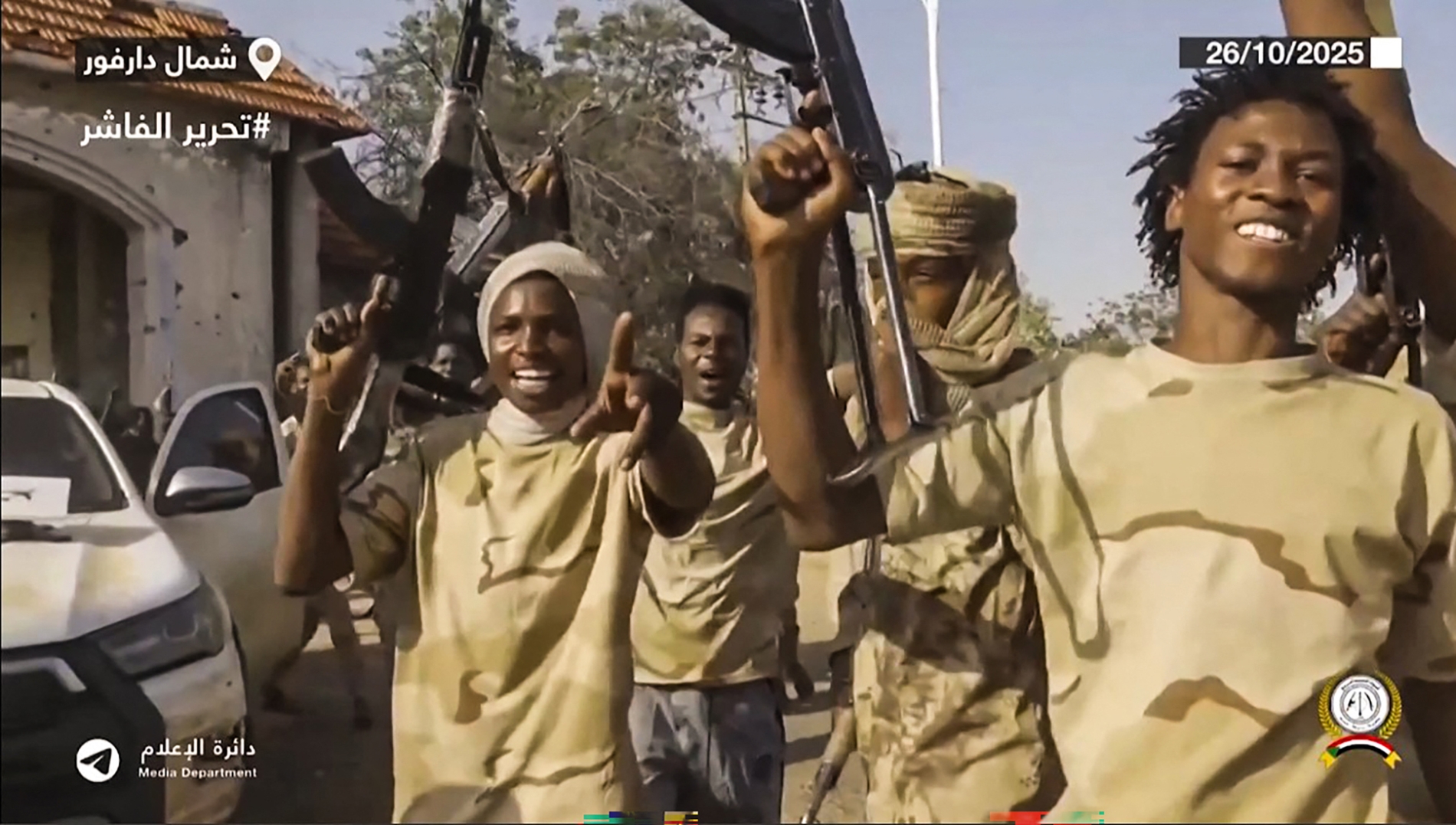
This image grab taken from handout video footage released on Sudan's paramilitary Rapid Support Forces Telegram account on 26 October 2025, shows RSF fighters celebrating in the streets of el-Fasher.
De facto partition
Alternatively, the status quo could further solidify Sudanese geography into separate spheres of influence without an official declaration of partition. In this context, the Rapid Support Forces would control most of Darfur and large parts of Kordofan, while the army maintains control over the center (Khartoum), the east, and the north, with remaining gray areas witnessing continuous conflict.
This reality creates quasi-independent entities managing their affairs locally, with multiple ethnicities, tribes, and armed groups fighting over resources and influence in each area. The rival Libyan entities and Somalia's weak central government provide models for this possibility. The Sudanese state would transform into a collection of warring areas lacking effective central authority, deepening the humanitarian crisis and turning Sudan into a focal point of regional instability for decades to come.
De facto partition would not prevent some tacit cooperation to keep the economy functioning at a minimal level. The most prominent of these arrangements occurred in the Heglig oil region, where South Sudan organised an agreement to avoid an oil crisis that could harm the interests of all parties, especially since the exports are a key part of the economy of both countries.
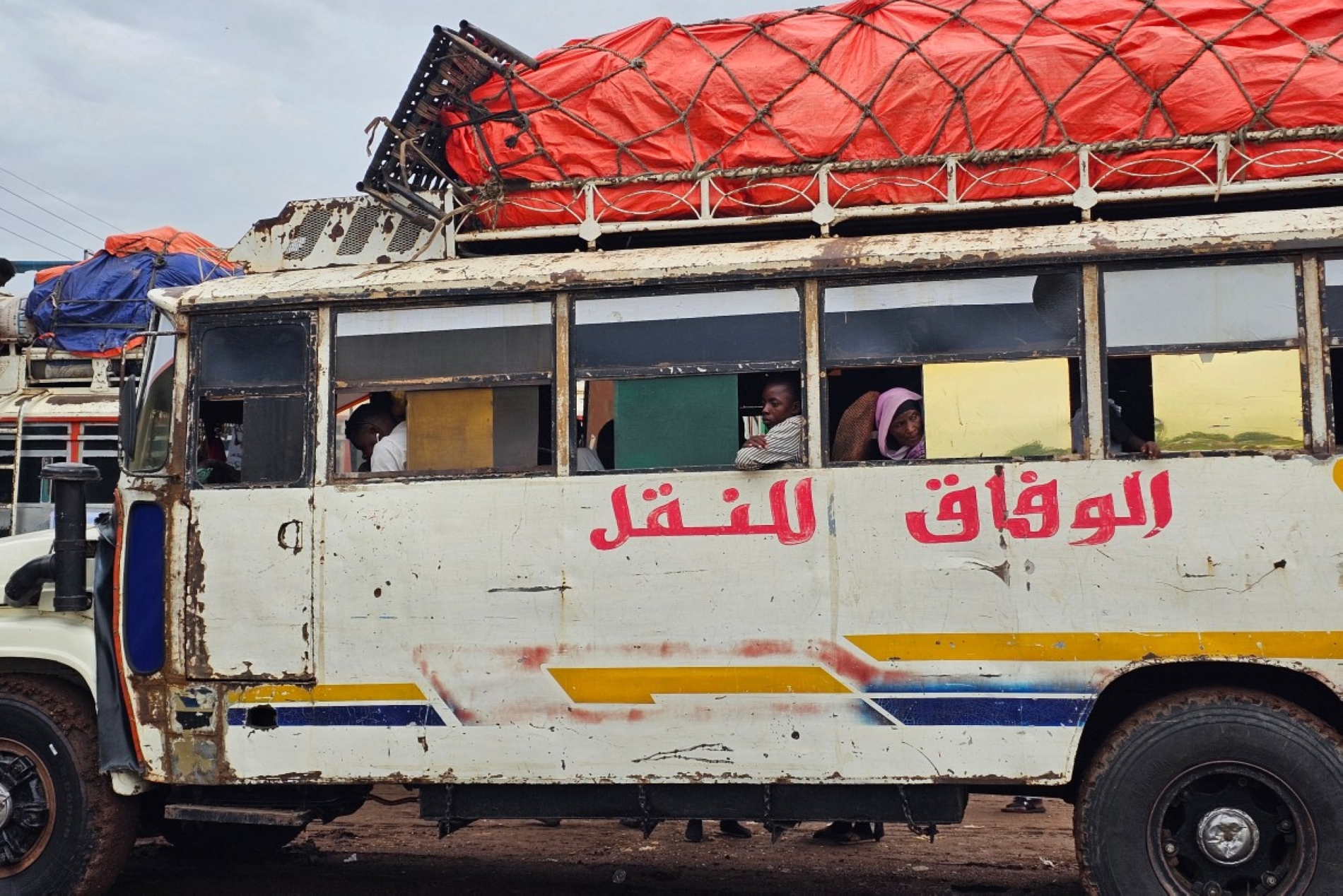
Displaced Sudanese arrive at a bus stop in Khartoum on 28 July 2025, upon their return to the capital.
An imposed peace
The only prospect for a ceasefire would be if the external supporters of the SAF and RSF cut off their supplies, forcing them to cease hostilities. That would require rivals—particularly Saudi Arabia and the UAE—to end their feud. Other actors within and outside the region would also have to stop sponsoring the rival actors. The United States is the only actor capable of forming an ad hoc group committed to a ceasefire, but it would be effective, given its unsuccessful bid to mediate between Saudi Arabia and the UAE in Yemen and on other bilateral issues.
Even if external actors were able to force a ceasefire, the same challenges of establishing civilian rule after the Bashir government would recur, complicated by the huge size of the army and likely renewed presence of Islamist forces. Moreover, civilian leaders who were at the heart of the post-Bashir revolutionary movement are now scattered in the diaspora and have substantial differences, visions and priorities.
The division of the "Freedom and Change" forces into multiple factions, and their inability to present a cohesive and unified political alternative, weakens their negotiating position against military parties that monopolise arms and field control. Any UN support mission to a weak civilian government would have to contend with these issues.
Unfortunately, 2026 is unlikely to get easier for Sudan and its people, and the war will likely rage on. And while President Trump prides himself on resolving regional conflicts, he tends not to follow through after signing the most tentative agreements that are quickly broken. Even if he personally invests in the Sudan crisis, as Crown Prince Mohammed bin Salman urged him to do in November, getting a ceasefire to stick will be tricky.