
Less than a week before China’s revised National Defence Mobilisation Law took effect, Col. Jiang Bin, a spokesman for the Defence Ministry, urged observers not to read too much into it. But commentators have been doing exactly that, linking the legislation to the prospect of military confrontation, either over Taiwan or elsewhere.
The amendments regulate China’s shift from peacetime to defence mobilisation, which Jiang said reflects changing circumstances while reaffirming China’s long‑standing doctrine of self‑defence and retaliation only if attacked, in line with the principle of ‘active defence’ rooted in the Mao era.
The revised mobilisation law took effect on 1 October after it was adopted by the Standing Committee of the National People’s Congress and signed by President Xi Jinping. It gives a legal framework that expands China’s capacity to mobilise military and civilian resources during emergencies and conflict.
By embedding defence preparedness across the machinery of the state, it strengthens Beijing’s ability to sustain a long war, should one occur. The law gives the state broader powers to draw on civilian and privately owned assets to support military operations, including requisitioning them under certain conditions. It also obliges sectors such as cybersecurity, artificial intelligence (AI), telecoms, data processing, and computing to contribute to defence mobilisation under the principle of ‘military‑civil fusion’.
Military and state institutions must now continuously assess the readiness and security of defence supply chains to reduce reliance on external sources, which could become vulnerabilities. Defence requirements are to be integrated into the design of big infrastructure projects. A data support system for mobilisation is to be established, recognising data and software as ‘resources’ essential to defence preparedness.
The most consequential change expands the grounds for mobilisation to include ‘national development interests’, sovereignty, and territorial integrity. Analysts say this gives Beijing more leeway to invoke the provision in sensitive regional disputes, such as on Taiwan or the South China Sea.

Securitising the state
The revised law is part of a broader shift that began when Xi Jinping assumed power, steadily widening the definition of ‘national security’ to include not just defence but also the economy and technology. Some dub this ‘comprehensive securitisation’. In 2014, Beijing established the Central National Security Commission and embraced the concept of ‘holistic national security’, extending its reach into civilian domains.
The following year saw the adoption of the National Security Law, accompanied by a sweeping restructuring of the People’s Liberation Army (PLA), the creation of five joint theatre commands, and a stronger role for the Central Military Commission. The Cybersecurity Law and National Intelligence Law followed in 2016 and 2017. In 2020, China amended its National Defence Law to broaden the areas covered by defence responsibilities. It then revised its counterespionage and state secrets legislation in 2023 and 2024.
The PLA’s April 2014 reorganisation established the Information Support Force and redistributed responsibilities for cyberspace, outer space, and logistical support to strengthen command structures and combat capabilities. Three months later, a Communist Party resolution called for improvements to the mobilisation system and deeper military‑civil integration. In May 2025, the white paper China’s National Security in the New Era outlined Beijing’s vision for modernising its national security architecture.
Evolving language
China’s transformation can be shown in its evolving political language, including Xi’s references to “great changes unseen in a century” and of the “Thucydides Trap” when it comes to China’s relations with the United States, replacing the earlier emphasis on China’s “peaceful rise” (the Thucydides Trap derives from the ancient Greek historian Thucydides, who attributed the outbreak of war between Athens and Sparta to the rise of Athenian power and the fear it provoked in Sparta).
In December 2017, addressing Chinese diplomats overseas, Xi first used the phrase “great changes unseen in a century" and it soon became a central motif of his discourse. Over the years, he has linked these changes to rising unilateralism and protectionism, the retreat of globalisation, the resurgence of Cold War thinking and ‘bloc politics,’ and widening deficits in peace, development, trust, and governance.
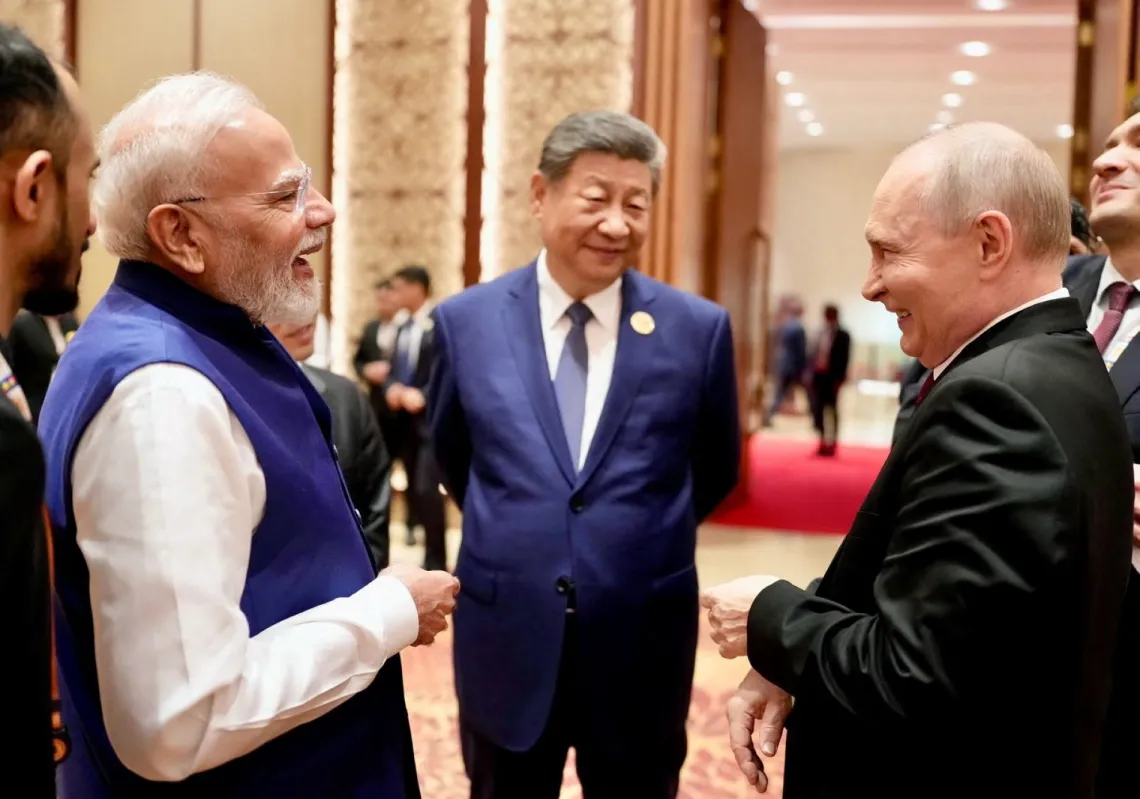
Speaking at the Shanghai Cooperation Organisation summit in Kyrgyzstan in September 2026, Xi spoke of the “spectre of war”, signalling heightened Chinese concern. The concepts of China’s “peaceful rise” and its “peaceful development,” as first promoted by Premier Wen Jiabao in a 2003 speech at Harvard University, have, in parallel, been put on the back burner. Wen had sought to reassure rival powers that China’s ascent would avoid the well-trodden path of war and domination.
At summits in Beijing in May, then in Washington in September, Xi spoke about the Thucydides Trap, emphasising that the US and China could avoid falling into it. This carried an implicit acknowledgement that China's rise has drawn relations between Washington and Beijing closer to the danger of confrontation. For observers, the most obvious potential flashpoint is Taiwan.
According to US assessments released this month, the likelihood of Beijing resorting to force against the island before 2028 has diminished. This may reflect delays in certain aspects of military readiness caused by the anti‑corruption campaign, as well as Beijing's decision to await the outcome of Taiwan's elections that year. For decades, Washington has committed to defend Taiwan, but whether that still holds is debated.