
Yemen has entered a decisive battle over the state's future, with implications for regional security. On 4 October, President Dr Rashad al-Alimi announced Operation Dawn of Yemen to reverse Houthi territorial gains made in September, including along the Red Sea coast and restore state authority nationwide.
Can the Yemeni government translate military momentum, greater international support, and the Arab Coalition’s military reactivation into lasting strategic gains? Previous campaigns saw varying levels of success because of fragmented command and control, uncoordinated international military responses, competing regional and Western priorities, inconsistent external backing, and a failure to protect what had been recaptured in Sanaa, al-Jawf, Marib, and Hodeida. This year’s reconfiguration of the Presidential Leadership Council, the weakening of the Southern Transitional Council, and Riyadh's more consolidated role within the coalition offer a chance to fight more effectively. Still, this political coherence must translate into unified military planning and execution.
Since 11 September, the Houthi offensive, backed by Iran’s Revolutionary Guards Corps, has reached well beyond the Tihama coast, while maintaining sustained pressure on the southern and western outskirts of Taiz, controlling much of the commanding rural terrain and threatening the route to Aden. Strangling supply lines may further divert nearby government formations but has alarmingly exposed civilians to renewed siege conditions 11 years on. Inside Taiz, Yemen’s second-most populous city outside the capital, prices of fuel and basic household items have skyrocketed.
To secure this territorial breakthrough, the Houthis launched offensives along more than 30 frontlines, deploying constant troop reinforcements under heavy, concerted drone, missile, and rocket fire cover.
Fighting is currently concentrated mostly on the frontlines of al-Aqroudh, Jabal Wahan, al-Dhabab, al-Waziáh, Kahbub, and al-Mahawela. The Houthis seek to take full control of Taiz and the approaches in Lajh to redraw the rules of engagement around Bab al-Mandab Strait. In Lahj, fighting around Kahbub, al-Madharbah, and al-Arah continues to threaten access to the coastal battlefield, while Marib remains a strategic centre of gravity for its energy, social, and military weight as the Yemeni government's last strong foothold.
Houthi outflanking manoeuvres, electronic warfare, sniper reinforcements, and fortified defences seek to control critical routes, cut supply lines, and besiege Yemeni government-aligned military formations, as seen in al-Mocha and rural Taiz, under heavy pressure, enough to erode operational momentum and disrupt the counteroffensive.
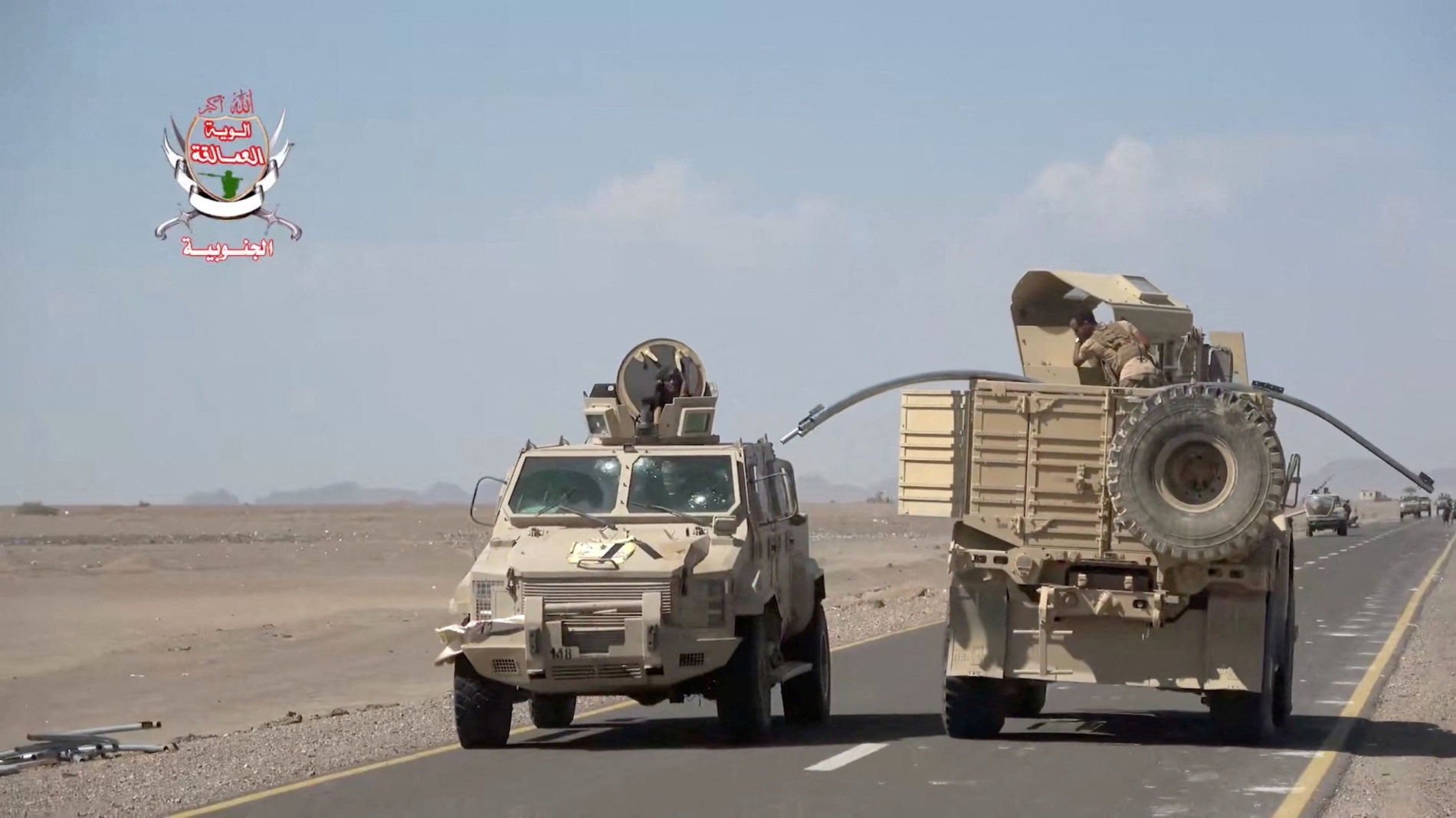
After seizing al-Mokha and Dhubab, the Houthi rebels immediately moved to fortify commanding heights, dig trenches, and lay extensive minefields to stall advances by the Yemeni Armed Forces. The government's priority was to retake Dhubab and Bab al-Mandab before the Houthis hardened those positions, taking advantage of the “kill box” where it restored control. However, advances toward al-Khokha and Hodeida will likely be slower and costlier because they require mine-clearance capacity, protected engineering assets, anti-drone defences, and secure military logistics. Stamina, not speed, will determine who prevails on the battlefield.
A stretched force
Despite relative gains, the widening battlefield is heavily testing Houthi combat and mobilisation endurance. Houthis have reportedly deployed child soldiers, senior ideologue commanders, police and security personnel to the frontlines, which indicates a fighting force that has been stretched thin. The further the Houthis advance, the more vulnerable they become to rear attacks.
None of this signals imminent collapse, as the Houthis retain substantial capacity to plan, mobilise and attack different frontlines with more secure military communication channels. But their reputation for inexhaustible manpower must not in any way be mistaken for unlimited combat power. Generating combat force is one thing; sustaining it across theatres in an expanding battlefield is another.