
In most Levantine cities, a version of ‘high society’ occupies the upper end of the socioeconomic spectrum: wealthy, westernised, English-speaking and often French-speaking, with enough familiarity with the West to treat it as a shared reference point rather than a foreign import.
The musical taste of this ‘westernised’ group follows the same logic: glossy, English-language pop; R&B and hip-hop with global production values; Arabic pop only when smoothed into something radio-friendly and cosmopolitan. In other words, Arabic à la Western. Closer to polished mainstream than to anything you might hear at a village wedding. This is not a matter of nationality, race, or even wealth alone—it is a distinct pop culture, liberal in its social habits, shaped by international education and Western media alike, and quietly confident in the superiority of its musical taste.
The Palestinian singer-songwriter Saint Levant’s early music fits this pop culture almost perfectly. Multilingual, melodic, and effortlessly code-switching between English, French, and Arabic, it sounded like it belonged on the same playlists as the Western and Westernised Arabic pop this audience already loved. Saint Levant did not ask this crowd to accept something new or alien; instead, he spoke in a language—literally and musically—they already spoke fluently, doing so with more charm and craft than most.
On the other side of the city sits a different group, more conservative in its social norms, more attached to tradition, and largely untouched by the nightlife and cosmopolitan fluency of the first group described above. Its music is folk at heart—dabke rhythms, wedding songs, the exuberant, unpolished, deeply local sound of mahrajanat (festivals) and shaabi (street or pop) and their derivatives. By most measures, it is wildly popular, but strictly confined to this second group, and rarely popular with the westernised group.
Same city, two mutually exclusive pop cultures. It is a divide the French sociologist Pierre Bourdieu would have recognised immediately: in his classic account of taste and distinction, what a class calls ‘good taste’ is rarely just an aesthetic preference—it is one of the main tools a class uses to mark and defend its own boundaries, dressing up class judgment as artistic judgment.
Intruiging turn
Which is what makes Saint Levant’s more recent turn so intriguing. In the last couple of years, his sound pivoted hard toward the very folk and traditional forms his original audience had never taken to enthusiastically—shaabi rhythms, mahrajanat energy, the vocal textures of tarab (an Arabic word that has no English equivalent, but translates loosely to "musical ecstasy" or "enchantment," describing a profound emotional state where a listener becomes completely absorbed and moved by music or poetry), the whole sonic vocabulary of wedding music the crowd would once have found faintly embarrassing. Surprisingly, his audience did not just tolerate the shift; they embraced it, enthusiastically, publicly, at volume.
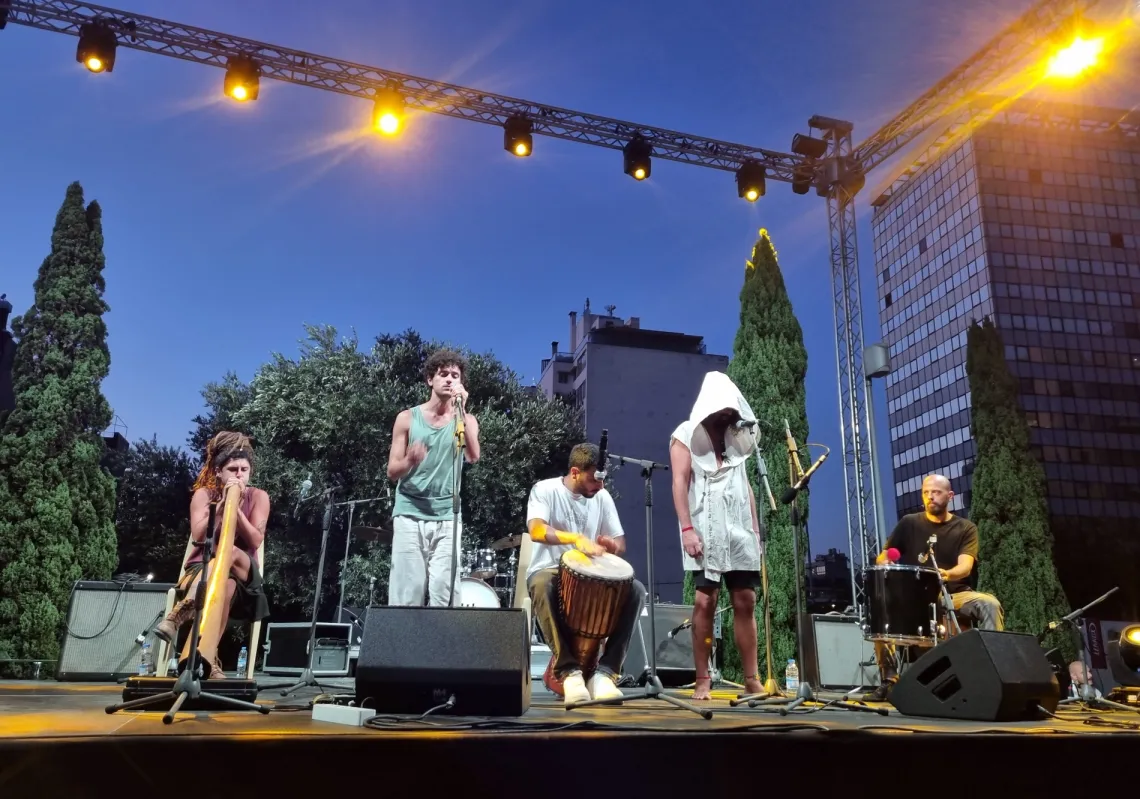
A recent concert in Amman, Jordan, made the point almost too neatly: Saint Levant performed to a not-so-thrifty crowd (six tickets cost more than the minimum monthly wage), filling a vacant lot with exactly the first group described, the stage dressed like a folk wedding—clichéd flower arrangements, deliberately cheesy staging, and an aesthetic this crowd would once have found comic.
The audience sang along and danced passionately to his folk songs. Later that same night, the artist turned up at a nightclub known for a strict, socially selective door policy—the kind of place that would not, on an ordinary night, let in the very folk-music scene it was now celebrating. He brought with him a guest performer from that world, and the crowd sang along to an artist they otherwise would not have been caught listening to at any other time or place.
Saint Levant is not the only artist whose folk-infused music is gaining popularity with the ‘westernised’ group. The Egyptian singer and rapper Tul8te is on a similar trajectory: unapologetically folk-inflected, festival-and-wedding-coded pop that, if it came from an unknown act, would likely have been dismissed as unsophisticated. Instead, Tul8te has found real affection from that audience. In June, the two artists released a song together, Nano, which is telling in itself: music once dismissed or ridiculed by the ‘westernised’ group has become something they actively embrace.
That begs a few questions: Why did the ‘westernised’ group suddenly open its door to this genre? Is it open to any and all folk singers? Will we start seeing international-school prom parties playing songs by Shaaban Abdel Rahim and Hamo Bika?
'Passport effect'
The simplest explanation is what might be called the ‘passport effect’. This resembles what the sociologist Michèle Lamont calls symbolic boundary work: the way social groups draw and defend the cultural lines between ‘us’ and ‘them’. Saint Levant’s early work established him, in the eyes of his original audience, as fluent in their language and therefore fundamentally ‘one of them’. Once that trust exists, a later move into unfamiliar territory tends to be read as an artistic choice rather than an identity change.