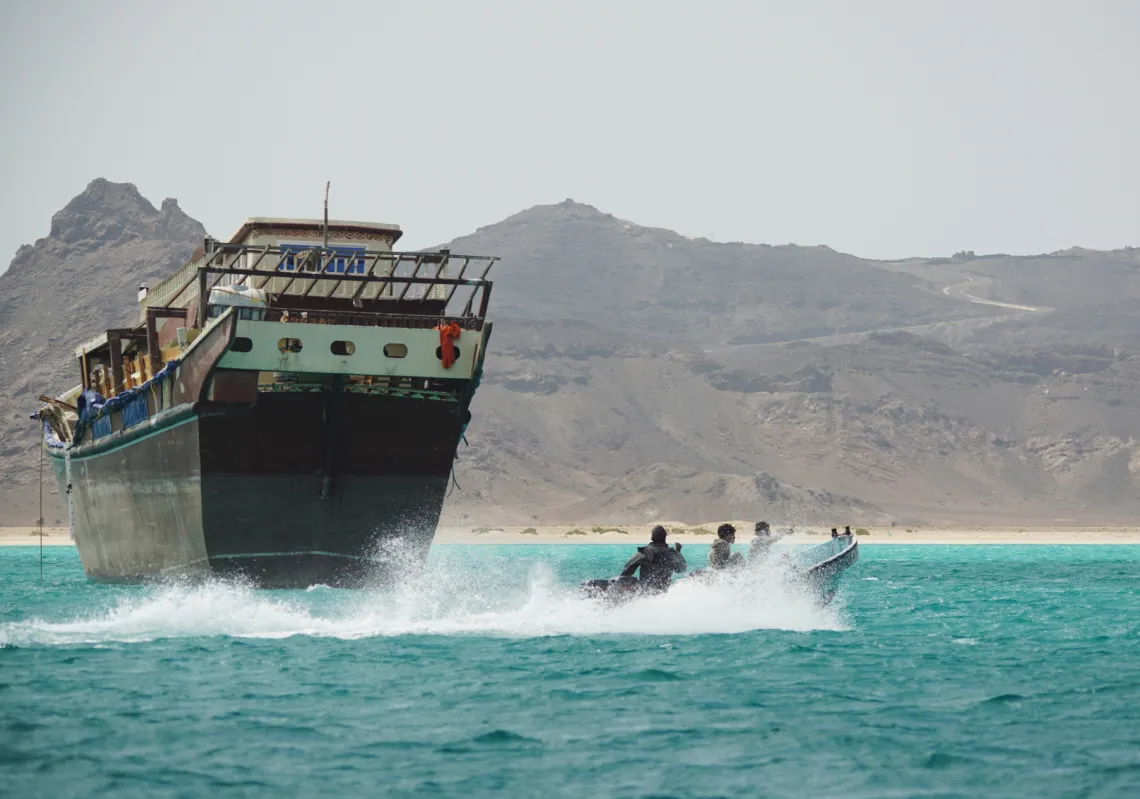
The Houthis have taken control of Yemen’s entire Red Sea coast, according to reports. The Yemeni rebel group took over the remaining towns on the coast in a lightning advance against the pro-Yemeni government forces early on Friday, and has pushed onto islands in the Bab al-Mandab Strait, government sources and witnesses say. This development effectively gives the Iran-backed group control over the key shipping route of Bab al-Mandab, which links the Gulf of Aden with the Red Sea.
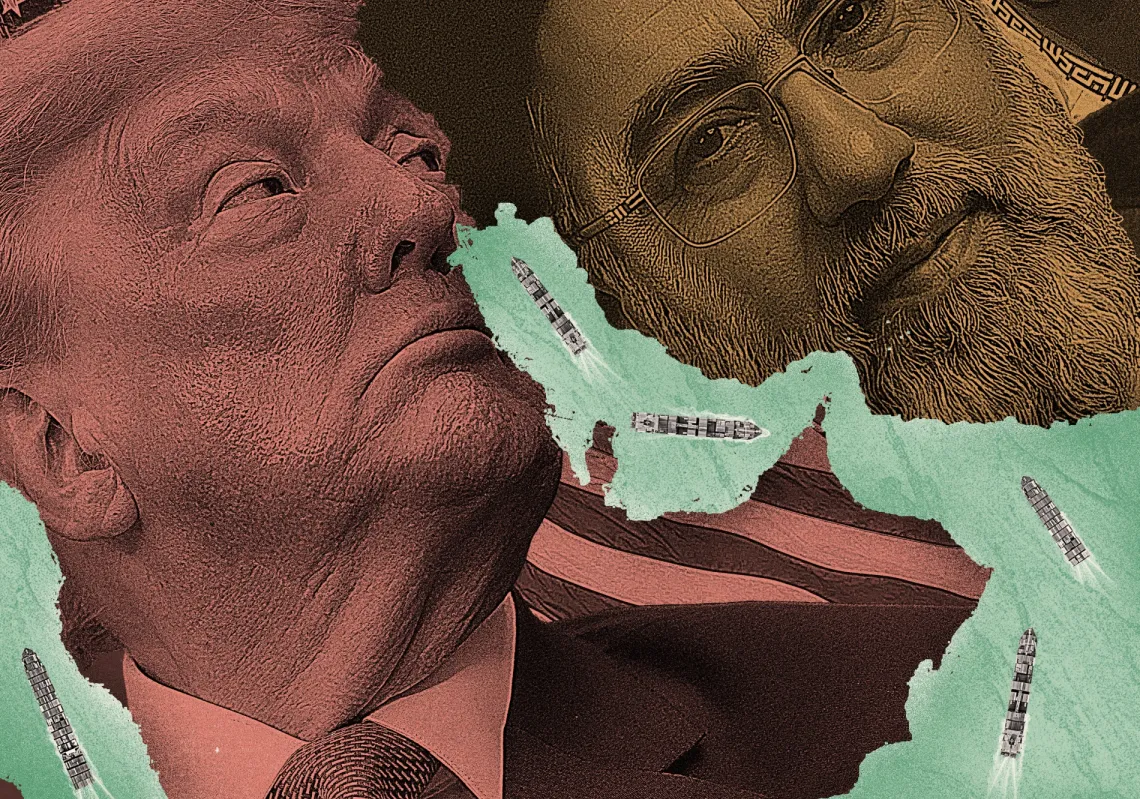
The route has been an alternative to the Strait of Hormuz, through which about one-fifth of global energy shipments were carried before the US launched war on Iran on 28 February this year.
For his part, Yemen’s Presidential Leadership Council chairman, Rashad al-Alimi, has insisted that the state will not shrink from its responsibility to protect its citizens, restore its institutions, reassert its authority across the country and defend its coasts, ports and territorial waters and warned against allowing Bab al-Mandab to become “another Hormuz”, or Yemen to serve as an instrument of geopolitical coercion on Iran’s behalf, adding that safeguarding the strait is vital to international security and commerce.
This consequential development shows that disrupting global trade has become both easier to inflict and harder to contain. The world is now relearning that lesson in real time as the Houthis are seeking leverage over one of the world’s most important maritime arteries with capabilities far cheaper than those once required to produce strategic effects of this magnitude. Such power was once largely the preserve of states. That shift risks setting a precedent that others may seek to emulate.
A Houthi military helicopter flies over the Galaxy Leader cargo ship in the Red Sea in this photo released on 20 November,2023.
Expanded campaign
The Houthis began attacking commercial shipping in the Red Sea in November 2023, against the backdrop of Yemen’s civil war and under the banner of solidarity with Gaza, while continuing to receive Iranian backing. Nearly three years later, the campaign has expanded far beyond that original frame and increasingly encompasses the coastline itself, using systems that in some cases cost less than a used car.
The Bab al-Mandab Strait and the Red Sea shipping route have grown more strategically important since the closure of the Strait of Hormuz. In July, the Houthis claimed to have struck two Saudi oil tankers in the Red Sea and declared a maritime embargo on Saudi Arabia, threatening vessels calling at Saudi ports. That prompted several tankers carrying or due to load Saudi crude to reverse course rather than risk transiting the Bab al-Mandab.
The Houthis' effective takeover of the Bab al-Mandab Strait shows how disrupting global trade has become both easier to inflict and harder to contain
By August, Saudi oil shipments through the strait had fallen dramatically, forcing Aramco to send some crude around Africa or through Egypt instead. This has pressured the alternative trade and energy route Riyadh had increasingly relied on as Hormuz became more hazardous.
That is what makes the Houthi campaign significant beyond the immediate conflict. A relatively small force does not need to close a waterway to impose costs through it. It only needs to alter the calculations of shipowners, insurers, and traders enough to change their behaviour.
The economics of countering that threat are similarly asymmetric. Intercepting a drone that cost the Houthis a few thousand dollars can run to millions in return fire. During the original 2023-24 campaign, naval missiles used to intercept drones ran around $2mn a shot, and by April 2024 US naval forces had already spent close to $1bn on munitions to defend shipping in the region. By April 2025, at least seven MQ-9 Reaper drones, each worth around $30mn, had been downed by low-cost Houthi defences.
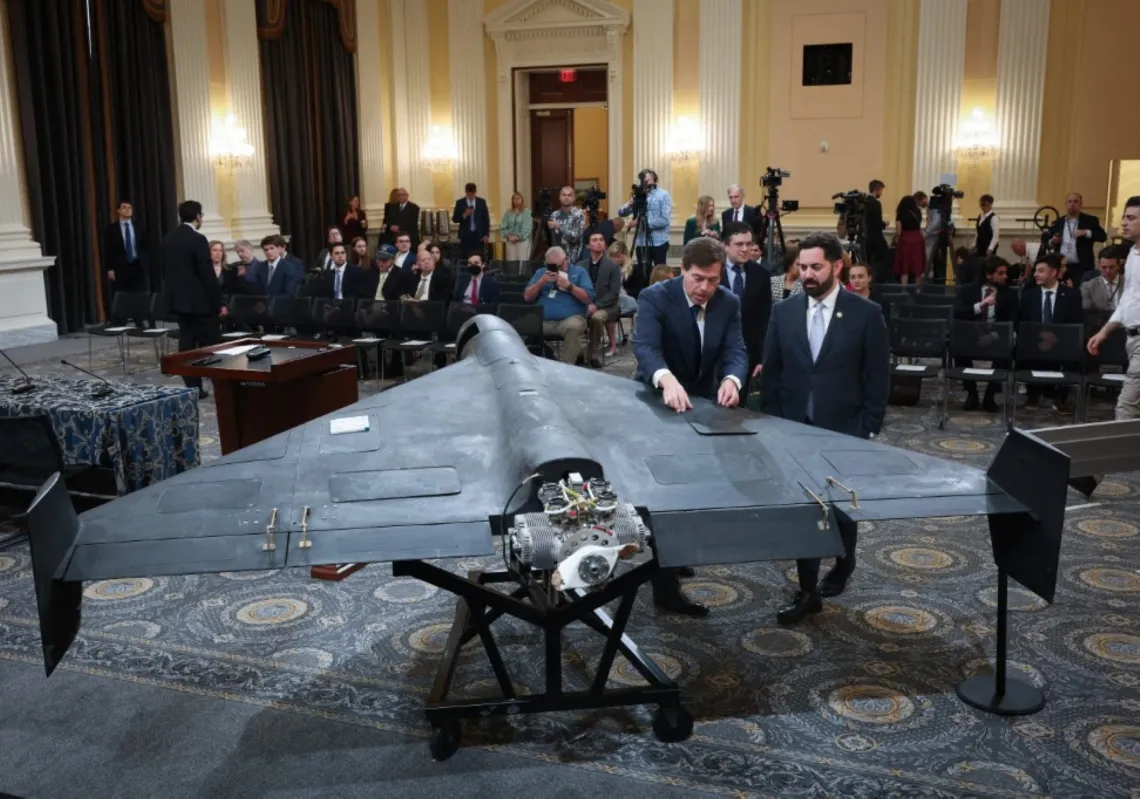
Mark Wallace (L), CEO of the non-profit United Against Nuclear Iran, talks with Rep. Mike Lawler (R) (R-NY) next to a Shahed 136 military drone during a press conference on Capitol Hill on 8 May 2025 in Washington, DC.
Stark arithmetic
The wider war the Houthis joined this year has made the arithmetic starker still. The White House sent Congress an $87.6bn supplemental request in June 2026, with $67.1bn earmarked for defence and $21bn specifically to recoup munitions expended in the conflict.
Washington is also seeking funds to replace at least two dozen lost MQ-9A Reapers, complicated by the fact that the MQ-9A model is no longer in production, leaving a capability gap the Air Force cannot close quickly. Pressure on US stockpiles is already feeding into procurement. In August, the US Navy awarded Raytheon a $22.9bn contract to accelerate Tomahawk production, explicitly citing the demands of current operations and the need to expand munitions capacity.
These funds are not being spent solely to counter the Houthis, but they show the same asymmetry: expensive, slow-to-replace Western systems being depleted against cheaper, faster-to-replace adversary capabilities, with replenishment increasingly an industrial as well as a military problem.
The technology explains how the Houthis have generated disruption. It does not explain why the international response has struggled to contain it. That requires looking at the architecture of the post-1945 international order.
The institutions established after the Second World War were designed to regulate relations between sovereign states, not technologically enabled non-state actors. They rest on the assumption that governments possess territory to defend, economies to protect and international relationships they cannot afford to lose. Diplomacy, sanctions, deterrence and international law all depend, to varying degrees, on those assumptions. They work because states generally have something at risk.
UN Security Council Resolution 2722, adopted in January 2024, demanded that the Houthis cease attacks on merchant shipping and reaffirmed the right of member states to defend freedom of navigation. Its reporting mandate has since been repeatedly renewed, most recently through Resolution 2826 in July 2026.
Yet this kind of instrument was designed principally for states, where there is a government to pressure, international obligations to invoke and an economy that can be made vulnerable to sanctions. The Houthis possess few of those characteristics. They have no meaningful international standing to lose, few overseas assets to freeze and only limited dependence upon the rules-based international order they are disrupting.
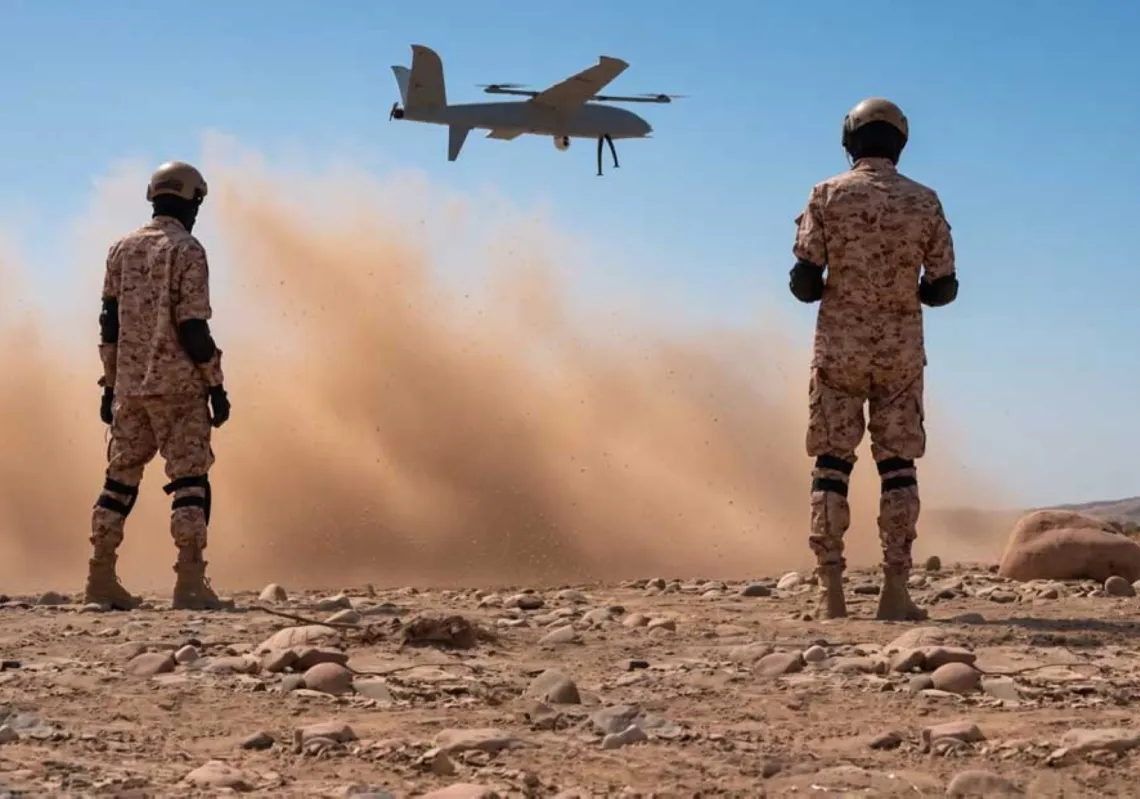
An FPV (first person view) drone with fibre optic cable, flies over the border from Lebanon to Israel as it is seen from the Israeli side of the border, on 19 May 2026.
Low-cost warfare
Technology has widened that gap. Commercial drones, open-source intelligence, AI-enabled campaigns, satellite navigation, encrypted communications and increasingly accessible missile technology have dramatically lowered the cost of exercising strategic influence. A militia no longer requires a navy to affect global shipping or an air force to impose costs on international markets. Strategic influence has become more widely distributed, but the institutions designed to regulate it have remained largely unchanged.
Military responses expose the same dilemma. Naval coalitions can escort convoys and strike launch sites, and both approaches have been tried repeatedly since 2024. Yet they have neither eliminated the Houthi threat to shipping nor prevented the group from expanding the territory from which it can exert pressure. Its advance towards Bab al-Mandab makes that failure particularly stark. After years of international military operations intended to protect the waterway, the Houthis are now fighting for territory that directly overlooks it.
At the same time, recognising that such groups possess genuine strategic influence risks inadvertently granting them political legitimacy. The rules-based order offers governments two equally unsatisfactory options. The Houthis are neither a conventional state adversary nor simply another terrorist organisation. They occupy an increasingly important space between the two, and the post-war security architecture offers remarkably few tools for dealing with actors that sit there.
That does not require granting the group political standing. Governments can treat the Houthis as a serious strategic challenge that must enter the calculations of navies and insurers while still denying them any claim to legitimate belligerent status.
The problem runs deeper than the Houthis themselves, and it is compounded by the behaviour of the states meant to be containing them. The post-war international order is increasingly confronting a mismatch between where authority resides and where power resides. Authority still sits largely with sovereign governments, international institutions and international law. Power, by contrast, is becoming more diffused. It now extends beyond states to militias, proxy networks, cyber groups and other technologically enabled actors capable of imposing strategic costs without exercising sovereign authority.
The institutions created to manage international security have adapted only slowly to that change, and the states that lead those institutions have made the adaptation harder still.
States have also weakened the system through their own selective enforcement of international law. When the powers most vocal about defending freedom of navigation also bypass multilateral authorisation whenever a strike suits their interests, as they have during the Iran war, the law loses much of its force as either a deterrent or a means of holding violators to account. A rule that is binding only when convenient discourages nobody, least of all an actor who never regarded itself as bound by it in the first place.
The challenge, however, would exist even if every state complied perfectly with international law. Selective enforcement has merely accelerated a deeper structural development.
A commercial vessel passes through an international shipping lane off Yemen's Hanish Island in the Red Sea on 27 July 2026.
Global cost
The consequences are already extending far beyond the Red Sea. Countries with no influence over Houthi strategy are nevertheless absorbing its costs. Australia, for example, derives around a quarter of its GDP from exports of goods and services, and its petrochemical and agricultural sectors rely heavily on imported diesel and petroleum derivatives.
KPMG modelling published in 2025, ahead of the closure, projected that a doubling of oil prices from a Hormuz shutdown could shave around 0.2 percentage points off Australian GDP. The crisis has reinforced the rationale behind Canberra's plans for an Australian-flagged strategic shipping fleet, intended to maintain access to essential goods during periods of disruption.
Japan's exposure runs deeper still. Some 90% of its oil imports depend on the strait, and when the route closed in March 2026, Tokyo released 80 million barrels from its strategic reserve, equivalent to 45 days of domestic demand, in an attempt to stabilise supply.
Both countries sit thousands of miles from the Red Sea, yet each is now living with the consequences of decisions made by a militia whose origins lie in the mountains of northern Yemen. The Houthis are therefore best understood as an early demonstration of how strategic influence will increasingly be exercised in the 21st century.
History offers parallels, but not equivalents. Geography has long allowed relatively small groups to exert influence well beyond their size. The Khyber Pass, linking Central and South Asia, illustrates the point. For more than two thousand years, successive empires sought to control one of the region's most important land corridors, from the Achaemenids and Alexander the Great in the fourth century BC to the Mughals and the British Empire. Yet none succeeded in exercising lasting control. Instead, a shifting mosaic of Pashtun tribes and local power brokers exploited the terrain to negotiate, resist, tax or fight successive imperial powers, often forcing far larger armies to pay heavily for access through the mountains.
At sea, the pattern was similar. Between the 16th and early 19th centuries, the Barbary corsairs operating from Algiers, Tunis and Tripoli preyed on Mediterranean shipping, capturing merchant vessels, taking crews for ransom and extracting tribute from European powers that often found payment cheaper than sustained naval campaigns. The young United States fought the First and Second Barbary Wars between 1801 and 1805 and again in 1815 to end those demands.
Further east, maritime raiders operating from Aceh, the Strait of Malacca and the Sulu Archipelago exploited narrow waterways and fragmented political authority to attack merchant shipping despite repeated campaigns by Dutch, British and Spanish colonial powers to suppress them.
The difference is one of scale, not principle. None of those groups could influence oil prices in Tokyo, insurance premiums in London or supply chains stretching across three continents. The Houthis have shown that commercially available technology, precision weapons and instant communications allow a regional militia to generate strategic effects that extend far beyond the immediate theatre.
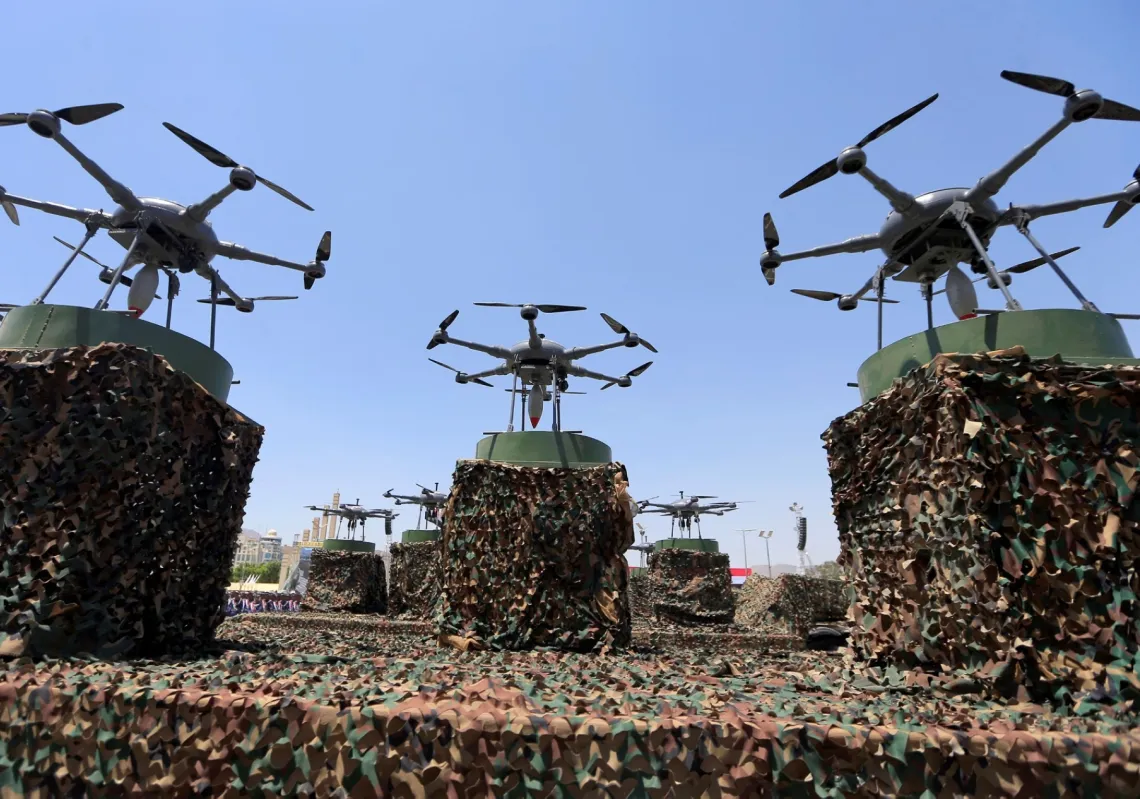
Drones displayed on a vehicle during a Houthi military parade in the capital, Sanaa, Yemen, on 21 September 2023.
Power to disrupt
Cheap drones, unmanned surface vessels and anti-ship missiles are proliferating among state and non-state actors alike, making it steadily easier to interfere with or close off a chokepoint anywhere around the world. The Strait of Malacca, for example, is of growing concern in light of this trend. The waterway carries an estimated 40% of global trade by volume and serves as the primary artery for energy moving from the Middle East to East Asia.
A closure would not be needed to cause serious disruption. Hormuz has already demonstrated how quickly commercial traffic responds to perceived danger, while the Houthi embargo on Saudi Arabia reduced traffic through Bab al-Mandab without closing the strait to shipping more broadly. Reproducing that risk calculation at Malacca would be enough to cause significant disruption, with consequences for China, Japan, South Korea and the ASEAN economies almost simultaneously.
This capability does not require ideological or strategic intent to be dangerous. Several regions already combine an armed non-state presence with a vulnerable chokepoint. Niger Delta-based pirate networks in the Gulf of Guinea have shown real operational sophistication and a readiness to use violence, but pursue ransom rather than geopolitical leverage.
Somali piracy persists in the northwest Indian Ocean for much the same reason, prompting concern about a compounding effect now that Red Sea tensions have escalated again. Further east, the Abu Sayyaf Group has run a kidnap-for-ransom campaign against merchant shipping through the Sulu and Celebes Seas for years, along a corridor carrying more than $40bn in freight annually, according to 2017 figures. If any of these groups reorient from extraction to pressure, as the Houthis have, the impact on global trade could be significant.
Puntland Maritime Police Forces patrol the Bosasso coastline in the Red Sea against IS in Bari Region, in the Gulf of Aden, Puntland region, Somalia on 30 January 2025.
The Houthis are exposing a much broader problem than maritime security alone. International institutions remain organised around sovereign states, yet a growing share of disruptive power now sits with actors that no institution can discipline in the conventional sense.
The same pattern is visible in cyberspace, where state-aligned hacking groups increasingly work through criminal ransomware operations to obscure attribution, blurring the line between an intelligence service and an extortion gang. The system was built for a world of accountable state actors, and that world is rapidly changing.
The Houthis matter because they are unlikely to remain exceptional. Until authority catches up with where power now resides, the post-war international order will remain vulnerable to relatively small actors that can impose disproportionately high costs.