How the 'new Syria' is confronting Iran

Syria’s new post-Assad leadership is working to sever Iran’s reach by shoring up its borders with Lebanon and Iraq, and by closing in on cells operating in the country

Al Majalla

How the 'new Syria' is confronting Iran

Since the fall of the Assad regime in December 2024, Syria’s new military, security, and intelligence institutions have worked tirelessly to secure the country’s porous borders with Iraq and Lebanon. Reinforcements have been sent in waves, joint border control frameworks have been established with Baghdad and Beirut, and senior smugglers have been arrested, all while Syria faces a complex array of domestic threats.

There is much still to do, however. Some cells remain active, notably those affiliated with pro-Iran militias and Islamic State (IS). Some regions of Syria still lie beyond the authority of the central government in Damascus, including areas populated by the Druze community in the south. In addition, the country is awash with weapons abandoned by Assad’s retreating forces, which has contributed to bouts of violence, such as on the coast in March 2025 and in Sweida in July 2025.

If that were not enough, Syria’s economy had been run into the ground by the time Bashar al-Assad fled. Essential services, infrastructure, and housing all need attention, as do Syria’s borders with Iraq and Lebanon. Damascus needs to impose security across Syrian territory and cannot do so if the borders are leaky. Halting the cross‑border narcotics trade is another urgent priority. Drugs corrode Syria’s social fabric and unsettle regional security, but under al-Assad, Syria became a major producer of drugs, particularly Captagon.

Battle for influence

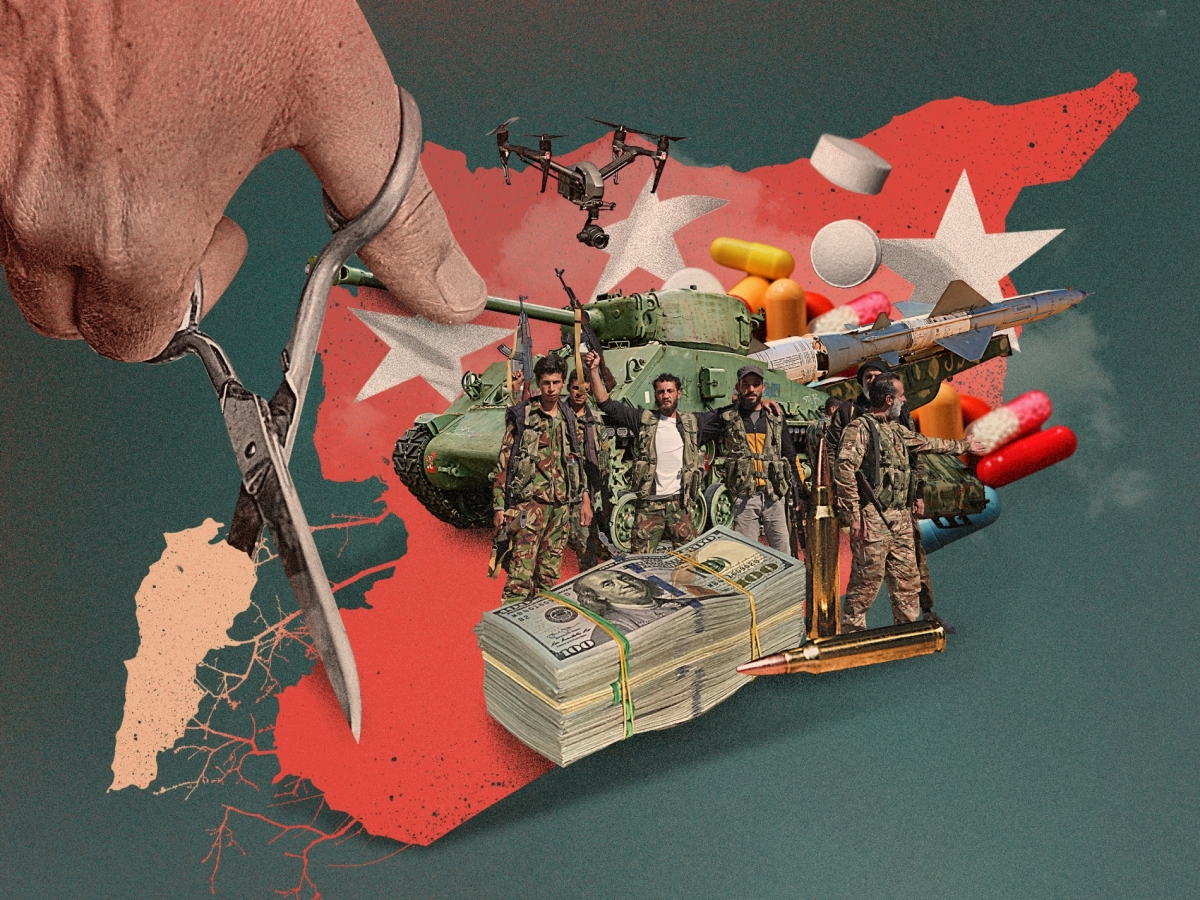
Strategically, Syria's new leadership is trying to ‘cut the cord’ with Iran and its militias. This means disrupting Iranian supply routes through Syria to Hezbollah in Lebanon. But Iran will not give up its land corridor without a fight. Militias aligned with Iran in Iraq and Lebanon likewise understand that the new government in Damascus threatens their lucrative smuggling operations, from drugs to fighters and weapons. Syria's leadership has arrested members of several Syria-based cells linked to Iranian militias in Iraq and Lebanon. This success, alongside Israeli military action, has been crucial to the degradation of Hezbollah in Lebanon.

For its part, Iran has taken note and has announced that it is prepared for an escalation of tensions, and could even be more proactive in its military approach going forward, especially towards entities it deems as collaborating with Washington. Media outlets with sympathies towards Tehran now portray the new Syrian government as an “enemy” and an American puppet.
BAKR ALKASEM / AFP
Syrian army soldiers inspect a tunnel on the Syrian–Lebanese border in the rural area of Al Qusayr on 1 April 2026.

Porous border

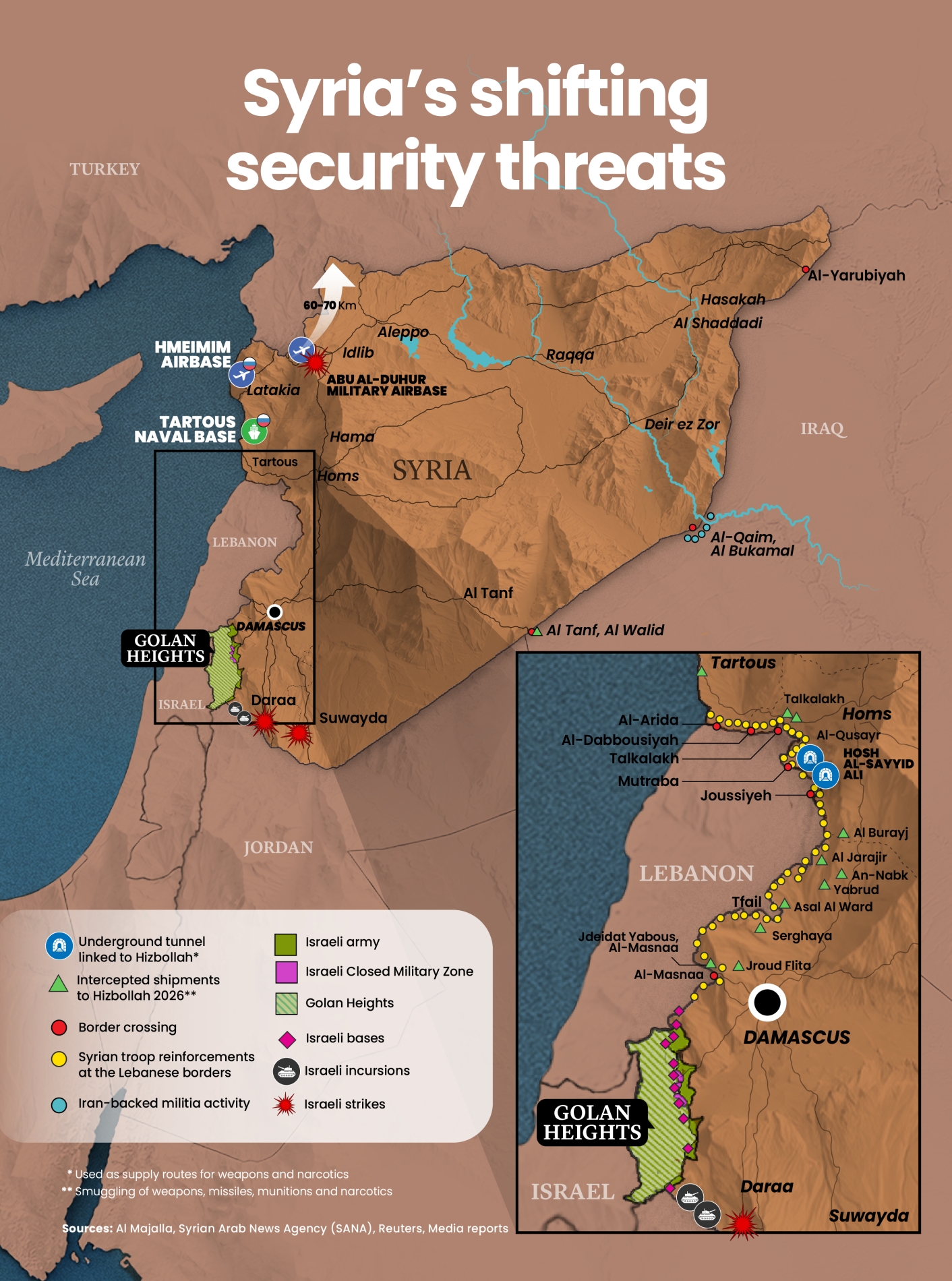
For decades, the Assad regime and Hezbollah built intricate smuggling networks through the mountains, including the construction and use of tunnels. Smuggling between Syria and Lebanon became easier than crossing an official border. Cars and military vehicles travelled along mountain roads and through tunnels as if moving between two neighbouring cities. Across the 375km Syrian‑Lebanese border are dozens of unofficial smuggling routes, both overland and underground. For Hezbollah, this is easy money.

Louay, a civilian from near Damascus who fled Syria to avoid conscription into Assad’s army, told Al Majalla that a Hezbollah vehicle took him from Qusayr to Beirut in 2023. “The journey was trouble‑free,” he said. “Within about two hours, we were on the outskirts of Beirut, all for just $600.” Moving weapons and fighters between Syria and Lebanon posed little difficulty, taking place “under the light of the sun and the moon”.

A resident of the southern Syrian town of Assal al‑Ward, near the Lebanese border, recalled seeing vehicles carrying rockets and weapons pass through the area towards Lebanon without even attempting to conceal their cargo. “We no longer felt that there was a border,” he said. “It began to feel as though the other side was simply a military barracks or an arms depot, with weapons being transported from Syria into Lebanon.”

The rapid collapse of the Assad regime, followed by the new Syrian authorities’ campaign against smuggling, narcotics, and militias, has dealt Hezbollah a setback. Its forces had to abandon numerous weapons depots as they fled Syria, and its most important Iranian supply route had been severed. But in the 20 months since al-Assad fell, Hezbollah has kept contact with its cells inside Syria, recruited new networks, and devised new methods, including using donkeys, balloons, and drones. This allowed them to preserve several smuggling routes.

Al Majalla has been told by well-placed sources in Syria that Hezbollah is preparing attacks in Syrian regions with diverse populations with the intent to "ignite ethnic and sectarian tensions and to provoke civil war". This is in coordination with remnants of the Assad regime, some of whom found refuge in Lebanon. Another aim is to obstruct security, political, and economic coordination between Syria and Lebanon, the sources assert.

In preparation for what it believes to be a looming attack from Syrian forces, Hezbollah has sent fighters to the Syrian border. It believes that Syrian authorities want to make peace with Israel. But Damascus rejects the claim and says it is part of an Iranian ruse to demonise the new authorities and recruit supporters in both Lebanon and Syria. Sympathetic media outlets portray Iran as “the protector of the resistance” and “the force preventing the Syrian army from entering Lebanon”.
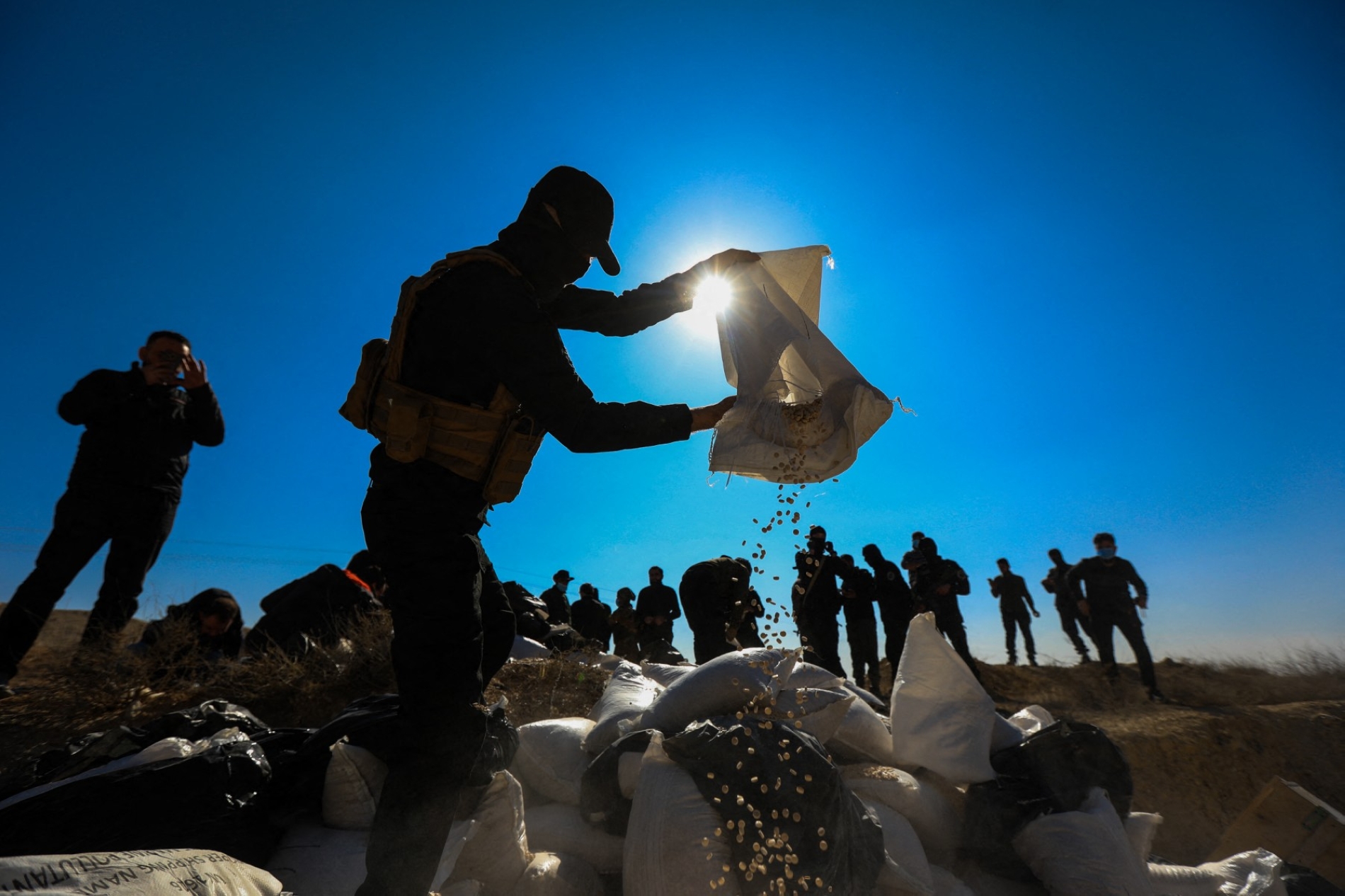
BAKR ALKASEM / AFP
A member of the security forces of Syria's new authorities empties a sack of Captagon into a ditch to burn them in a field near the Fourth Division's Security Bureau on the outskirts of Damascus on 19 January 2025.

Difficult task

Damascus is still in the process of institution‑building, setting priorities, and strengthening its military capabilities, but has had to devote time and effort to Hezbollah to curb its operations inside Syria and along the border. For a government still in its infancy, with limited military and logistical means, that has proved difficult. Syria has not yet laid the intelligence groundwork required to map and understand the network of tunnels and routes that Hezbollah had spent decades building.

Syrian authorities have intercepted around one smuggling attempt across the Lebanese border every week since December 2024 and arrested dozens of members of Hezbollah‑affiliated cells, Al Majalla's sources say.

In July, 48 security force operations targeted those involved in the drugs trade, seizing more than seven million Captagon pills, 1,190kg of hashish, 124,000 pharmaceutical tablets, 15,000 pregabalin pills, 8.3kg of crystal meth, 151g of cocaine, 22g of heroin, and 1.8 kg of precursor substances used in drug production.
Syria's success in severing smuggling routes, alongside Israeli action, has helped degrade Hezbollah.

Another problematic border

Alongside its campaign against smuggling on the Lebanese frontier, the Syrian government is waging a parallel battle along its 610km border with Iraq—a vast expanse that includes open desert. In previous years, Iran‑aligned Iraqi militias have strengthened their presence along this frontier, particularly from the al‑Qaim crossing to al‑Tanf, with an extensive network of roads and tunnels built over many years. Some were first built by IS.

Coordination between Iran‑aligned militias in Iraq and their counterparts in Syria (including Hezbollah, the Fatemiyoun and Zainabiyoun brigades) and local armed groups has increased from 2020-25 that they established formal 'coordination offices,' operating either inside the al‑Bukamal crossing or at Iranian bases in Syria, most notably the Imam Ali base south of al‑Bukamal, which has been the target of Western airstrikes.

Representatives of the militias staff the offices and coordinate the movement of drugs and weapons across the border. The offices have also helped settle disputes among the militias themselves, or between armed groups and smuggling networks, avoiding escalation.

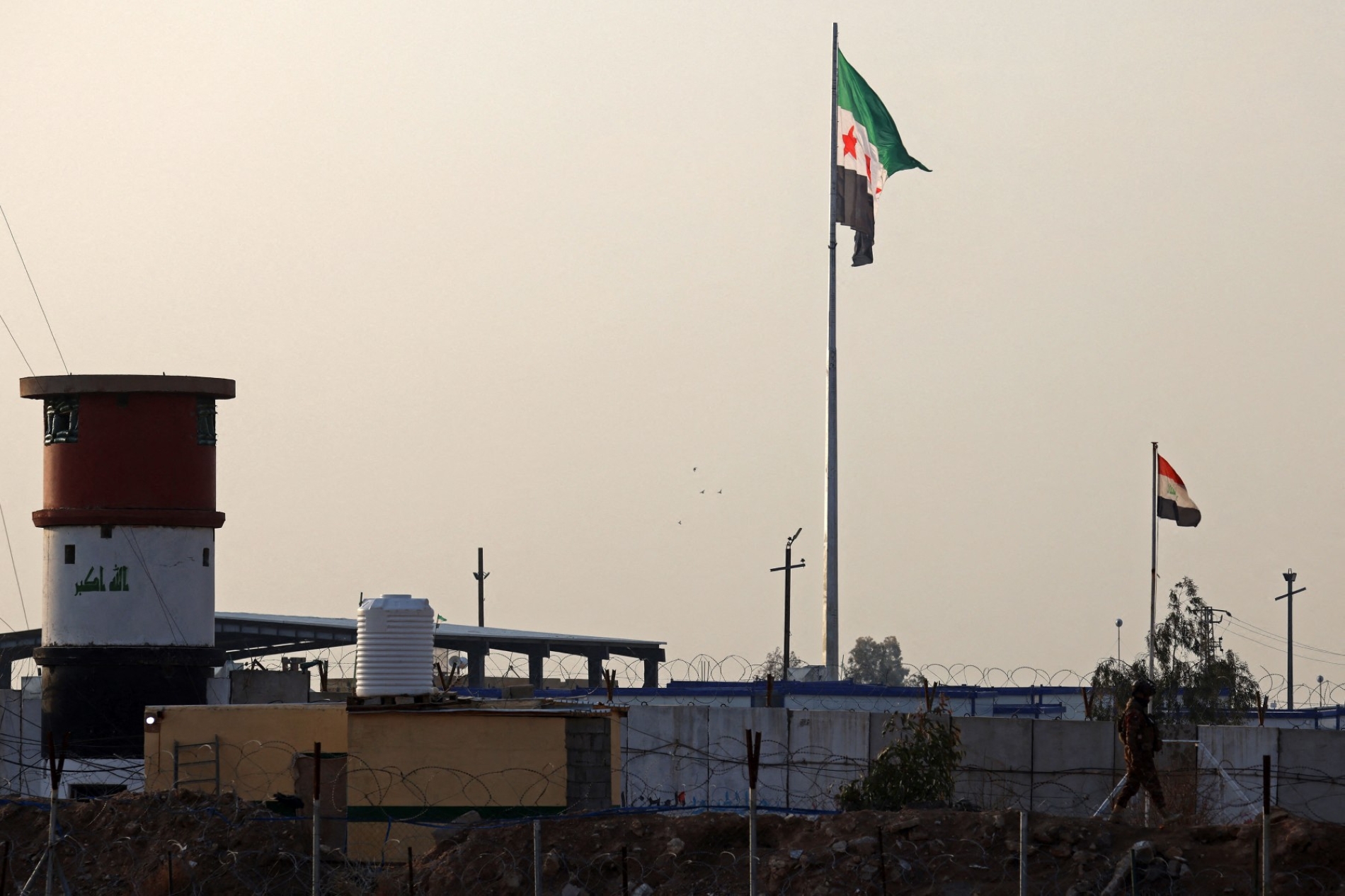
AHMAD AL-RUBAYE / AFP
Syria's (L) and Iraq's national flags are pictured near the Iraqi-Syrian border, in Al-Qaim, west of Iraq, on 23 January 2026.

Former Assad regime soldiers who served at the al‑Bukamal crossing told Al Majalla that arms, drugs, fighters, and fighters' families were transported through al‑Bukamal or via routes close to the Imam Ali base.

The most important of these was known as the "military crossing" or the "railway crossing"—an unofficial passage south of al‑Bukamal used mainly for moving heavy weapons and drones. Its proximity to the base was crucial, since the base served as a storage and distribution hub for weapons arriving from Iran for its proxies. The former soldiers said the Syria‑Iraq border contained numerous unofficial crossings and tunnels previously used by IS.

Adapting to changes

Coordination was important because smuggling between Syria and Iraq served several purposes. Narcotics generated funds for the militias, while oil and arms strengthened their capabilities (other weapons were bound for Lebanon). But the fall of the Assad regime disrupted the finances of Iraqi groups and severed the supply lines to  Hezbollah. In response, Iran‑aligned Iraqi militias adapted their methods, concealing weapons inside Iraqi oil tankers transiting Syria.

The aim has been to create tension between Damascus and Baghdad, to impede their growing economic cooperation. Iraqi militias also sought to recruit Syrians who had previously worked alongside them. In recent months, there have reportedly been reinforcements along the Syrian border in preparation for attacks. Iran would like to draw Syria into a resource-draining conflict, so militias who take their cues from Tehran have carried out several attacks in recent months against Syria and Gulf states.

It is not yet known whether Syria's hastily assembled military is ready to deal with threats originating beyond its borders. Iran may be keen to find out.

The Saudis responded by bombing Iraqi locations. This put the Iraqi government in a bind. Arab states have pushed Baghdad to disarm the militias operating on its territory and establish a Badia Operations Command tasked with preventing militias in Iraq and Lebanon from launching attacks against Arab countries.

The new Syrian authorities initially sought to reduce smuggling by meeting some of the big families known to be involved in the trade, aiming to persuade them to restrict their smuggling activities to food, electronics, and tobacco, to which Damascus would turn a blind eye, as it continued reorganising its military, security, intelligence, and logistical capabilities, and established more systematic border‑control operations.

Damascus also offered to settle and regularise members of pro-Iranian militias in Syria and those who had worked with them militarily or in smuggling, while also offering jobs to those wishing to join the new Syrian army, security forces, and police. Together, these strategies aimed to strengthen Syria's military and logistical capabilities, while Damascus also reached out to Baghdad and Beirut, offering to build relations based on respect, cooperation, and non‑interference.

By the time Bashar al-Assad fled, Syria's military and defensive capabilities were gravely depleted, yet within hours of his departure, Israel bombed what remained of the country's military infrastructure, including ships, barracks, airfields, and planes. Ever since, Israel has felt able to launch airstrikes in Syria. Most recently, on 18 August, the runway and hangars at Abu al‑Duhur military airbase in southern Idlib were struck. Days earlier, the Syrian armed forces had begun training sorties using whatever aircraft they had managed to salvage and repair. 

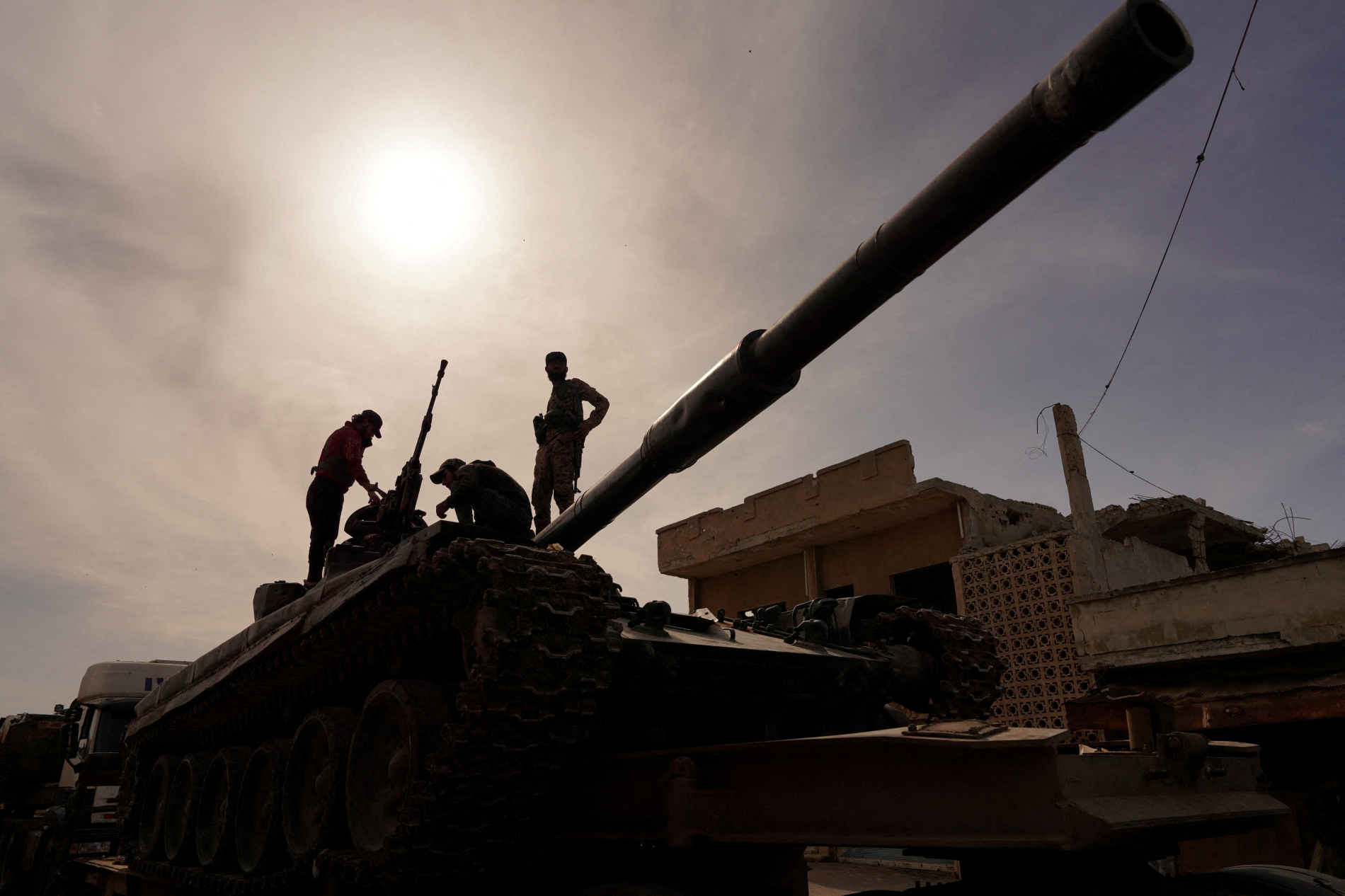
REUTERS/Karam al-Masri
Syrian troops sit atop a tank as they head towards the Syrian-Lebanese border following clashes with Lebanese soldiers and armed groups, in Qusayr, Syria, on 17 March 2025.

An enormous task

Syria's task has been huge and complex. It has involved integrating more than 100 armed factions into one national army, then distributing them according to a regional framework and organising them into 22 divisions under joint command structures. The plan is intended to organise Syrian army forces into five geographically distributed corps covering the country's provinces. If implemented, responsibility for the Syrian‑Lebanese border would fall to the Fourth Corps, based in Damascus, and the Fifth Corps, responsible for the coastal region, while the Syrian‑Iraqi frontier would come under the First Corps, covering the eastern region.

Recruitment is ongoing, and the army, internal security forces, and intelligence services have repeatedly reassessed personnel files, conducted successive rehabilitation and training programmes, and evaluated commanders, making changes where necessary. Those assigned sensitive portfolios are scrutinised even more attentively. Several personnel have been removed and arrested after they were found to have secret associations with groups such as IS, or to have been involved in corruption.

The restructuring may soon be needed; Syrian authorities believe that Iraqi militias and Hezbollah are building up their forces and moving weapons towards the frontier in preparation for possible attacks on Syria, if the US resumes bombing Iran. Damascus has conveyed to both Baghdad and Beirut that it would retaliate if Syria were attacked. It is not yet known whether Syria's hastily assembled military is ready to deal with threats originating beyond its borders. Iran may be keen to find out.

font change