
In this feature, we offer an overview of what’s new on the big screen, spanning mainstream and arthouse films across all genres, and occasionally revisiting titles from the archive.
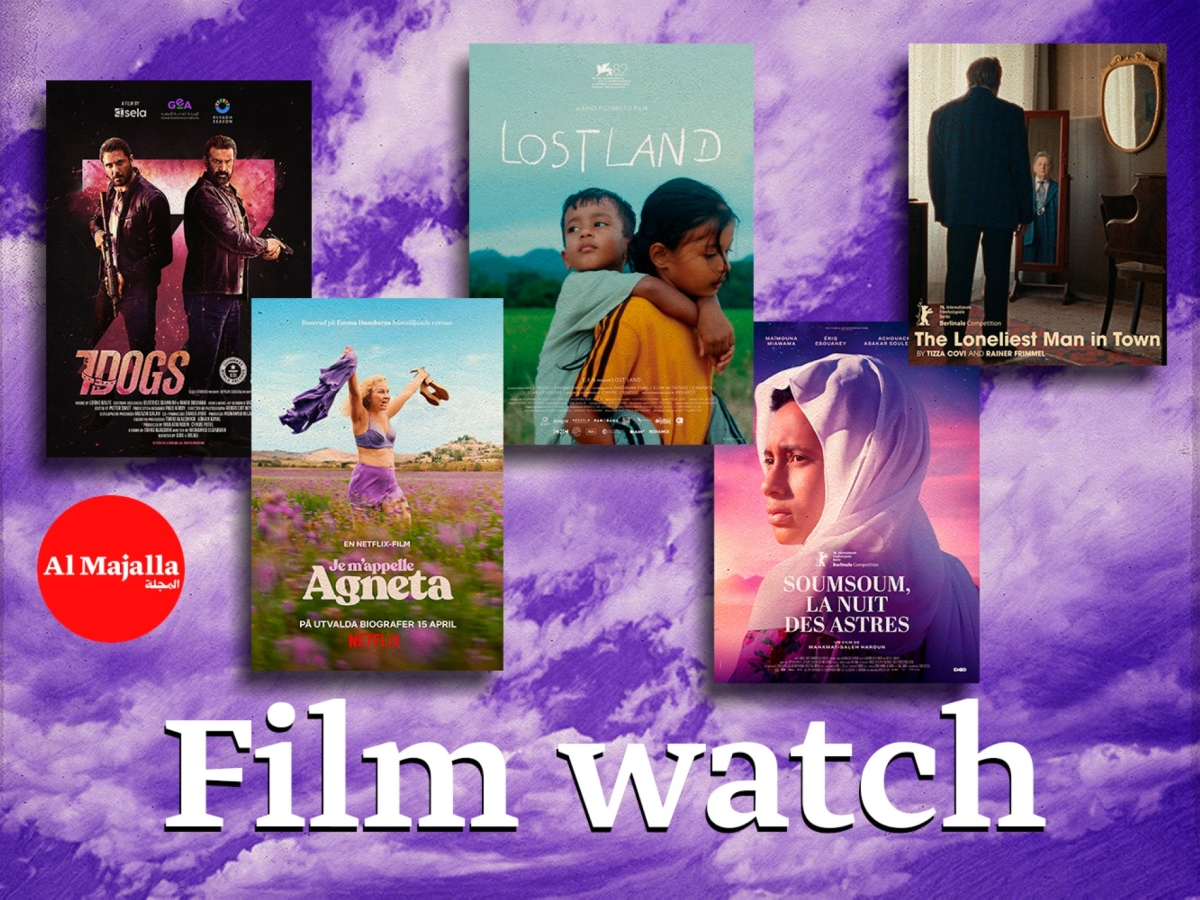
7 Dogs
Screenplay: Mohammed Al-Dabbah
Directed by: Adil El Arbi and Bilall Fallah
Country of production: Saudi Arabia
The idea for 7 Dogs came after the third instalment of Welad Rizk, when Turki Alalshikh, chairman of the General Entertainment Authority, sought to repeat the success but on a much broader and more thrilling scale. As the film’s two stars recount, he asked about the most expensive car ever destroyed on camera and the most explosives ever used in a film. 7 Dogs later entered the Guinness World Records for the largest amount of explosives used in a single scene (beating the James Bond film No Time to Die).
This film follows Khaled Al-Azzazi (Ahmed Ezz), an Interpol officer, and Ghali Abu Dawood (Karim Abdel Aziz), a defector from the 7 Dogs organisation, as they work together to track down the network’s members and foil an operation to smuggle synthetic narcotics into the Arab region. In their pursuit, they move through India, China, and the United States on a cross-border journey, with each stop given its own visual identity through rhythm, set design, and action sequences, even though the film was shot at Al-Hisn Studios in Riyadh.
The film brings together stars from Arab cinema, Hollywood, and Bollywood, including Monica Bellucci, Salman Khan, and Sanjay Dutt (Khan and Dutt are reunited 25 years after their last joint appearance). They appear alongside Martin Lawrence, Giancarlo Esposito, and Saudi star Nasser Al-Qasabi (in a completely different role), as well as Hana El Zahed, Tara Emad, Hala Fakher, and Sayed Ragab.
Having two co-directors is notoriously difficult in filmmaking, as the scarcity of successful examples shows. Both need to share the same artistic vision and be able to work well together. Thankfully, Adil El Arbi and Bilall Fallah are on the same page. In interviews, they exchange comments and ideas with an easy rhythm, yet they look like polar opposites and have very different heritage (Belgian and Moroccan).
Theirs is a complementarity founded on difference and their partnership leaves its imprint on the screenplay and the movement of events, particularly through a wide array of directorial effects that seek to give the film a panoramic quality, led by the visual element and by the continuous philosophy of motion it contains. That motion is present even in ordinary dialogue scenes, such as with the use of flying camera shots that might more commonly be employed in wide scenes or chase sequences.
The directors have an adventurous approach to filming, using cameras capable of capturing the scene at a 360-degree angle, carried both by the actors themselves and by the camera crew. The result is a kinetic and visual experience that refuses to confine movement or excitement within the limits of the frame. Instead, it draws the viewer's eye into the scene and into a sensory entanglement, as if entering a virtual reality.
Perhaps the most important distinction of 7 Dogs lies in its success in creating a professional environment of international calibre, through a different production model that, taken as a whole, demonstrates the ability of modern Arab cinema to compete more widely in the film market, once the necessary conditions are in place.
Soumsoum, La Nuit des Astres
Screenplay: Laurent Gaudé, with the director
Directed by: Mahamat-Saleh Haroun
Countries of production: Chad, France
Chadian director Mahamat-Saleh Haroun is known for his focus on how custom, tradition, and the shifting policies of ruling regimes affect people's destinies. This has been in evidence since his first film, Bye Bye Africa (1999), in which he observes the relationship between the expatriate and his homeland. In Daratt (2006), he traces the aftershocks of civil war through the lens of revenge. In Lingui, The Sacred Bonds (2021), he looks at individual freedom within a society constrained by inherited traditions and social legacies.
This concern extends to his new film, Soumsoum, La Nuit des Astres, which is co-written with the French playwright Laurent Gaudé, but in a form closer to myth or magical realism. The film follows Kilo, a young woman living as an outcast in her small village in the heart of the desert, after villagers call her "blood girl" because her mother died while giving birth to her.
Her life is overturned when terrifying visions and dreams of the future begin to recur, and she comes to regard them as prophecy. Her isolation and fear deepen, as people see in her an omen of misfortune and a bearer of extraordinary powers. At the same time, a friendship develops between her and an older woman who has also been excluded after being accused of sorcery and bringing harm to others.
The film weaves a world in which popular belief and myth mingle with daily reality, opening space for visual motifs, from burial rites to collective celebrations. The atmosphere is deepened by Bibi Tanga's score, which draws on rhythms and sounds attuned to the mystery of the desert and of the rituals that create the film's mood.
Viewers see Kilo's magical world through a series of events and situations that unfold in calm contemplation. The expanse of the desert becomes a stage on which to embody her obsessions, dreams, and fears, notably of those around her. Through an anthropological lens, the film moves from magical realism to a clear political allegory, returning once again to the notion of patriarchal authority.
Je m'appelle Agneta
Screenplay: Isabelle Nylund, Emma Hamberg, with the director
Directed by: Johanna Runefvad
Country of production: Sweden
Je m'appelle Agneta is a Swedish film described as a drama-tragedy, or 'dramedy,' based on a simple, self-evident idea: that life stops only with death, and that new beginnings can occur at any point until then. The film approaches this idea through a journey of self-discovery that its heroine, Agneta, is drawn into almost against her will.
Eva Melander embodies her in a dazzling performance, whether through the physical transformations or the character's uneven psychology, within a clear feminist vision that extends beyond the subject of the film to its makers themselves. The screenplay is based on Emma Hamberg's novel of the same title. As an author, Hamberg is concerned with relationships and personal transformations, what some call 'recovery writing'.
Agneta lives a desolate life as she approaches 50. "Do not expect too much from it," she says. She rarely sees her two grown sons, and communication between them has almost entirely dwindled due to requests for money. Her husband, meanwhile, lives a parallel life with his training partner and reproaches her for her weight, leading her to secretly eat. The tragedy is complete when she loses her job at the Swedish Transport Ministry after 25 years.
She faces total emptiness that hems her in on every side, yet the rhythm of her life veers in an unexpected direction when she sees a newspaper advertisement seeking a nanny for a family in France. She has always wanted to see France, so she goes, believing that she will be caring for a small child. Upon arrival, however, she discovers that she will be caring for an eccentric old man.
Her journey thus becomes something entirely different to the one she imagined, but one that restores her self-confidence. Through their developing relationship, the pair is forced to consider acceptance (both of others and of self), affirmation, and forgiveness. At its heart, it shows that in loving others, we can learn to love ourselves.
As each tells the other about their past, it feels confessional and cleansing. The man she cares for abandoned what he loved to live the life he believed he deserved, while she abandoned herself to live the life she believed she deserved. The film resolves its central debate at the end, as Agneta finally looks fully into the mirror. Freed from her harsh view of her own body, she hugs herself and apologises. "Hello, little fat rolls," she says tenderly, no longer needing the world's approval.
Lost Land
Written and directed by: Akio Fujimoto
Countries of production: Germany, Malaysia, France, Japan
In his new film Lost Land, the young Japanese director Akio Fujimoto moves further into the cinematic project he began almost a decade ago: a cinema of the Asian diaspora. That project first took shape in his debut feature film, Passage of Life, which followed a refugee family living illegally in Japan. He later turned to the suffering of Vietnamese migrant women in Along the Sea (2020), further training his focus on asylum and migration, themes he has consistently shaped through his own writing. Fujimoto has written all his films, including his first short, which drew in part on his own life and his studies in psychology.
This time, Fujimoto ventures into the outer reaches of marginality, tracing the ordeal of a minority caught in what a United Nations report has described as the world’s largest refugee crisis. He does so through the journey of two children who flee a Rohingya refugee camp in Bangladesh by sea, hoping to reach Malaysia, where a relative awaits them.
One aspect that particularly stands out is that the film is the first ever in the Rohingya language. The screenplay constructs its world through the eyes of the two children, avoiding the familiar dramatic devices associated with films about migration and asylum. Instead, it offers a quiet observation of the journey’s details, relying on its opening scenes on a severe visual economy, with no music and little dialogue. The handheld camera further sharpens the immediacy of the experience.
The director works with a cast of non-professional actors, drawing on dozens of real Rohingya refugees, including the two children in the leading roles. All of them have endured harsh life experiences, perhaps harsher than anything they were asked to perform in front of the camera. This gives the film a documentary-like realism.
The result recalls Luchino Visconti’s celebrated Italian masterpiece La Terra Trema (1948), in which the director likewise used real Sicilian fishermen to play themselves. The kinship between the two films also appears in their use of the community’s own language, Rohingya in one case and Sicilian in the other, as a form of resistance to the imperatives of the Hollywood box office. There is, finally, the geographical force of the setting: the sea, which in both films becomes a dramatic adversary, swallowing the boats of death along with the dreams of the innocent.
The Loneliest Man in Town
Screenplay: Tizza Covi
Directed by: Tizza Covi and Rainer Frimmel
Country of production: Austria
Once again, the Austrian husband-and-wife filmmaking duo Tizza Covi and Rainer Frimmel continue the cinematic project they have pursued since the 1990s: an exploration of the grey zones between documentary and fiction, and of the fertile space created by their fusion.
Their latest film, The Loneliest Man in Town, offers an unusual treatment of the life and struggle of the renowned Austrian blues musician Al Cook, who plays a semi-imagined version of himself within a dramatic framework grounded in real events and episodes from his life, while allowing fiction to enter and reshape them. The experiment comes close to the territory known as docufiction.
Alois Koch, better known as Al Cook, was born in Bad Ischl, Austria, in 1945, shortly before the end of the Second World War. He later moved to Vienna, where he spent almost his entire life, specifically in the city’s third district, which forms the setting of the film.
During adolescence, he developed an interest in astronomy and hoped to become a scientist in the field. Circumstances, however, forced him to work for years as a car mechanic before his path changed in the early 1960s, when he saw Loving You (1957), starring rock legend Elvis Presley. He then chose to abandon the prospect of a wretched labourer’s life and enter the world of music. This required a long effort of study and self-education, until he mastered singing in English simply by listening to old interview tapes of Presley and blues artists. He did not release his first album, Working Man Blues, until 1970.