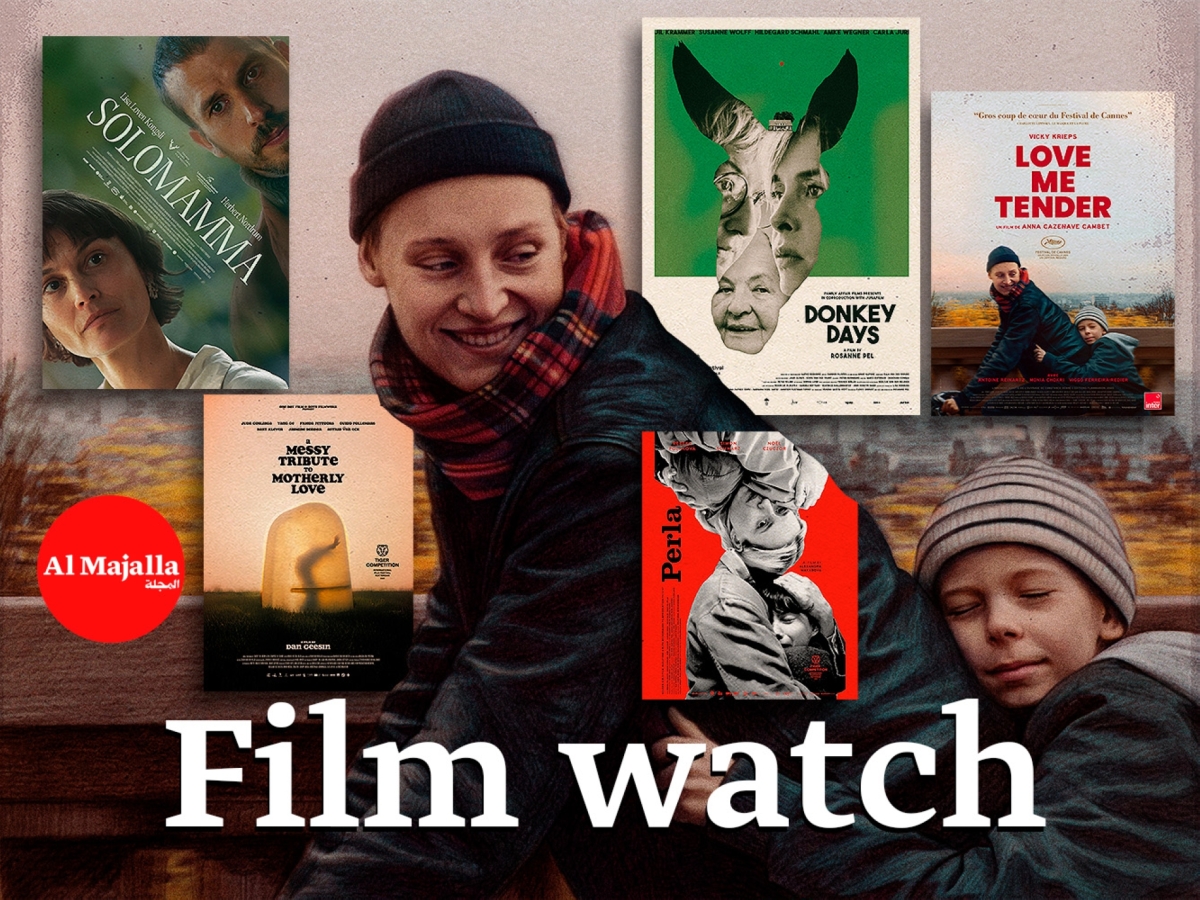

On the occasion of Mother's Day, we tour the newest movie releases that tackle the complex theme, while also reviewing an older classic for good measure.
Perla
Written and directed by: Alexandra Makarová
Country of production: Slovakia, Austria
In her second feature film, Alexandra Makarová continues excavating the memory of migration, returning to the Cold War of the 1980s and a world divided between two rival poles. She has a distinctive feminist vision, avoiding overt political alignment, even though the film’s events are closely interwoven with historical realities, most notably life under a totalitarian order in Czechoslovakia.
By fusing reality and imagination, the director can explore ideas of femininity from several angles, including motherhood. Her heroine is an unconventional woman who cherishes family life yet chafes against the confines of the role of housewife. The framework centres on a migrant trying to protect her new life from a past that refuses to loosen its grip, especially after her former husband is released from prison. She carries her daughter and her past with the same unstudied ease with which the two ride a bicycle, oblivious to the world around them, before tension gradually builds.
Makarová shapes her protagonist in deliberate defiance of convention. Rather than presenting motherhood as a fixed emblem of sacrifice or virtue, she allows her heroine to remain contradictory, sometimes guarded, sometimes impulsive, in ways that unsettle the customary expectations attached to maternal behaviour. Through the voice of her heroine, who was born in Slovakia, the director recalls a history of displacement across generations of her family, beginning with exile in Russia and extending into migration during the Soviet era.
This inheritance also informs the film’s visual language, beginning with the opening shot by the lake, which prepares the viewer for a journey steeped in memory and unease. The cinematography draws out the contrast between the muted colours of Vienna, with their air of outward stability, and the sombre atmosphere of communist Czechoslovakia, creating a visual echo of the heroine’s inner conflict.
Rebeka Poláková delivers a striking performance as Perla, charged with shifting and often competing emotions that find their fullest expression in moments of silent tension.
Her presence is deepened by her finely judged interplay with her daughter Julia, played by Carmen Diego, in a relationship that lends the film an added layer of emotional ambiguity.
Love Me Tender
Screenplay by: Constance Debré
Directed by: Anna Cazenave Cambet
Country of production: France
In Love Me Tender, French director Anna Cazenave Cambet ventures a bold vision of motherhood outside most social norms. Her heroine is under unrelenting scrutiny because of the decision she makes, but the deeper question is whether she has the right to make such a decision at all. The same scrutiny shadows mothers who leave their children behind, whether by choice or not, in search of a new beginning with someone else.
This is a familiar dramatic premise yet Cambet avoids the well-trodden path, opting instead for a more delicate and controversial drama. When that ‘someone else’ is also a woman, it becomes a matter of social judgement, a double trial whose consequences extend to others who bear its cost in full. On one level, the film asks how far societies can absorb and accept what departs from the norms.
In this sense, the film is less about loss than it is about whether a person can remake a life while preserving a measure of privacy, without leaving wounds in others. The film had its world premiere at the latest edition of the Cannes Film Festival, where it was screened in the Un Certain Regard section devoted to new cinematic vices.
Solomamma
Screenplay by: Jørgen Færøy Flasnes, Mads Stegger
Directed by: Janicke Askevold
Country of production: Norway, Lithuania, Denmark, Finland
After several short films and documentaries, Norwegian director Janicke Askevold makes her feature debut with Solomamma, a film whose premise initially appears deceptively familiar. As the drama unfolds, however, it gradually opens into more layered terrain.
Its heroine, Edith, is a single mother and journalist played by Lisa Loven Kongsli. She finds herself compelled to track down the anonymous sperm donor father of her child, against the advice of others. It ends up reshaping her relationship both to herself and to her child. Her effort to find him and know him leads her to reconsider her relationship to the very idea of fatherhood.
She meets him under false pretences. As time passes and their meetings multiply, the viewer is left wondering whether two strangers can truly become a couple simply because they had a child together, without ever having shared a prior bond.
The screenplay moves across two levels. On one, it scrutinises the relationship with an irony edged by judgement. “All I did was masturbate into a cup,” he says, memorably. On another, the film engages with the anxieties created by paternal absence, anxieties familiar to many mothers, and thus offers a contemporary reading of single motherhood.
Askevold previously noted that she drew the story from a friend's real-life experience before dramatically reshaping it. It covers similar ground to the Canadian film Starbuck (2011), in which a man in his 40s discovers that he is the biological father of hundreds of people. In that way, it taps into a social and scientific phenomenon, because around the world, donor conception is increasingly an option for those who want a family but who need donor sperm or eggs.
The film, which premiered at the Locarno Film Festival, has moments when its rhythm slackens, but it remains remarkably cohesive. Askevold generally avoids the lure of easy shortcuts and succeeds in questioning the traditional family form.
Donkey Days
Written and directed by: Rosanne Pel
Country of production: Germany, the Netherlands
The director Rosanne Pel continues her exploration of fraught family relationships in this film after her debut feature, Light as Feathers (2018), looked at how an abusive bond between an adolescent boy and his mother could spill over into the world.
Here, Pel builds her story around two adult sisters: Anna (Jill Kramer) and Charlotte (Susanne Wolff). They struggle to win the attention of their mother (Hildegard Schmahl), who emerges as a figure of finely shaded complexity. At first, she seems intent on preserving a measure of balance between her daughters.
Gradually, however, it becomes clear that she is in fact fuelling the rivalry between them. Whether she does so consciously, out of manipulation, or subconsciously remains an open question, because the film offers no definitive answers to the psychological tensions and crises it raises.
From another angle, it delivers a sharp, satirical critique of society, as its characters move between the gravity of everyday life and its bitter comedy. Laughter becomes a mode of endurance and resistance in the face of life's absurdity, while the wager on deceptive simplicity opens a path into the intricacies of the human psyche and its dealings with others.
This is a semi-improvised black comedy, with mounting yet submerged hostility among all those involved. That film's atmosphere is generated by the strength of the performances and the restless handheld camera, repeated lateral framings accompanied by deliberately rough editing, and a discordant musical score that intensifies the sense of disturbance.
At times, this may leave the viewer disoriented, since the plot does not always unfold in chronological order, because Pel conjures an imagined reality in which fantasy and truth intermingle, and in which the two sisters encounter their mother in her youth.
A Messy Tribute to Motherly Love
Written and directed by: Dan Gysen
Country of production: Belgium, Germany, the Netherlands
The storytelling in this film takes experimental forms and unfolds in a surreal world in which people explode from emotional overload. It follows a bereaved man, his mother, and a friend. The atmosphere is created in part by unsteady camera work and the juxtaposition of images and fragmented shots.
Director Dan Gysen establishes the film's central ideas, moving beyond the realm of physical and corporeal strangeness into a drama that is more violent and more absurd. The result is a sense of chaos fully in keeping with the title, though one never stripped of philosophical reflection on human relationships.
Each return to this world reveals another shade of motherly love, including care, desire, and the pursuit of manufactured happiness. Out of this human disarray, Gysen fashions characters who seem akin to the strange figures of Milan Kundera's fiction, wavering between dream and fantasy.
There are rooms designed to allow citizens to die without disturbing others, alongside specialised systems for disposing of human remains. Yet many dimensions of this world remain unexplored. What emerges is a form of everyday life uncannily close to our own, though quieter and more rural, and perhaps governed by stricter—or at least more emotionally regulated—codes of conduct.