10 years on, Brexit continues to divide Britons

The decision to leave the EU has not solved the myriad complex challenges concerning the nature of Britain's future relationship with its European neighbours

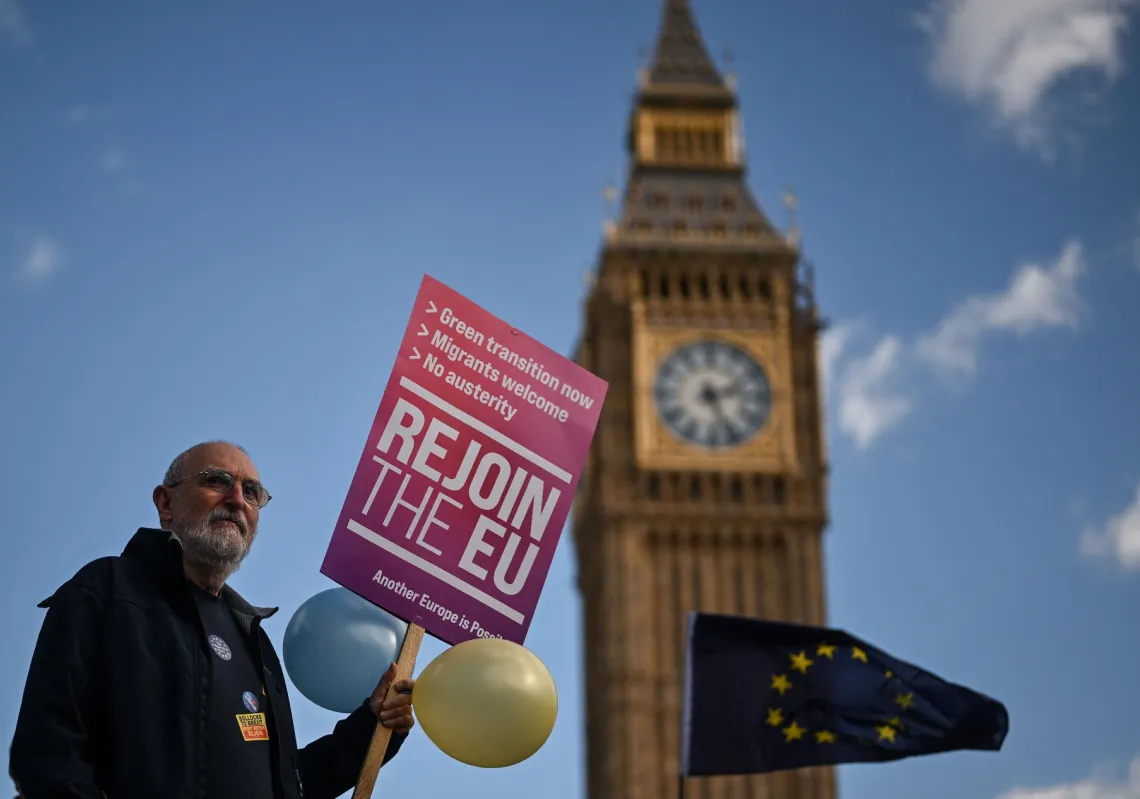
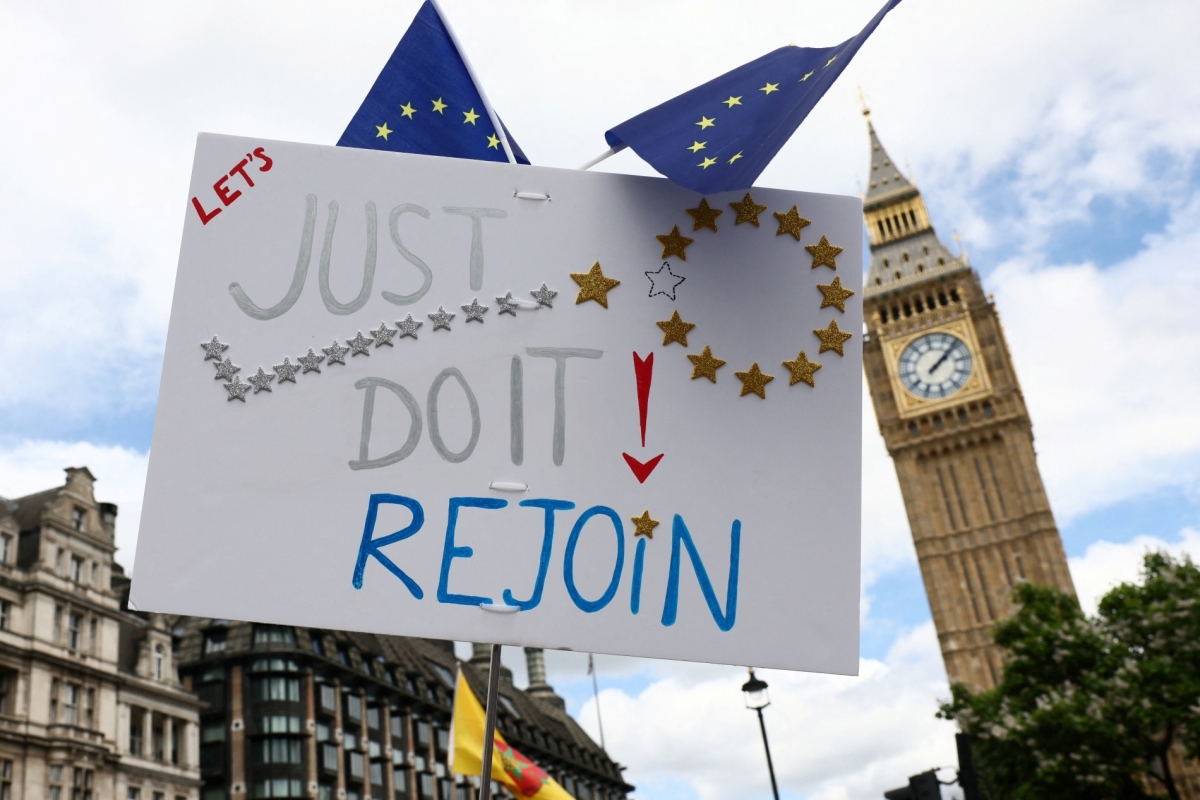
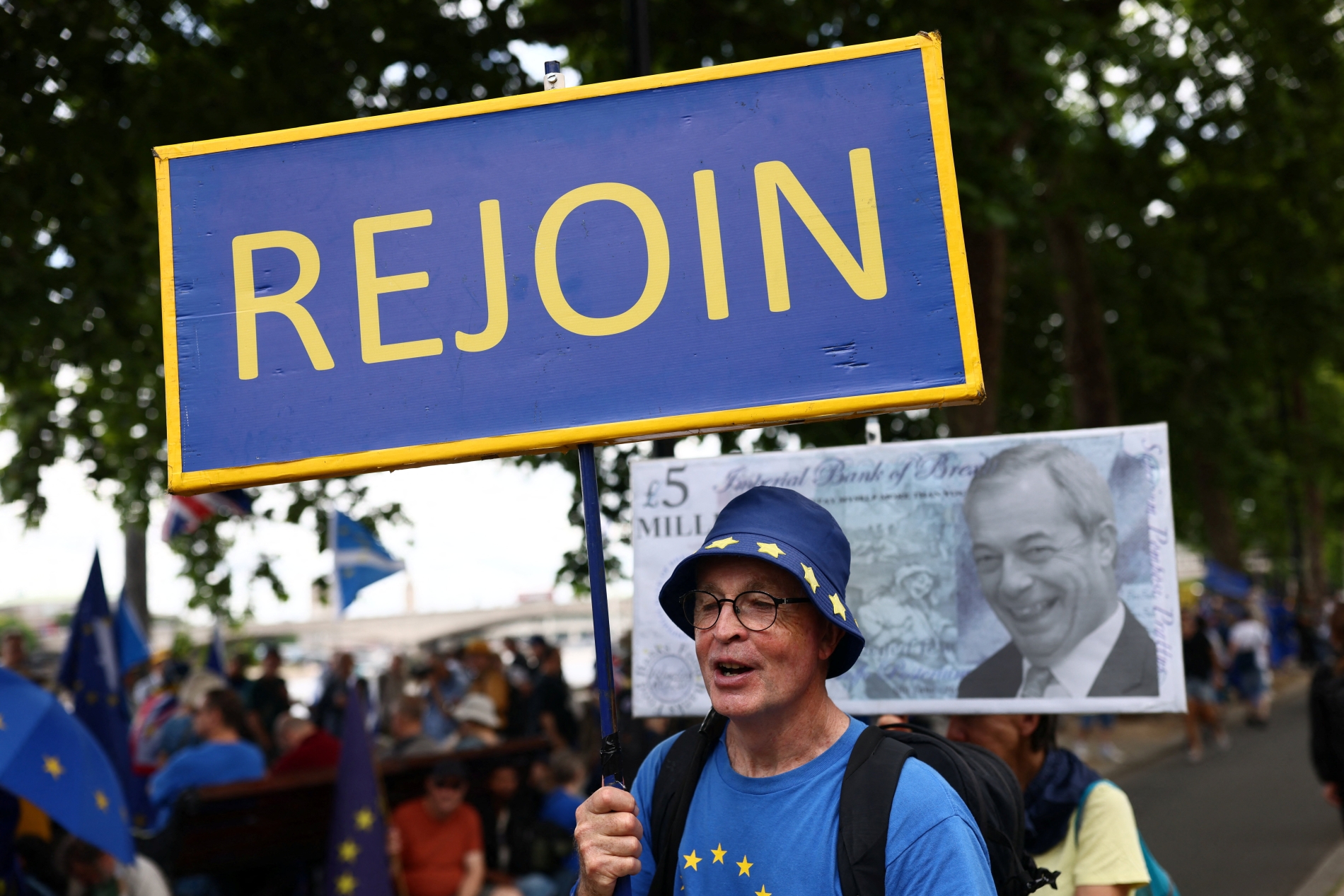
A placard is held at a protest marking ten years since Britain voted to leave the European Union in 2016 and calling for closer cooperation between Britain and Europe, in London, Britain, 20 June 2026.
REUTERS/Jack Taylor
A placard is held at a protest marking ten years since Britain voted to leave the European Union in 2016 and calling for closer cooperation between Britain and Europe, in London, Britain, 20 June 2026.

10 years on, Brexit continues to divide Britons

Ten years ago, when the UK voted by a narrow majority to leave the European Union in a bitterly contested national referendum, the importance of the vote was reflected in the fact that more of the British public voted for a single cause than they have ever before or since.

For David Cameron, the British prime minister who made the fateful decision to call the referendum on the UK’s continued membership of the EU, the outcome was a personal political disaster, leaving him with no option but to resign.

The subsequent political turmoil, which ultimately resulted in the Conservatives losing power in 2024 following the failed Conservative premierships of Theresa May, Boris Johnson, Liz Truss and Rishi Sunak, continues to this day, begging the question: what on earth persuaded Cameron to call the referendum in the first place?

On such a complex issue, there are no easy answers, but Cameron’s announcement of his intention to hold a referendum on the vexed issue of EU membership was based as much on his desire to keep the Conservative party in power as it was to do with addressing the UK’s problematic relationship with its European neighbours.

In his memoirs, For the Record, Cameron tried to argue that an in/out referendum on the UK’s membership of the European Union was not necessarily a historical inevitability. Even so, for domestic political reasons, Cameron opted to hold a referendum in 2016—assuming the Conservatives would win a ruling majority in the 2015 general election—because he thought it was the best way to end the constant infighting among Conservative MPs over the EU. Or, as Cameron himself memorably remarked, he wanted his party to “stop banging on about Europe.”

Cameron fully understood that he was taking a risk by calling a referendum, not least because Chancellor George Osborne, his best friend in politics, kept telling him so. But Cameron remained confident that he could win the vote by negotiating a better deal for the UK with the EU, especially on the toxic issue of immigration, and by rallying key allies in the Conservative Party, such as Boris Johnson and Michael Gove, to support the Remain cause.

Cameron failed on both counts, factors that weighed heavily on the referendum's eventual outcome, with the majority of Britons voting to leave the EU, a decision that both ended Cameron’s political career and exacerbated the political divisions within British society over their attitude to Europe, which persist to this day.
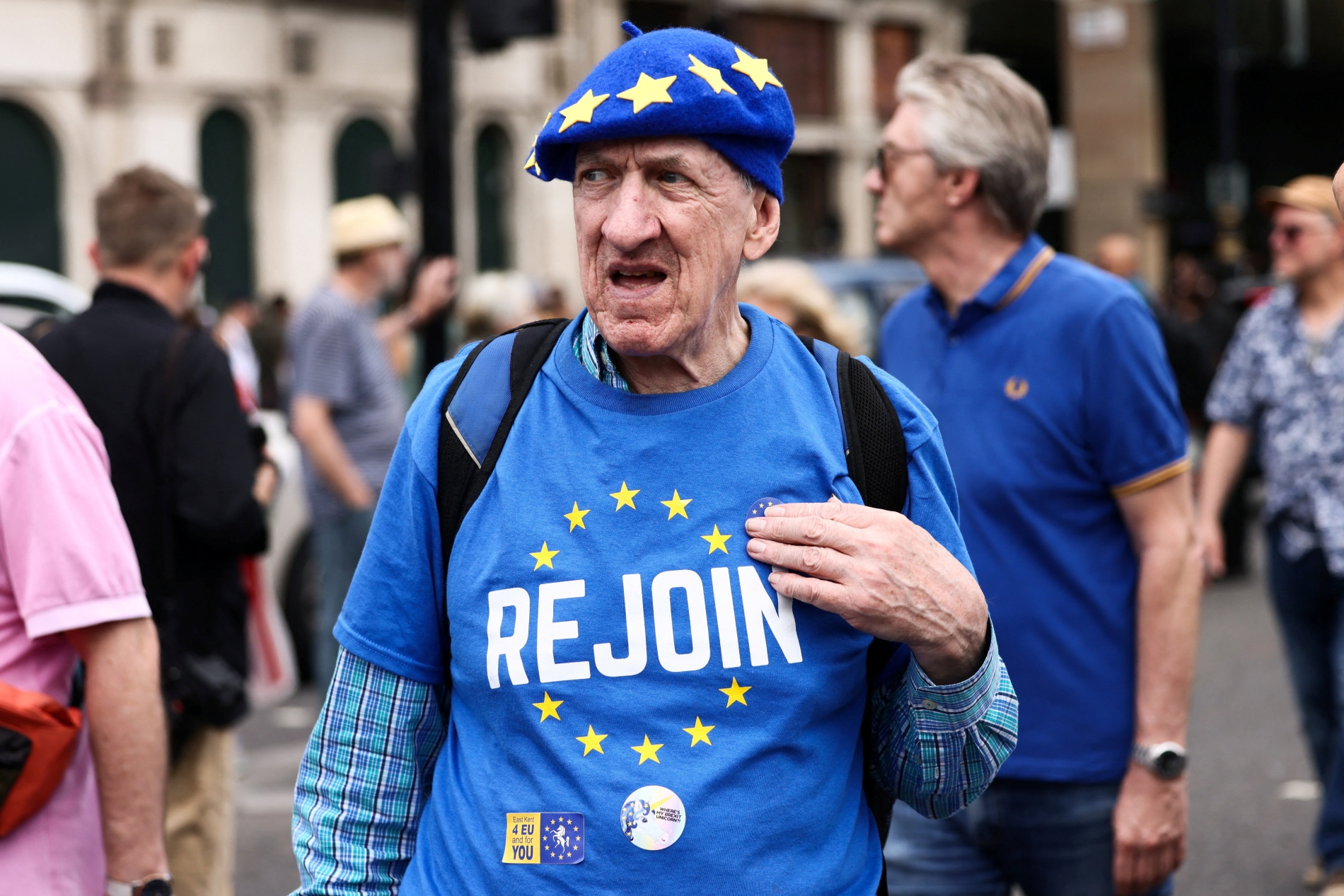
REUTERS/Jack Taylor

Profound impact

That the Brexit vote should have such a profound impact on the UK’s global outlook was hardly surprising given that London’s relationship with Europe has never been simple or static. For centuries, Britain’s global empire and maritime power meant its geopolitical focus was largely outward, initially keeping it at arm’s length from the continental European project that began to take shape after World War II. It took the country years to join what was then the European Community, and even then, when it was last put to a vote in 1975, many backed it grudgingly or for narrow economic reasons.

The UK initially chose not to join the European Economic Community (EEC), a European trade group formed in 1957 by the Treaty of Rome, which was signed by Belgium, France, Germany, Italy, Luxembourg and the Netherlands. Britain later applied to join the organisation in 1961, but the then French President, Charles de Gaulle, vetoed British entry twice, viewing the UK as a “Trojan horse” for American interests with Europe.

After de Gaulle left office, the UK successfully joined the EEC on 1 January 1973 under Conservative Prime Minister Edward Heath. Heath, who had personally witnessed the devastation caused in Europe by the Second World War, saw in the EEC the possibility of “an end to divisions which have stricken Europe for centuries”.

However, the relationship was immediately controversial. Just two years later in 1975, the newly elected Labour government held the UK’s first-ever nationwide referendum on whether to stay in the EEC. About 67% of voters chose to remain, though deep divisions over Europe persisted.

But over the decades, British voters slowly changed their minds about the value of remaining in the alliance, with their earlier ambivalence turning into outright hostility as the EU gradually transitioned from a trade bloc to a political union, thereby challenging the sovereign independence of the major European powers.
The importance of the Brexit vote was reflected in the fact that more of the British public voted for a single cause than they have ever before or since.

Growing scepticism

This led to decades of scepticism towards the EU among politicians and in large parts of the UK media. Deepening integration among the European powers gathered pace during the 1980s and 1990s. Conservative Prime Minister Margaret Thatcher, one of the UK's most prominent Eurosceptics, clashed regularly with European leaders on a range of issues, including the UK's disproportionately high financial contributions, and successfully negotiated the "UK rebate" in 1984.

Thatcher's hostility to the EU project was defined by the famous speech she delivered in Bruges in 1988, in which she warned against the creation of a "European super-state" and advocated a free-trade area rather than a political or economic union.

The EEC formally became the European Union (EU) through the Maastricht Treaty in 1993. Under the treaty, the UK was granted critical opt-outs, most notably refusing to join the single currency (the Euro) and the Schengen passport-free zone of 29 European countries that abolished passport and border controls at their mutual borders, functioning for travellers as a single territory, allowing seamless movement across member states under a common visa policy.

But following the EU's expansion into Eastern Europe in 2004, the UK experienced a massive influx of migrants. This stoked public concerns about local infrastructure, wage suppression, and cultural changes. Furthermore, the 2008 financial crisis strained European economies, and the subsequent bailouts caused significant discomfort among the British with deeper fiscal and political integration. The Eurosceptic UK Independence Party (UKIP), led by Nigel Farage, gained massive political traction. They campaigned fiercely on leaving the EU and sharply reducing immigration, posing a significant electoral threat to the ruling Conservative Party.

REUTERS/Jack Taylor
A person protests ten years since Britain voted to leave the European Union in 2016 and calling for closer cooperation between Britain and Europe, in London, Britain, 20 June 2026.

Immigration backlash

Another key factor in Cameron's decision to hold a referendum was to stop his Conservative Party from losing votes to UKIP. A deep national debate over immigration, sovereignty, and the economic impacts of globalisation then fuelled the campaign.

Conservative MPs continually pressured the party leadership to hold an EU referendum, while UKIP gained momentum by campaigning hard against EU membership. When Cameron surprisingly won an outright majority in the 2015 general election, ending the five-year coalition with the Liberal Democrats, he announced his decision to call a referendum the following year.

The core issues in the Brexit debate were immigration and sovereignty, as many voters wanted to restore the full power of the UK Parliament and courts over EU law. Economic anxiety caused by the 2008 financial crisis also left many working-class communities feeling left behind, and fostered a sense of anti-establishment as the Leave campaign channelled distrust of elites in both Westminster and Brussels.

Voters ultimately chose to leave the European Union by 52% to 48% on 23 June 2016. Cameron may have won one leadership contest—two if you include the formation of the 2010 coalition—one general election and two referendums in the past ten years, but his luck ran out. By putting himself front and centre of the Remain campaign, and framing the decision as a question of trust, he staked his political future and personal reputation on the outcome.

Having put so much store on his ability to secure a fundamental change in the UK's relationship with the EU, it was always likely that the concessions he came back with following nine months of negotiations with the EU would be dismissed as inadequate by Eurosceptics in his party.

CARLOS JASSO / AFP
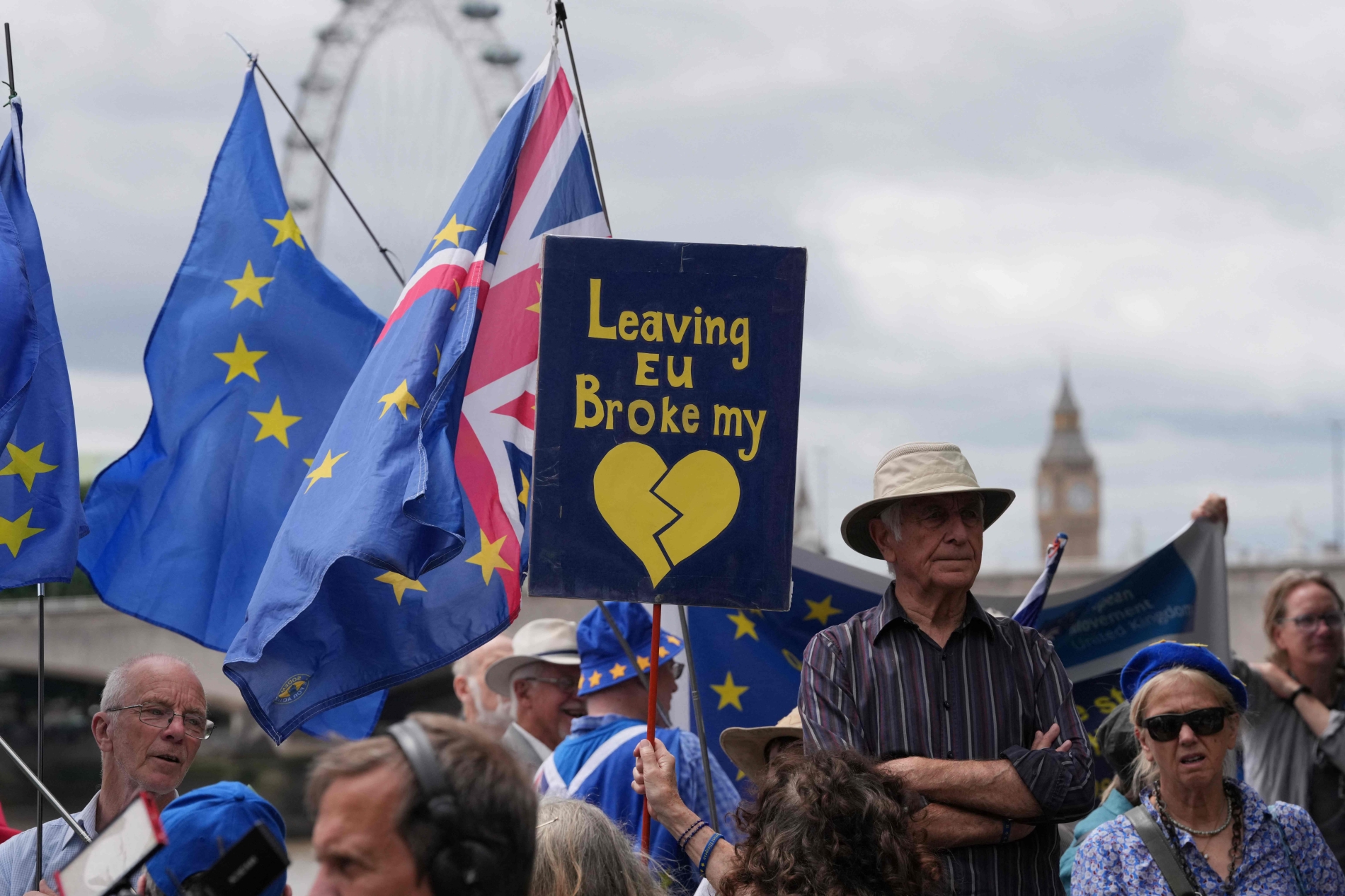
People wave flags and hold banners as they gather for a National 'rejoin the EU' march in central London on 20 June 2026.

This summed up a deeper problem. Having constantly stated that he would "not rule anything out" if he didn't get what he wanted, trying to enthuse the UK to stay in on the basis of reforms that many believed were modest at best, was always going to be a hard task.

Unsuited to winning over Labour supporters, the prime minister was unable to persuade enough floating voters to give him the benefit of the doubt. It was his failure to get the outcome he wanted, coupled with his desire to try and unify the country after the bruising campaign, that prompted him to say he would stand down as PM by October.

What became clear from the campaign was that the vote to Leave was as much a statement about the country's national identity, and all that involves, as it was about its economic and political future. Prime Minister Theresa May formally triggered the exit process, known as Article 50, on 29 March 2017.

The vote to Leave was as much a statement about the country's national identity as it was about its economic and political future

After three years of complex domestic and international negotiations, the UK formally left the European Union on 31 January 2020. An 11-month transition period followed, with the new trading rules and regulations under the EU-UK Trade and Cooperation Agreement taking full effect on 1 January 2021.

Ten years later, the Brexit debate remains as divisive as ever, with many of those who voted to leave outraged by attempts by Sir Keir Starmer's Labour government to form closer ties with the EU. The 2016 Brexit vote may have been a seismic moment in UK politics, but even now it has not resolved the complex challenges concerning the nature of Britain's future relationship with its European neighbours.

font change