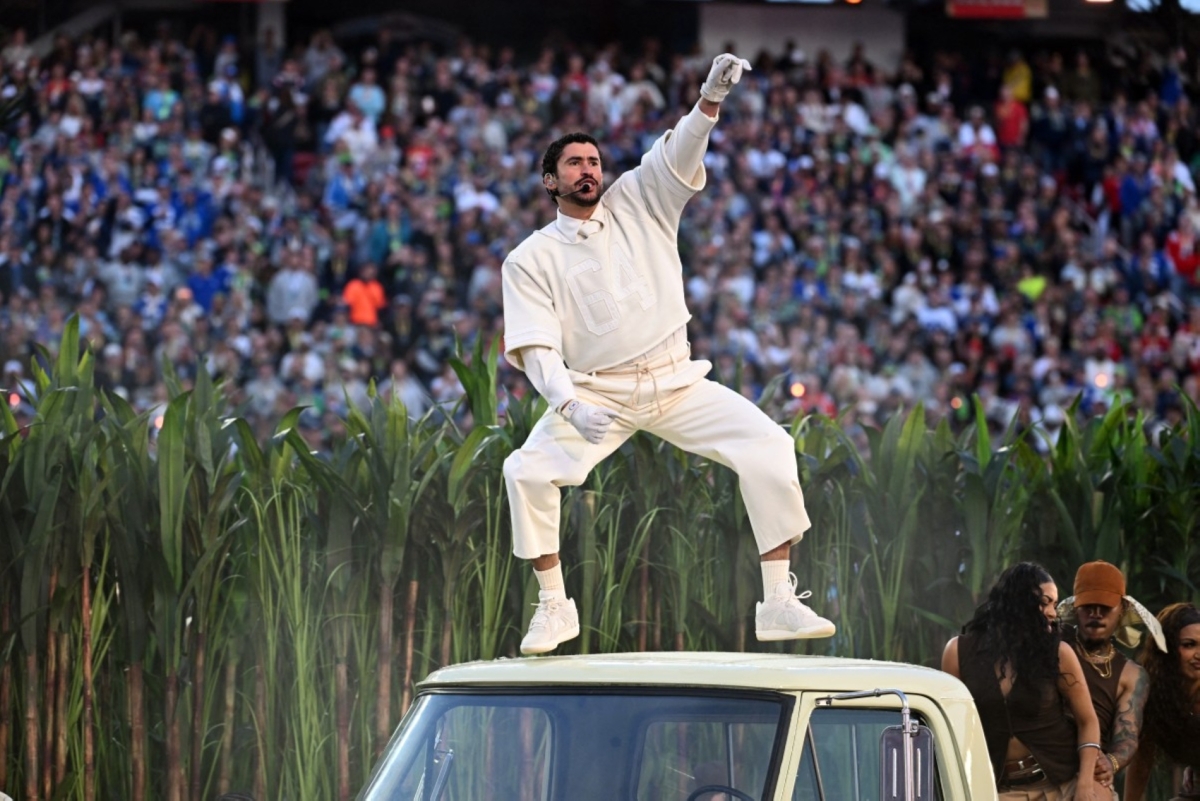

The Super Bowl is supposed to be a familiar ritual: a crowded stadium, a television audience in the hundreds of millions, and a halftime show designed to entertain the viewers. This time, Benito Antonio Martínez Ocasio, better known as Bad Bunny, took the stage in Santa Clara, California and performed entirely in Spanish, sparking a firestorm of criticism from conservative America.
His performance was meant to be an ode to the Americas, not just the United States but the entire Western Hemisphere. Within hours, that choice had been recast as political provocation. President Donald Trump called the show “absolutely terrible” and “a slap in the face” to the country, implying that English was the sole language of the United States, even though it isn’t designated as an official language, and that large swaths of the country speak Spanish.
Despite the controversy, Bad Bunny’s performance drove record viewership, with Apple Music reporting, “Within the first 48 hours, the Super Bowl LX Halftime Show Press Conference with Bad Bunny became the most watched in Super Bowl history with more than 63 million views across an array of related content, including the live stream and social clips.” The company also confirmed that Bad Bunny’s overall listeners on Apple Music jumped seven times immediately after halftime.
Early life and career
To understand why his performance stirred so much controversy, it helps to begin where Bad Bunny began. Martínez Ocasio was born on 10 March 1994 in Bayamón and raised in Vega Baja, Puerto Rico, an island in the Caribbean considered a US territory but not a state, even though its residents hold American citizenship. His father, Tito Martínez, worked as a truck driver, while his mother, Lysaurie Ocasio, is a teacher. His childhood was shaped by church and community life, including choir singing, before fame propelled him to bigger stages. He grew up listening to Latin music like reggaetón, Salsa and Latin trap.
After high school, Martínez enrolled in an audiovisual communications programme at the University of Puerto Rico at Arecibo while earning money part-time as a bagger and cashier at an Econo supermarket. His music career took off before he could complete the course. Without understanding Bad Bunny’s upbringing, his political stances during his rise could be misread as grandstanding. They are, however, consistent with choices he made early in life, including building his career without feeling the need to cater to English-speaking audiences, often treated as the gateway to stardom in the United States.