Walking 'The Path' with Oliver Laxe and Abdulnasser Gharem

A shared idea of passage links the themes of two films, where the road becomes a metaphor for trial shaped by survival and the risk of collapse

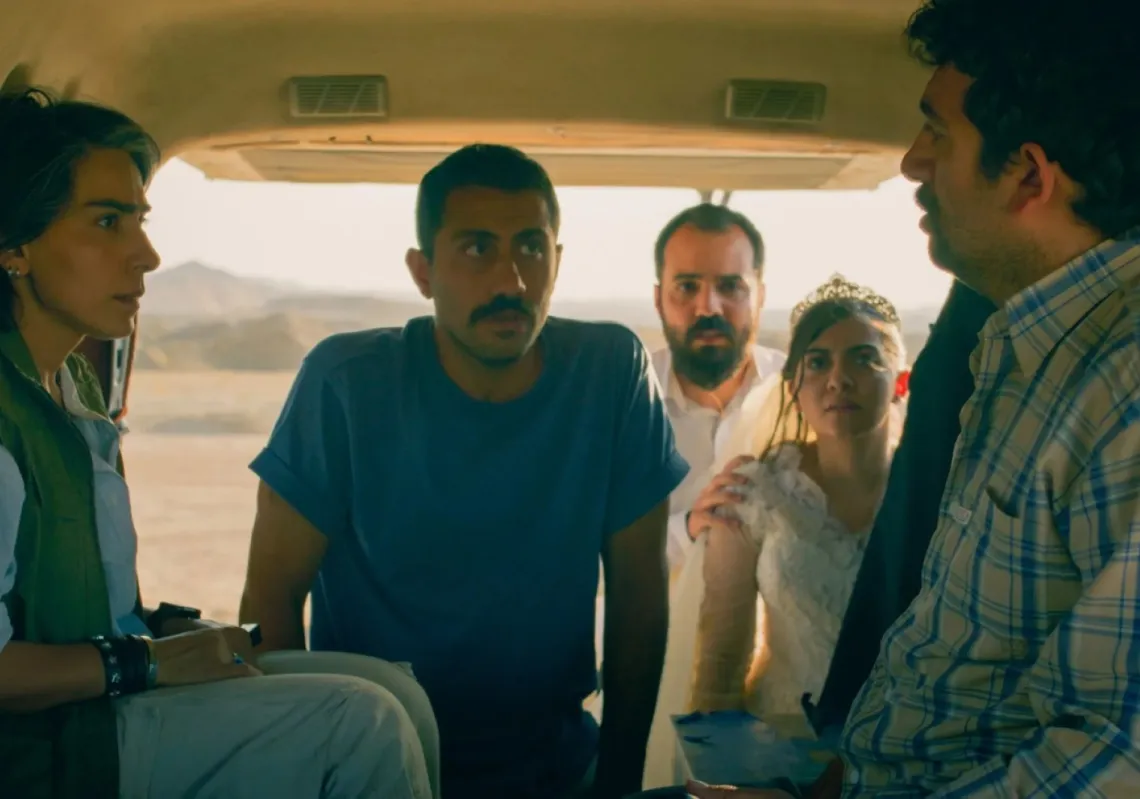
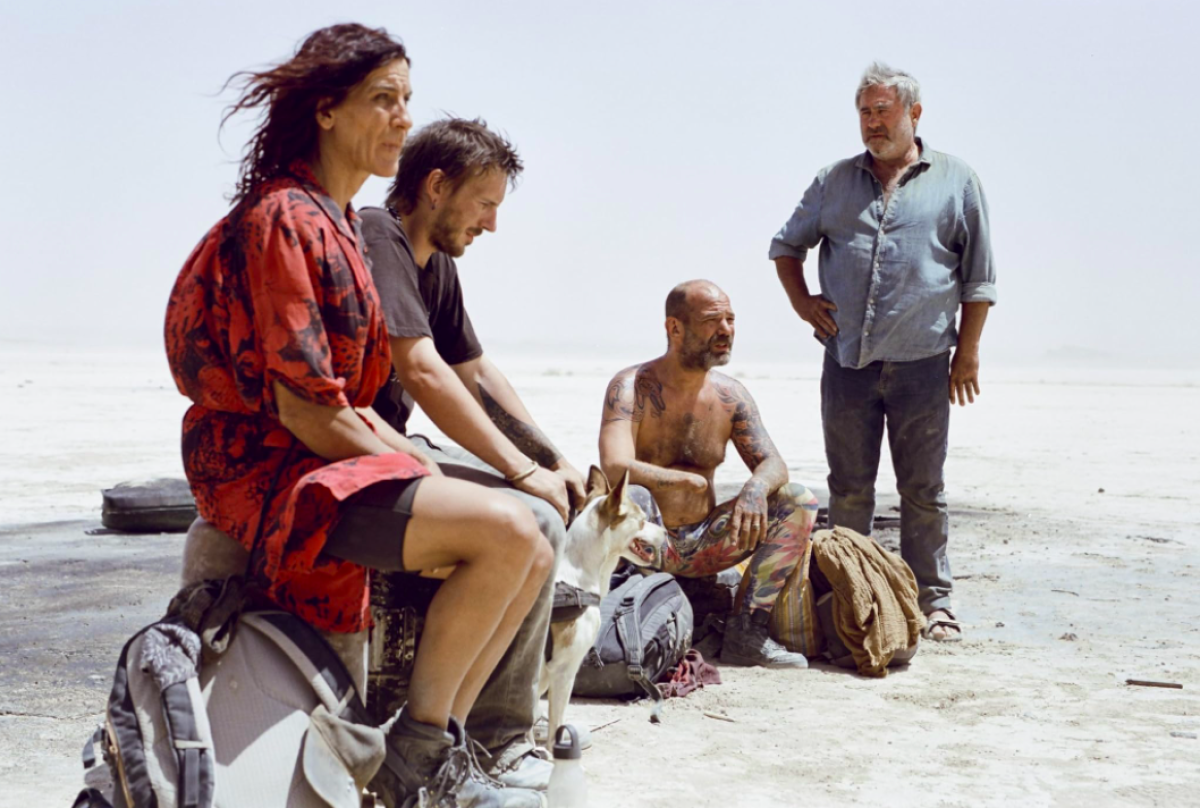
A scene from the film 'Sirat' by French director Oliver Laxe

Walking 'The Path' with Oliver Laxe and Abdulnasser Gharem

After watching French director Oliver Laxe’s Sirat, I found the title lingering in my mind with unusual insistence, leading me back to the work of Saudi artist Abdulnasser Gharem, which also bears the title Siraat (The Path). It is a piece I have engaged with before.

A connection that appeared merely nominal gradually suggested a deeper convergence rooted in the very structure of both works. The film meets, at several points, the questions raised by Gharem’s piece: the meaning of crossing, the proximity of danger, the fraught relation between the path and salvation, and between movement and collapse. Shared dimensions emerge with sufficient force to suggest a dialogue between the two works—one that discovers in each a distinct mode of appearance.

It is important to note that this comparison does not seek to weigh one work against the other, nor to measure the influence of one upon the other. It seeks instead to trace a single intellectual and artistic disposition as it moves across two separate artistic fields: cinema, as time unfolding before our eyes, and conceptual art, as an event condensed into a moment yet prolonged through its documentation.

Within this horizon, Siraat becomes less confined to its immediate religious reference and draws closer to an open symbolic structure that points towards a recurring existential condition: the unannounced test, the passage that appears plain while concealing profound ambiguity. From this vantage, the two works may be read as attempts to seize that condition, each in its own language, with a clear resonance at the deepest level.

This convergence opens onto a deeper plane as we move closer to the act on which each work is founded. In Sirat, a group crosses a harsh desert expanse in Morocco at a moment when the earth itself seems poised to come undone. The journey moves deeper into danger, the road giving way to encounters with the unknown across a hostile landscape. Movement falls into a strained rhythm, driven by danger and a strange compulsion to continue.
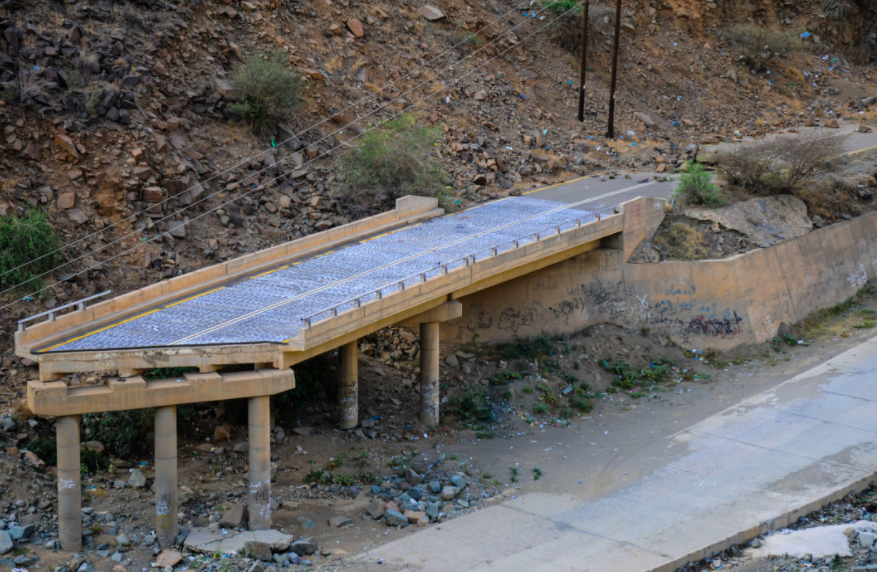
A scene from the film 'Siraat' by Saudi artist Abdulnasser Gharem

By contrast, Abdulnasser Gharem’s work draws on a real incident. The artist used a mountain bridge that had borne witness to a tragedy—the so-called ‘Saturday Bridge’ incident—in which residents of a nearby village fell while taking shelter from torrential floods. He transformed that site into a live-action space, with people and animals crossing the bridge under the shadow of that memory. What Gharem staged was not a reenactment of the catastrophe, but an evocation of human weight, later fixed in photographs and video and left open to renewed readings.

In both works, the act unfolds within an unstable temporality. In the film, it takes shape through movement, reshaped with each passage from one place to another. In Gharem’s work, it persists in the trace left of the event, as the moment extends into layered meanings. In both, human presence forms part of this flow, shaped by it even as it reshapes it in turn.

This extension places both works close to live performance, where experience itself comes to the fore. In the film, the moment is seized in the act of becoming. In Gharem’s work, it is recovered through its athar—its residue or trace. In both, there is an attempt to grasp time in motion as it slips away, to seize a passage that never settles into stillness yet leaves enough marks to be read anew.

Place as force

This same preoccupation extends from time into geography, where place becomes an active force rather than a mere backdrop. In the film, the Moroccan desert unfolds in all its austere vastness, placing the characters in direct confrontation with exposure. The horizon lies open yet offers no comfort, sharpening their vulnerability with every step across a landscape that promises nothing—especially as they pass through a minefield and fall, one after another, as they dance to the pulse of electronic music.
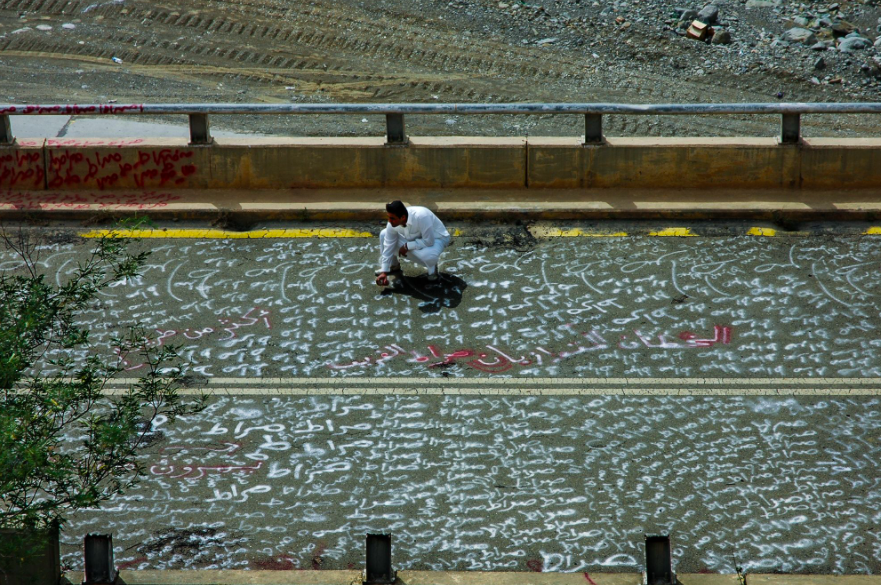
A scene from the film 'Siraat' by Saudi artist Abdulnasser Gharem

In Gharem’s work, place is concentrated in a sharply bounded form: a narrow mountain bridge suspended above an abyss and marked by the memory of an earlier fall. This constriction heightens the sense of danger and charges the crossing with unbroken tension.

In both works, place assumes the form of an edge. The desert stretches towards loss, while the bridge hovers at the brink, shadowed by the fear of falling. Each holds the human being in suspension between pressing on and the impulse to stop, giving movement a significance beyond simple passage. The mountain stands in the background as a sign of crossing, while distance continues to divide the two sides whose ends remain unseen.
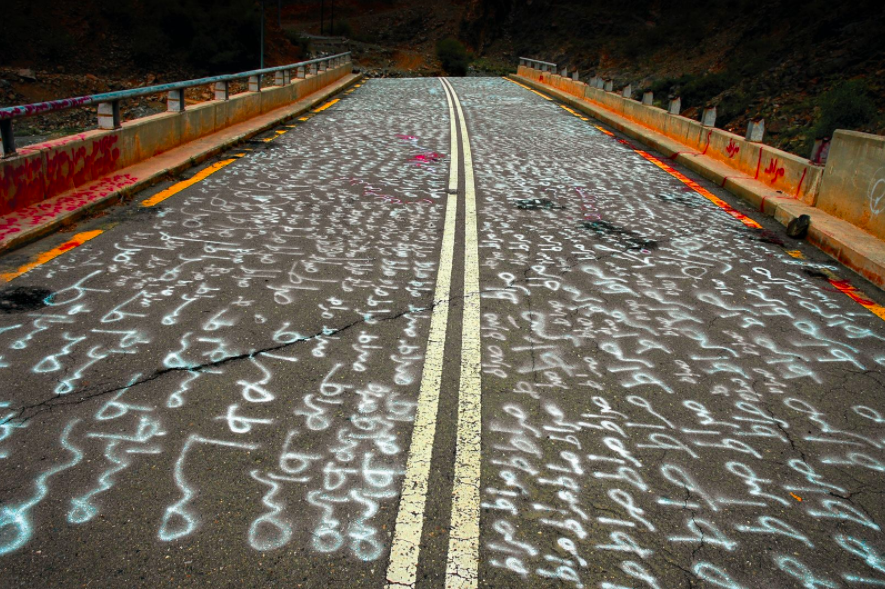
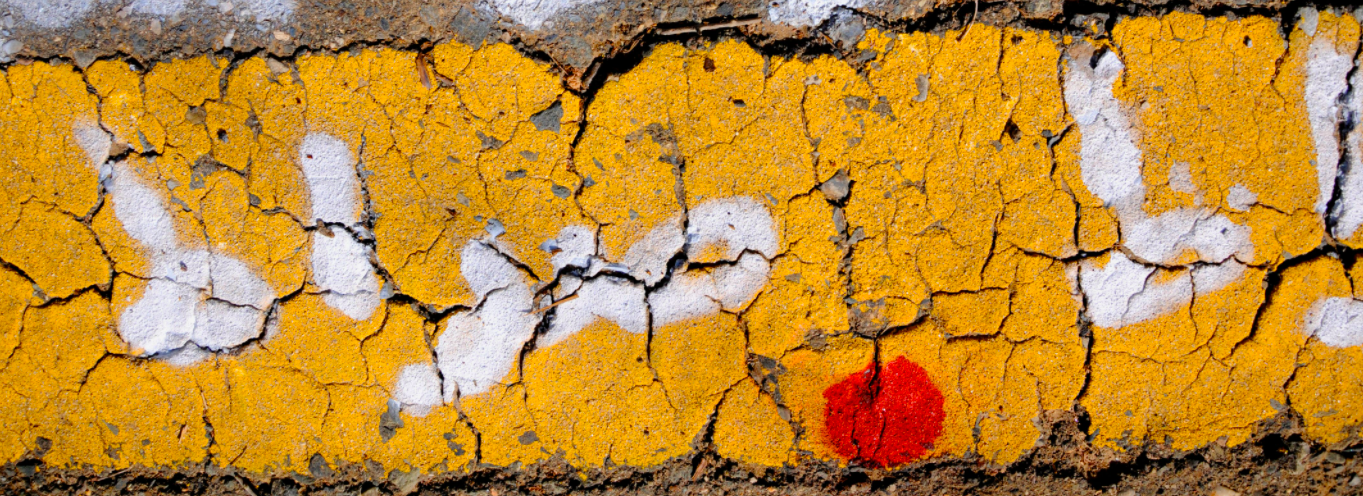
The entanglement of geography and danger warps the idea of the road. It is no longer a straight course to be followed, but an ordeal to be lived through, much like life itself.

This entanglement of geography and danger reshapes the idea of the road. It is no longer a straight course to be followed, but an ordeal to be lived through, much like life itself, where the desire for survival mingles with the possibility of stumbling. With every step, place tests the very notion of passage, redefining it as an act encircled by doubt and open to more than one ending.

Out of this spatial tension, the road takes on a more intricate form, always shadowed by the possibility of rupture. In the film, movement leads less to a stable destination than to a deeper immersion in experience. Each transition carries the risk of faltering, and every effort to continue involves an incalculable risk. The road remains the only course, yet offers no assurance of deliverance or arrival, as walking itself becomes a necessity from which there is no retreat—even as the protagonist, searching for his daughter, witnesses his son's plunge into the abyss. 

A scene from the film 'Siraat' by Saudi artist Abdulnasser Gharem

In Gharem's work, this idea is condensed in the bridge, where the road assumes a definite material form while retaining an essential fragility. To cross it is to remain in a state of constant vigilance rather than safety, for the slightest disturbance can summon the memory of the fall the site still carries within the collective imagination.

Here, the road is charged both with what has already taken place and with what may yet return, so that crossing becomes a negotiation with danger. For this reason, the repeated inscription of the word siraat across the bridge is so striking. Repetition becomes a mode of release, resisting paralysis, for there is a repetition that confines and a repetition that liberates, as the French philosopher Gilles Deleuze suggests.

This convergence shows that, in both works, the road serves as a site of trial rather than a route to resolution. Movement draws its meaning less from reaching an end than from the strain it lays bare between the impulse to press on and the ever-present risk of collapse. As such moments gather, the experience turns on an unvoiced question: what does it mean to go on when the path beneath one's feet holds the possibility of falling?

At this point, the meaning opens onto a deeper dimension, where the road becomes entwined with the idea of trial. Geography no longer stands apart from time but becomes part of the test, each step recasting the relation between them. Place exerts its pressure, while time stretches or quickens according to the intensity of the moment. What appears to be a road gradually discloses itself as an open field of trial, its contours reshaped by the footsteps of each new passerby. 

Mystical rhythm

Alongside this tension, a different rhythm enters both works, approaching a mystical register in which repetition pierces the surface rather than replaying what has already occurred. In the film, this appears in dance erupting into open space to the pulse of electronic music—a music concerned less with conventional harmony than with driving the body towards a gradual estrangement from its own centre. Continuity of movement becomes an entry into a state that exceeds direct meaning, where the boundary between body and surroundings begins to dissolve, and immersion in rhythm becomes one mode of crossing space.

In Gharem's work, repetition takes a quieter form, yet retains depth. The act of crossing the bridge, together with the repeated inscription of the word siraat, creates a rhythm close to ritual, repeating in order to fix the imprint of the incident in consciousness. Repetition generates an additional temporal layer in which the present becomes entangled with what preceded it, while movement remains encircled by the meanings that have gathered around it.

In both cases, the body becomes the medium of experience. It moves as the bearer of an unstable identity, subjected to a continuous test, shaped by rhythm even as it reshapes it. As the boundaries between inner and outer, individual and collective, begin to recede, the human being is relieved of fixed definitions and becomes part of a wider experience that exceeds narrow affiliations.

This extension opens both works onto a broader human horizon, where cultural particularities recede before a more universal experience. Human presence in the film, as in the artwork, appears at the margins of settled definitions: some figures bear visible bodily traces, while others pass fleetingly, as though existence itself were being returned to a primary state before classification. This, in turn, echoes the religious dimension of Siraat, across which every person must pass, regardless of background or identity. 

A scene from the film 'Siraat' by Saudi artist Abdulnasser Gharem

In this artistic context, Siraat exceeds its religious reference and becomes a worldly path of survival, passing through body, place, and time without ever wholly severing itself from its wider symbolic horizon. It remains a suggestive point of reference, binding artistic form to conceptual meaning. The artistic experience, however, unfolds across multiple layers and cannot be reduced to a single point of origin, even when those layers converge.

Rearranging the familiar

This trajectory reaches its fullest expression in the aesthetic structure of both works, which incline towards the uncanny—not as ornament, but as a rearrangement of the familiar. In the film, this uncanniness appears across several elements: vehicles moving beyond conventional roads, electronic music slipping free of expected rhythm, and bodies marked by their own impairments, without any attempt to conform to an established aesthetic model. 

In Gharem's work, this uncanniness takes another form. Those who take part do not come from a single artistic background, and their presence is almost spectral, moving within the scene without a clear centre of gravity. The bridge itself, for all its material solidity, is surrounded by an unstable aura shaped by memory and by the tension of the act. The scene is composed of ordinary elements which, once brought together, produce a configuration estranged from the familiar language of art.

This aesthetic choice draws both works away from the centre of the conventional image and opens the way for an experience built upon a measured deviation rather than harmony. Other layers of meaning surface. The uncanny does not sever reality from itself, but rearranges it to disclose what had remained concealed, compelling the viewer to reconsider the terms of their relation to what they see.

At this point, what joins the two works extends beyond the title or symbol to the way experience itself is re-formed. The idea of passage—first appearing as a shared axis drawn from a religious element of Islamic culture—unfolds across multiple planes: time that moves without settling, place that tests rather than reassures, a body that enters rhythm and slips beyond its own limits, and an image that shifts slightly away from its centre to open a wider horizon for reflection and interpretation.

Through this interweaving, Siraat emerges as an idea that passes between media without settling into a single form, preserving its ability to transform and shape each experience. In that transformation lies the strength of both works. They meet at a shared depth despite the difference in their artistic vocabulary, and leave an effect that exceeds their own boundaries, extending towards a broader question: how does the human being make a passage through a world where paths overlap, and the edge remains present, however clear the route may seem?

font change

Related Articles