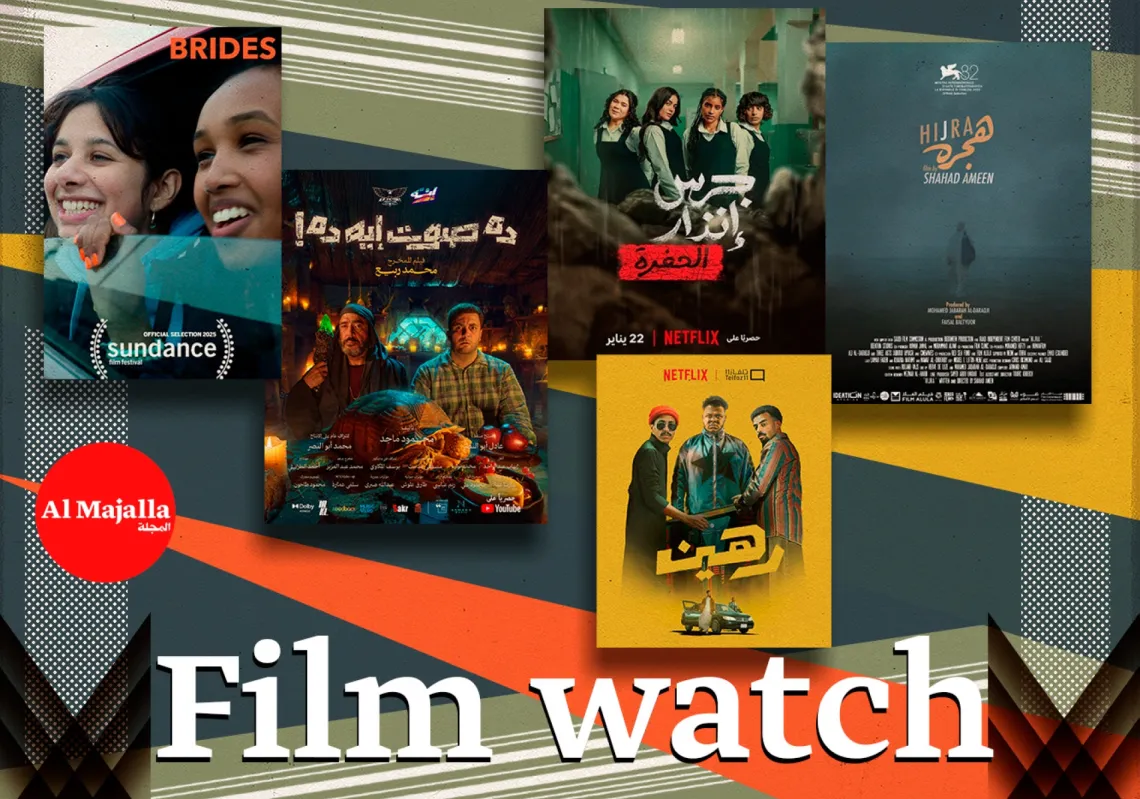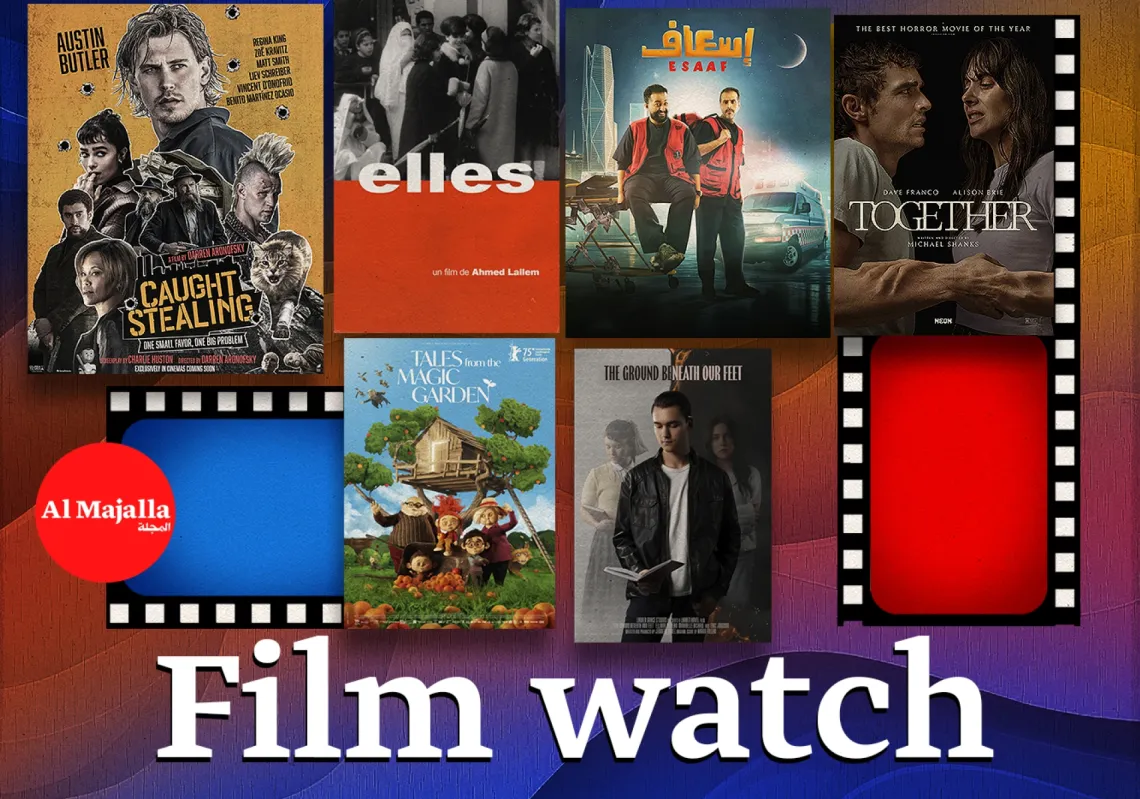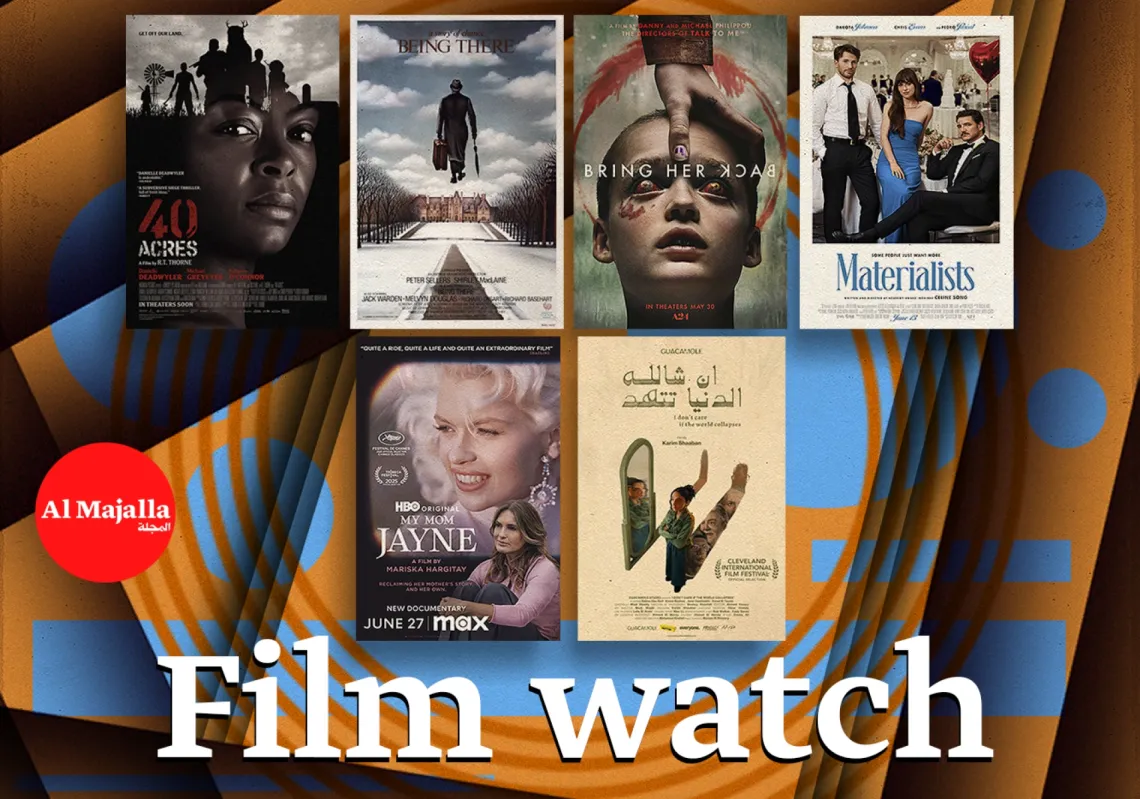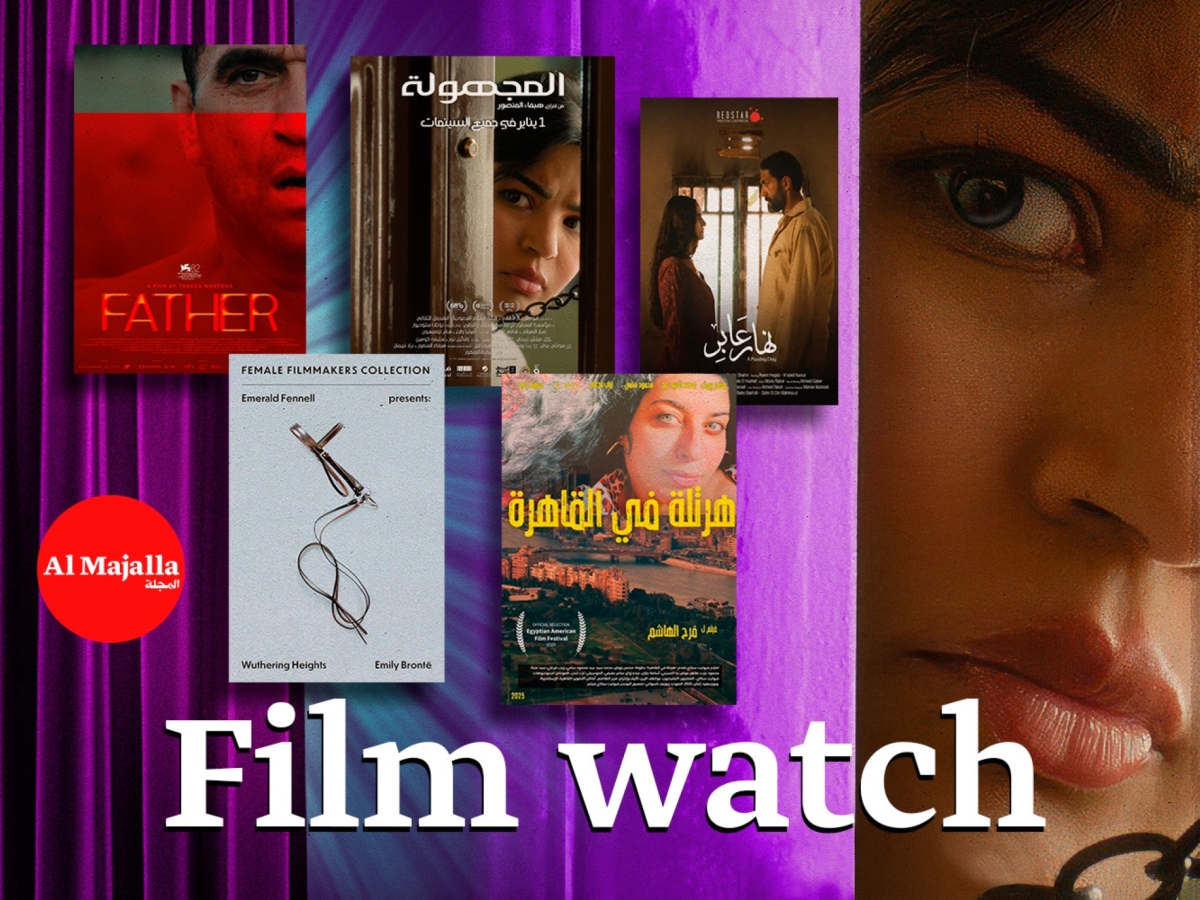

In our Film Watch, we review the latest Arab and international cinema productions from mainstream to arthouse, while also revisiting an older film from the archive. This week is dedicated to International Women’s Day, as we cover the most prominent recent works by women, both Arab and international.
Al-Majhoula (Unidentified)
Written and directed by: Haifaa Al Mansour
Country of production: Saudi Arabia
Director Haifaa Al Mansour has been concerned with women’s rights since her first feature length narrative film Wadjda in 2012, the first film to be shot entirely inside Saudi Arabia. This line of enquiry has since broadened to the crises facing humanity as a whole. Alongside it has been her adoption of an ‘auteur cinema’ approach.
Her film titles, like her heroines’ names, are often symbolic, encapsulating the central idea of the work—the dream her characters seek to realise, whether it be a girl wanting to ride a bicycle like the boys (as in Wadjda), or through Dr Maryam in The Perfect Candidate in 2019, whose attempts to repair the muddy road outside her clinic in a remote village morphs into a bold decision to run in local council elections.
In her new film Unidentified, Al Mansour continues the theme of female protagonists crossing the social boundaries imposed on them. This time, she enters unfamiliar narrative terrain through the world of crime, perhaps driven by an eye on mainstream audiences. That her choice of police drama is a genre avoided by most directors in both Saudi and Arab cinema makes the film an exceptional experience.
Produced by Rotana Studios, Unidentified premiered at the Toronto International Film Festival and marks the director’s second collaboration with the young actress Mila Alzahrani (who played the lead in Wadjda). Saudi cinemas began its commercial release at the start of 2026. The cast includes several new actors, including Somaya Alshareef, Othoub Sharar, and Intisar, a social media influencer, reflecting the director’s keenness to address the reality of youth.
In the opening scene, we watch the expanse of a vast desert, whose frightening stillness intensifies the weight of the moment, as a passing car appears, throws out the body of a young woman, then speeds away, leaving behind a cloud of dust. Nawal Al Saffan, played by Alzahrani, is an inquisitive character who strays beyond her official duties after being appointed to the police department. She becomes engrossed in following the threads of the murder of a female student.
Saffan pursues it with a passion that exceeds the limits of her assignment, allowing an ethical outlook at the world. The film’s screenplay begins in-line with the conventions of the genre, drawing on Hitchcockian logic of classical suspense. The opening shots visually and psychologically implicate the viewer in the story.
Through the dramatic framework of crime, Mansour reflects on of justice not as a legal procedure, but as a gendered problem within a patriarchal society. In so doing, she moves beyond the limited idea of identifying the killer, towards a broader interrogation of the simplified narratives through which crimes against women are reduced.
Wuthering Heights
Written and directed by: Emerald Fennell
Country of production: UK, US
One of the darkest texts in English literature, Wuthering Heights is the only book by British poet and writer Emily Brontë. Published in 1847, it remains one of the world’s most famous novels. The book’s tragic world may itself be an extension of its author’s own tragedy. She died at the age of 30, less than a year after the novel was published. Some of its lines can be read with that in mind. For example, as the character Nelly Dean says to Mr Lockwood: “A person who has not done one half his day’s work by ten o’clock runs a chance of leaving the other half undone.”
At more than 700 pages, Wuthering Heights is an epic that has tempted moviemakers into dozens of film adaptations across different languages and cultures, including in Arabic. The latest instalment is an American adaptation written and directed by Emerald Fennell, the English actress and filmmaker who directed the gothic thriller Saltburn (2023) after her Oscar-winning directorial debut Promising Young Woman (2020) starring Carey Mulligan.
In her new project, Fennell summons the drama of the original story, reprising the theme of impossible love. Yet what separates the lovers Cathy and Heathcliff (played by Margot Robbie and Jacob Elordi respectively) is not a family feud of the kind seen in Shakespeare’s Romeo and Juliet, but harsh class divisions. In her examination of their relationship, the director invites reflection on concepts such as dominance, possession, and sensual desire, drawing on a clear feminist perspective. At times, this feels melodramatic. At others, it can be unsettling.
Fennell’s works have won acclaim at festivals and in reviews, while box office sales have been healthy, but her Wuthering Heights was always likely to draw comparison to the many others, and her passion for rereading female characters has not always been universally appreciated. Ohers applaud her efforts to reinterpret the classics in a contemporary language marked by a ferocity that feels clearly authentic.
Father
Screenplay by: Tereza Nvotová, Dušan Budzak
Directed by: Tereza Nvotová
Country of production: Slovakia, Czech Republic, Poland
Tereza Nvotová’s Slovakian film Father begins with a deft act of misdirection, built on a series of long opening shots. It is early morning in a city still asleep. A man in his 40s goes out for a run, and the camera follows him quietly until he reaches home, where his wife and their little girl, Dominika, are waiting.
He is meant to take her to nursery on his way to work, but their daily routine soon turns into catastrophe. As the sun grows hotter, the air conditioning in the father’s office breaks down. He then remembers that he has forgotten the child in the back seat of the car, trapped in a furnace, heat by the sun’s reflected rays from the glass façades of the city’s skyscrapers.
The screenplay takes its dramatic course from Forgotten Baby Syndrome, a rea and recognised condition stemming from a decisive moment powerful enough to reshape a person and their relationships. Viewers see how the parents’ life veers off course after the loss of their daughter and how psychological conflict takes over in the father’s admission and the mother’s accusations.
The tension escalates as it moves into the courts and the justice system. The director does not search for motives or rush to condemnation, opening space instead to contemplate human fragility in the face of crisis, and of death in particular. Even the film’s visual language serves this aim, with long, extended shots deepening the sense of tragedy.
In her works, Tereza Nvotová enters social territory that is often left unspoken, portraying harsh realities but with poetic sensibility, whether in documentary or fiction. She examines questions of power, gender, and memory, weaving her worlds using both a documentary logic and dramatic language. A promising female voice, she pushes boundaries between form and narrative in contemporary cinema.
A Passing Day
Written and directed by: Rasha Shahin
Country of production: Syria, Egypt
Syrian director Rasha Shahin's short film A Passing Day was screened recently in Cairo after an Arab and international festival run over the past year. The idea for the film was born from a set that Shahin happened to glimpse on the Alexandria Desert Road, but just as they were preparing to film, the set was removed entirely, forcing her to look for alternatives. Each time, the new location imposed its own logic on the story. They eventually produced three different versions of the screenplay, with different camera angles capturing the actors' movements.
Shahin's first film, A Passing Day weaves her narrative world around two characters, in what is sometimes called a duo-drama. Apart from a few voices heard through telephone calls, the physical presence is limited to these two characters, a woman and a man, played by Reem Hegab and Khaled Kamal, as though they were Adam and Eve in the ruins of an unnamed Arab city that had suffered the devastation of war.
Within the ghostly confines of the woman's home, w she prepares to receive the paying guest, who arrives for a moment of pleasure. Their relationship becomes a reflection of a wider relationship between desire and survival, or of the human need for intimacy. The film's screenplay relies heavily on visuals, to such an extent that dialogue is almost entirely absent. When someone does speak, it is fragmented, reflecting the characters' unsettled psychological state and the memory of the place itself.
The director succeeds in using the severe austerity of the set and props to serve the dramatic build-up. Loss is at the heart of the 30-minute film, and production design by Onsi Abou Seif allows visual compositions in a space proportionate to the conditions of that loss. This is enveloped in variations of silence. By the end, the viewer is left uncertain about the reality of the emotional encounter.
Cairo Rhapsody (Hartala fi al-Qahira)
Written and directed by: Farah AlHashim
Country of production: Kuwait
The documentary film Cairo Rhapsody has stirred debate, with opinion split between supporters who saw in as a free-spirited adventure, and opponents who felt it was overly provocative. The controversy escalated when director Farah AlHashim made it available free of charge on her YouTube channel around five months ago, presenting it as an independent work outside conventional distribution channels, amid early reports that it had not received censorship approval for screening.
About ten years ago, AlHashim's film Breakfast in Beirut won good responses. Here, she is more experimental, beginning with an improvised journey through Cairo's streets with a camera, passing its famous cafés, then eating sweets and ice cream at Groppi while invoking Farid al Atrash in a scene in which he shares her table, fulfilling a personal wish.
The film blends documentary and staged performance in an attempt to capture the spirit of Egypt's capital. The director succeeds in many scenes and narrative interludes, including the image of Gamal Abdel Nasser displayed on the pavement among second-hand antiques. "How much for Abdel Nasser?" we hear her ask. "Five hundred pounds," comes the reply.
As for the title, the colloquial Egyptian term 'hartala' was used to describe a foolish person, and also a worn-out garment whose threads had come apart. In old Arabic usage, if someone said a man was hartala, it usually meant that he walked unsteadily.
Today, it means speech that lacks logic or precision, which may explain why some opponents objected to the film's title in relation to Cairo. A closer reading of the film reveals that 'hartala' does not apply to the city itself but to the angle from which it is seen, recalling the familiar warning on car mirrors that the image is not a complete representation of reality.