
In 1325, the Moroccan explorer Ibn Battuta set out for Mecca to join the waves of pilgrims converging on the holy city. En route through Egypt, he witnessed the people of Abyar celebrating the sighting of the crescent moon marking the beginning of Ramadan. Staying with the city’s judge, Izz al Din al Mulayji al Shafi‘i, he recorded what he saw.
“Their custom on that day is for the jurists and notables of the city to gather after the afternoon prayer on the 29th of Sha‘ban at the judge’s residence,” wrote Ibn Battuta. “When they have all assembled, the judge mounts his ride, and all those with him do the same. Then everyone in the city follows them, men, women, servants, and boys. They proceed to a high place outside the city, where they watch for the crescent. That place is laid out with carpets and furnishings, and the judge and those with him sit there to watch for the moon. They then return to the city after the sunset prayer, with candles, torches, and lanterns carried before them. Shopkeepers light candles in their shops. The people accompany the judge to his house and then depart.”
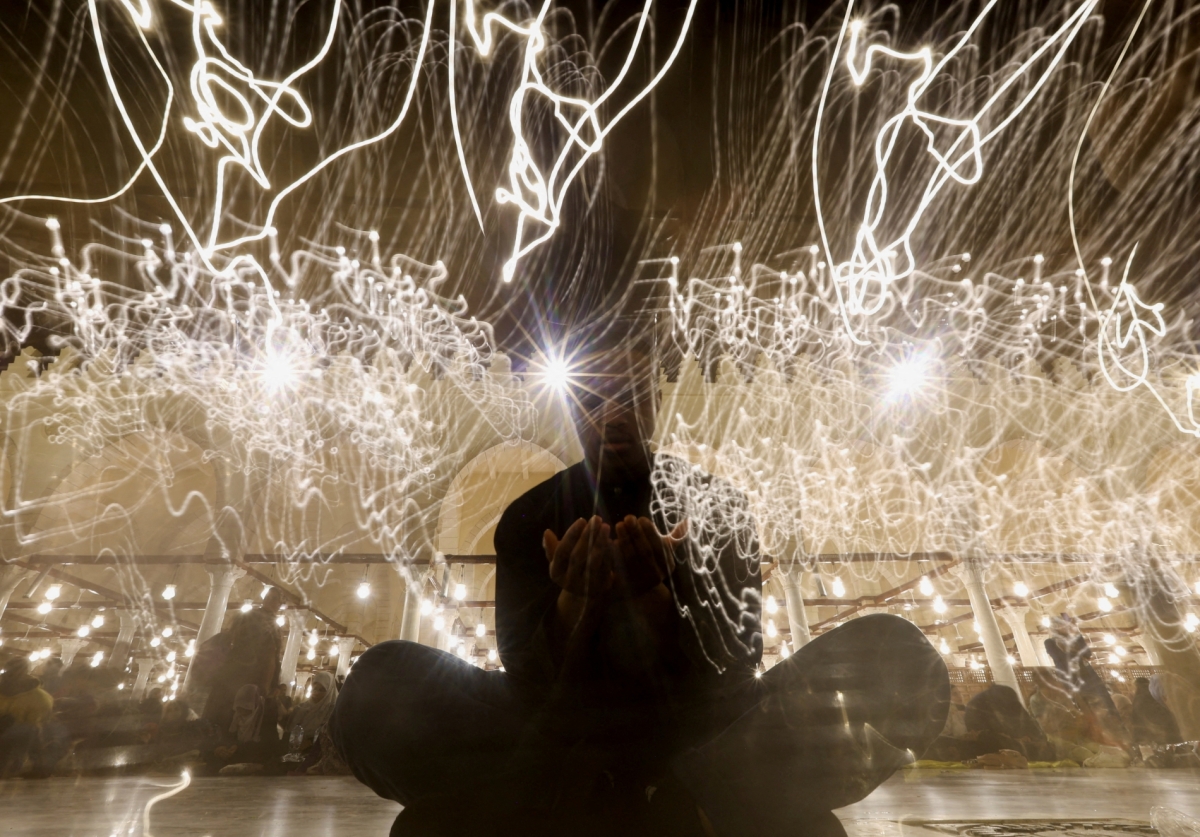
A year later, while still in Mecca, the renowned traveller once again recorded the scenes around him as the crescent moon appeared. Kettledrums were beaten at the residence of the Emir of Mecca, and celebrations were held at the Sacred Mosque, “where the mats are renewed, and the candles and torches increased until the sanctuary glitters with light and shines with splendour and radiance.” The imams, he wrote, were divided into groups—the Shafi‘is, Hanafis, Hanbalis and Zaydis—while the Malikis gathered “around four reciters who take turns reciting and lighting candles. Not a single corner or side of the sanctuary is left without a reciter leading his congregation in prayer.”
Across the Arab world, cities and towns take on a special radiance during Ramadan. In the 10th century, the Palestinian geographer and traveller Al-Muqaddasi described how the blessed month was welcomed in Aden, where people greeted Ramadan with joy even before it began. “They decorated the rooftops two days before Ramadan and beat kettledrums upon them,” he wrote in The Best Divisions for Knowledge of the Regions. “Then, when Ramadan began, groups gathered and walked about at suhoor, reciting poems until the end of the night.”
In his travelogue The Rihla, Ibn Battuta notes the deep piety and communal generosity of Mecca’s residents during Ramadan, especially in the last 10 days of the holy month. He highlights the solemnity of these nights, marked by Qur’anic recitation in the Sacred Mosque attended by judges, jurists, and leading figures, often led by members of notable families. These gatherings featured a sense of grandeur, with a pulpit adorned with silk, lit candles, and a sermon upon completion of the recitation. Afterwards, the leader’s household would host feasts with abundant dishes and sweets for scholars and worshippers—a tradition repeated on key nights, reaching its peak on the 27th, when the Qur'an was completed near the Kaaba’s Station of Ibrahim.
'Ramadan Nights’ by Algerian miniature painter Mohammed Racim (1896-1975) pic.twitter.com/BZkDNBrIA9
— MENA Visuals (@menavisualss) February 17, 2026
Lanterns over the Sacred Mosque
The geographer Ibn Jubayr, born in Al-Andalus, also witnessed Mecca’s seasons of light and beauty, spending nearly six months in the city before departing for Iraq and the Levant. Precise details of his time in Mecca are recorded in The Travels of Ibn Jubayr, in which he describes the majesty of the Sacred Mosque and the solemnity of its four corners, where the preacher’s pulpit stood on four wheels. On Fridays, as the time for prayer approached, the pulpit was moved to the side of the Kaaba facing the Station of Ibrahim, between the Black Stone corner and the Iraqi Corner, and set in place there.
Ibn Jubayr paints a dignified portrait of the khatib in his black robes and cloak as he walks towards the Prophet’s Gate. “As he approaches the pulpit, he first goes to the Black Stone, kisses it, and offers supplication there. He then hastens to the pulpit, while the chief muezzin of the Sacred Mosque rushes ahead of him, likewise dressed in black.” The scene is completed when the khatib takes his seat, and the muezzins proclaim the call to prayer in a single voice that fills the sanctuary with tranquillity.
He also recounts the great care with which the people of Mecca prepared to receive the blessed month. The arcades of the sanctuary were laid with new carpets, and the light of the lamps shone from sunset until dawn. Taraweeh prayers were held in several circles, and worshippers moved between the 24 Raka’at (units of prayer) and the circumambulation of the Kaaba, in a scene that brought prayer and tawaf together. Suhoor, too, had its own distinctive call, raised from the minaret at the eastern corner, where the muezzin stood with two young boys who responded to him with supplications and reminders.
To alert houses far from the sanctuary, “a long wooden pole was raised, topped by a rod about an arm’s length long, fitted with two small pulleys from which two large glass lanterns were suspended. These remained lit throughout the suhoor period. As the first signs of dawn approached and the call to prayer was given at broken intervals, the muezzin lowered the two lanterns from the top of the pole, and muezzins from every direction began to join in the call to prayer. When the people of Mecca saw from the rooftops of their tall houses that the two lanterns had been extinguished, they knew that the time had ended.”
Nights of learning and fellowship
When Ibn Battuta arrived in Damascus during Ramadan of 1326, he witnessed the circles of learning that enlivened every evening. In the Umayyad Mosque, a great gathering of jurists and seekers of knowledge assembled, and there the traveller heard the entirety of Sahih al-Bukhari recited in 14 sessions, beginning in the middle of the month and ending on the 28th. This scholarly flourishing was not confined to men. Ramadan lessons in the Umayyad Mosque also served as a beacon for learned women, who granted ijazahs to men, including Ibn Battuta.
The explorer recorded the character of the people of Damascus, noting that one of their virtues was “that not one of them breaks the fast alone on the nights of Ramadan. If a person is one of the emirs, judges, or leading men, they invite their companions, and the poor break their fast with them. If a person is one of the merchants or leading market people, they do likewise. If they are among the humble folk or the Bedouin, they gather each night in the house of one of them or in a mosque, and each person brings whatever they have, and they all break their fast together.” These words remain a testimony to the spirit of solidarity and gathering that shape Ramadan.
The 11th century Persian poet, philosopher, and traveller Nasir Khusraw offers a description of the Amr ibn al-As Mosque in Fustat, Cairo. Rich in splendour and sanctity, preparations for Ramadan appeared in their finest form, with Khusraw observing that “more than 700 lamps were lit on the nights of festivals and celebrations, that the mosque was spread with ten layers of coloured mats laid one upon another, and that mosques were perfumed with incense, camphor, and musk.”
A few hundred years later, the Andalusian traveller Ibn al-Hajj al-Abdari also visited Egypt during Ramadan, conveying his observations of scenes of solemnity and social grace in Cairo’s alleys. Hanging lanterns, he said, was a deeply rooted custom among Egyptians at that time, with which they adorned their nights and lit their way.
In 1662, the Moroccan traveller Abdallah al Ayyashi recorded a precise description of the crescent moon’s sighting. The Shafi’ judge and upright witnesses climbed, on the night of the 13th, to the top of the minaret of the Sultan Al Mansur Qalawun mosque, located in the Qalawun Complex on al-Mu’izz Street, where they watched the horizon until darkness fell around them. When they saw nothing, “they lit the lamps in the minaret, as was their custom on every night of the month. People then understood that the following day was Ramadan, and the claims of the astrologers were proved false.”
In The Ayyashi Journey to the Hejaz Region, he also wrote of the suhoor customs that filled the alleys with life, noting that “the suhoor call outside the congregational mosques was made by means of the well-known drum, still known today, which was carried through the residents of the Rab‘as [a type of collective housing or apartment building] and other neighbourhoods as people went from house to house beating it.” With this description, the image of Cairo’s nights is complete: a world of worship, expectancy, and the simplicity of everyday life.
This is the oldest audio recording of Quran recitation (Surah ad-Duha) from Makkah in 1885, documented by the prominent Dutch orientalist Christiaan Snouck Hurgronje. pic.twitter.com/4XjMOSllqt
— 5Pillars (@5Pillarsuk) December 16, 2025
Ramadan through foreign eyes
Ramadan was also recorded by European travellers and adventurers, as well as orientalists such as Christiaan Snouck Hurgronje, whose book Mekka in the Latter Part of the 19th Century provides a detailed account of Meccan life. Describing those preparing to break the fast, Hurgronje noted that, as sunset approached, the arcades of the Sacred Mosque were prepared to receive the faithful, in a scene marked by calm and order.
“Before prominent figures took their assigned places, special pitchers were set out containing desalinated water, rainwater, or spring water, according to each person’s taste and preference,” he wrote. Meanwhile, crowds streamed through the mosque’s 19 gates, each carrying a modest provision of dates and figs, while the servants of the wealthy followed behind with platters laden with many kinds of food.
In those still moments, as people waited for iftar, all eyes were fixed on the “head of the prayer timekeepers” as he climbed to the upper level surrounding the Zamzam well and waved his flag towards the citadel. The cannons then fired the signal permitting the divine hospitality to begin. “At that moment, one could hear throughout every part of the mosque a special supplication, along with the sounds of drinking from the pitchers and the clatter of plates and dishes.” Then the calls to prayer rose from the seven minbar stations, and the prayer was held behind the imam beside the Maqam.