Oil prices soar as US-Iran war sparks supply worries

European gas prices have jumped by 30% after some big GCC oil and gas producers cut supplies, and now a vital maritime trade route is being threatened. The stakes have seldom been higher.

Al Majalla

Oil prices soar as US-Iran war sparks supply worries

The economic effects of the US-Israeli war on Iran have been predictably profound in a region that holds the world’s largest energy reserves. With Iran’s warning on 2 March that it would “set fire” to ships passing through the Strait of Hormuz, one of the world’s busiest energy shipping lanes, markets reacted by sending the price of oil soaring to a 13-month high and gas to a three-year high, amid worries about supply.

Around 15% of the world’s oil and 20% of the world’s liquefied natural gas (LNG) passes through the strait. US President Donald Trump said the US Navy would escort ships “if needed,” but this would be unsustainable in the long run, meaning that the storage and maritime transport of oil and gas are now subject to intensifying uncertainty and price increases, including rising insurance premiums.

Wider effects

Air traffic across the Middle East is also in turmoil, with airspace closures spreading across much of the region in response to the military action. Airlines have suspended services and diverted routes. Middle East Airlines, Lebanon's national flag carrier, revised its schedule to and from Beirut, particularly for flights bound for Gulf states and Iraq, cancelling services at the outbreak of hostilities. Lebanon closed its airspace for several hours, as did Israel’s Ben Gurion Airport.

Airspace in the Middle East reopened to limited operations on Monday, with a handful of flights departing the UAE. Qatar’s airspace remains closed. It has also halted all maritime traffic in its territorial waters following Iranian attacks. Qatar and the UAE sit at the crossroads of East-West air traffic and are popular transit hubs.

Panic has spread across the region, with concerns over potential shortages of food, medicine, and fuel, after shipments were cast into doubt. Some big oil producers and trading companies suspended shipments through the Strait of Hormuz at the outset of the war. Iran subsequently sought to impede passage by targeting vessels, while the United States advised commercial ships to avoid the Gulf altogether.

Meanwhile, the Port of Beirut declared a heightened state of readiness, opening its facilities around-the-clock. The Financial Times has reported that marine insurers are considering cancelling certain policies or repricing coverage across the Middle East. Maritime brokers anticipate that insurance premiums for vessels could rise by as much as 50% while shipowners are exploring alternative routes to reduce the risks facing crews and cargo.
Ryan Lim / AFP
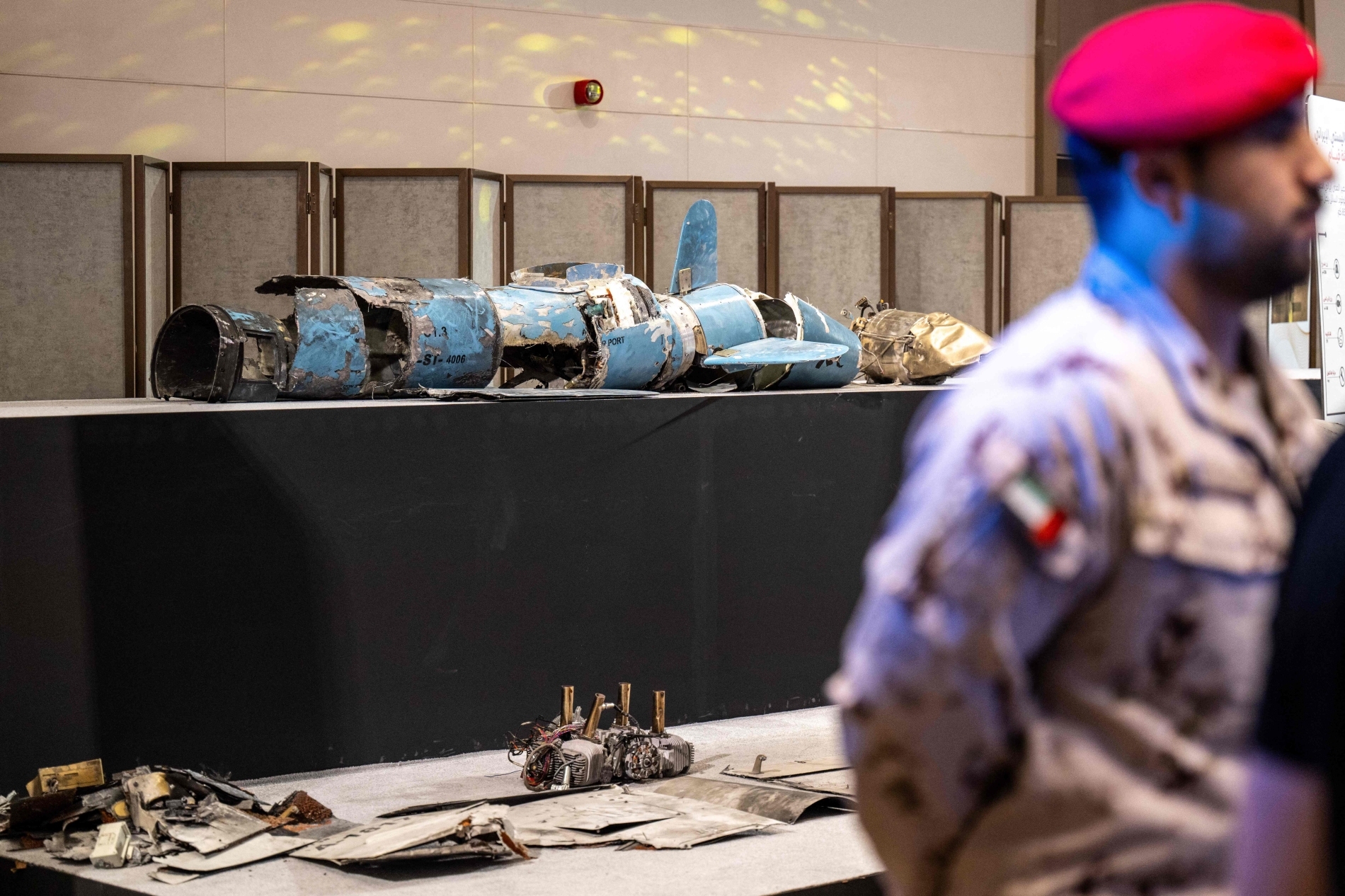
Pieces of missiles and drones recovered after Iranian strikes are displayed during a press briefing by the UAE government held in Abu Dhabi on 3 March 2026.

A climbing price

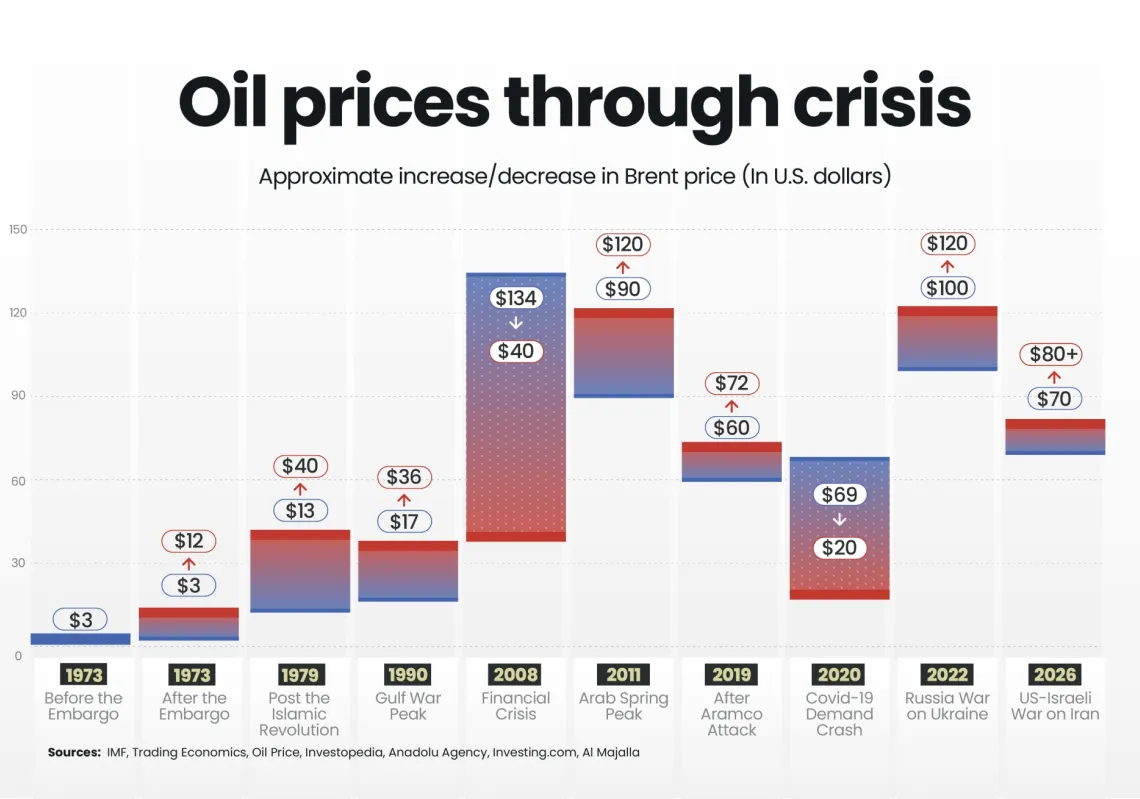
Bassem Bawab, Professor of Economics at the American University of Beirut, told Al Majalla that the war carried direct repercussions for the Gulf and the wider Middle East. The threatened paralysis of the region’s oil and gas industry could cost billions of dollars each day, he said, noting the likelihood of inflation as oil prices climb. He also felt that gold prices could rise by 10%, while a barrel of oil may increase by about $10. At the time of writing, a barrel of Brent crude was $83.7.

Islamic Revolutionary Guard Corps (IRGC) General Ebrahim Jabbari threatened to hit “all economic centres” in the Middle East if attacks against Iran continued. “We have closed the Strait of Hormuz,” he told Iranian news agency ISNA. “Currently, the price of oil is above $80 and will soon reach $200.” Most of the oil shipped through the Strait of Hormuz goes to Asia, with China, India, Japan, and South Korea accounting for 70% of shipments, according to the US Energy Information Administration.
We have closed the Strait of Hormuz. Currently the price of oil is above $80 and will soon reach $200

IRGC General Ebrahim Jabbari

Oil production in the region has already been cut. In Iraq, the Rumaila oilfield—one of the world's biggest, with around 17 billion barrels—has reduced output from 700,000 barrels per day (bpd) to 460,000 bpd, two unnamed officials told Reuters. Export disruptions from the Strait of Hormuz slowdown have pushed storage towards capacity limits in southern Iraq, they said. The field, which accounts for around 12% of Iraq's oil, is operated by BP, together with PetroChina.

Iran has attacked the Gulf states' oil and gas industries. On 3 March, an Iranian drone hit the Fujairah oil facility in the UAE. Oman's news agency reported that a fuel tank at the country's Duqm commercial port was hit. Qatar halted LNG production on 2 March after an Iranian drone struck a power plant in Mesaieed Industrial City and an energy facility in Ras Laffan belonging to QatarEnergy. It later said it would also halt production of related products like urea, polymers, methanol, and aluminium.

Reuters
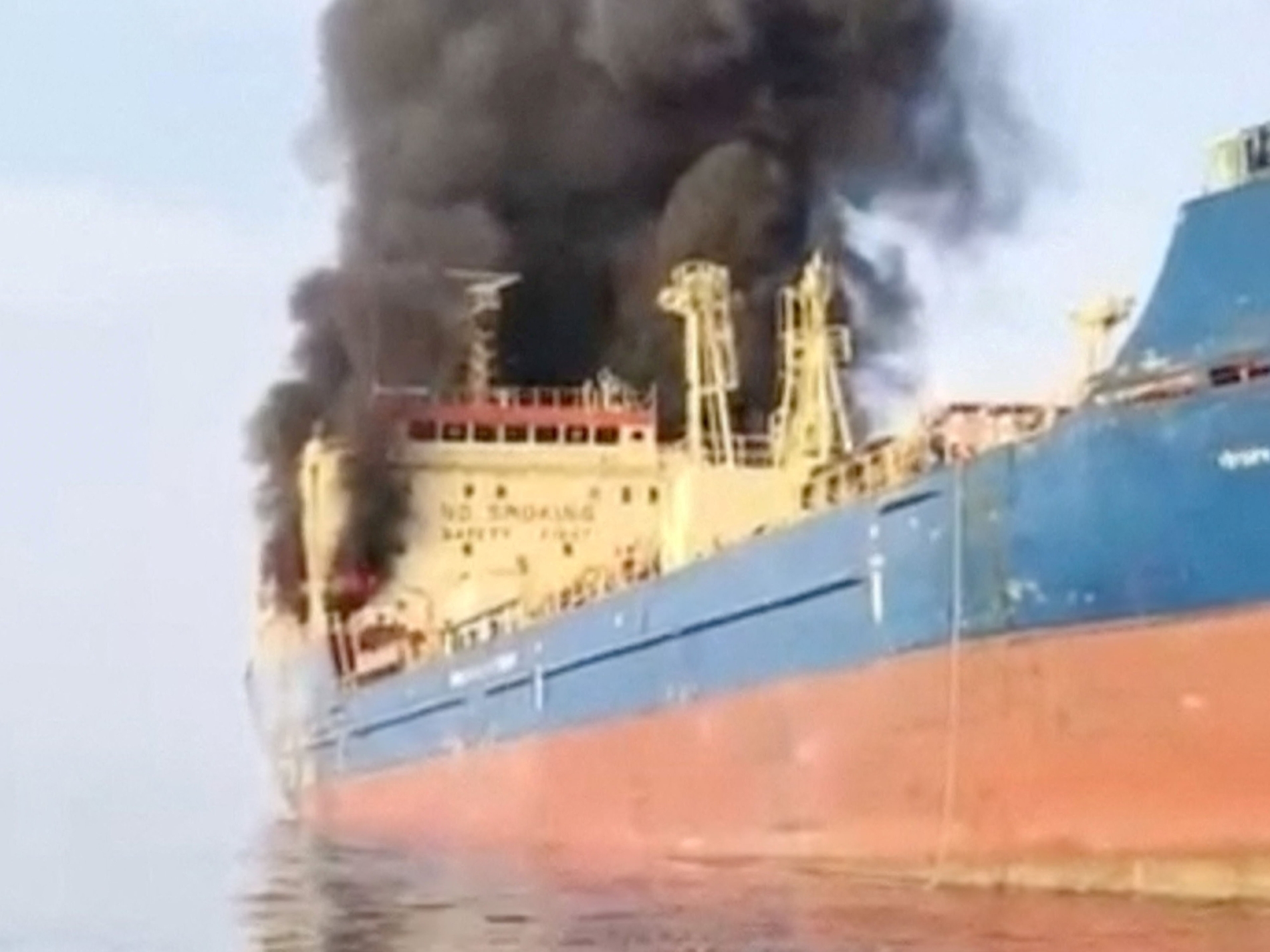
An Omani oil tanker is seen emitting smoke after being hit by a missile in the Arabian Gulf on 1 March 2026.

Knock-on effects

Anticipating shortfalls in Gulf crude, countries such as Indonesia have already sought alternative oil suppliers. European gas prices have jumped by 30% since the war began. Indian companies have already reduced natural gas supplies to industries. India is Abu Dhabi's largest LNG client and Qatar's second-largest. Meanwhile, Zhejiang Petrochemical Corp, a major Chinese refiner backed by Saudi Aramco, said it was closing one of its units for March, in anticipation of tighter supplies. China is the world's biggest oil importer, getting about half its crude from the Middle East.

Energy expert Laury Haytayan also told Al Majalla that oil prices had already been on an upward trajectory prior to the military strike, driven by geopolitical tensions and the markets' anticipation of further escalation, even during US-Iran negotiations. She said Saudi Arabia and the UAE retained a relative capacity to export oil through alternative routes that bypass the Strait of Hormuz. 

Haytayan set out a range of potential scenarios. The first concerns a possible US embargo on Iranian oil, which could remove around two million barrels per day from global supply. Some of these exports reach international markets indirectly through China. In such a case, oil-producing nations could respond by raising production to steady markets and contain price pressures (at the most recent OPEC+ meeting, eight member states agreed to increase output by 206,000 bpd).

I think the war is unlikely last more than ten days, as the global economy lacks the resilience to absorb sharp and prolonged increases in oil and gas prices

Petroleum industry engineer Rabih Yaghi

A second scenario involves direct American strikes on Iranian energy facilities, though Haytayan suspects that this is unlikely, given that Washington does not want to precipitate Iran's total economic devastation. A third possibility is limited strikes on Iran's refining facilities to generate domestic disruption.

In each scenario, upward pressure on oil prices seems likely, though by how much will depend on the damage to critical infrastructure. If essential facilities are attacked, a barrel could pass $100. Petroleum industry engineer Rabih Yaghi offered a more tempered assessment, however. He felt that the war was unlikely to extend beyond ten days, as the global economy lacks the resilience to absorb sharp and prolonged increases in oil and gas prices. He thought oil prices would not pass $85.

The Middle East accounts for about 30% of global oil consumption, or 105 million bpd, and roughly 20% of global gas trade, with annual consumption reaching 4.17 trillion cubic metres, according to OPEC. Threatening the Strait of Hormuz, therefore, carries immediate and far-reaching implications for the global economy. The consequences are only just beginning to play out.

font change