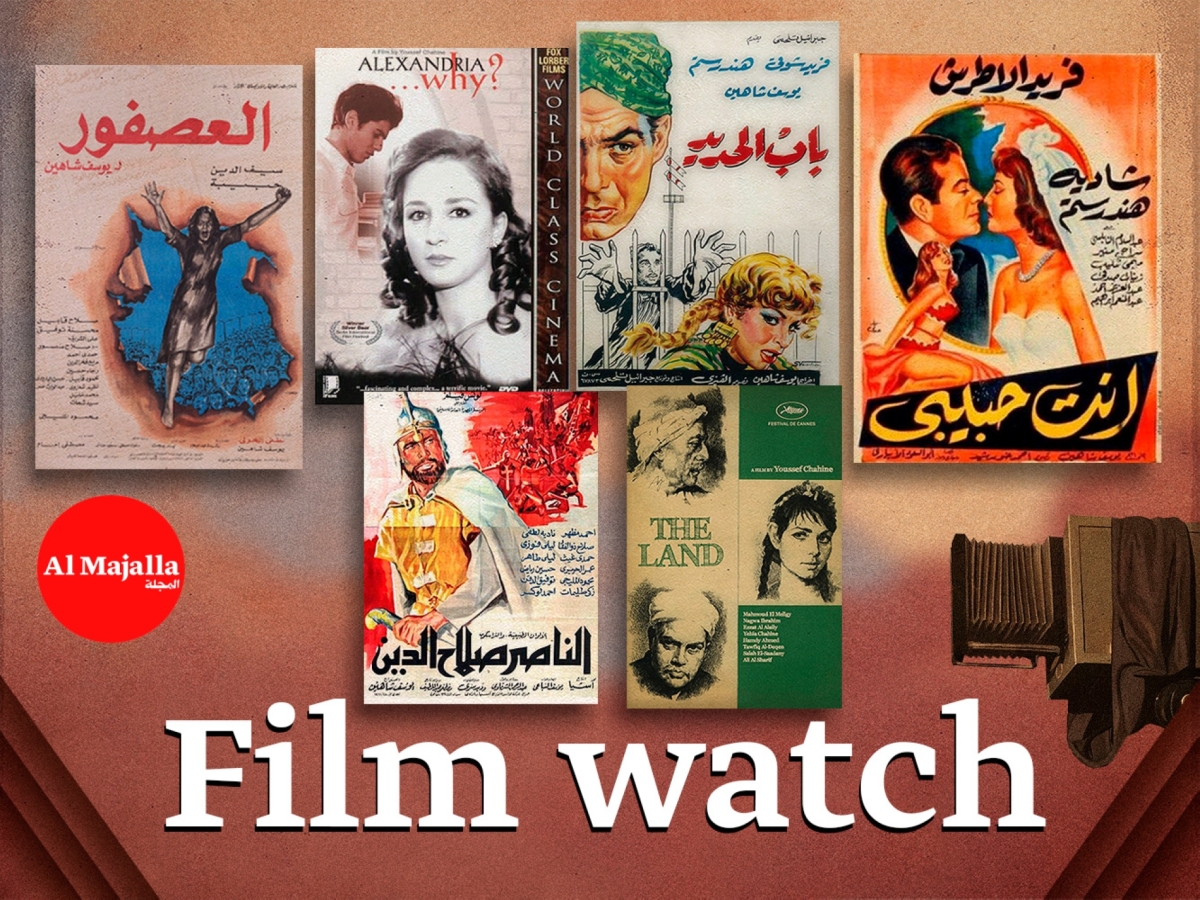
Al Majalla's Film Watch: the best of Youssef Chahine

On the centenary of his birth, Al Majalla highlights some of the many standout films of the legendary Egyptian director's illustrious career

Al Majalla

Al Majalla's Film Watch: the best of Youssef Chahine

Over a legendary career spanning 58 years, Youssef Chahine directed around 40 films, including several shorts and documentaries. On the centenary of his birth, Al Majalla highlights some of the many standout films of the Egyptian director's illustrious career.
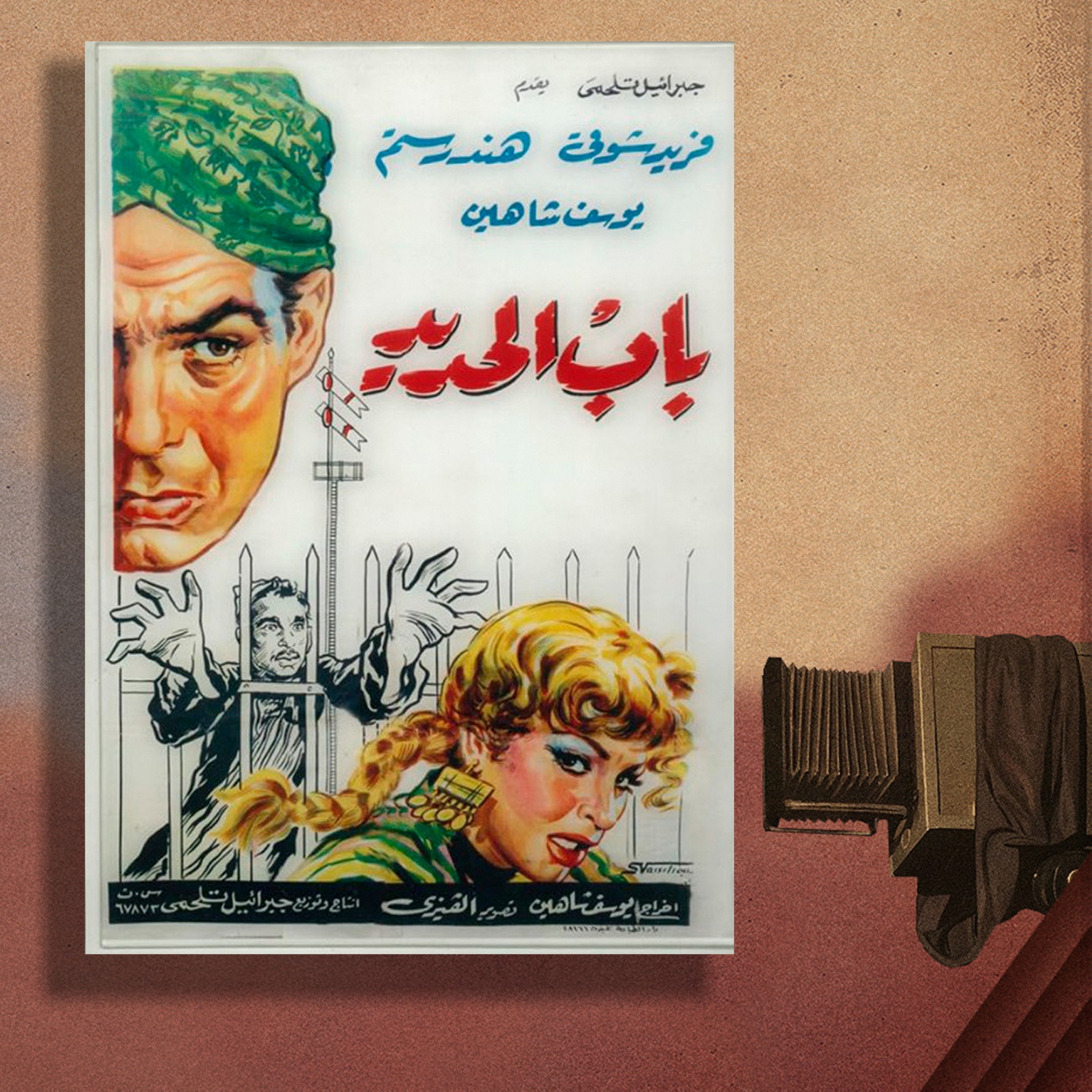

Cairo Station

Screenplay: Abdel Hay Adeeb

Producer: Gabriel Talhami

Starring: Hind Rostom, Farid Shawqi, Youssef Chahine

Released in 1958, Cairo Station is considered one of the most distinguished films in Egyptian cinema, not only for its historical importance but also as a pivotal moment in Youssef Chahine’s artistic development. While Chahine acknowledged his debt to Italian neorealism, particularly Vittorio De Sica’s Bicycle Thieves (1948), he created a form of realism entirely his own. His version was imbued with a shimmering, dreamlike quality, shifting between sensuality and lyricism.

This unique style enabled him to merge the personal with the collective. Rather than simply depicting reality, he reimagined it. The train station becomes a psychological stage, a setting in which the characters’ hidden desires are revealed, especially those of Qanawi, as trains arrive and depart.

With a screenplay that was both bold and deceptively simple, written by Abdel Hay Adeeb, Chahine moved away from the security of conventional drama and entered a more unsettled, vulnerable territory. Here he constructed a psychological universe of rare subtlety, one he would seldom revisit with the same intensity in later years.

Through Qanawi, Chahine realised a long-standing aspiration to act, delivering a performance so unique that it left a lasting impression on audiences. This broke from the dominant pattern in Egyptian cinema, where films often served merely as vehicles for star power. For this reason, Cairo Station remains the director’s most recognisable work among the broader public.

Yet there is another layer, perhaps not even fully recognised by Chahine himself, that reveals a form of self-portrait within the film. Qanawi bears more than a passing resemblance to Chahine. Beyond their shared stammer, Qanawi symbolises the filmmaker at a crucial juncture in his career. Up to that point, Chahine’s films had largely remained within traditional boundaries, despite their ambition.
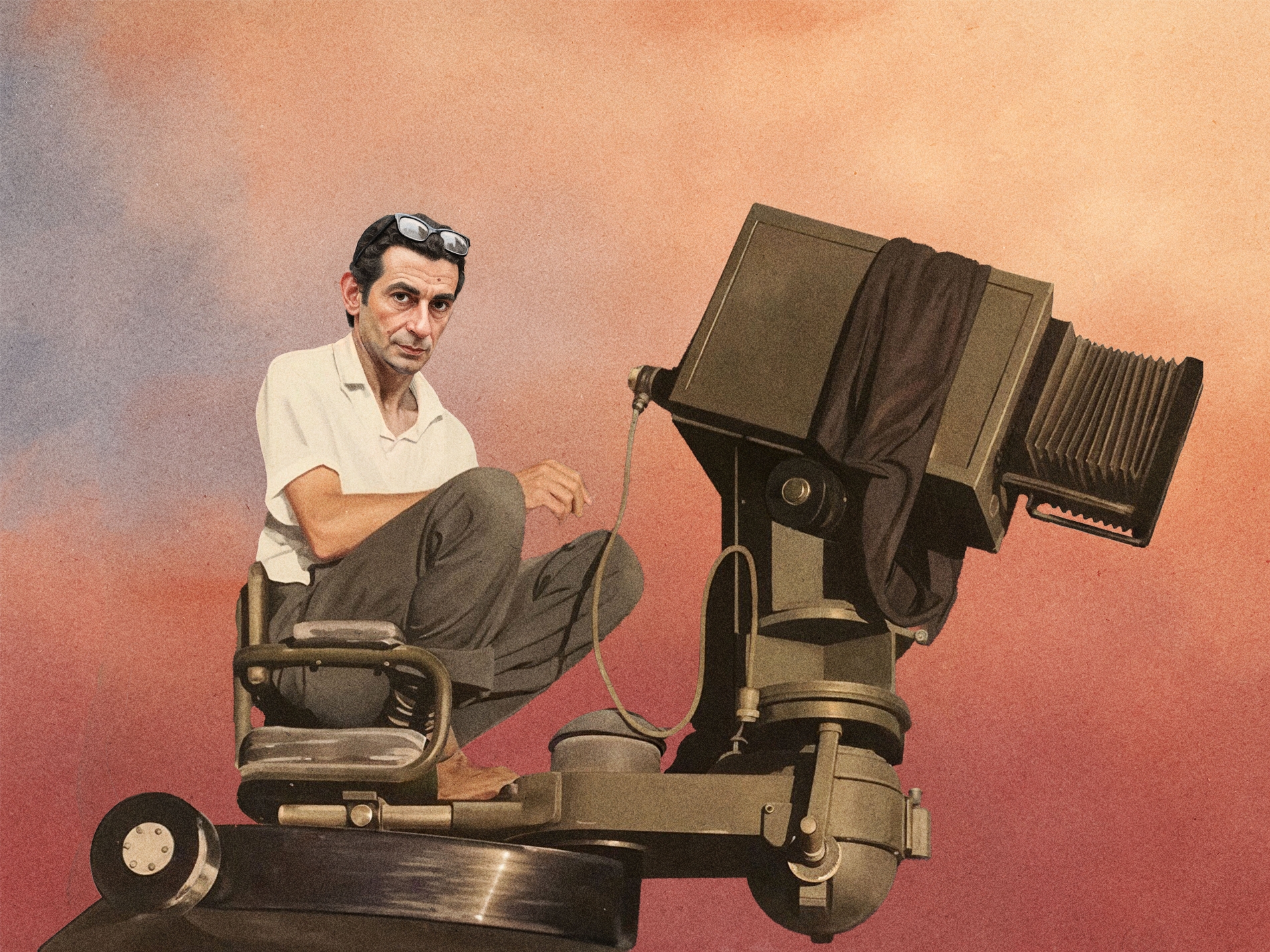
Lina Jaradat

In contrast, Hanouma can be seen as a personification of cinema itself—specifically, the popular and commercial cinema that embraced the likes of “Abu Sre’e” Farid Shawqi, dubbed “King of the Terzo,” while mocking the troubled, introspective cinema represented by Qanawi, the unstable outsider.

In this light, Qanawi’s limp acts as a visual and psychological metaphor for Chahine's own anxieties, doubts and perhaps even feelings of inadequacy as he sought to develop a new cinematic language that was still taking shape.

Despite the film’s celebrated status today, it was a commercial failure at the time. The response was so hostile that some cinema-goers vandalised the venue in protest. Makeup artist Mohamed Ashoub recalled that a group of Farid Shawqi’s fans sent him a letter offering financial assistance if hardship had led him to accept such a role. They ended the message with a line both affectionate and reproachful: “Don’t ever do that again.”

Not even the star power of two of the era’s biggest names could salvage the film’s commercial fortunes. Audiences were left bewildered—by Hind Rostom’s unfamiliar appearance and by the absence of the narrative structure they had come to expect. Chahine thus established a pattern of challenging, even shocking, his audiences.

There was precedent for this: in Struggle in the Valley (1954), the execution of Sheikh Saber (Abdel Warith Assar) went ahead despite the audience’s belief in his innocence, marking a clear departure from the prevailing conventions of realism at the time.
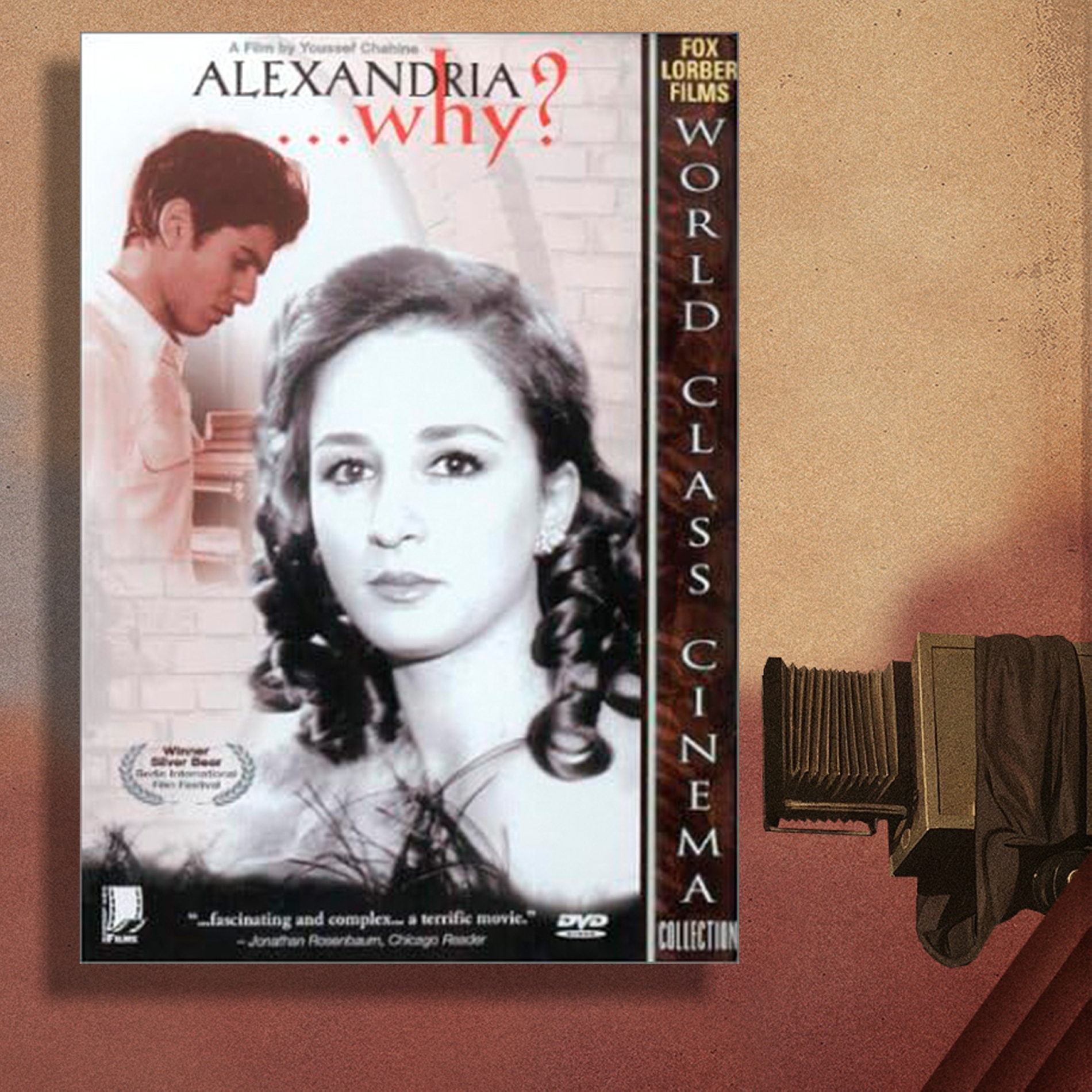
Alexandria...Why?

Screenplay: Mohsen Zayed, with contributions from the director

Production: Misr International Films

Starring: Mohsen Mohieddin, Mahmoud El-Meligi, Mohsena Tawfik, Farid Shawqi

Youssef Chahine was born on 25 January 1926 in Alexandria, a city he remained emotionally and intellectually bound to throughout his life. The city became the central character in his autobiographical film cycle, which began with Alexandria... Why? (1978), continued through An Egyptian Story (1982) and Alexandria Again and Forever (1989), and concluded with Alexandria...New York (2004), which was the weakest of the four.

Yet Chahine did not give the films a straightforward dramatic structure. He deconstructed them, rebuilding them into a near-circular form that ends where it began—with a nostalgic longing for formative years. Alexandria, in his hands, becomes a memory capacious enough to contain both the personal and the collective.

In Alexandria...Why?, Chahine begins with the Shakespearean dilemma “To be or not to be”, mapping the terrain of adolescence where early dreams take root within the halls of Victoria College, before his departure to study cinema at the Pasadena Playhouse in California. It is notable that Chahine assembled an exceptional cast for this foundational work of his cinematic autobiography, including emerging stars alongside the dean of Arab theatre, Youssef Wahbi, as if to underscore Alexandria’s cosmopolitan spirit.

He does not merely portray the city through a multiplicity of voices. He traces the transformation of the self—the filmmaker’s own self—as it matures, revises its ambitions and embarks on a kind of enclosed voyage of self-discovery that reconsiders even its relationship with cinema. Film becomes a confessional lens through which he holds himself and his intellectual milieu to account.

In a striking scene from An Egyptian Story, the real Hanouma confronts Yehia/Chahine, telling him that his connection to them never extended beyond fictional invention, dismissing his work as make-believe: “like the black paste you use in makeup to smudge your face... but we have the real tar.”

In another scene from Alexandria Again and Forever, Chahine breaks the fourth wall to insult the audience, declaring, “Damn you all.” While some interpreted this moment as reflective of the perceived arrogance of his cinema, others praised its boldness, noting that the insult was directed at himself as much as anyone else—whether for his abandonment of Hanouma or for his disdain toward what might be termed popular consciousness.

Chahine constructed his quartet in the spirit of major literary projects that celebrated place as the bedrock of their fictional worlds. A clear parallel can be drawn with Lawrence Durrell’s Alexandria Quartet, where the city emerges as a polyphonic space—one shaped and reshaped by its shifting cultural fabric, filled with competing voices and layered identities.
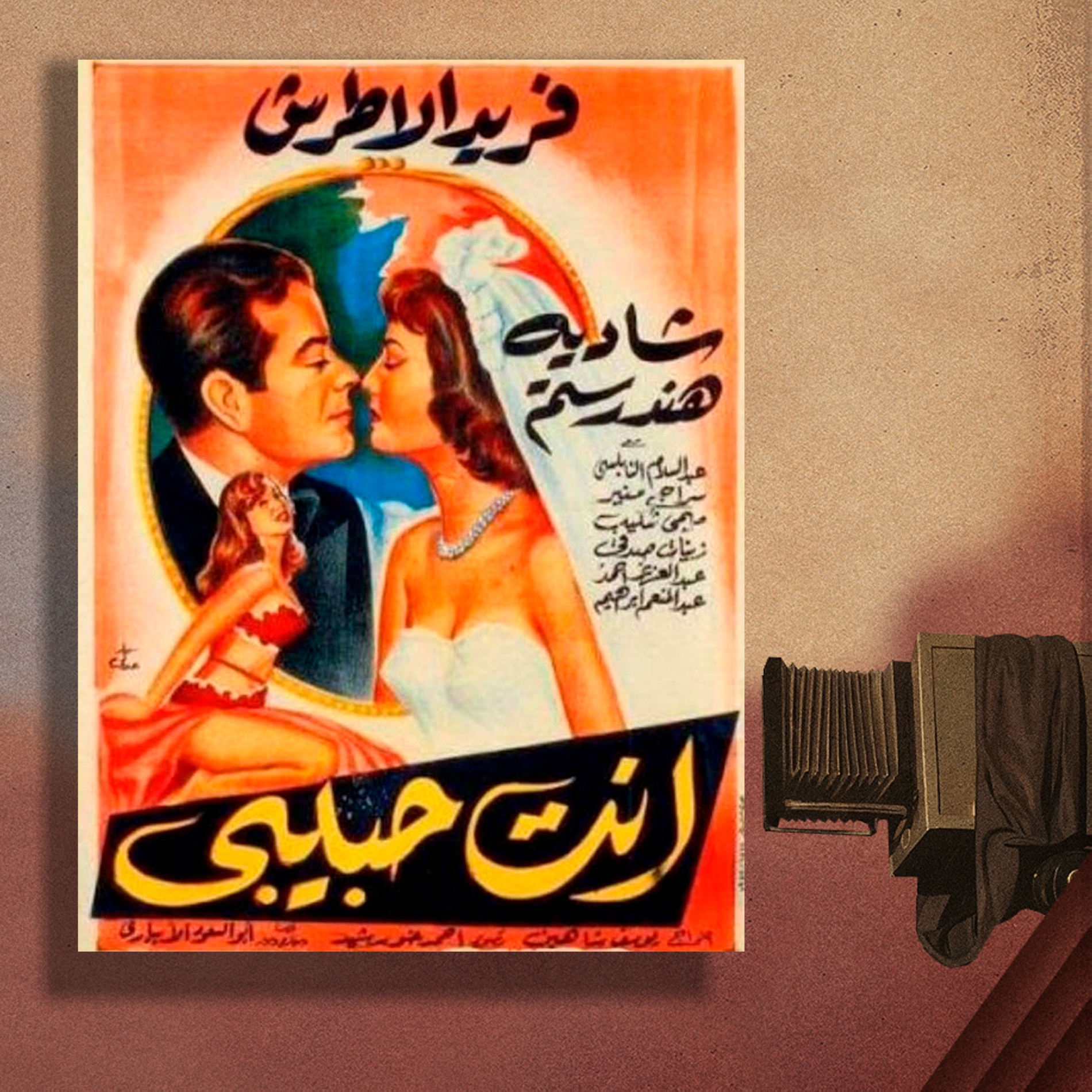
You Are My Love

Screenplay: Abu Al-Su’oud Al-Ebiary

Production: Farid Al-Atrash Films

Starring: Shadia, Farid Al-Atrash, Hind Rostom

Youssef Chahine often drew inspiration from Hollywood—visually through dramatic contrasts of light and shadow, energetic shot composition and a restless, almost anxious camera style; and structurally through layered narrative techniques and rapid editing that at times bordered on the frenetic. His filmmaking was also characterised by a strong musical sensibility, where song and dance were not decorative but integral to the dramatic progression.

Hollywood had long celebrated the musical and the spectacle film, genres that formed Chahine’s earliest cinematic attachments. It is unsurprising, then, that he dedicated The Sixth Day (1986) to a celebrated Hollywood star who embodied the unity of singing, acting and dancing, writing in the credits: “To Gene Kelly, who filled the days of our youth with joy.”

In the same film, Chahine collaborated with the poet Salah Jahin on the song “Haddouta Hattetna”, composed by Omar Khairat. He even performed in front of the camera himself—in the operetta “The God” from Alexandria Again and Forever (1989)—and danced briefly, revealing a personal relationship with performance that transcended genre and touched on his own artistic and emotional biography.

Over a career spanning 58 years, Chahine directed around 40 films, including several shorts and documentaries. Among the most notable of these is Cairo as Told by Its People (1991). It is striking that musical films constitute nearly a third of his total output. In them, he worked with some of the most celebrated singers of his time, beginning with Layla Murad in The Lady on the Train (1952), in which she performed six songs, including the beloved “From Afar, My Love, I Greet You.”
Cairo Station (1958) is considered one of the most distinguished films in Egyptian cinema, not only for its historical importance but also as a pivotal moment in Youssef Chahine's artistic development

In the mid-1960s, Chahine took a different turn, collaborating with Fairuz in The Ring Seller, an adaptation of the Rahbani Brothers' operetta, for which they also wrote the screenplay. Fairuz performed over ten songs in the film, including "O Messenger of Messengers," "Come or Don't Come" and "O Ring Seller."

The Return of the Prodigal Son (1976) also stands out for its musical richness. Written by Salah Jahin, the songs were rendered by Chahine with a strong visual and theatrical instinct. The film moves between operetta, as in "The Street Is Ours," solo pieces such as "Crossroads," and what could be seen as an early iteration of the music video style, most notably in "Bye-Bye, Our School."

You Are My Love (1957) began, as the story goes, with a simple idea Farid Al-Atrash shared in passing: a man running through the streets, chased by a crowd, crying, "They're going to marry me off." From this lighthearted concept, Abu Al-Su'oud Al-Ebiary crafted one of the most graceful and playful screenplays in Egyptian cinema, interwoven with a charming set of songs performed by Shadia and Farid Al-Atrash, especially their popular duet "Ya Salam Ala Hobi Wi Hobak."

Despite the film's popularity, however, Chahine himself was never satisfied with it—or with his subsequent collaboration with the same star, who also served as producer, in I Bid You Farewell, My Love.

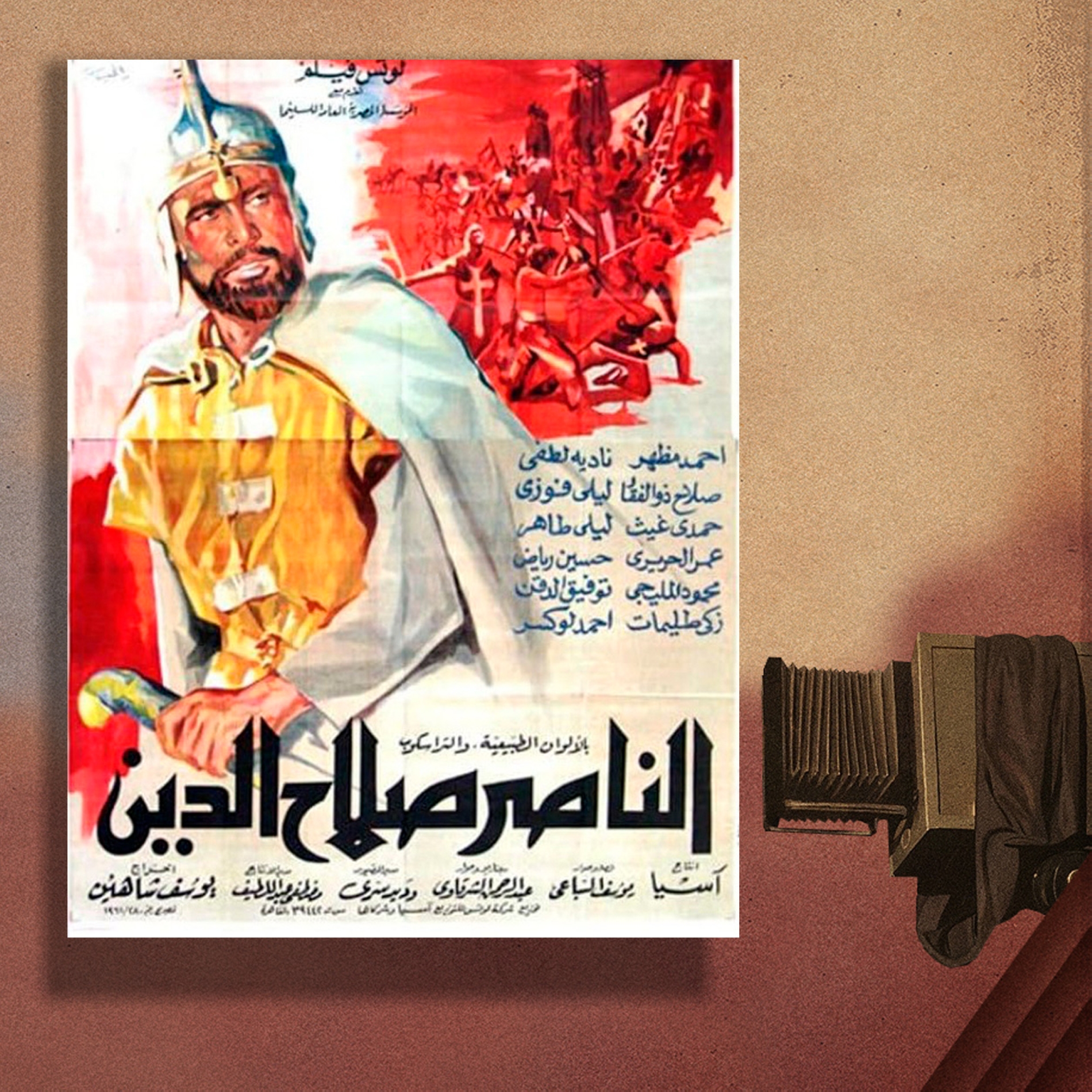
Saladin the Victorious

Screenplay: Abdel Rahman Al-Sharqawi, with contributions from the director

Production: Lotus Film, The Egyptian Film Organisation

Starring: Ahmed Mazhar, Nadia Lutfi, Hamdy Gheith, Zaki Toleimat

Youssef Chahine's cinema was never disconnected from history, in all its temporal layers. Yet, despite this deep engagement, his explicitly historical films number only five. This journey began with Jamila, the Algerian (1958), which portrayed the life of the famed resistance fighter, and concluded in 1997 with Destiny, a film that presented a different kind of struggle through the figure of the philosopher Ibn Rushd.

Destiny was screened at the Cannes Film Festival's golden jubilee celebration, where Chahine received the festival's lifetime achievement award—the first Egyptian and Arab director to be so honoured. His long-standing relationship with Cannes began decades earlier with Son of the Nile (1951), his third feature.

Over the course of his career, he participated in ten editions of the festival, with works including Adieu Bonaparte (1984) and The Emigrant (1994), the latter sparking one of his most intense confrontations with state authorities and leading to accusations of blasphemy.

Saladin the Victorious (1963) adopts a grand visual language, realised through expansive crowd scenes, geometric camera movement and a dynamic musical score that reinforces the historical weight of the narrative.

Though the film is direct in its political messaging, it is widely regarded as the pinnacle of Chahine's historical output. In it, he channels the political anxieties of the Nasserist era by reviving the figure of Saladin—presented in his historical setting, yet infused with modern ideological concerns.

But rather than portraying the military commander as a mythical figure, Chahine offers a more human and ethical representation. This emerges clearly in scenes showing Saladin's compassion for prisoners or his principled refusal to conspire against Richard the Lionheart.

Unlike many Arab historical films that merely echo official narratives, Chahine expands the frame through peripheral or imagined characters and through individuals portrayed with rich symbolic and emotional nuance, such as Issa Al-Awwam. In doing so, he asserts that history is not the preserve of legendary leaders alone, but the product of collective endeavour. Individual lives are situated within a broader social and political project.

For this reason, the film cannot be disentangled from the political context of the 1960s. It strongly reflects the discourse of Arab nationalism, particularly in its emphasis on the need for unity in facing external threats and its clear rejection of internal division and betrayal.

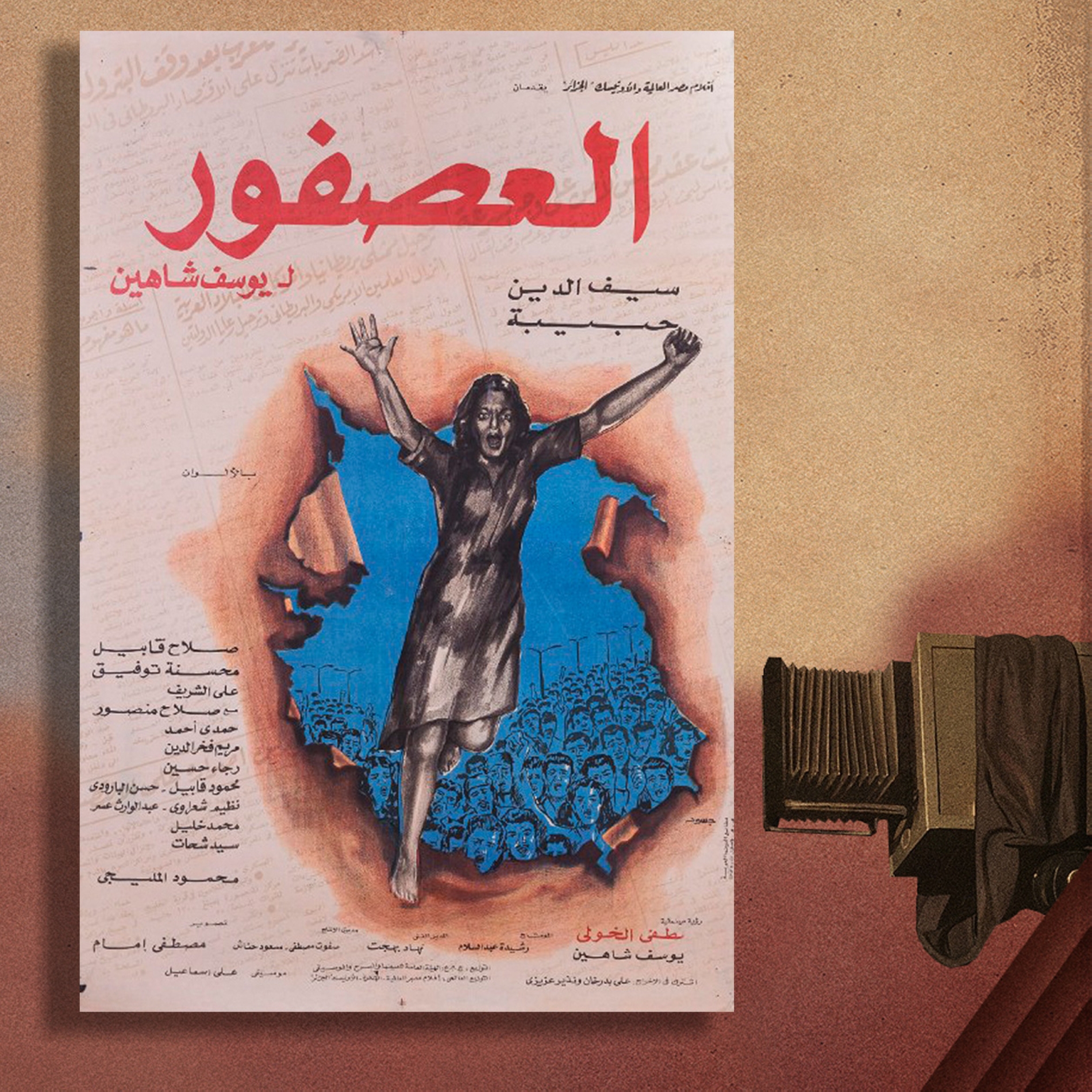
The Sparrow

Screenplay: Lotfi El Khouli, with contributions from the director

Production: Misr International Films, ONCIC

Starring: Seif El Din, Salah Kabeel, Mohsena Tawfik, Mahmoud El Meligi, Salah Mansour

Youssef Chahine approached politics in its broadest sense—one that extended far beyond explicit messaging or ideological proclamation. For him, no action was devoid of political significance, however minor or seemingly mundane. This could take the form of open confrontation or unfold through metaphor and allegory. It is for this reason that most of his films are driven by a political impulse or feature recurring tensions with ruling powers, including the Nasserist regime itself, whose nationalist discourse he had once supported.

Yet The Sparrow (1972) closes with the iconic cry of Bahia, played by Mohsena Tawfik, shouting "We will fight, we will fight", just as Mahmoud El Meligi appears briefly, releasing a sparrow from its cage. The scene takes place in the wake of President Gamal Abdel Nasser's announcement of his resignation on 9 June, following Egypt's defeat in the 1967 war. Through this parallel act of protest and symbolic release, Chahine issues a quiet indictment of the political system embodied in the singular figure of the leader, even as he affirms the role of the collective as the true force of resistance.

The plot of The Sparrow begins with a mission to apprehend Abu El Khadr, a fugitive being used by unknown actors to mask a network of financial corruption linked to public sector factories. The journalist Youssef, played by Salah Kabeel, sets out to investigate, gradually uncovering the complex threads of a series of collective crimes. The premise carries faint echoes of The Thief and the Dogs (1962), the real-life case of Said Mahran, which Naguib Mahfouz reimagined as a philosophical critique of political failure.

The film reflects a shared cinematic vision between Lotfi El Khouli and Chahine. The credits also note that Ali Badrakhan and Nazih Azzazi joined Chahine as directors. Despite facing censorship and accusations of defaming Egypt's image, the film does not attempt to provide neat answers or sweeping verdicts. Its focus is instead on raising fundamental questions about responsibility—individual and collective. The film's critique is not limited to the regime; it extends to society at large.

A pointed critique appears from the film's very first frames. The opening credits unfold over a series of scattered newspaper headlines, exposing the role of a manipulated or state-controlled press. From "Honouring Our Armed Forces" in Al-Ahram, to reports of Abu El Khadr's disappearance and the killing of a guard, alongside broader narratives such as "Israel Cries Out: The Arabs Want to Throw Us into the Sea", and "The Legitimate Thieves Behind Abu El Khadr", the sequence culminates in the most striking and ironic headline of all: "The Glorious Hours Lived by the Entire Arab Nation." Through this framing device, Chahine places the media at the centre of responsibility, portraying it as a key accomplice in the construction of collective delusion.

The Land

Screenplay: Hassan Fouad

Production: The Egyptian Film Organisation

Starring: Nagwa Ibrahim, Ezzat El-Alaili, Mahmoud El-Meligi

Youssef Chahine's cinematic journey began with elements of fantasy and the improbable. His debut, Papa Amin (1950), told the story of a deceased father, played by Hussein Riad, whose spirit returns to observe his family after death. As his career progressed, Chahine's cinema earned a reputation for intellectualism—sometimes even elitism—that made it challenging for general audiences and, at times, even for those within the industry. The acclaimed actress Sana Jamil once admitted she could not make sense of his work, despite starring in Dawn of a New Day (1965), one of his lesser-known and rarely revisited films.

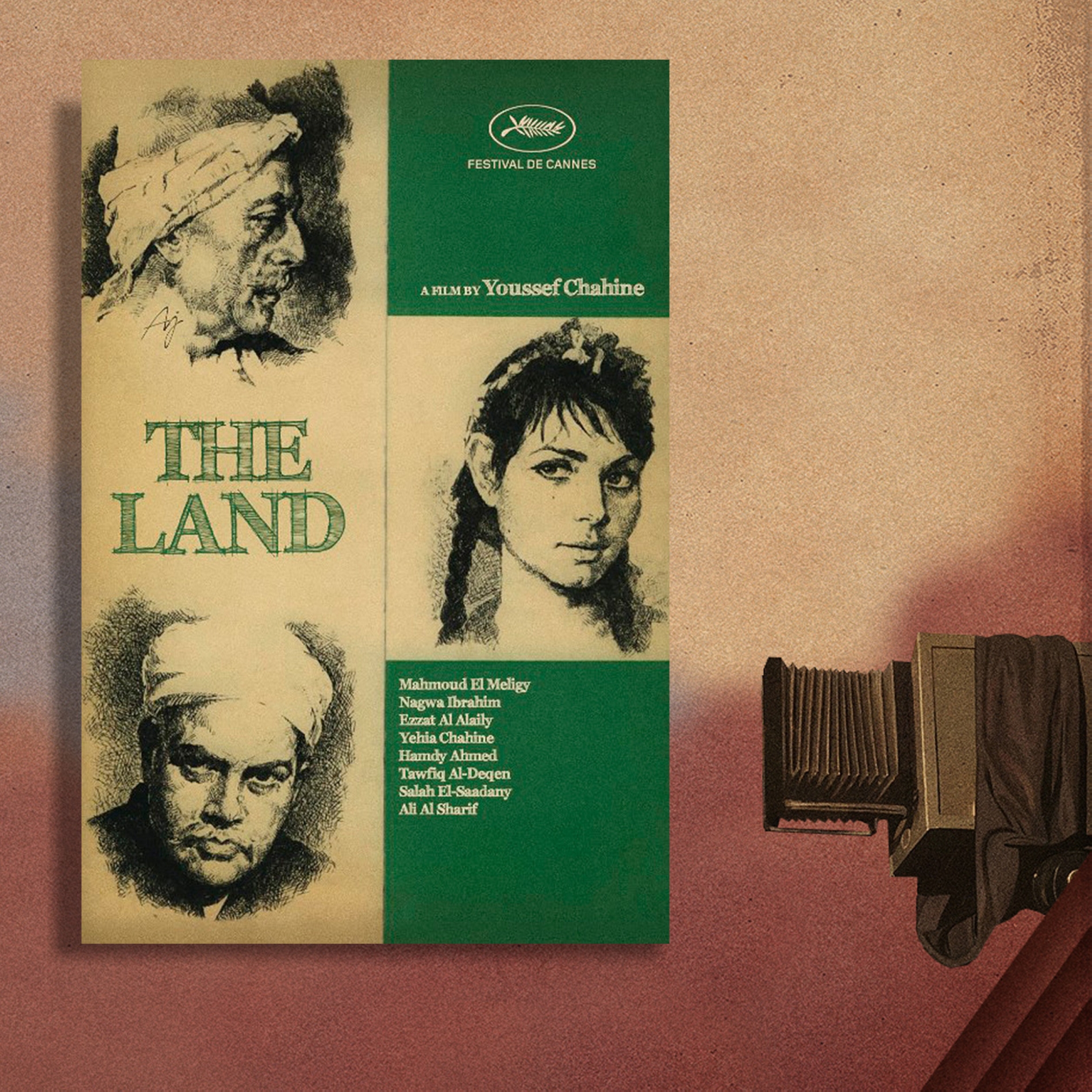
Yet this widespread label collapses when confronted with The Land (1969), one of Chahine's most powerful and coherent realist works. Its achievement is not only personal but stands as a cornerstone of the realist school in Egyptian cinema. The 1950s and 1960s had already produced a string of politically engaged films rooted in collective consciousness—Return My Heart, The Soft Hands and Cairo 30, among others.

The Land, adapted from Abdel Rahman Al-Sharqawi's novel, belongs squarely to this tradition. The screenplay was written by Hassan Fouad, and the cast features an ensemble including Nagwa Ibrahim, Ezzat El-Alaili, Mahmoud El-Meligi, Yehia Chahine, Hamdy Ahmed, Tawfiq El-Deqn and Ali El-Sherif in his screen debut.

In this film, Chahine set aside cerebral structures and formal experimentation in favour of a realism that listens to the collective voice. His camera becomes a tool for documenting the many facets of rural resistance against oppression and exploitation. Here, realism is more than an aesthetic—it becomes a moral position. This commitment reaches its peak in the film's iconic final scene, one of the most enduring images in Arab cinema. Mohamed Abu Sweilem is dragged across the earth in defence of his land, to the haunting sound of the song "If the Land Is Thirsty."

Lina Jaradat

The sequence distils the entire conflict into a single, unforgettable moment. Mahmoud El-Meligi, who played Abu Sweilem, insisted on being dragged in real time before the camera, believing that only authenticity could convey the full emotional truth of the scene. The act left him physically injured.

In 2007, Chahine released what would be his final film, Chaos, co-directed with his protégé Khaled Youssef. Less than a year later, on 27 July, he passed away at the age of 80. While the film bears little of Chahine's stylistic signature, Khaled Saleh's performance as the police officer Amin is arguably the most striking and possibly finest element in the film.

font change