In Davos, a tale of two speeches

Trump follows Greenland threats by announcing a “future deal,” while Canada’s prime minister describes it all as a “rupture in the world order"

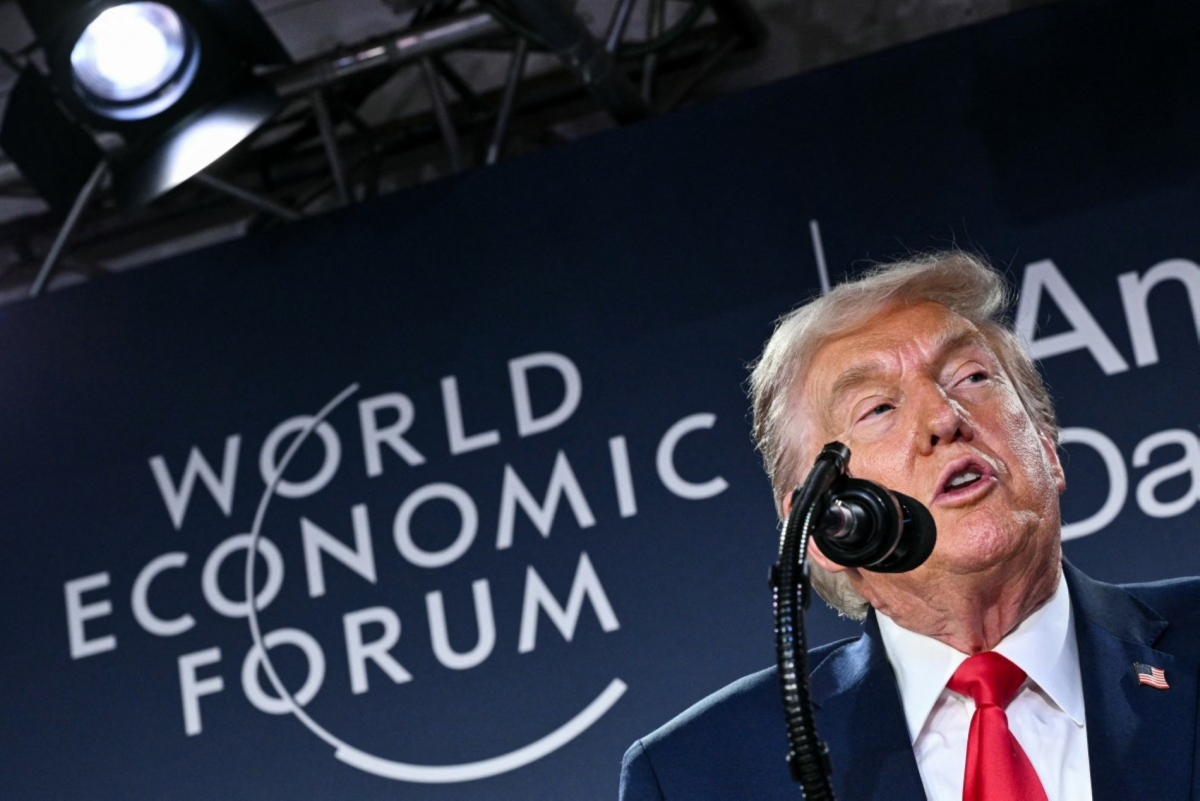
US President Donald Trump speaks during a reception with business leaders on the sidelines of the World Economic Forum (WEF) annual meeting in Davos on 21 January 2026.
Photo by MANDEL NGAN / AFP
US President Donald Trump speaks during a reception with business leaders on the sidelines of the World Economic Forum (WEF) annual meeting in Davos on 21 January 2026.

In Davos, a tale of two speeches

DAVOS, Switzerland: Let’s get the headline out of the way first. After reading out a long speech from a teleprompter that listed out various domestic accomplishments without once mentioning his recent threats against Denmark, US President Donald Trump, ever the showman, realised what the hundreds of diplomats, world leaders, and businesspeople had gathered in the room to hear. “Would you like me to say a few words on Greenland?” he asked.

The answer was, of course, yes. And then it came.

“I’m seeking immediate negotiations to discuss the acquisition of Greenland,” he announced, even as he admitted he didn’t plan to use force. “All we’re asking for in Greenland is right, title, and ownership. ... You can say yes, and we will be very appreciative. You can say no, and we will remember.”

Hours later, an about-turn emerged on, you guessed it, Truth Social. Trump announced a “future deal with respect to Greenland” but held back on details, except to say the expected 1 February tariffs would no longer be imposed. “Further information will be made available as discussions progress.” So, what was the point of the day’s drama?

Commentators have long wondered if the World Economic Forum’s annual meeting in the ski resort town of Davos was losing relevance. But Trump always delivers. For all the summit’s carefully crafted sessions on topics such as AI, the economy, and critical minerals, the issue on everyone’s minds was the one that the US president had turned into a real, live, international crisis.

Over the weekend, he announced tariffs on Denmark and seven other European countries for not supporting his bid to take over Greenland. His previous interest in the territory governed by Denmark was no longer hypothetical: He was now deploying economic warfare to pressure Europe to give in. Would they?

No one knew the answer because everyone was waiting to first hear from Trump himself. Commerce Secretary Howard Lutnick, interviewed by Foreign Policy economics columnist Adam Tooze in a panel on stage on Tuesday, refused to directly engage with whether his boss would actually force Europe to sell Greenland. When this author asked him from the audience whether sovereignty applied equally to the United States as well as other countries, Lutnick obfuscated.

And so it went as a parade of other cabinet members and Trump delegates spoke on TV and on stage ahead of the president’s arrival on Wednesday, parroting his circuitous talking points without saying anything about what the White House’s plan actually was.


The question now is whether Canada and Europe will match their words with actions that would be enough to deter Trump's American power trip

Unsurprisingly, when the time came, on Wednesday at 2:30 p.m. local time, thousands of Davos delegates dropped other plans to file into the main Congress Hall—and several overflow rooms—to hear Trump live and in person. What would he say about Denmark?

Over more than 30 minutes of scripted remarks, it seemed Trump would troll the audience by not engaging with the one thing they wanted to hear. When it finally came, Trump's comments on Europe were pockmarked with misinformation.

"The United States was virtually paying for 100% of NATO," he said—a gross exaggeration of the fact that European members could have been contributing more. "What we've gotten from NATO is nothing. … We'll be there for NATO 100%. I know we'll be there for them. I don't know if they'll be there for us."

The facts would show otherwise, as countless leaders in the room knew all too well. NATO's Article 5, which any member state can invoke, treats an attack on one country as an attack on all of them, requiring a treaty-bound response; the only time it has been invoked in the alliance's nearly 77-year history was by the United States, right after the 9/11 attacks. Ironically, one of the main contributors to US efforts in Afghanistan turned out to be Denmark, which lost a greater percentage of soldiers as a ratio of its population than any other member state.

But Trump didn't care for history—unless he could twist it to serve his purpose. He cited the end of World War II instead and described how the United States saved Europe—and Greenland—from the Axis powers, ignoring the contributions of other great powers, including the Soviet Union, China, and an array of then-colonised countries. "We literally set up bases on Greenland for Denmark," Trump said. "How stupid were we to give Greenland back. How ungrateful are they now!"

The question now is what Trump's negotiations on a "future deal with respect to Greenland" might look like—and whether he changes his mind again. Trump, already playing bully, has his eyes on the leaders who are meeting his threats with tough words. "Emmanuel, I watched your speech," he said disapprovingly, remarking to France's president, Emmanuel Macron, who on Tuesday had reiterated the importance of sovereignty.

Trump was sterner still with the other speaking star of the week. "Canada … I watched your prime minister," Trump said during the unscripted part of his remarks, referring to Mark Carney. "The next time you speak, Mark, watch yourself."

The World Economic Forum's latest annual meeting has turned out to be a tale of two speeches. On the one hand, Trump's rambling and bullying of his country's closest allies, heralding an era of jungle law, where the biggest power can have its way with smaller economies. In sharp contrast lies Carney's eloquent exposition of the dangers of a world where might makes right. (It's worth reading the full transcript here.)

Carney didn't portray the rules-based international order as faultless but instead pointed to how those very rules needed nurturing and not destroying. "Other countries … are not powerless. They have the capacity to build a new order that encompasses our values, such as respect for human rights, sustainable development, solidarity, sovereignty, and territorial integrity. (Watch the full speech below).

"The powerful have their power," he added later. "But we have something, too—the capacity to stop pretending, to name reality, to build our strength at home, and to act together. This is Canada's path. We choose it openly and confidently, and it is a path wide open to any country willing to take it with us."

Carney stands at a lectern in front of a blue backdrop featuring the World Economic Forum logo. He wears a black business suit suit and tie.

Carney's speech came on the heels of a closely watched visit to China, a relationship that he described as "recalibrating" just one year after calling Beijing "the biggest security threat" facing Ottawa. A deal announced between the two countries included easing tariffs on Chinese electric vehicles, a product the United States has long sought to throttle international sales of.

Today, Carney's phone must be blowing up with messages. The question is whether Canada and NATO's European members will match their words with actions that would be enough to deter a US president who seems to only just be discovering the extent of American power.

font change