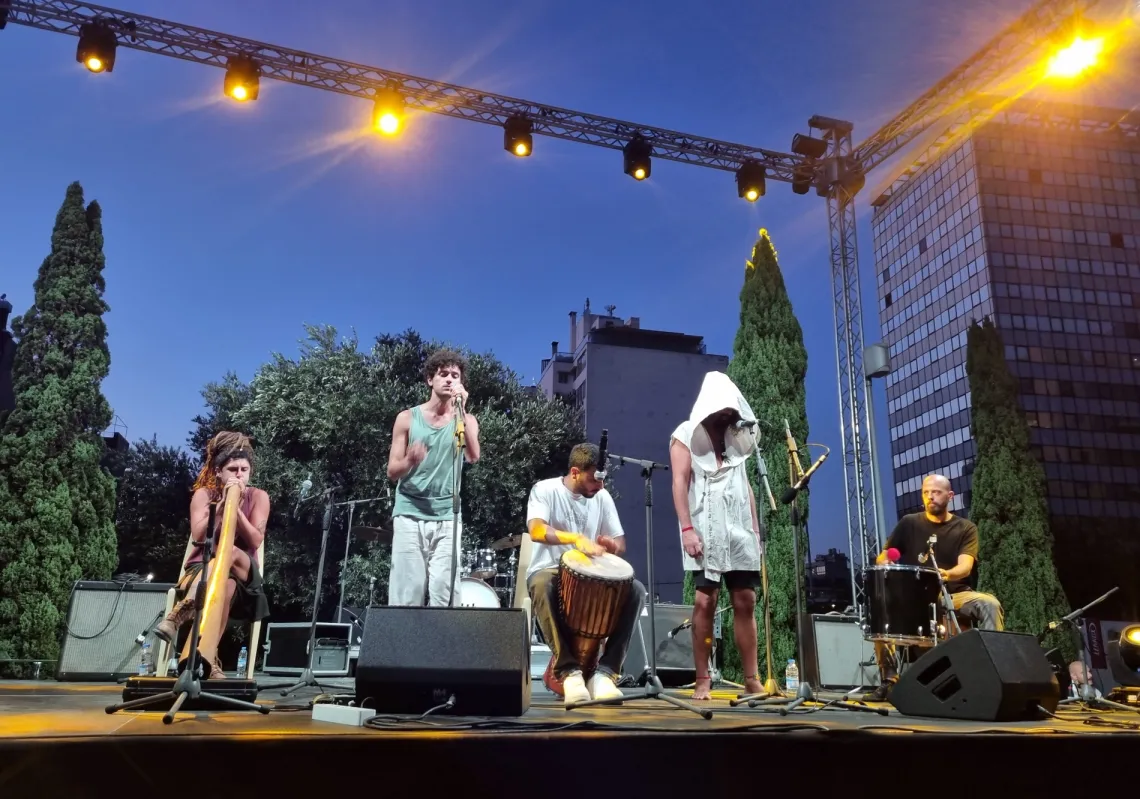
The economy is a mess and the politics are askew but the Lebanese are once again learning how to celebrate, these days to the tune of Badna Nrou, meaning 'We need to calm down'
The Syrian artist's works on display in Beirut consider the hopes and dreams of migrants, the walls they face, and their eventual arrival in a safe harbour
Iraqi sculptor's epic wall-mounted installations evoke the destruction of Aleppo and Mosul, displayed in Beirut in the shadow of ongoing genocide in Gaza.
Built a century ago by Ala's grandparents, her 97-year-old uncle Aziz still lives on the third floor of this grand sea-facing property that developers would love. Instead, it is now a public space.
In his current collection, Palestinian artist Taysir Batniji tries to depict the Gaza war with art that has almost entirely lost its form, in part because events since October 2023 go "beyond descript
Hezbollah's stronghold has been under relentless Israeli attack for weeks. On the ground, Al Majalla explains how Beirut's once diverse southern suburb evolved into a 'little Tehran' over time.
US academic Jonathan Gribetz asks why Palestinian nationalists in Lebanon set up a research centre on Zionism, why it was important, what fate had in store for it, and what lessons can be drawn
Disruption in the Hormuz can have major implications for global trade, but it also creates opportunities for smaller nations like Iran to become global political players
The Iraq war was viewed as disastrous in retrospect, while the Iran war was unpopular from the get-go. Al Majalla highlights the similarities and differences between the two.
Pipelines have a chequered history in the Middle East, but the closure of the Strait of Hormuz has led US Tom Barrack to conclude that a new route through Syria could solve some problems.