A northern region that was captured by the Houthis in 2020 has been the scene of fierce fighting in recent weeks, with some gains by government forces. Why is it important?
In the battle for Yemen now being waged between the Iran-backed Houthi militia and the Saudi-backed internationally recognised government, the oil-rich Al Jawf governorate in the country’s east has become one of the main fronts. A military offensive launched by Aden-based government forces on 5 October seeks to restore state institutions, recapture the capital, Sanaa, and end the Houthis’ hold. In this effort, Al Jawf could play a major role, partly because of its resources and partly because of its location.
Al Jawf is the largest governorate in northern Yemen, and most of it came under Houthi control in 2020, when the world was consumed by the Covid-19 pandemic. To the north of Al Jawf is Saudi Arabia, to the west is the Houthis’ mountainous heartland, to the east is the Empty Quarter desert, while parts of Marib and Sanaa lie to the south.
On 1 November, the Yemeni Armed Forces said its troops from the First Emergency Division had recaptured several military positions and strategic heights east of Al Hazm, the capital of Al Jawf, following fierce clashes with the Houthis. The armed forces “seized stockpiles of (Houthi) weapons and ammunition before its fighters fled their positions around the Duhayda mountains,” it said.
Yemeni news agency Saba said the Presidential Leadership Council met on 2 November. Chaired by Rashad Al Alimi, it noted “the gains made by the armed forces and popular resistance, with substantial support from the Coalition to Support Legitimacy, as part of Operation Dawn of Yemen, on the Al Jawf, Marib and western coast fronts, as well as the heroic resistance on the Taiz fronts”. A day earlier, Al Alimi appointed Maj. Gen. Amin Ali Al Akimi as governor of Al Jawf and commander of the Al Jawf Military Axis.
It is a mixed picture. Although the Houthis control 11 of Al Jawf’s 12 districts, government forces now hold more than 90% of Khabb wa Al Shaaf, the governorate’s largest district, which accounts for four-fifths of its total area. According to Yemen’s National Information Centre, Khabb wa Al Shaaf covers 32,510 sq. km, compared with the governorate’s total area of 39,495 sq. km.
Geological studies identify Al Jawf as one of Yemen's most promising regions for oil and gas, but conflict and instability have prevented exploration
Al Hazm and the areas of Khabb wa Al Shaaf and Al Yatmah came under Houthi control on 1 March 2020. The fighting left dozens dead and wounded on both sides. According to the most recent government figures, 11,430 people displaced by war were living in Al Jawf, but these numbers are from 2023, and the situation has likely changed.
Al Jawf is regarded as a vital line of defence for Marib governorate to the north and east. If government forces want to pressure Houthi strongholds in Saada and Sanaa, they need to go through Al Jawf, about 150km from the capital, and once home to the ancient Kingdom of Ma'in. Its population of 440,000 accounts for only 2.3% of Yemen's total, and most inhabitants earn a living through farming, growing cereals, vegetables, fruit, and fodder.
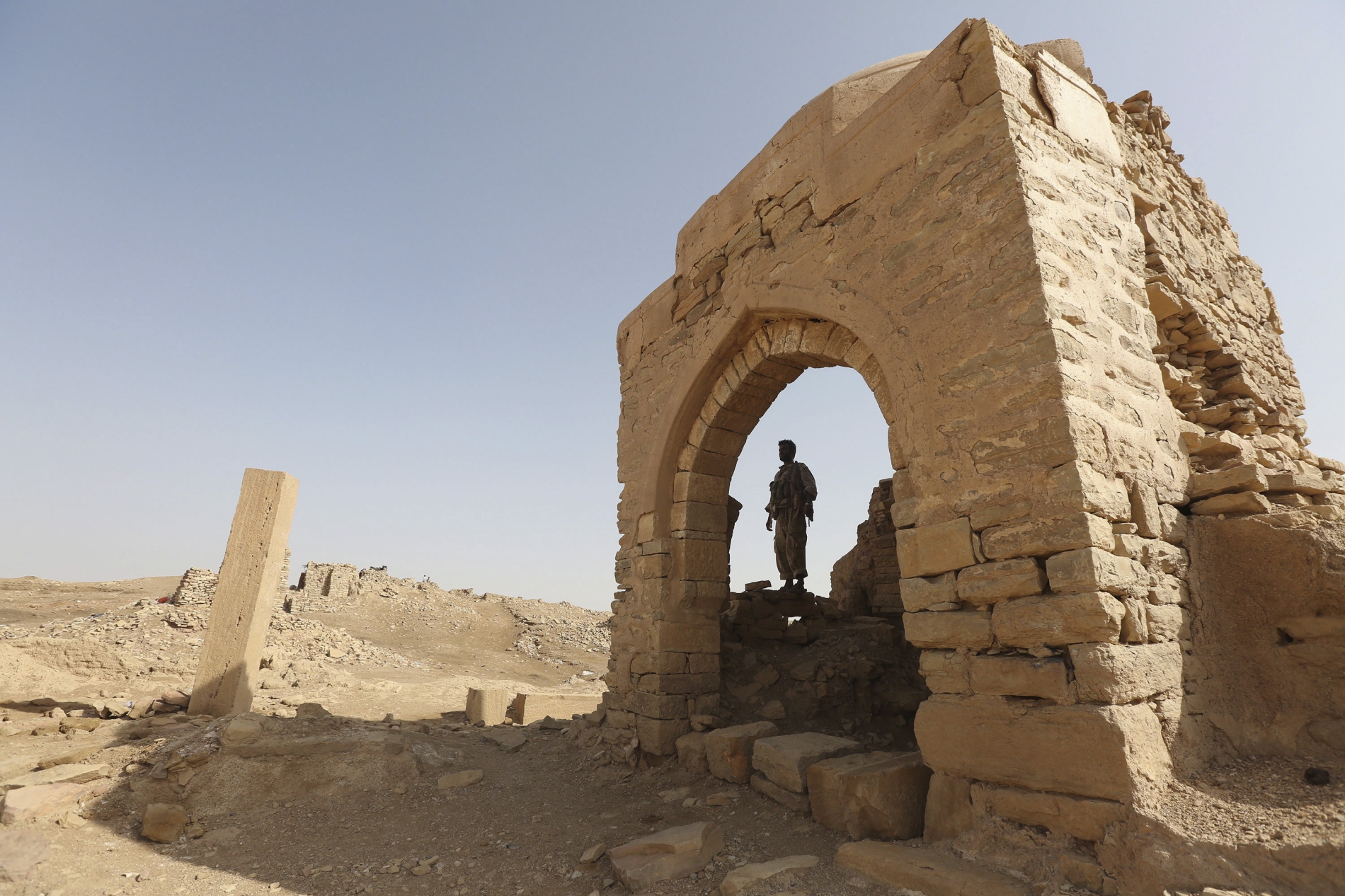
A man stands inside a monument at the historical town of Baraqish in Yemen's al-Jawf province after it was taken over by pro-government forces from Houthi fighters on 6 April 2016.
This mountainous landscape features plateaux and extensive plains with fertile land, large valleys, and semi-desert areas. It has a long history, as several important archaeological sites can attest, notably Qarnaw, the ancient capital of Ma'in, Al Kharbah Al Bayda, Al Kharbah Al Sawda, and Baraqish. The Minaeans, who flourished around 2,500 years ago, established their kingdom in Al Jawf. As a merchant republic, they held a near-monopoly on frankincense and aromatic spices and traded with the Greeks, Egyptians, Arabians, and Mesopotamians.
Oil and gas potential
Geological studies identify Al Jawf as one of Yemen's most promising regions for oil and gas, but conflict and instability have prevented exploration. The Washington-based energy news platform Attaqa ranks the Al Jawf oilfield, discovered in 1991 and brought into production in 1995, among Yemen's five most important, with reserves estimated at 300 million barrels. Before operations ceased, oil production at Al Jawf was around 30,000 barrels per day (bpd).
A 2022 study entitled Oil in Yemen: Facts and Indicators, published by the Mokha Centre for Strategic Studies, examined Al Jawf's potential. In the southern part of Al Jawf, which extends westwards from the oil and gas-producing Marib Shabwa Basin, it said wells were drilled in Block 19. "While indications of gas and oil were observed during the drilling of several wells, the quantities were not sufficient to be commercially viable," it concluded.
In northern Al Jawf, however, the study noted that "wells drilled in the basin have confirmed the presence of promising reservoirs". In 2013, the Petroleum Exploration and Production Authority announced that the licenses to three promising oil blocks (19, 57, and 58) had been offered to international companies for investment. The huge 85,000 sq.km Marib Al Jawf oil block (18) is operated by Yemen's Safer company. According to the authority, production from Block 18 peaked at 197,600 bpd in 1991.
Yemen's government notes encouraging evidence of gold deposits at 13 locations across Yemen, including four in Al Jawf. These include Rabaq Al Namasah (5.3 g/t), Al Matammah (5 g/t), Jabal Sabreen (18g/t), and Al Rayyan (4.6g/t). The study also reported encouraging results for copper (1.7%) and chromium (4.7%) in Wadi Salbah in Al Jawf.
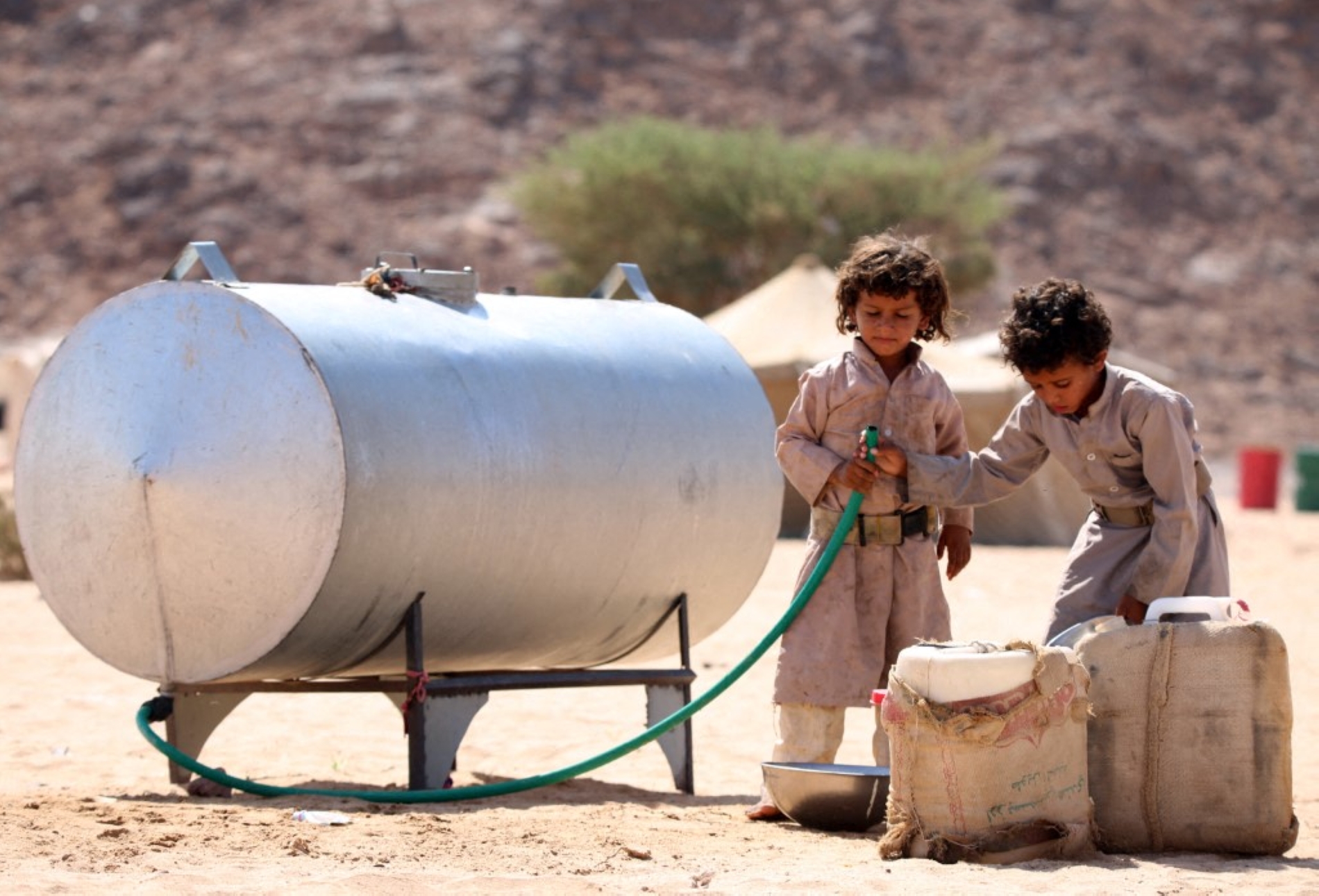
Displaced Yemeni children, who fled the northern Al-Jawf province due to fighting between Houthis and government forces fill water containers at a camp in the desert east of the capital Sanaa, on 21 October 2015.
Strategic location
A study published on 9 August by the Arab Democratic Centre for Strategic, Political and Economic Studies describes the significance of Al Jawf governorate as "a strategic area where security, economic, military, and regional considerations intersect," adding: "Its geographical location, vast territory, and natural resources have made it one of the most influential governorates in Yemen's conflict and in the security calculations of neighbouring countries, particularly Saudi Arabia."
It sits between the interior highlands and the desert expanses, while its direct connection to Saudi Arabia's southern border makes it an important overland gateway in the Arabian Peninsula, yet its vast size allows military forces freedom of movement. This gives whoever controls it considerable scope for operational and logistical manoeuvre. Its topography affects military operations, supply routes, and troop deployments. Its demography is equally complex, characterised by a tribal structure with longstanding historical and social ties to neighbouring border areas. Tribal affiliations have long governed relations between the state, society, and armed groups.
Al Jawf's geographical connection to Hadramawt governorate (to the east) adds to its importance, meaning that Al Jawf cannot be viewed merely as a border region, but as a geopolitical hub centred on location, borders, resources, and operational depth. Together, these elements give the governorate a direct influence on the balance of power within Yemen. No wonder they are fighting over it.