It's an uphill road for Germany’s carmakers

For decades, Germany’s auto manufacturers have produced world-leading products at premium prices, but the sector is facing a series of tough and existential challenges. What must it do to adapt?

Grace Russell

It's an uphill road for Germany’s carmakers

Germany’s car industry has long been central to the country’s industrial identity and a hallmark of its engineering excellence. Through auto manufacturers like Volkswagen, Mercedes-Benz, and BMW, Germany catered to the demand for premium vehicles, establishing extensive supplier networks. For decades, its companies were the world’s technological leaders and innovators in internal combustion engine (ICE) cars.

The model is now under pressure on several fronts. Chinese competition is intensifying, the transition to electric vehicles (EVs) is reshaping the market, and high domestic production costs are eroding competitiveness and profitability. Is it just a temporary dip in fortunes? Perhaps not. Figures through October 2026 suggest a crisis deeper than a typical cyclical downturn. According to the German Association of the Automotive Industry (VDA), passenger car production fell to 3.03 million vehicles in the first nine months of 2026, down 4% year-on-year, and down 15% from 2019. Foreign orders for German cars also fell by 16% in September alone.

A study by Ernst & Young examining the performance of the world’s 19 largest automotive groups in the first half of 2026 found that German manufacturers’ sales in China had declined by 25%, while their revenues fell by 2.9%. German carmakers also face stronger EV competition and higher domestic production costs. Ernst & Young said German automotive groups’ operating profits fell by 19% to €13bn in the first half of 2026, while their operating margins narrowed from 5.5% to 4.6%.

On 13 October, Volkswagen chief executive Oliver Blume warned of the immense pressures facing European industry, calling for greater regulatory flexibility and improved manufacturing conditions. Three days later, France and Germany agreed on a common approach to the future of Europe’s automotive industry, linking the climate transition with protecting the industrial base and jobs and strengthening competitiveness.

Both called for emissions reductions to be accompanied by greater regulatory flexibility and support for research and development. They aim to be globally competitive without sacrificing climate goals, but it is a bumpy road. Exports have declined by 4% to 2.295 million vehicles, and on 23 October, Reuters reported an escalation in the dispute between Volkswagen and trade unions over wage agreements, with the company planning to cut 100,000 jobs.
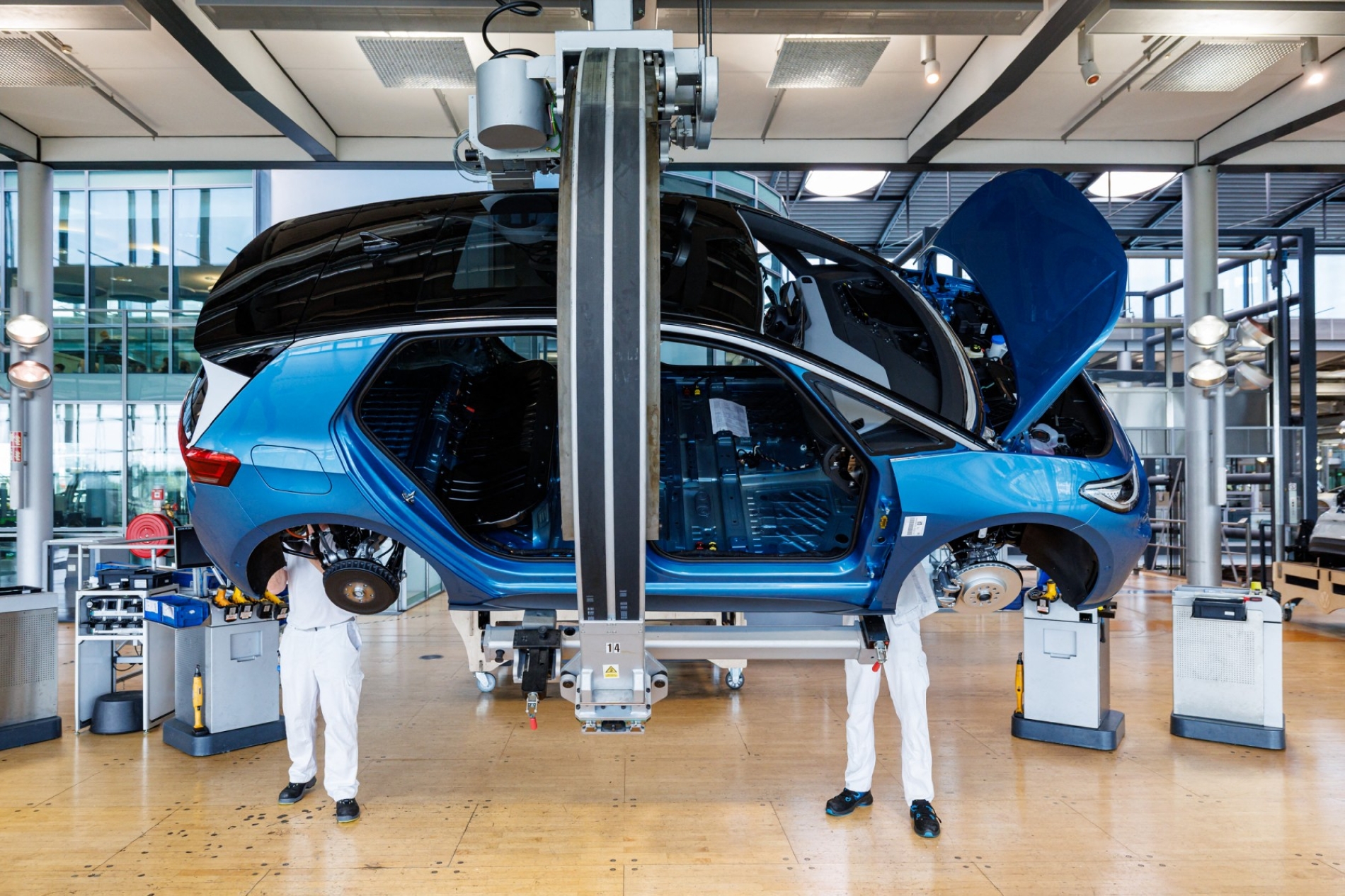
JENS SCHLUETER / AFP
Employees work on the assembly line for the Volkswagen (VW) ID.3 electric car of German carmaker Volkswagen in Dresden, eastern Germany, on 14 May 2025.

Capacity and costs

As pressure on German carmakers intensifies, some factories operated at around 60% capacity in 2025, with 75-80% typically required for profitable production. This underutilisation increased manufacturing costs per vehicle by up to €5,000, twice that seen at one of Europe’s most cost-efficient production sites. Roland Berger, the German consultancy firm, forecasts 15-20 fewer auto factories over the next nine years.

Savings need to be made. Ernst & Young analysis published in September 2026 found that the combined revenues of Germany’s three leading carmakers fell by 2.9% to €284bn in the first half of the year, while operating profits dropped 19% to €13bn. Operating margins varied (3.8% for Volkswagen, 5.4% for Mercedes-Benz, 5.8% for BMW), but the overall trend is one of falling profits reducing the funds available for future investment.
German automotive groups' operating profits fell by 19% in the first half of 2026, while their operating margins narrowed from 5.5% to 4.6%

Firms restructuring

Manufacturers are cutting costs, consolidating vehicle platforms, and reassessing projects. Porsche plans to cut 9,000 jobs and lower its break-even point to fewer than 200,000 vehicles a year. BMW plans to cut 8,000 jobs worldwide from its 150,000-strong workforce, primarily through voluntary redundancy. Volkswagen's 100,000 job losses across the group by 2030 include 50,000 additional positions beyond those already earmarked for the chop. Its restructuring plans may mean reorganising four German factories.

Cost-cutting alone cannot make up for lost technological ground. Manufacturers know they need to redirect resources towards activities that generate greater added value. The VDA has called for improved manufacturing conditions, better charging infrastructure, and a review of regulatory burdens, but cutting red tape alone won't close the innovation gap unless accompanied by substantial investment.

REUTERS/Florence Lo
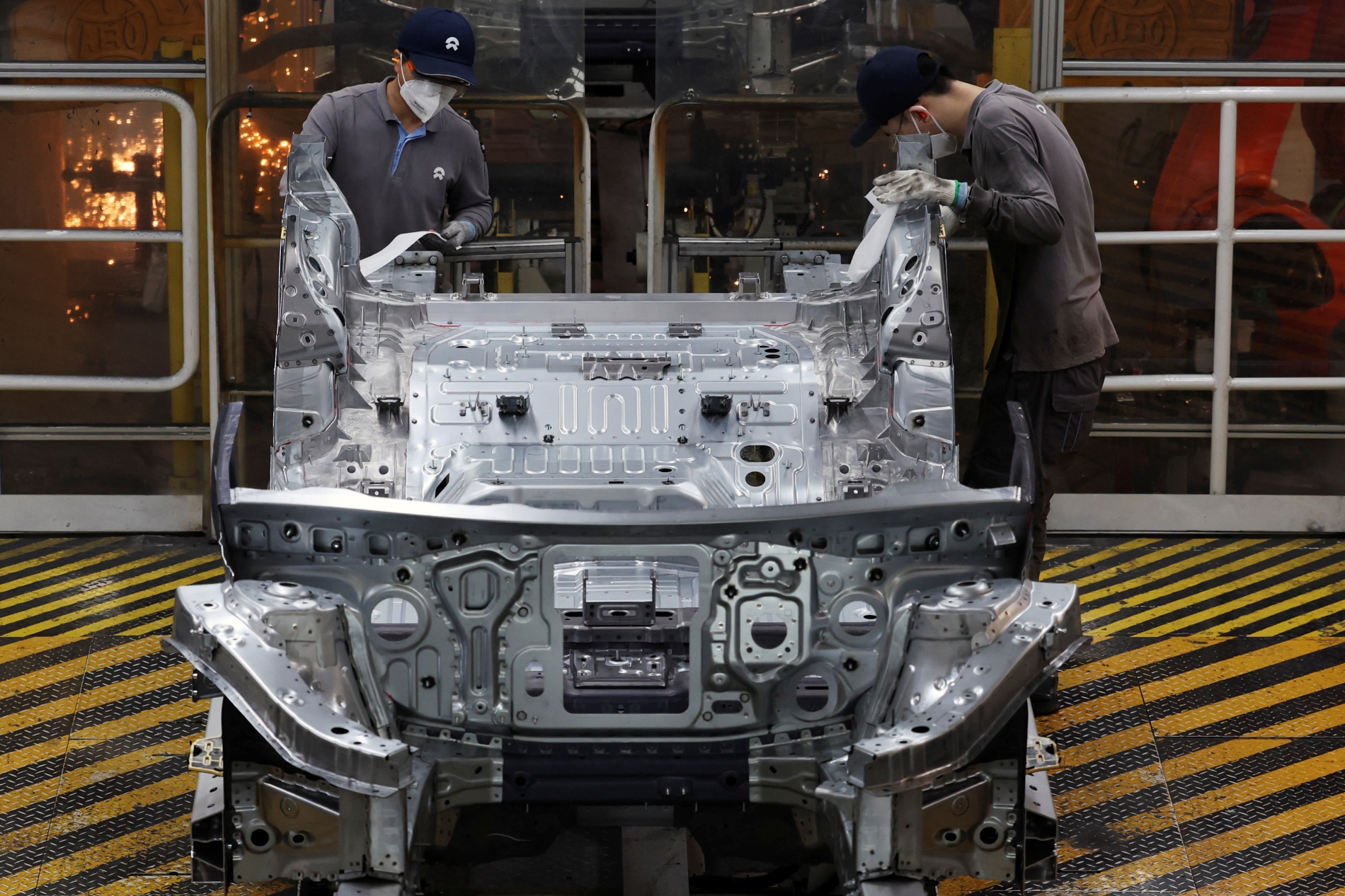
Employees work on the production line at a factory of Chinese electric vehicle (EV) maker Nio in Hefei, Anhui province, China, on 2 April 2025.

Industrial policy

China's competitive strength, built on integrated supply chains and rapid product development, presents European industrial policymakers with a dilemma. Tariffs offer no remedy for high domestic production costs, while local production and sourcing requirements can increase manufacturers' expenses. Allianz Trade, the German trade credit insurer, has warned that mandating European-made batteries could increase a vehicle's price by €2,000.

On 16 October 2026, France and Germany reached a common understanding on the future of Europe's automotive industry. It aims to strengthen domestic production of vehicles and components, allow greater flexibility in emissions regulations, and maintain a broader commitment to the climate transition. It also seeks to establish a European industrial policy that protects jobs, strengthens competitiveness, and safeguards consumers' purchasing power. For now, though, it is only a joint position and will need approval from European institutions.

The repercussions are already being felt through German supplier networks in states such as Bavaria and Baden-Württemberg, further straining the country's export-led economic model. Allianz Trade warns that a further loss of three percentage points of market share in Europe and China by 2030 would risk €3bn in added value.

Germany's economic performance cannot be attributed to the car industry alone, yet the sector remains one of its principal sources of industrial and export strength, so any weakening weighs on investment and industrial demand, potentially compounding the wider economy's difficulties. Most agree that Germany's car industry will survive, but perhaps in a smaller, more concentrated form.

The Roland Berger study argued that incremental adjustments are not enough. Production capacity must align with declining output, while vehicle development cycles need to be shortened considerably. Factories operating below capacity will need to find commercially viable alternative uses or face closure, leading to more job losses. It predicts that Germany's automotive workforce could shrink by 200,000 full-time jobs over the next five years, even under favourable conditions.

REUTERS/Xiaoyu Yin
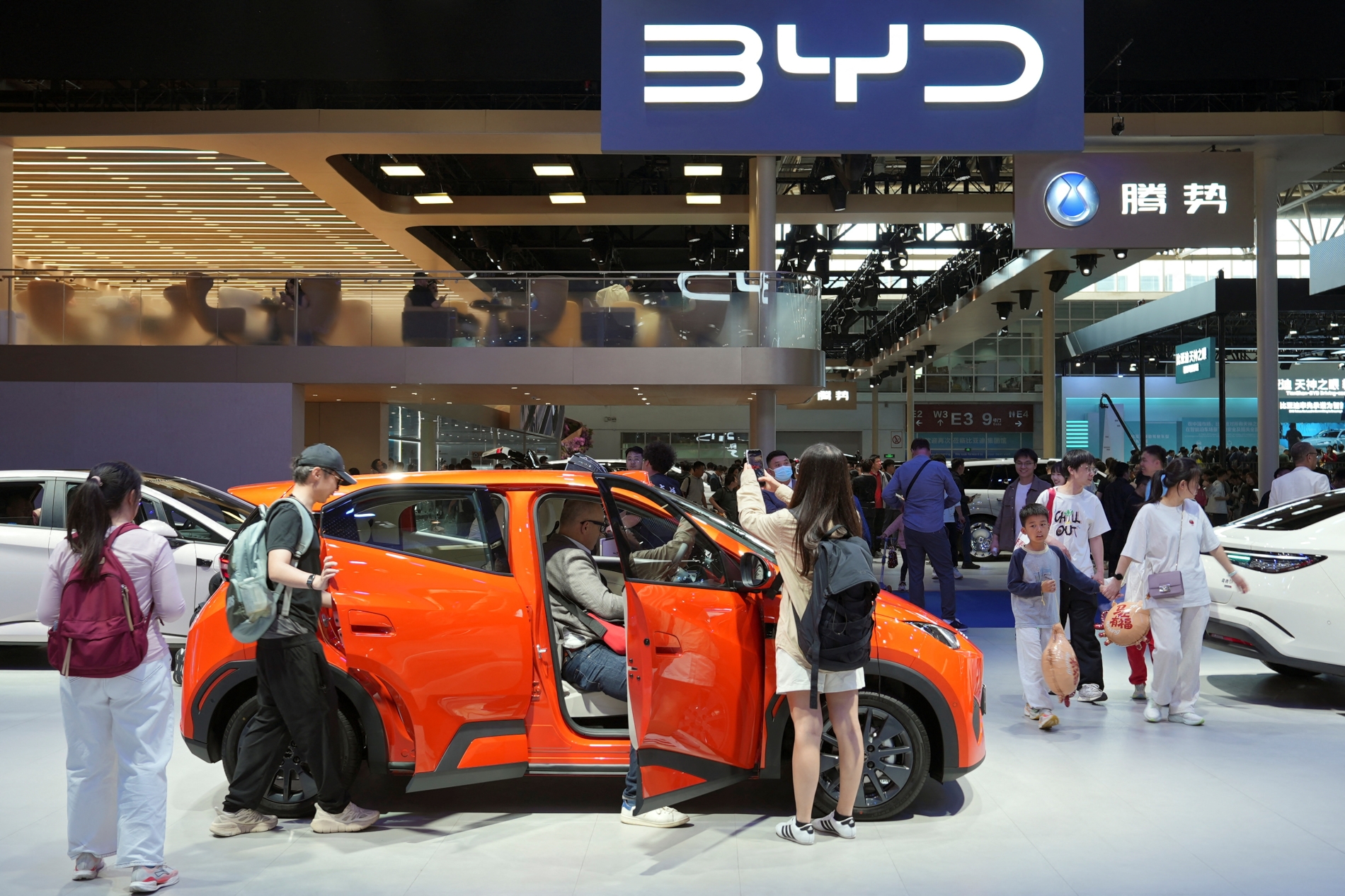
Visitors check a BYD Seagull electric vehicle (EV) displayed at the Beijing International Automotive Exhibition, or Auto China, in Beijing, China, on 26 April 2026.

Reorganising for tomorrow

Manufacturers cannot make these adjustments alone. Germany must improve its business environment and strengthen its competitiveness if domestic car manufacturing is to remain economically viable. The aim is to preserve a sustainable, profitable base of activities that generate added value within the sector. The industrial base will be smaller than it is today, but better able to generate profits, with a manufacturing footprint more closely aligned with future demand.

The future already seems clear: VDA figures show that EV registrations in Germany rose 95% in September 2026. Whether German manufacturers can benefit from this growth will depend on their ability to offer vehicles that are competitive in both price and technology, along with efforts to retrain and adapt the workforce. Germany's traditional engineering advantage now depends on faster development, lower costs, and mastery of the technologies driving tomorrow's cars, such as software and batteries. The road ahead is windy. Berlin will hope that it is not also slippery.

font change