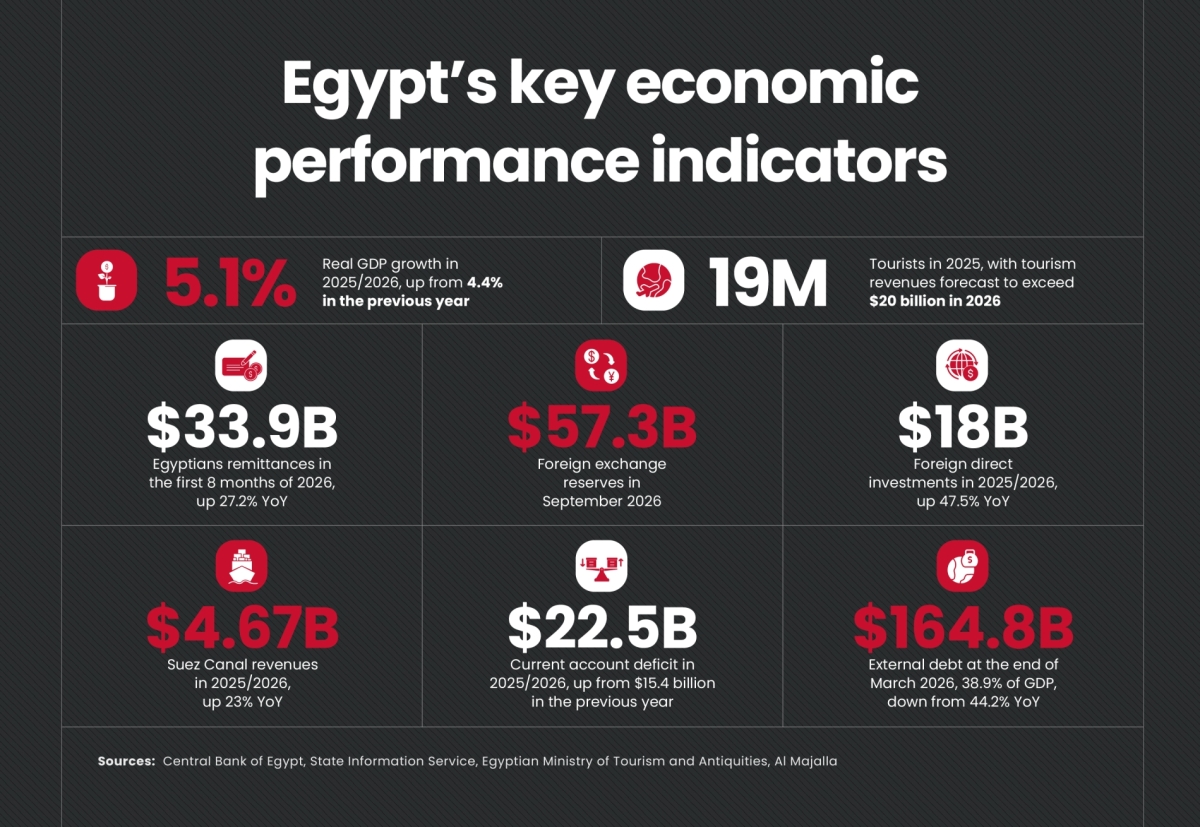

Record remittances, stronger investment inflows and higher foreign reserves are giving Egypt’s economy greater room to absorb shocks, but sustaining the recovery will depend on addressing financial imbalances and accelerating economic reforms.
Egypt found itself better equipped to absorb disruptions caused by the latest regional turmoil than it was four years ago, when the Russia-Ukraine war exposed deep-seated distortions in the foreign exchange market and triggered a severe dollar shortage. Performance in the 2025/2026 fiscal year points to a shift in how the country manages external pressures, but it does not mean that the economy has overcome its structural weaknesses.
Real GDP growth accelerated to 5.1%, alongside stronger foreign currency inflows and rising investment. Remittances from Egyptians working abroad, together with tourism revenues and foreign direct investment, helped bolster the country’s foreign currency resources. Foreign reserves also reached $57.3bn in September 2026, providing a larger buffer against volatility and helping Egypt meet its external obligations.
Egypt welcomed around 19 million tourists in 2025, while authorities are banking on tourism revenues exceeding $20bn in 2026, despite regional tensions. The Suez Canal, meanwhile, remains well below its record levels, even though revenues rose to $4.67bn in the 2025/2026 fiscal year, up 23% from the previous year.
Revenues reached around $10.25bn in 2023 before Houthi attacks on commercial shipping in the Red Sea, which began in late 2023, disrupted navigation through the Bab al-Mandab Strait and prompted international shipping companies to reroute vessels around the Cape of Good Hope to avoid security risks. These disruptions reduced canal traffic and revenues, depriving Egypt of a significant source of foreign currency at a time when the country was seeking to strengthen its dollar reserves and ease pressure on its balance of payments.