
After more than eight years under the control of Yemeni government forces, the fall of the strategic Red Sea port of Mokha represents a serious setback. Its significance lies partly in the area’s geopolitical importance and the loss of more than 140km of territory.
More troubling is that Mokha fell after more than a decade of confrontation with the Houthi militia and after weeks of clear signs that war was resuming. That span should have been ample time to prepare. Houthi military tactics are now familiar, and they have fewer troops and less equipment than the government.
More than anything, the loss of Mokha and the surrounding area is a result of deep divisions within the anti‑Houthi camp, the diversity of which should be one of its strengths, since it mirrors the political and social character of Yemeni society and affirms that this coalition is both broad and national, encompassing varied constituencies and identities (unlike the narrow social and political base of the Houthi movement).
This lets the anti‑Houthi camp legitimately claim to represent Yemen’s different social groups and, numerically, most Yemenis. Indeed, over the past decade, the number of political and social forces aligned against the Houthis has increased, while the Houthi camp has steadily contracted owing to exclusionary practices and rigid group loyalties.
Diversity’s double-edged sword is that it can become a liability without a structure to regulate it. This may culminate in military failure when disparate armed formations pursuing differing aims fail to coordinate and get organised. Recent events along Yemen’s south-west coast revealed this vulnerability with stark clarity.
Tariq Saleh’s forces were responsible for administering and defending the area, but most of his fighters hail from northern Yemen (including Houthi defectors following the militia’s 2017 battle against forces loyal to Saleh’s uncle, the former president Ali Abdullah Saleh, which ended with Saleh’s killing). Others came from central governorates such as Ibb and Taiz. Most were outsiders in the coastal region of Tihama.
An attempt was made to address this by creating the so‑called Tihama Forces, recruited from the local population, but the people of Tihama are some of the most marginalised in Yemen, and grievances run deep. It is now understood that, whilst aiming to prevent the emergence of another powerful regional force, the Tihama units were divided into three components: some came under Tariq Saleh’s command, some were independent formations, while others were incorporated into the Giants Brigades.
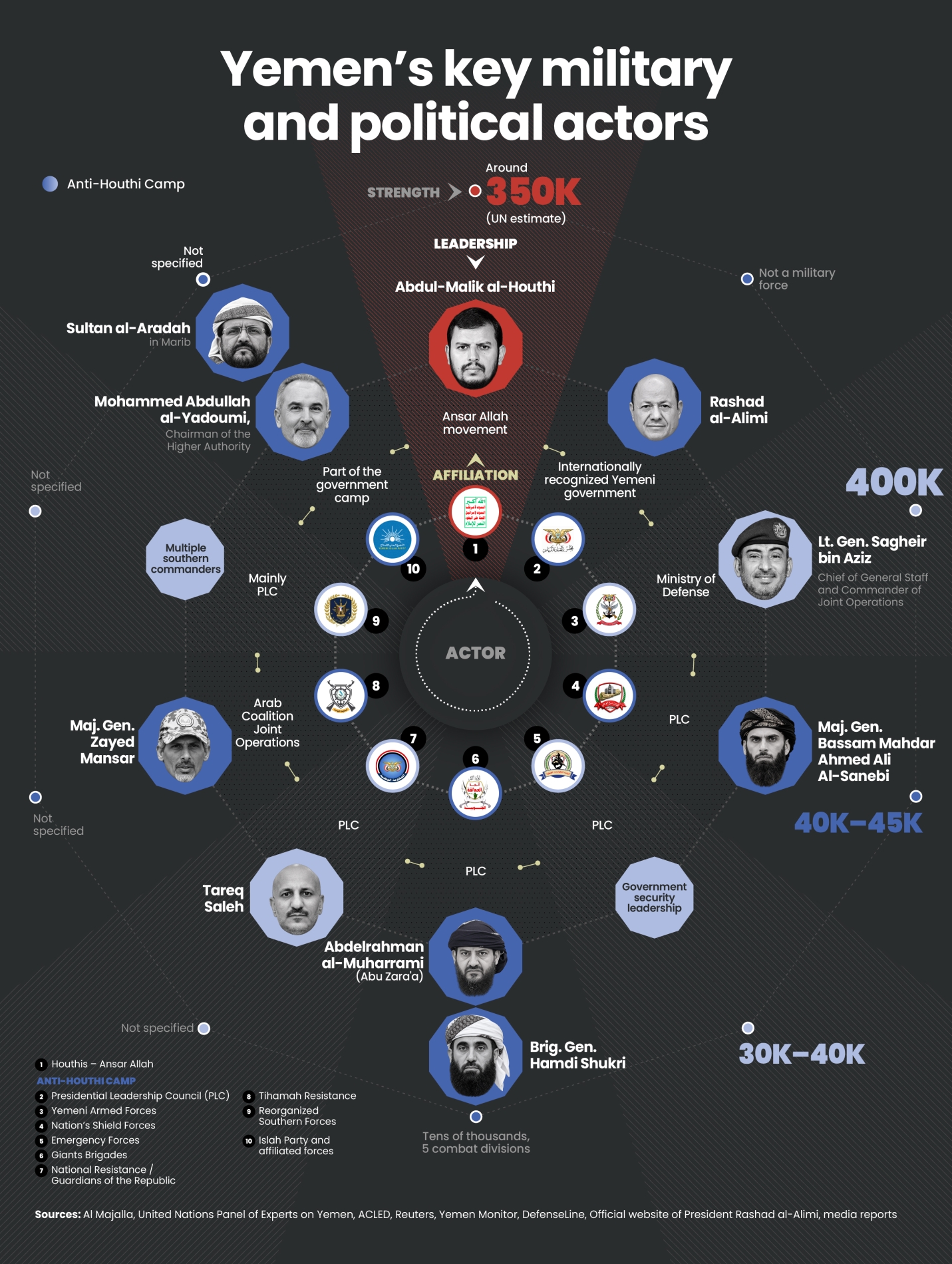
Led by Hamdi Shukri, the Brigades control areas to the south, from which they recruit their fighters (in particular from al‑Subaiha). They are often described as ‘southern separatists’, but that description is inaccurate. They are predominantly Salafist, and their relationship with Saleh’s forces has long been marked by intense rivalry.
East of the coast are forces affiliated with the Islah Party, which includes the Muslim Brotherhood. They form part of the Yemeni army’s Fourth Military Region in the Taiz and Tur al‑Bahah fronts. Their relationship with Saleh’s forces is also deeply hostile, largely because of the bitter political rivalry between the two sides following the 2011 uprising that removed Ali Abdullah Saleh from power.
The picture that emerges in the aftermath is that Tariq Saleh’s National Resistance Forces were confined to a narrow, flat, and strategically vital strip of territory, and that relations with the surrounding military formations were strained. Whilst manageable in peacetime, such a situation in wartime is dangerous. The coast cannot be defended without securing its hinterland, and this requires close cooperation with the other military forces operating around it, which explains why the Houthis’ offensive on the western coast began through Taiz and Tur al‑Bahah (fighting continues in the mountains of Taiz as the Houthis seek to secure their hold over the coast).
Coordination between the coastal and Taiz forces was needed long before the Houthi advance, and historic grievances should have come second to military imperatives and the reality of a shared threat.