Gadi Eisenkot's sudden rise as a viable candidate for the premiership has surprised many. But can he survive the improvisational chaos of Israeli politics?
Israeli politics are littered with the unaccomplished ambitions of former generals who thought they could turn military gravitas into political success. Of Israel’s 14 prime ministers, only three were generals, and the last one (Ariel Sharon) was elected more than 20 years ago. Still, a long line of military commanders has since tried (unsuccessfully) to overturn this purported curse, which sees generals quickly climb in the polls and later fade into oblivion.
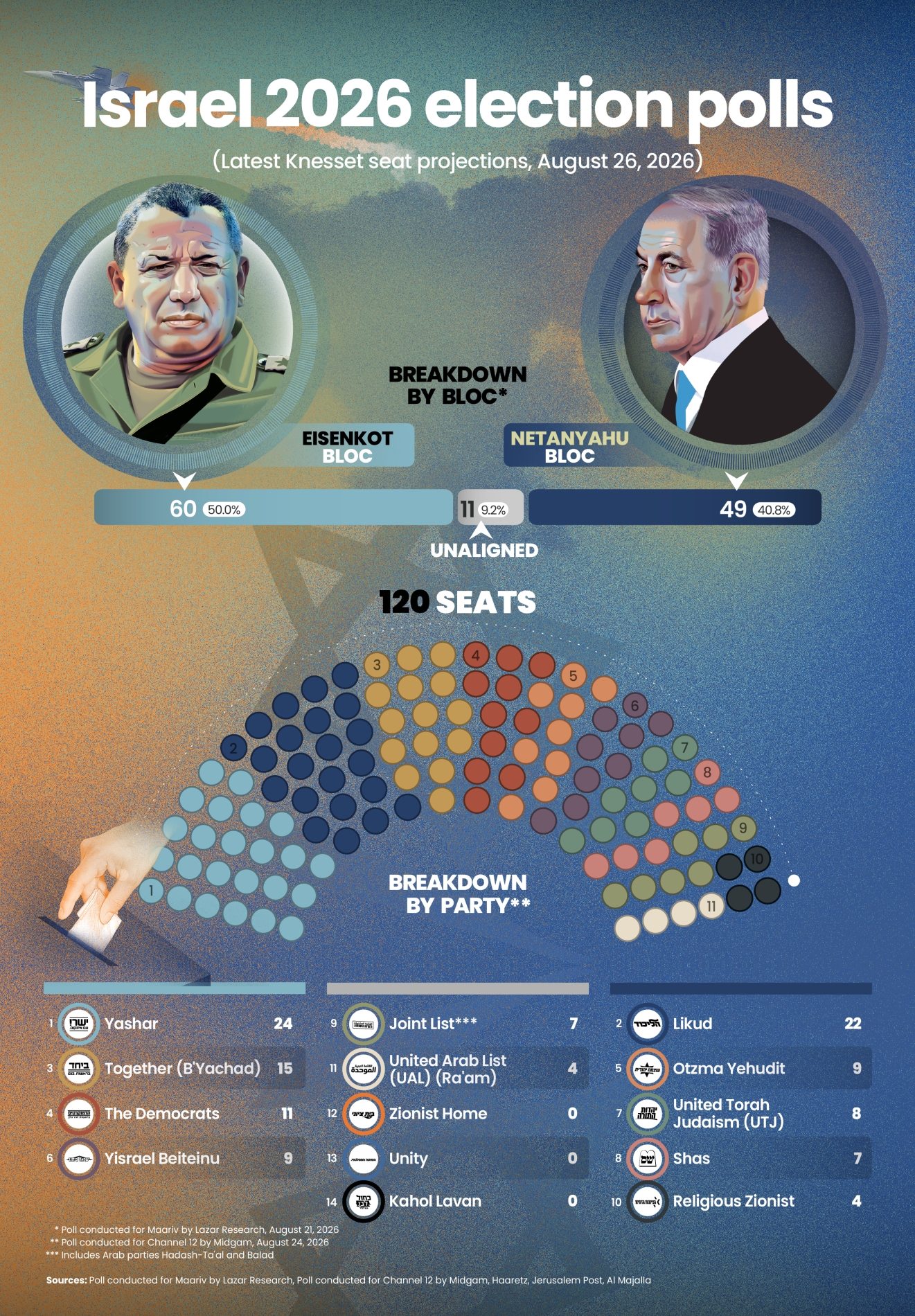
The latest candidate, Gadi Eisenkot, has a chance to be different. For one, polls give him an edge. Data from Channel 12 as of 13 July 2026 places Eisenkot as the preferred Prime Minister for 43% of the public, compared to Netanyahu’s 34%. A concurrent Channel 13 survey projects Eisenkot’s fledgling party holding a narrow 23-to-22-seat lead over Likud.
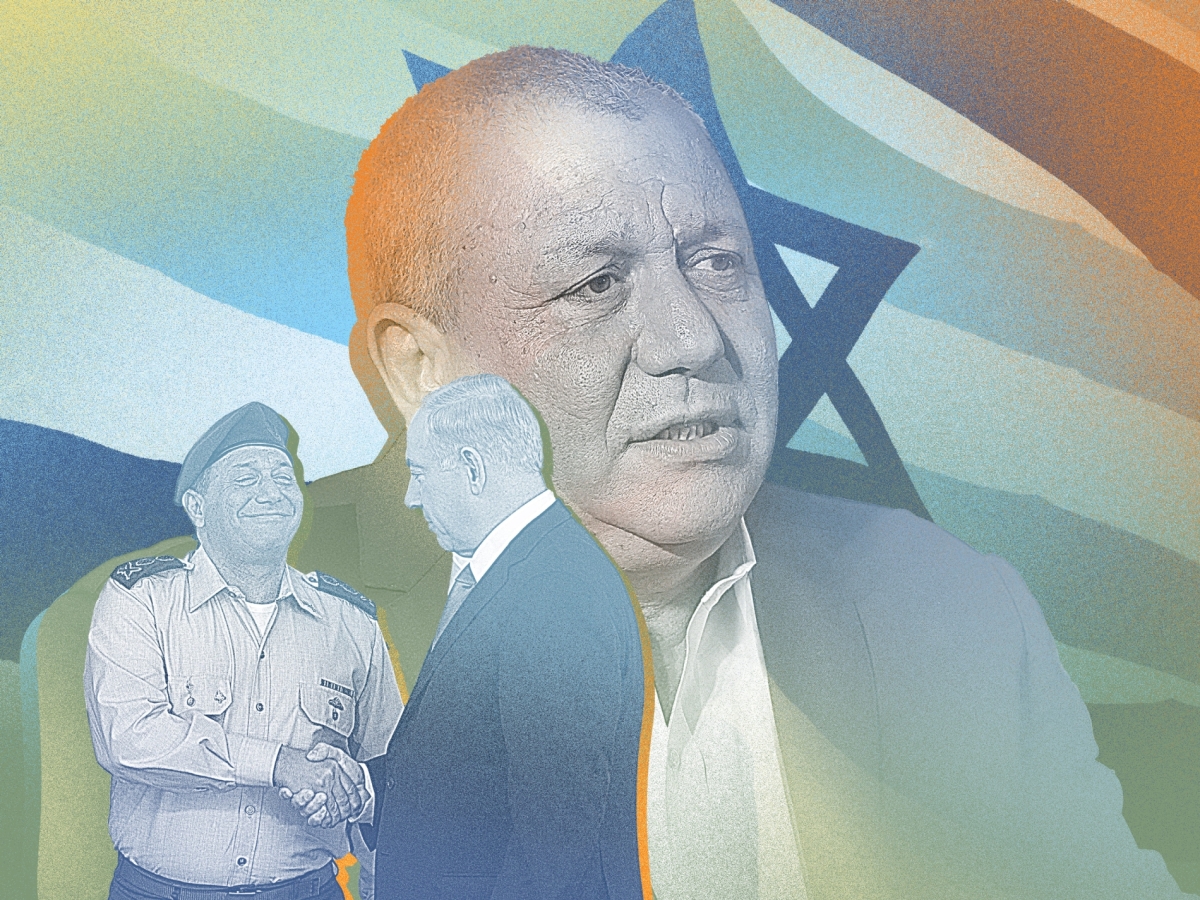
But this goes beyond simple electoral arithmetic. In many ways, Eisenkot has emerged as the quintessential "Anti-Netanyahu": a figure of stoic, almost pained authority whose sobriety offers a stark alternative to the theatrics of the current ruling coalition. Netanyahu is often criticised by his opponents as a man who put his own interests before the nation's. Eisenkot's image, by contrast, is built on a return to public service rooted in military discipline and personal bereavement.
Eisenkot’s political brand is built on two main pillars. The first is his modest origins: a man who came from the periphery and climbed the military ranks not through elite units, but through the Golani Brigade—a foot-soldier unit whose members come from all walks of Israeli society. By contrast, Netanyahu and Ehud Barak (another military man-turned prime minister) both served in the elite Sayeret Matkal (the chief of staff’s commando unit). Netanyahu himself grew up in the heart of the opulent Rehavia neighbourhood in Jerusalem, the son of a right-wing intellectual. Eisenkot, the son of Moroccan immigrants, grew up in the small port city of Eilat.
The second element behind Eisenkot’s brand is just as important, as it stems from his personal sacrifice: The former Israeli military chief lost his own son during the war in Gaza. Eisenkot’s family paid a heavy price during the war, as two of the former Israeli army chief of staff’s nephews also died in the course of the fighting.
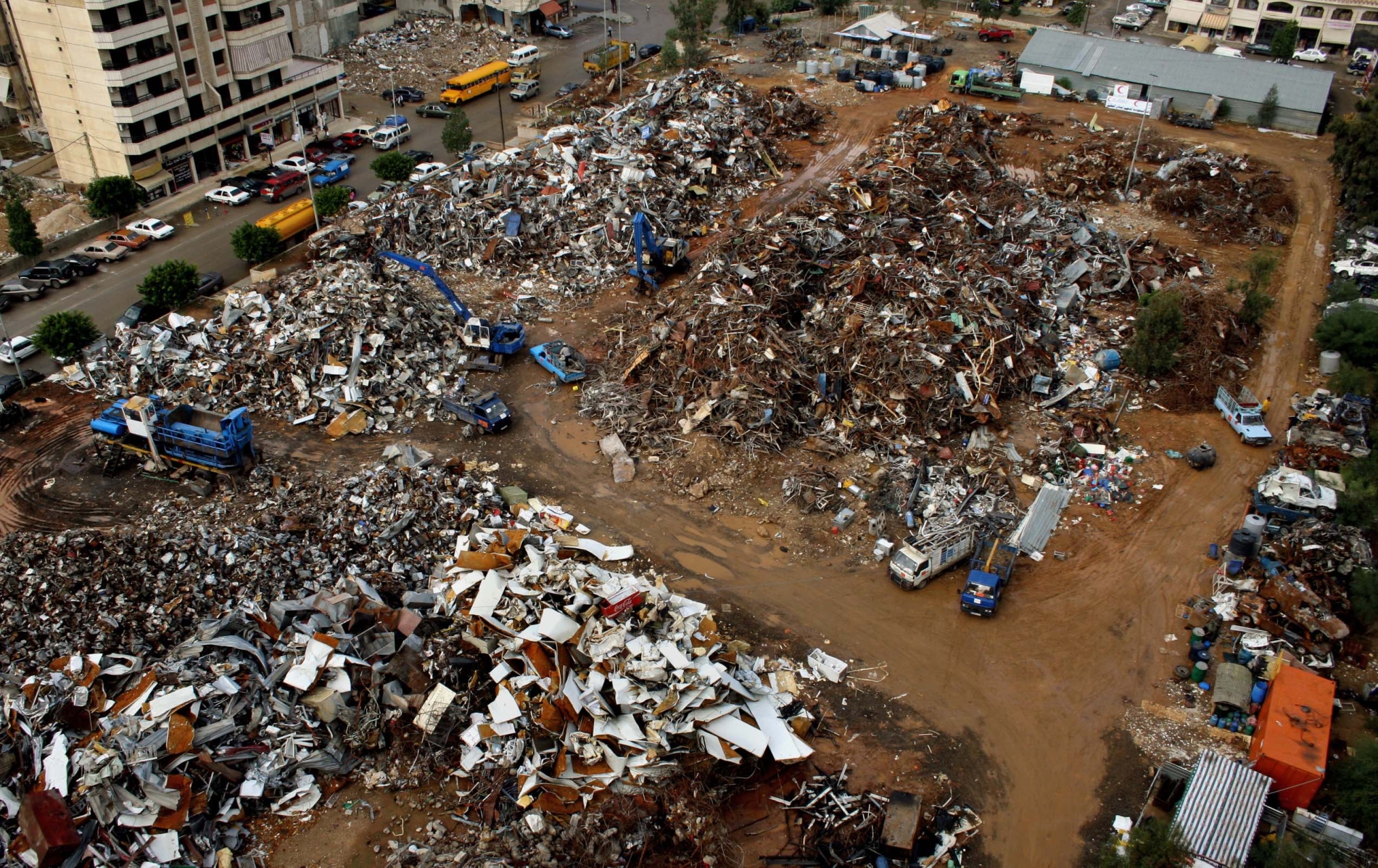
Lebanese workers gather near mountains of debris and twisted iron collected from the devastated southern suburbs of Beirut on 10 November 2006.
Dahiyeh Doctrine architect
Eisenkot’s name is associated with the infamous “Dahiyeh Doctrine" named after the southern suburb of Beirut. The doctrine, which was first executed during the 2006 war in Lebanon, calls for disproportionate force and destroying civilian infrastructure to create deterrence. As a result, Eisenkot is often branded as a hawk—an aggressive general who uses force as the only way to resolve most problems.
The reality is slightly more nuanced. Eisenkot’s term as chief of staff was one of the quietest in the last two decades. His first action, after joining the war cabinet in 2023 (the executive body that led Israel after October 7), was to oppose a surprise attack against Hezbollah and the expansion of the war to the north (advocated at the time by another military man-turned-politician, Defence Minister Yoav Gallant).
This makes him a relative mystery: a general from the people, a pragmatic hawk, an experienced military man but an untested political figure defined largely by the image he projects rather than the actions he took. To shed light on this mystery, one needs to trace back the steps that made Eisenkot who he is today.
Eisenkot is associated with the Dahiyeh Doctrine, which calls for disproportionate force to create deterrence.
Early life and career
For decades, Benjamin Netanyahu has maintained a grip on power by positioning himself as the champion of the "voiceless" Mizrahim (Jews from North Africa and the Arab world) against a perceived Ashkenazi "Deep State" elite. This narrative, however, is being disrupted by Eisenkot's biography.
Eisenkot was born in 1960 in Tiberias to a family of Moroccan origin, then raised in Eilat, about as far from the corridors of power in Jerusalem and Tel Aviv as the country allows. He studied in the naval-and-mechanics track at a technical high school and enlisted in 1978, not into an elite unit, but into the Golani Brigade's 51st Battalion.
He never planned a military career. "Every year I thought about quitting, but then I signed up for another year, and over the years it turned into 33 years in uniform," he told a local paper in his hometown. That accidental-marathon quality is the first pattern worth flagging, because it recurs throughout his life: Eisenkot is a man of patient accumulation, rather than bold strokes.
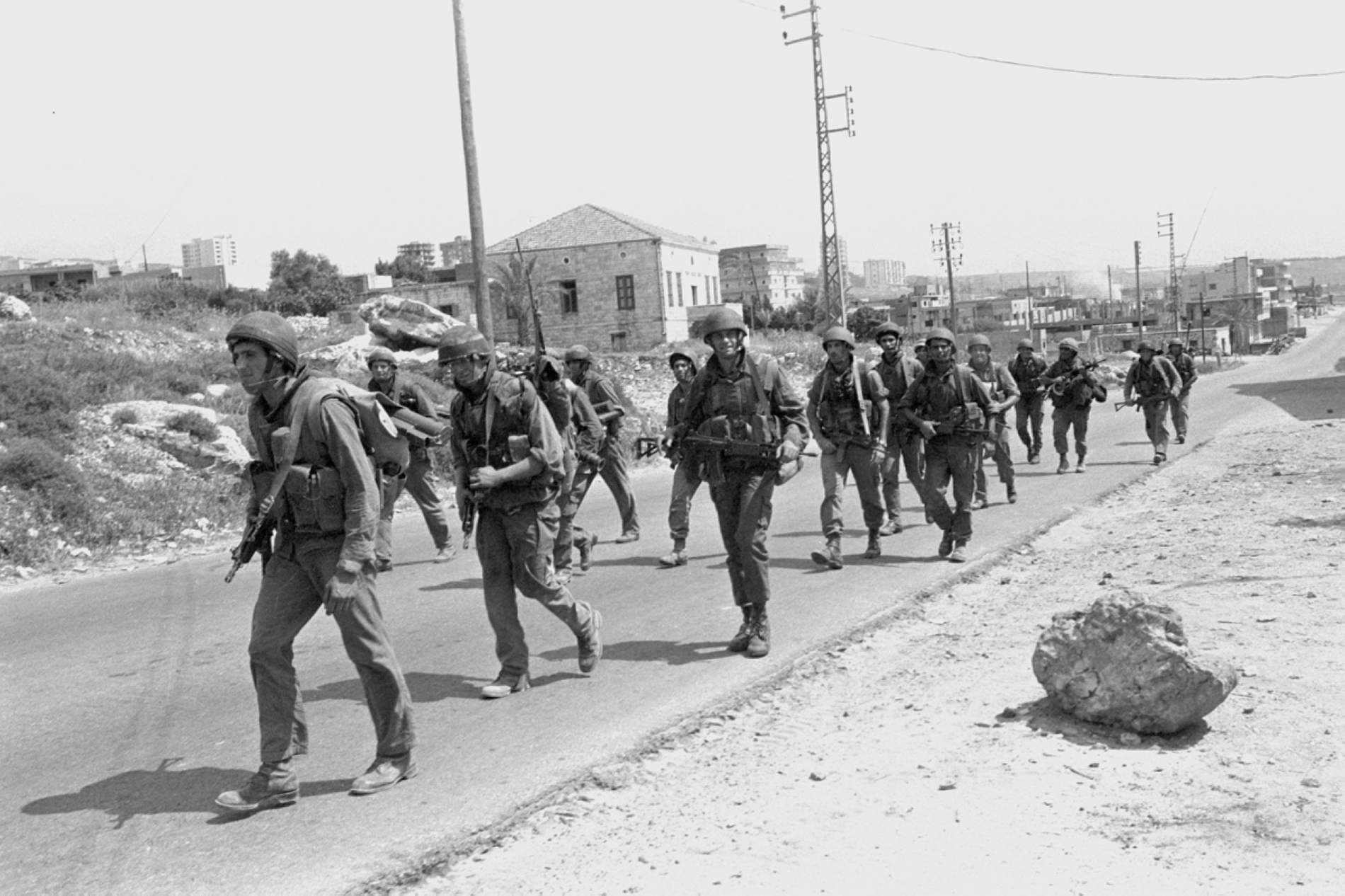
Israeli paratroopers seize the Beirut International Airport during a military operation in 1982.
He fought in the 1982 Lebanon War as a company commander, present at the brutal fighting for Beirut's airport, where he lost close friends. He was wounded three times and yet kept returning anyway. He rose through Golani's chain of command, then diversified: reserve infantry brigades, the Efraim Regional Brigade, and, in 1999, a high-visibility post as military secretary to Prime Minister and Defence Minister Ehud Barak, where he sat in negotiations with Syria.
The career that followed reads like a checklist of the Israeli army's most consequential postings of the 2000s: commander of the Judea and Samaria Division (the military unit operating in the West Bank) during the bloodiest years of the Second Intifada (2003), head of the Operations Directorate during the calamitous 2006 Second Lebanon War, and then, after that war's failures forced out the sitting Northern Command chief, commander of Northern Command itself for six years—an unusually long tenure that let him quietly rebuild deterrence against Hezbollah after Israel's calamitous showing in 2006. As chief of staff from 2015 to 2019, colleagues described him as unshowy, risk-averse, and allergic to "adventurism". He is remembered for having overseen a tenure without a major war.
One would also be wrong to cast this "general of the people" as an uneducated man. Eisenkot is an avid reader of military history who holds a bachelor's degree in general history, a master's in political science, and who completed the US Army War College programme in Carlisle, Pennsylvania—an unusually academic résumé for an infantry officer.
Even when looking at his image as a "hawk", a closer read reveals a more nuanced portrait. While the Dahiya Doctrine established his "hard" security credentials, the 2016 Elor Azaria case defined his moral framework. At the time, Azaria (an Israeli army soldier) had shot dead an incapacitated Palestinian assailant, who no longer posed a threat. The case divided Israel's public opinion, with some (particularly among Netanyahu's constituency) being outraged by the fact that the military was putting the soldier through a trial for killing a Palestinian attacker.
Eisenkot's insistence on court-martialing the soldier demonstrated a commitment to military code of conduct that put him in direct conflict with Netanyahu's populist instincts. For Eisenkot, military discipline ranked above politics. This rift was the first sign of a deeper ideological divide that would culminate in the war rooms of 2023.
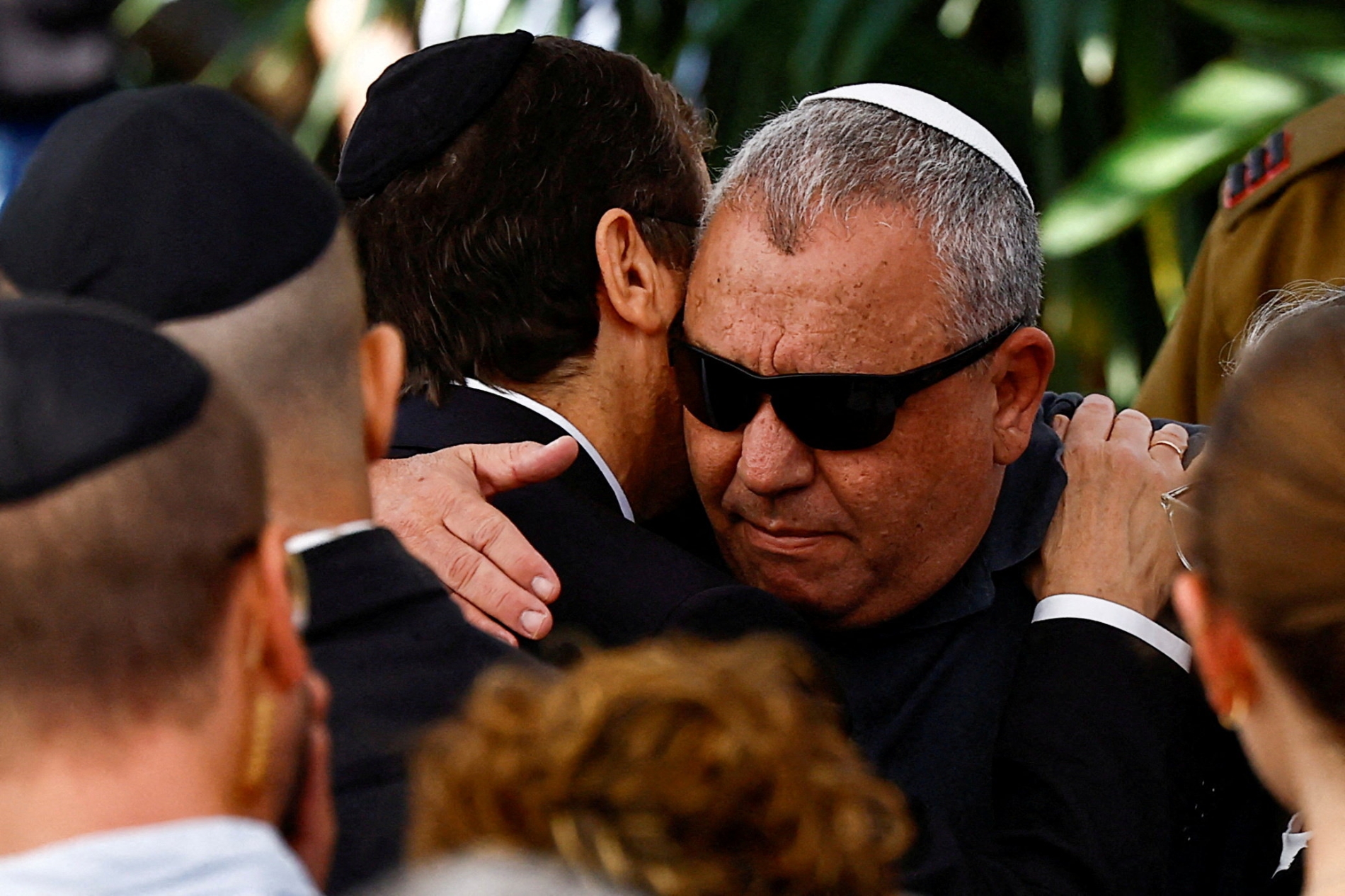
Eisenkot entered the "war cabinet" in the aftermath of October 7. He would plead multiple times to take every opportunity to save hostages held by Hamas in Gaza. On 6 December 2023, war reached inside Eisenkot's own family: his 25-year-old son, Sergeant Major (Res.) Gal Eisenkot, a medic and infantry fighter with the 551st Reserve Brigade, was killed by an explosive device in Jabaliya while searching for the bodies of hostages.
He returned to the war cabinet within days of burying his son. Months later, in April 2026, he wrote publicly of the grief: "The infinite void you left when you went, Gal, and the crushing understanding that I will never see you again, sear my soul". This resonated with many Israelis who saw him not only as a competent former general, but a father who paid the war's price personally and still stayed.
Gadi Eisenkot is consoled by Israeli President Isaac Herzog, on 8 December 2023, in Herzliya, Israel, as he attends the funeral of his son Gal Meir Eisenkot, 25, an Israeli soldier, who was killed in Gaza during Israel's war there.
Campaign pitch
And he is using this resonance to his advantage ahead of the elections. He has labelled the Netanyahu-led list the "October 7 list", pinning the blame for the Hamas attack squarely on Netanyahu. The calculation is straightforward: Netanyahu's political appeal has long rested on his image as "Mr Security." Even as many Israelis have grown disillusioned with him, some have remained loyal out of concern that no rival could protect the country as effectively.
But October 7 shattered that premise. The attacks exposed a profound failure of preparedness and deterrence under Netanyahu's leadership—one that Eisenkot can invoke to challenge the foundation of his political legitimacy.
Netanyahu, in turn, is betting that Israel's post–October 7 recovery will restore the security narrative: Hamas weakened, Hezbollah degraded, the 'Axis of Resistance' blunted, and Iran checked. Nasrallah, Khamenei, Sinwar: all dead. Yet that case is increasingly difficult to argue. The war with Iran remains deadlocked; Hezbollah, despite significant setbacks, retains the capacity to menace northern Israel; and Hamas has not been decisively defeated.
Eisenkot has emerged as the quintessential "Anti-Netanyahu": a figure whose sobriety offers a stark alternative to the current ruling coalition's theatrics.
What it takes to win
This rise to fame, almost by accident, is what explains Eisenkot's appeal, but it may also be what could lead to his undoing. While Eisenkot may have stumbled onto the top of Israeli polls, he certainly cannot sleepwalk his way to the premiership. Winning will require smart manoeuvres both against Netanyahu and vis-à-vis his natural allies in the opposition.
So far, Eisenkot is relatively unproven, though he did show his mettle recently. Eisenkot left Gantz's National Unity bloc in mid-2025 and launched his own party in September 2025 under the provisional name "Yashar!" (Hebrew for "straight," "honest"). Opposition leader Yair Lapid welcomed the launch immediately, calling it a chance to "change direction for the State of Israel".
Still, while Lapid and soon-to-be political partner, Naftali Bennett, saw Eisenkot as a useful tool to attract the Mizrachi and right-wing vote, they were wary of his popularity. For months, Israel's two main opposition figures tried to woo the former chief of staff, to no avail. As his popularity soared and theirs plateaued, they decided to unite—yet Eisenkot still retained his popularity and is now in a position to dictate his conditions. For the first time, Eisenkot showed himself to be more than a brand and proved some of his worth as an Israeli politician.
This means that (so far), Gadi Eisenkot has won the argument over who should replace Benjamin Netanyahu. However, he has not yet won the argument that decides Israeli politics: who can assemble 61 seats in parliament (out of the 120).
That distinction matters greatly. In late August, Eisenkot's Yashar party was polling at 26 seats, six ahead of Likud in one Maariv survey. Eisenkot led Netanyahu 52% to 38% when voters were asked who was better suited to be prime minister. Other surveys placed Yashar at 23 to 25 seats, consistently first or tied for first. The Israeli electorate has made Eisenkot the leading alternative to Netanyahu. The Byzantine way Israeli politics work may still deny him victory.
The 27 October election is not simply a contest between Netanyahu and Eisenkot. It is a test of whether Israel's fractured anti-Netanyahu camp can act like a bloc. Each party has its red lines and demands, which will require significant negotiating skills and the ability to bend on key principles. Netanyahu has proven to be a master at coalition crafting, but will the former Israeli army chief of staff be as skilful? Even if his party comes first, Eisenkot will have around a month to lock in his coalition: If he fails, Netanyahu will then have a chance to form his own bloc.
Two paths to power
Eisenkot has two viable routes to the premiership. The first is a clean "Zionist majority": Yashar, Together, Yisrael Beytenu, the Democrats, and a smaller centre-right partner, such as the Hendel-Tropper list. This is Eisenkot's preferred option because it gives his partners a majority without relying on outside support. It also enables a government to legislate a state commission of inquiry into October 7, revise the military-service regime to tackle ultra-Orthodox conscription, and impose a fixed term for the prime minister without bargaining over every vote with non-coalition parties. Furthermore, it lets Eisenkot present the government as a national corrective rather than a narrow anti-Netanyahu arrangement that is powerless to change anything.
But, as is often the case, ideal scenarios can seldom be counted on, and Eisenkot faces one key obstacle: vote fragmentation. Israel's electoral threshold means that if a party does not get a certain percentage of the votes (3.25%), it is disqualified, and the votes do not count towards any seats. A party that wins four seats can be useful. A party that falls just below Israel's electoral threshold can erase four seats from the whole bloc—and several of them are on the line. The Hendel-Tropper list, a potential Eisenkot ally, has repeatedly hovered near or below that line. So has Blue and White (the party of former Israeli army chief, Benny Gantz) in several surveys. The arithmetic of 61 is cruel: a small party's failure can negate the gains of a large one. As a result, several recent polls have also shown that a possible Eisenkot bloc may get close to the 61 line, but not cross it (staying at 60 or 57 votes).
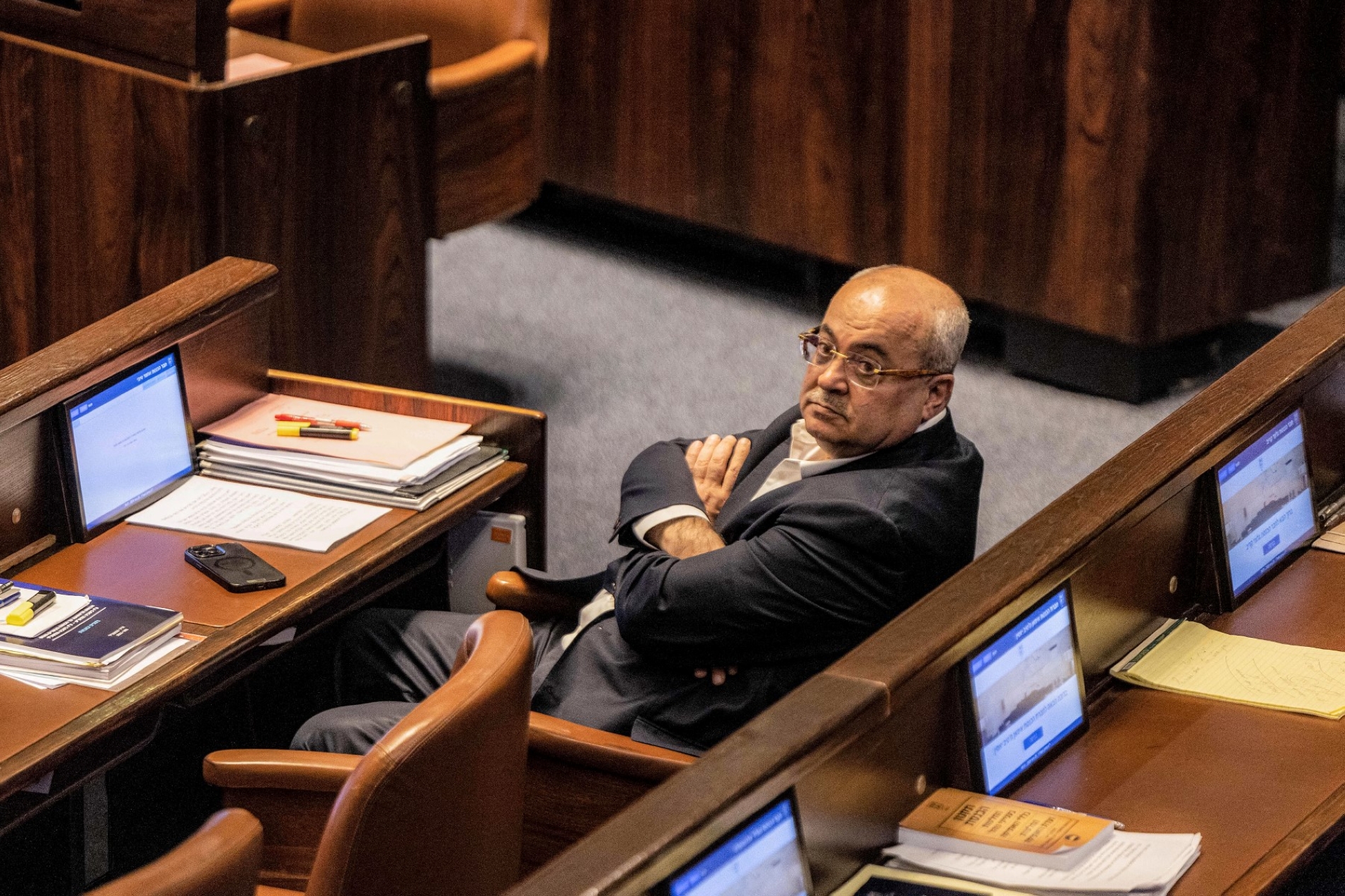
Arab-Israeli parliament member Ahmad Tibi attends a parliamentary session at the Knesset (Israel's parliament) in Jerusalem on 25 June 2024.
The second route is a minority government backed from the outside. The numerical logic is simple. If the Zionist opposition reaches 57 to 60 seats, Arab parties could prevent a Netanyahu government without formally joining an Eisenkot coalition. Several Arab parties have shown some willingness to vote in a way that aims to bar Netanyahu's road to the premiership, whilst Ra'am (one of a set of Arab parties in Israel) made the unprecedented decision to join the Lapid-Bennett government in 2022.
This option would give Eisenkot the premiership but not freedom of action. Any major budgetary, constitutional, or security initiative could become a negotiation. It would also hand Netanyahu a ready-made campaign against the government's legitimacy. Several questions would likely be taboo—including anything that has to do with Palestinians.
Overall, this means that the pathway to victory is not straightforward. Although Eisenkot has an edge over Netanyahu, he still has to ensure all his potential allies cross the electoral line and agree on a shared platform. Short of a majority, he may have to count on Arab parties' support (even if that support is not formally expressed). This in turn would be a key vulnerability, given Eisenkot's foreign policy positions.
Electoral platform
Eisenkot is not campaigning as a dove. His position on the Palestinian question makes that clear. In May 2025, he said a Palestinian state was "not relevant after October 7", and repeated the claim just in August 2026, stating "There is no Palestinian state, and in the government, we will form, no Palestinian state will arise". Eisenkot rejects resettling Gaza, but his opposition rests on strategic rather than conciliatory grounds: Israel should not assume responsibility for the enclave's civilian population or expose itself to another long-term security burden. He defines policy through preserving a strong, Jewish, democratic Israel—not through a revived peace-process framework.
Hamas fighters secure an area before handing over an Israeli-American hostage to a Red Cross team in Gaza City on 1 February 2025, as part of the fourth hostage-prisoner exchange.
His Gaza doctrine has three elements. First, Hamas must lose its military and governing capacity. Second, Israel should retain security freedom of action and keep forces in Gaza until Hamas is disarmed and the strip demilitarised. Third, the postwar order must not be a return to Hamas or an indefinite Israeli civilian occupation. Eisenkot has spoken of an upgraded Palestinian Authority, backed by Arab states and technocrats, as part of the "day after." This latter part is perhaps the only difference between Eisenkot's policy and Netanyahu's: Eisenkot is willing to officially back a reformed Palestinian Authority as a partner.
These two stances are hard to reconcile. On the one hand, Eisenkot wants a Palestinian governing alternative to Hamas but, on the other, he rejects Palestinian statehood. The central question is whether his rejection of a Palestinian state is political calculus or true conviction. Eisenkot knows if he were to express even remote support for Palestinian statehood, this would turn into an effective angle of attack for Netanyahu, whose campaign paints him as the only Israeli leader capable of fending off pressure to establish such a state.
On Lebanon, Eisenkot's policy is equally hard-edged. He argues that Israel cannot soon withdraw from southern Lebanon and that the Israeli army must retain operational freedom not only in the south but in Beirut and the Bekaa Valley, where Hezbollah's critical infrastructure sits. He views Hezbollah's disarmament as a long-term project requiring American, French, and moderate Sunni Arab involvement, not merely Israeli firepower.
The distinction matters. Eisenkot supports the force, including a military manoeuvre to degrade Hezbollah, but rejects the idea that Hezbollah can be permanently disarmed by Israel alone. Military pressure must serve a political arrangement; otherwise, Israel merely trades a short-term tactical gain for an open-ended occupation.
On Iran, he supported the 2026 war against Tehran's nuclear programme and described US-Israeli coordination as an opportunity to eliminate Israel's most serious threat. Yet he has also rejected maximalism. He says regime change cannot be imposed from the air and that killing senior officials does not itself create political transformation. That is classic Eisenkot: aggressive on capability, but conservative on objective, and on what force alone can truly achieve.
Gadi Eisenkot holds a meet-and-greet with people at a coffee shop as part of his campaign ahead of Israel's general elections in Jerusalem on 12 August 2026.
Translating popularity into victory
The question now is not whether Eisenkot is a viable candidate—the polls suggest he is; it is whether he can translate a rare combination of personal credibility, security experience and public grief into the coalition-building discipline that Israeli politics demands. Unlike Netanyahu, he cannot rely on an inherited political machine, nor can he simply command obedience as he once did in uniform. He must keep a fragmented opposition intact, prevent allies from falling below the electoral threshold, and perhaps accept uncomfortable parliamentary dependence on Arab parties—all while resisting Netanyahu's inevitable effort to portray him as weak on security.
Israel has seen popular generals before—Ehud Barak's landslide victory in 1999 collapsed within two years; Benny Gantz's Blue and White surge in 2019 fractured before it ever reached office. What may set Eisenkot apart is that his appeal was never manufactured by a campaign strategist; it was forged in the Golani ranks, tested in the Azaria affair, and paid for in Gaza.
That authenticity is precisely what Netanyahu cannot manufacture. But authenticity alone has never won an Israeli election. Eisenkot will still need to navigate coalition math, manage allies like Lapid and Bennett, and prove that the discipline which defined his military career can survive contact with the improvisational chaos of Israeli politics. If he manages that, he may finally break the curse that has haunted every general before him. If he does not, he will simply be the latest name added to a long list of soldiers who mistook public admiration for political mandate.