The Iran war exposed the risks of being too closely tied to US military posture, which is why some Gulf states are repositioning themselves not merely as consumers of security but as architects of it
PAKISTAN PRIME MINISTER'S OFFICE / AFP
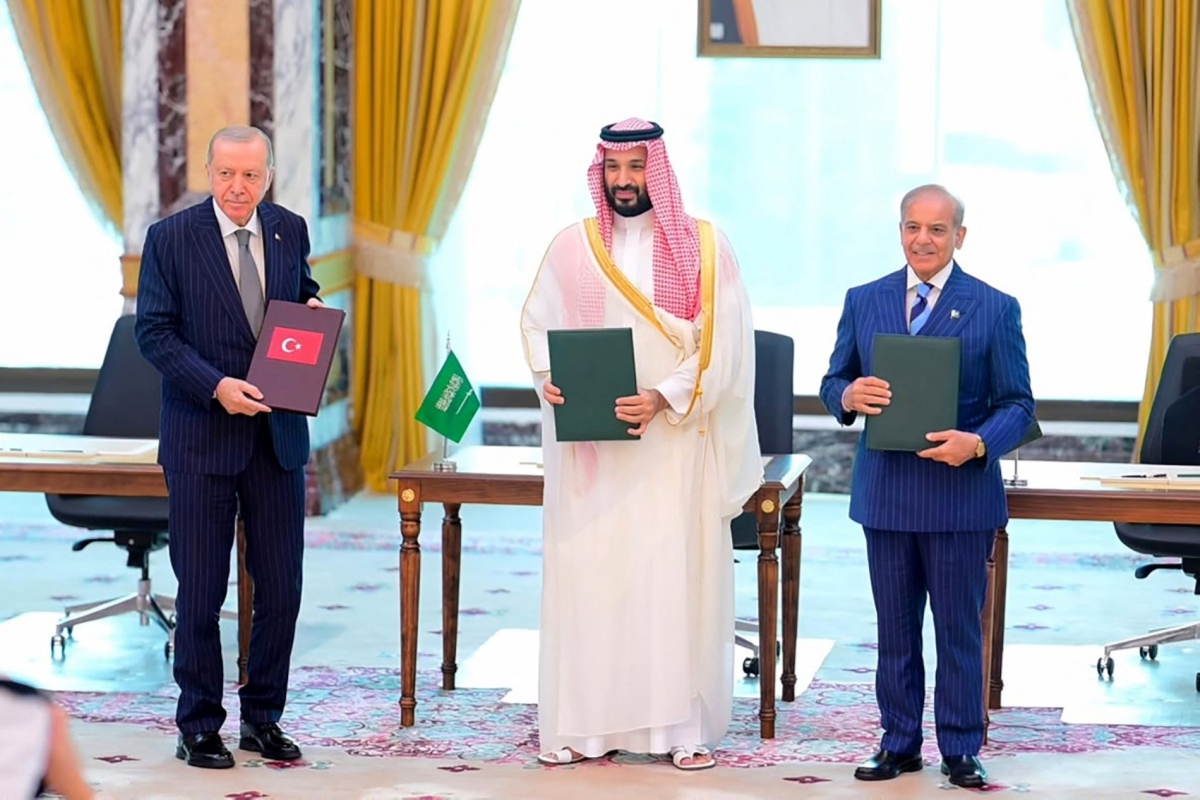
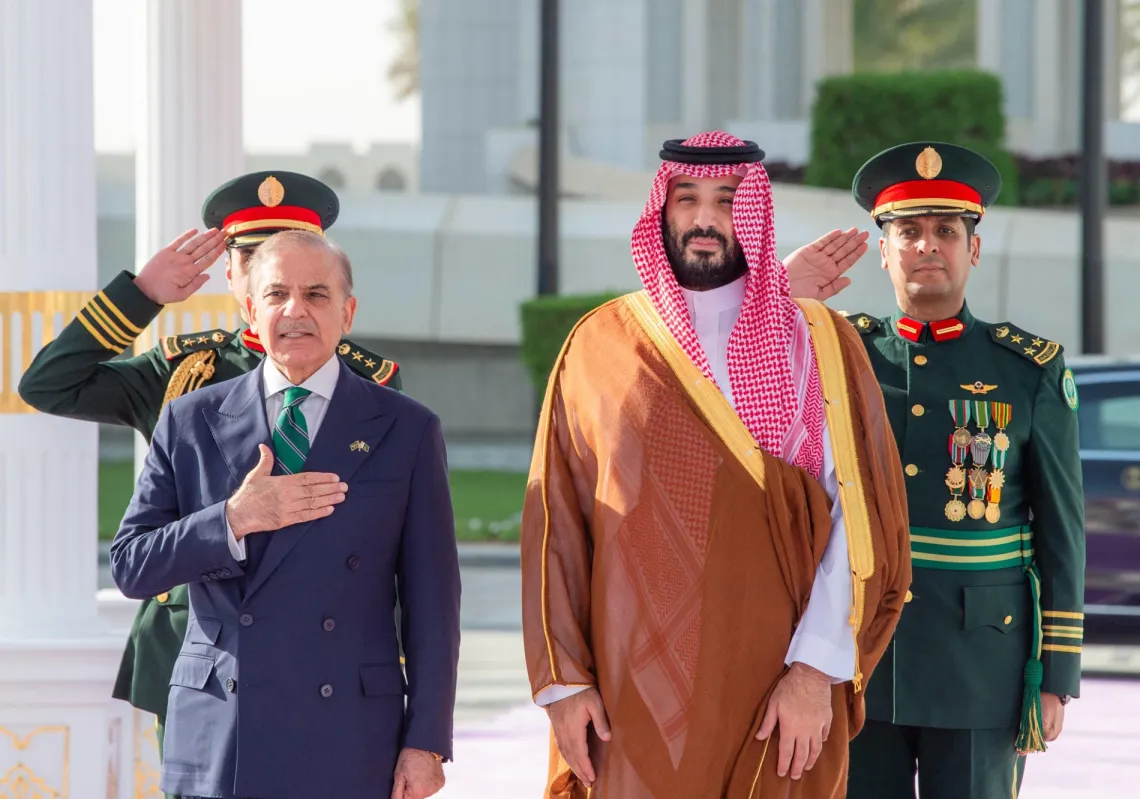
Saudi Crown Prince Mohammed bin Salman (C), Turkish President Recep Tayyip Erdogan (L) and Pakistani Prime Minister Shehbaz Sharif posing after signing the Mecca Joint Defence Agreement in Mecca, Saudi Arabia on 7 August, 2026.
The Middle East is entering a new security era. For decades, the regional order was largely shaped by the United States providing a broad security umbrella; Israel preserving its qualitative edge; Iran projecting influence through long-range weapons and proxies; and Arab states relying on Washington to compensate for their own military limitations. The system was not stable, but nonetheless, it endured.
That framework is now breaking down. The current regional turmoil has exposed the framework’s limits and forced regional states to rethink the foundations of their security. What is emerging is not a single alliance system but a layered architecture of traditional alliances, smaller coalitions, bilateral defence arrangements, economic partnerships, indigenous military capabilities, and diplomacy with former adversaries. This central shift suggests regional states are no longer entrusting their security entirely to one outside power.
The United States remains the region’s dominant external military power. Its bases, intelligence networks, missile defences, naval presence, and logistical reach are difficult to match. Gulf states still depend heavily on US weapons and security cooperation, but their confidence in American protection has substantially eroded.
The war with Iran has sharpened Gulf awareness of the risks that come with being tied too closely to Washington’s military posture. It also has shown that countries hosting US forces can become targets even when they do not seek confrontation. The argument that Gulf capitals are hedging is true but overstated. All wish to preserve the American relationship and still depend on it for their security more than anything else. But they are complementing this dependence with regional partnerships and a policy of entente with Tehran.
The recent Mecca Agreement—a defence pact between Riyadh, Ankara and Islamabad—adds layers of deterrence beyond a US security guarantee.
Credible intent
Saudi Arabia best illustrates this shift. Riyadh is not walking away from Washington but merely diversifying. It wants US support, but it is also deepening ties with Türkiye, Pakistan, Egypt, and other regional powers. The recent Mecca Agreement—a defence pact between Riyadh, Ankara and Islamabad—matters because it adds layers of deterrence beyond an American guarantee, including political-military coordination, joint exercises, and cooperation on drones, electronic warfare, artificial intelligence, and defence production. It will take time to mature, no doubt, but the intent of Riyadh, Ankara, and Islamabad to forge stronger defence and security ties seems credible.
To be sure, this is not a 'Middle Eastern NATO'. The region is too divided, and its threat perceptions too varied, for that. Saudi Arabia, the UAE, Qatar, Oman, Egypt, Türkiye, and Pakistan each have different relationships with Iran, the United States, and one another. Cooperation will remain selective. States will partner in one arena, compete in another, and continue talking to adversaries at the same time. It is a portfolio-like approach to security cooperation.
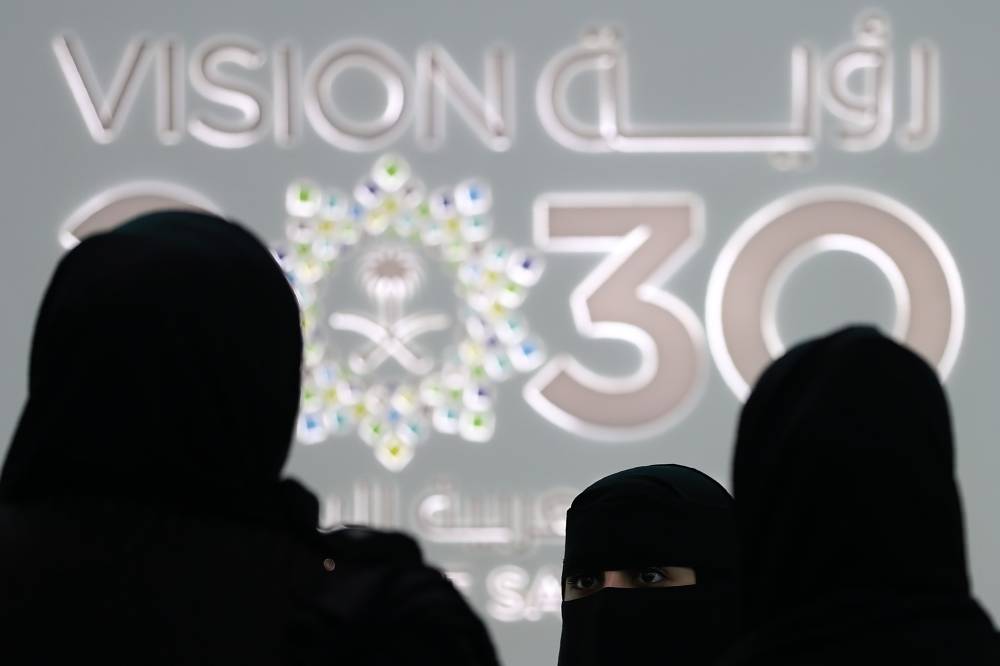
Saudi women stand next to the Saudi pavilion (Vision 2030) at the Gitex 2018 exhibition at the Dubai World Trade Centre in Dubai on 16 October 2018.
Need for stability
Gulf states also understand that security is now inseparable from economic transformation. Saudi Vision 2030, the UAE's investment strategy, Qatar's energy role, and broader Gulf diversification all depend on stability. Ports, airports, energy facilities, financial centres, tourism projects, data centres, and industrial zones have become strategic assets. Defending them requires more than fighter jets and missile defences; it requires cyber resilience, maritime security, intelligence sharing, counter-drone systems, and protected trade routes.
Economic integration can positively impact regional security—connectivity can reduce dependence on maritime chokepoints, attract capital, support non-oil growth, and raise the cost of disruption—but it cannot redefine it. Physical safety, achieved through stronger deterrence and defence, remains the top pursuit and core requirement for any state in the region.
Regional powers are trying to fill the security gap left by the United States. Israel has relied exclusively on military force to reshape its security environment and alter the regional balance of power in its favour. Türkiye brings military reach, a powerful defence industry, strategic geography, and political access across the region. Pakistan adds significant military capacity and long-standing ties with Gulf Arab states.
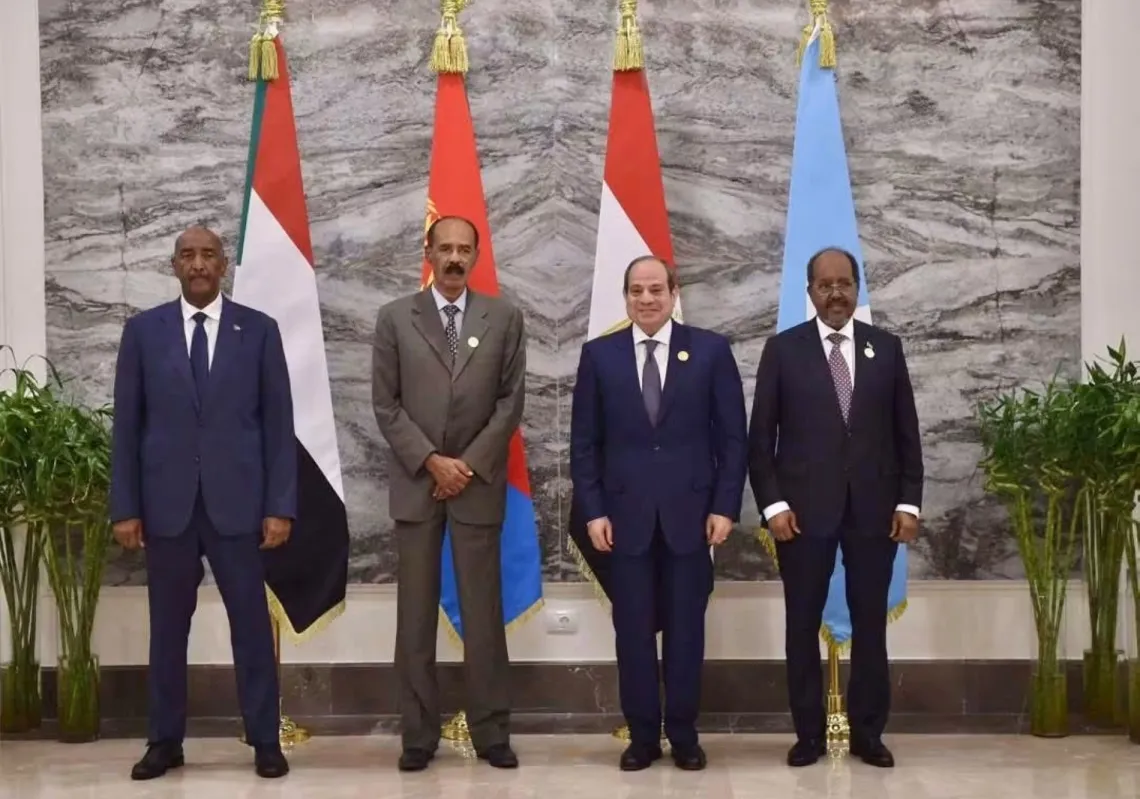
More insular than others, Egypt may have to reconsider its stand-off approach as problems materialise on its doorstep. Its role matters because of its population, military weight, control of the Suez Canal, and position between the Levant, North Africa, and the Red Sea. These countries' growing roles point to a larger reality: the next security architecture will not be confined to the Gulf. It will stretch across the Gulf, the Red Sea, the Eastern Mediterranean, and South Asia.
Through the latest war with Iran, regional states have also come to the realisation that an adversarial relationship towards Tehran is counterproductive. A lasting regional order cannot be built by pretending Tehran can be excluded. Its geography, population, missiles, military capabilities, influence in Iraq, Lebanon, Yemen and beyond, and ability to disrupt maritime traffic give it a permanent role in the regional balance. The question is not whether Iran will be part of the order, but what role it will play.
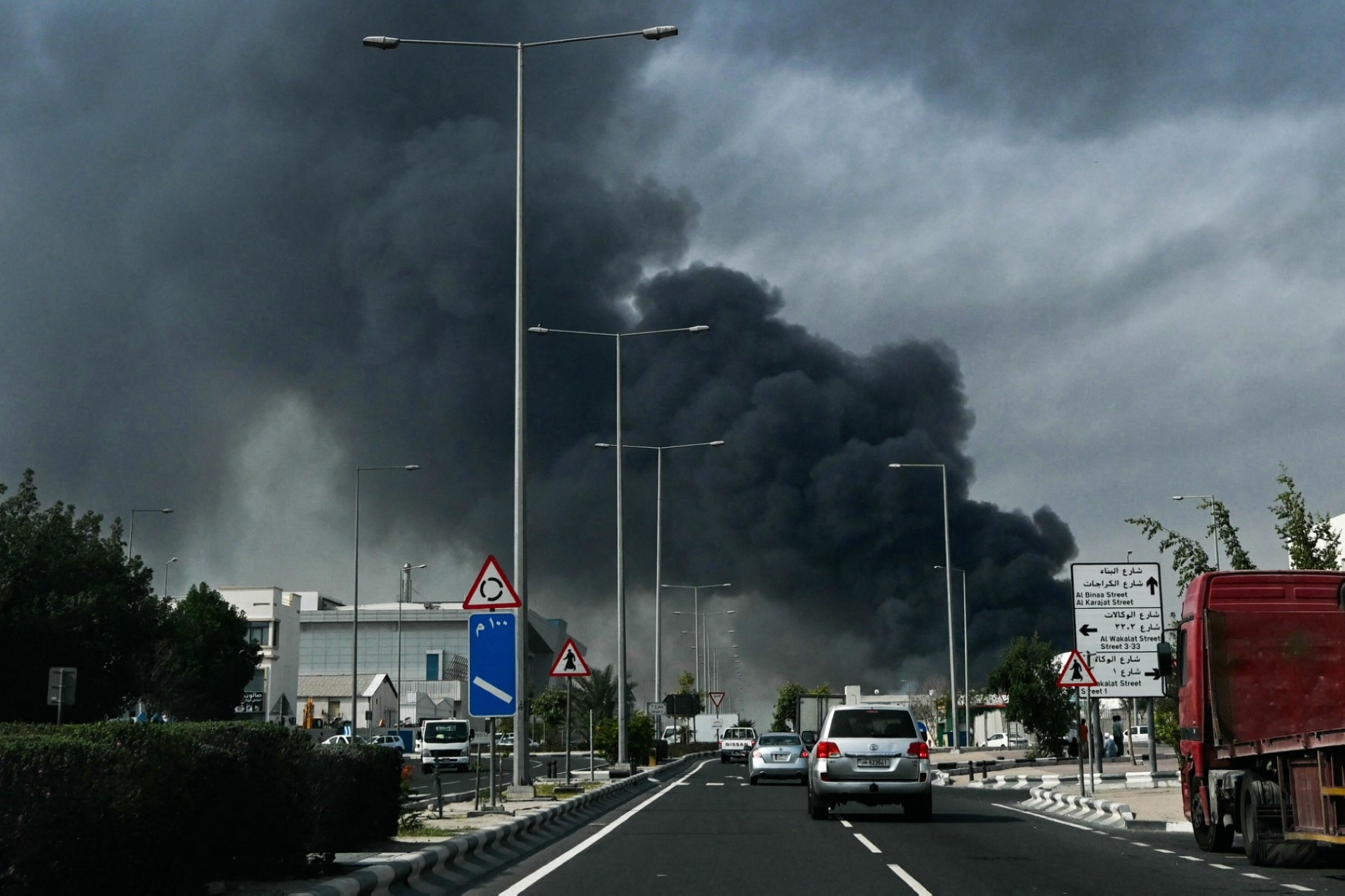
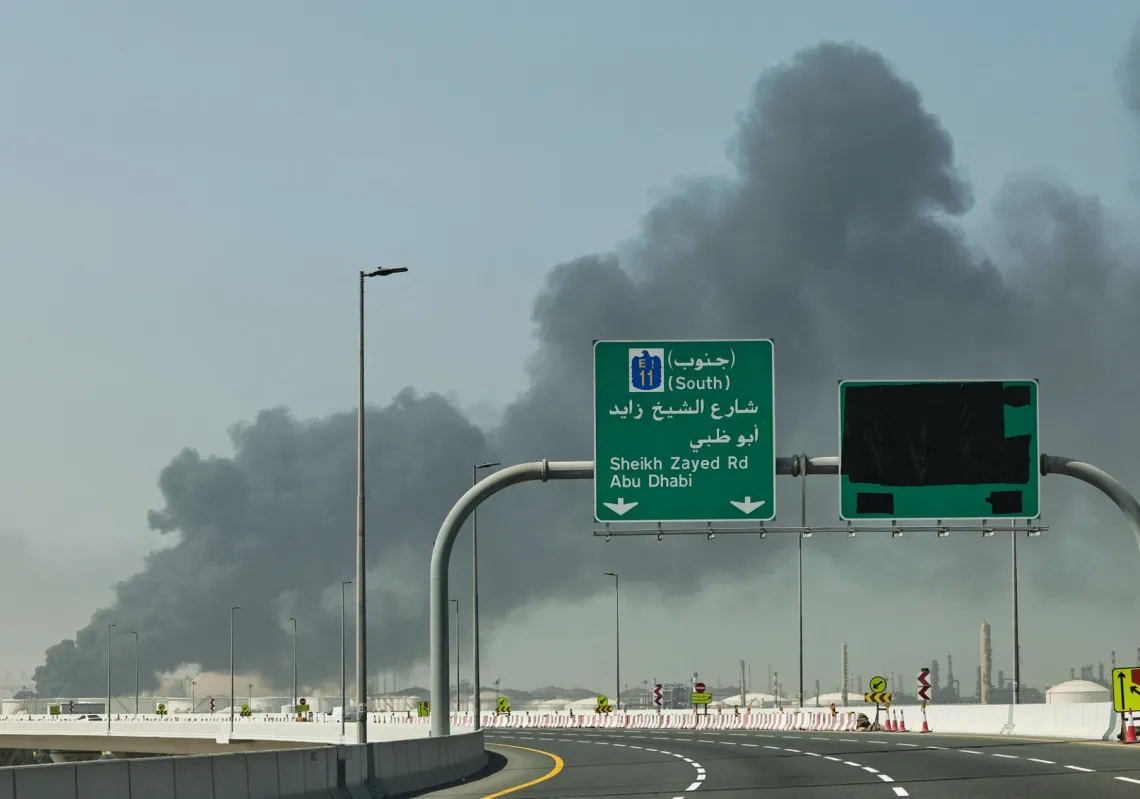
Motorists drive past a plume of smoke rising from a reported Iranian strike in the industrial district of Doha on 1 March 2026.
Deterrence and diplomacy
For Gulf states, this is a difficult square to circle. Iranian missiles, drones, proxies, and maritime forces pose real threats. But permanent confrontation with Iran would carry steep economic and strategic costs. That is why deterrence and diplomacy now move in parallel: stronger air defences and military partnerships on one track, communication with Tehran on another.
Israel presents a different challenge. The Abraham Accords showed that some Arab states were prepared to cooperate openly with Israel on economics, technology, and security. Israel's military and technological strengths make it a valuable partner in missile defence, intelligence, cybersecurity, and advanced technology.
But Israel's wars have also exposed the political ceiling on that cooperation. Arab governments cannot ignore the Palestinian issue, especially when public opinion is highly sympathetic to Palestinian suffering. Cooperation with Israel will therefore likely remain selective and carefully managed. Israel may remain part of regional security networks, but it is unlikely to become the centre of an openly anti-Iranian alliance.
That distinction matters. The Middle East is not dividing into two clean blocs. It is forming overlapping networks. One network may link the United States, Gulf states, Israel, and European partners. Another may connect Saudi Arabia, Türkiye, Pakistan, and Egypt. A third may involve Gulf states and Iran through diplomatic and economic channels. Maritime security creates another layer around the Red Sea and critical trade routes. Counterterrorism, cyber defence, artificial intelligence, and defence industrial cooperation add still more.
The hardest task is turning this web of partnerships into effective cooperative security. The Middle East still lacks an inclusive forum where major powers can regularly address military crises, maritime security, arms control, missile proliferation, and confidence-building. Existing bodies—the GCC, the Red Sea Council, GCC-plus formats, and diplomatic forums—help, but none provides a comprehensive mechanism. The more realistic path is to strengthen what exists rather than invent a new institution from scratch.
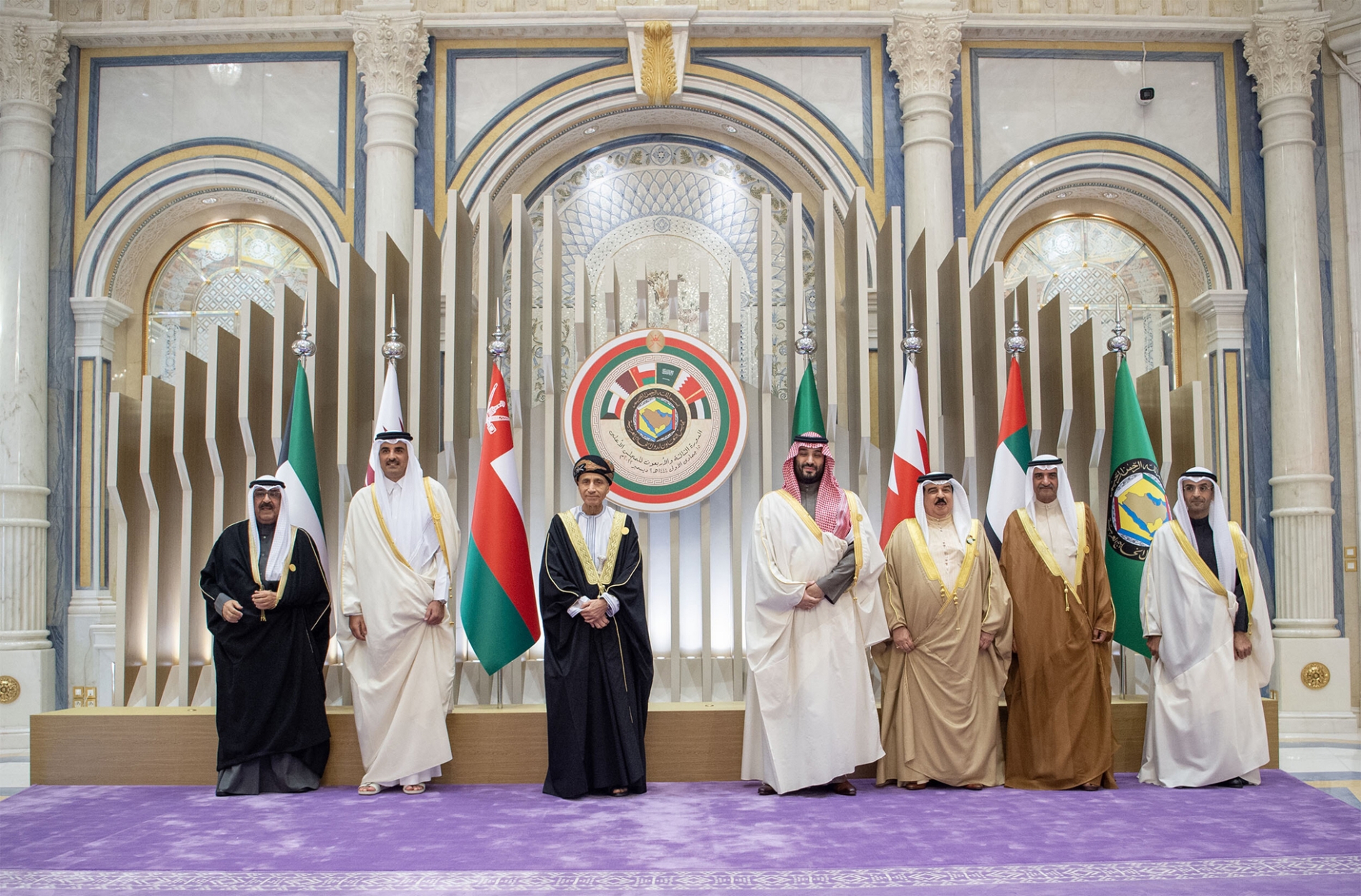
A family photo during the 43rd Gulf Cooperation Council Summit at the King Abdulaziz International Convention Centre in Riyadh, 9 December 2022
A 360-degree approach
The future order will depend as much on diplomacy as on weapons. Air and missile defences, intelligence sharing, joint exercises, and military partnerships can reduce vulnerability, but they cannot resolve political disputes. A durable system must combine deterrence with dialogue: the ability to punish aggression and the channels to prevent crises from becoming wars.
The Middle East is moving away from a system in which security was largely outsourced to an external power, but it has not yet built a functioning alternative. The transition will take years, and it will not produce a neat alliance map.
The emerging Middle East is more multipolar. States will keep the US close while expanding ties with Beijing, Moscow, Ankara, Islamabad, and one another.
The emerging Middle East will be more multipolar, militarised, transactional, and economically networked. States will keep Washington close while expanding ties with Beijing, Moscow, Ankara, Islamabad, and one another. They will buy advanced weapons while building domestic defence industries. They will strengthen deterrence while talking to adversaries. And they will treat economic resilience, technology, infrastructure, energy security, and connectivity as core elements of national security. The old architecture is not disappearing; it is decentralising.
The United States will remain indispensable, but it will no longer be sufficient. Regional powers will carry more of the burden. Smaller coalitions will supplement, not replace, traditional alliances. Iran and Israel will remain central, but neither will define the order alone. Gulf states—especially Saudi Arabia—are repositioning themselves not merely as consumers of security, but as architects of it.